To use ChatGPT for investment research, give it public documents and work it can be checked on: summarising a 10-K you have already downloaded, drafting questions for a management meeting, explaining an accounting term, or turning your own notes into a first draft. Then check every number and quotation against the source page before it goes anywhere. What it should never see is broker research licensed to named readers, material nonpublic information, expert-call transcripts or your firm's positions, and regulators have said the firm answers for staff use of public chatbots whether or not anyone approved it. Investment research is hard precisely because the useful answer sits across all of those sources at once; Botminds' Investment Research Assistant exists to answer across them inside the firm, reading as the person who asks, with every sentence cited to its page.
This guide sets out the rules that make a public chatbot safe for research, the evidence on how often its answers are actually supported, and the line where a firm-controlled assistant has to take over. The worked examples come from a fictional sample firm, Quillfield Capital, as it runs through the solution; the research figures come from regulators and peer-reviewed or clearly labelled studies, linked where they appear.
Seven rules for using ChatGPT on investment research
- Paste only what is already public
Filings, press releases, published transcripts and your own non-sensitive drafts. If you would not post it on a public website, it does not go in a prompt.
- Never paste licensed broker research
A broker report is licensed to named readers. Copying it into a third-party tool can breach the licence even if nobody else ever reads the output.
- Never name a restricted issuer or describe a wall-crossing
A prompt is a written communication leaving the firm. Material nonpublic information has no safe place in one.
- Ask for the page, not just the answer
Request the exact passage and page number for every figure, then open the document and read it yourself.
- Treat every number as unverified until you find it
A confident figure with a plausible citation is the most dangerous output, because it looks finished.
- Keep the prompt and the output
If the work informs a recommendation, the exchange belongs with the rest of the research file your firm keeps.
- Use your firm's approved tool, under its policy
Supervisors expect firms to control staff use of AI in any form, approved or not. Ask compliance which tools are sanctioned.
Can you use ChatGPT for investment research? Yes, on public material, with three limits
You can use ChatGPT for investment research on public documents, as long as you keep three limits: nothing licensed, nothing nonpublic, and nothing unverified leaves your desk. Within those limits it is a capable reader. It will summarise a long filing, list the risk factors that changed between two years, draft the questions you want to ask an investor relations team, or explain how a lessee accounts for a sale-and-leaseback in two paragraphs.
The limits matter because of what a research question usually needs. A useful answer to "which of our holdings does this tariff hit" draws on four kinds of source: the firm's own notes, broker research the analyst is licensed to read, company filings in their original languages, and expert calls compliance has cleared. A public chatbot can see only the third kind, and only the documents you hand it. The answer it gives is an answer to a smaller question than the one you asked, delivered in the same confident tone.
There is also a quieter limit: the model does not know your universe. It does not know which names you hold, at what size, or what your own analyst wrote last month. Every answer about "our exposure" depends on context you would have to paste in, and portfolio holdings are exactly the kind of information a firm does not want sitting in a third-party tool.
Eight research tasks, and whether a public chatbot is the right tool
| Task | Public chatbot? | Why |
|---|---|---|
| Summarise a 10-K or annual report you downloaded | Yes, then check | Public document; verify every figure against the page before using it. |
| Explain an accounting or regulatory term | Yes | General knowledge; low cost if wrong, and easy to confirm in the standard itself. |
| Draft questions for a management meeting | Yes | The output is your own working draft, not a claim about the company. |
| Compare two years of risk-factor language | Yes, with both texts pasted | Works on what you supply; it cannot fetch the right filing reliably on its own. |
| Summarise a broker's initiation report | No | Licensed to named readers; pasting it into a third-party tool can breach the licence. |
| Rank exposure across the funds you manage | No | Needs positions, which are confidential, and your own notes, which it cannot see. |
| Read an expert-call transcript | No | May contain material nonpublic information; only compliance-cleared transcripts should be read, inside the firm. |
| Draft a client-facing research note | Only as a private draft | Every sentence must be sourced and approved; attribution and recordkeeping duties apply. |
What do regulators say about staff using ChatGPT?
Regulators say the firm is accountable for staff use of public chatbots, whether or not the firm approved it. ESMA's May 2024 statement on AI in investment services says its principles and controls are meant to remind firms that they should have "appropriate measures to also control the use of AI systems by employees in any form, including any third-party AI technologies" (ESMA public statement, May 30, 2024). The statement was written for retail investment services, but its logic travels: the firm owns the output, and so it owns the tool choice.
The same statement asks firms to keep records of how AI is used, covering "decision-making processes, data sources used, algorithms implemented, and any modifications made over time". A conversation in a personal chatbot account sits outside every one of those records.
In the United States, FINRA reminded its members in June 2024 that its rules apply whether a firm builds a tool or leans on a third party's, "including through embedded features in existing third-party products", and listed "concerns about accuracy, privacy, bias, intellectual property" among the issues the technology raises (FINRA Regulatory Notice 24-09). The SEC's Division of Examinations said for fiscal 2026 that it would check whether advisers have policies and procedures to monitor or supervise their AI, and its fiscal 2027 priorities, in the SEC's own new term, extend that to "super intelligence" (SEC, FY2026 Examination Priorities, November 17, 2025; the examiners' questions are collected in AI washing: what the SEC charged, and what examiners now ask). Exam priorities are staff statements, not rules, but they say what examiners will ask for.
The profession's own code has already met the problem in a form that will feel familiar. CFA Institute's guidance on Standard I(C), Misrepresentation, works through a manager who, short of real experience, "uses ChatGPT to complete the portion of the RFP" describing how his firm uses AI. The outcome: he violated the standard "by misrepresenting his firm’s capabilities relating to AI in its investment process and using ChatGPT to respond to the RFP to hide his superficial knowledge" (CFA Institute, Standard I(C), updated April 2024). The tool was not the violation; passing off its output as expertise was.
Is it safe to put broker research into ChatGPT? No, and the reason is the licence
It is not safe to put broker research into ChatGPT, because the research is licensed to named readers under a contract with the broker, and a third-party AI tool is not one of them. No regulator publishes those contracts; their terms vary by provider. What they commonly have in common is that the report is for the licensed reader's own use and may not be redistributed, and copying the full text into an outside service is the kind of use they do not grant.
NIST's generative AI profile names the general risk in plain terms. Among the twelve risks it lists is intellectual property: the "eased production or replication of alleged copyrighted, trademarked, or licensed content without authorization" (NIST AI 600-1, July 2024). A summary of a broker's model that reproduces its estimates is a replication of licensed content, whatever the wording.
There is a professional duty on top of the contractual one. CFA Institute's Standard I(C) says "The preparation of research reports based on multiple sources of information without acknowledging the sources is a violation of this standard" (Standard I(C)). A chatbot that blends a broker's view into a paragraph without naming it invites exactly that failure. How licensed reading can work with an AI, reader by reader, is set out in who may read broker research reports, and how AI can.
Does ChatGPT make up financial data? Often enough that every figure needs its page
Yes: language models produce confident, specific and wrong figures, and they produce citations that look right and are not. NIST calls the behaviour confabulation, and warns that it extends to invented reasoning and invented citations offered to justify an answer (NIST AI 600-1). In research, a made-up citation is worse than none, because it survives a skim.
“AI tools for natural language generation are known to “hallucinate” and produce outputs that are factually incorrect even if they sound realistic and accurate.”
ESMA, public statement on the use of AI in the provision of retail investment services, May 30, 2024
The best measurement of the citation problem comes from an audit of generative search engines, the tools that answer with in-line references. Human evaluators found that, on average, only about half of the generated sentences were fully supported by their citations, and one in four citations did not support the sentence it was attached to (Liu, Zhang and Liang, Findings of EMNLP 2023). Those were general queries, not filings, but the mechanism is the same: the model writes the sentence and finds a reference for it, rather than reading a passage and writing only what it says.
How often an AI answer is actually supported by what it cites
51.5%
of generated sentences fully supported by their citations, across four generative search engines
74.5%
of citations that actually supported the sentence they were attached to
51%
of EU securities firms surveyed name model hallucinations as a concern
Filings are harder, not easier. Figures depend on units, periods and restatements; the same line can appear in a segment note and a reconciliation with different values; and a model that rounds, annualises or picks the wrong column produces a number nobody can trace. How far accuracy moves with the way documents are fed to a model is the subject of what FinanceBench shows, and what a defensible answer must prove.
How do I get ChatGPT to cite sources, and check them?
Ask for the exact passage and page for every claim, then verify each one yourself: a citation from a chatbot is a lead to check, not evidence. A prompt that works asks the model to answer only from the documents provided, to quote the sentence it relied on in full, to give the page number, and to say "not found" rather than guess. That reduces invented support. It does not remove it, because the model still decides which passage supports which sentence.
A research prompt that asks for evidence, not just an answer
Documents. Use only the attached documents: [the FY2025 10-K, pages 1–142] and [the Q3 2026 earnings release]. Do not use anything you know from elsewhere.
Question. [What share of revenue came from outside the United States in FY2025, and how did management describe tariff exposure?]
Format. One claim per line. After each claim, quote the sentence or table row you relied on, in full, with the document name and page number.
Limits. If a figure is not stated in the documents, write "not found". Do not calculate a figure unless I ask, and if you do, show the inputs and the page of each.
Separation. Label each line as "stated" (the document says it) or "inferred" (your reading of it).
The checking is the part that cannot be skipped, and NIST's profile puts it in the measurement step: sources and citations in the output are to be reviewed and verified before deployment and throughout use (NIST AI 600-1, MS-2.5-003). For an analyst that means opening every cited page and reading the sentence, confirming the period and unit, and striking any claim whose passage says something weaker. In practice it is the slow half of the work, and the half most often skipped on a busy morning.
Three habits make the checking faster. Ask for one claim per line, so each has its own citation. Ask the model to separate what the document states from what it infers, which mirrors CFA Institute's Standard V(B) requirement to distinguish fact from opinion. And keep the documents you gave it alongside the output, so a colleague can repeat the check.
Material nonpublic information and expert calls never go in a prompt
Anything that could be material nonpublic information stays out of a public chatbot, without exception. Advisers registered with the SEC must keep written policies reasonably designed to prevent the misuse of material nonpublic information under Section 204A of the Advisers Act (15 U.S.C. 80b-4a). A restricted list, a wall-crossing, a draft that mentions a private placement or an expert's remark about an unannounced contract are all information the firm controls by limiting who sees it. Typing it into an outside service undoes the control.
Prompts leak in less obvious ways too. The Bank of England and FCA's 2026 survey of UK financial firms lists "data leakage via prompts/outputs" among the generative AI risks firms rate highest, alongside hallucinations and prompt injection (Bank of England and FCA, October 26, 2026). A question that names an issuer the firm is restricted on reveals the restriction, even if the answer is harmless. How a restricted list should be checked before any research work begins is covered in a method for restricted list compliance.
Public chatbot or firm-controlled assistant: what changes
A firm-controlled research assistant differs from a public chatbot less in the model than in what surrounds it: whose permissions it reads under, which sources it can reach, and what it keeps. The comparison below is the practical one for a research team deciding where each task belongs.
Public chatbot versus a firm-controlled research assistant
Public chatbot, personal account: Its training data and the documents you paste in.
Investment Research Assistant, inside the firm: The firm's own notes, licensed broker research, filings in their original languages, and cleared expert calls.
Public chatbot, personal account: None checked; anything pasted is used.
Investment Research Assistant, inside the firm: Checked with each provider for the reader asking, and again for every recipient when a memo is shared.
Public chatbot, personal account: Unknown to the tool; a prompt can reveal the restriction.
Investment Research Assistant, inside the firm: Read from the order management system; a question about a restricted issuer is blocked and logged, and nothing is read.
Public chatbot, personal account: Produced with the answer; may not support it.
Investment Research Assistant, inside the firm: Every sentence footnoted to its page; a Verifier re-reads each passage and deletes what it cannot support.
Public chatbot, personal account: Sources blended into one confident paragraph.
Investment Research Assistant, inside the firm: Disagreeing sources set side by side; the analyst chooses and gives a reason.
Public chatbot, personal account: Whatever the personal account keeps, outside the firm's files.
Investment Research Assistant, inside the firm: Every question, plan, passage, licence check, viewer and decision in an append-only trail, kept seven years by default.
Where Investment Research Assistant takes over
Investment Research Assistant takes over at the point a question needs anything a public chatbot must not see: licensed research, the firm's own view, positions or a nonpublic source. Take the sample firm's analyst, Lena Whitfield, on a Friday in October, asked by her portfolio manager which consumer holdings a proposed 25% duty on Vietnamese footwear would hit. She types the question in plain words. Before anything is read, the Planner shows five sub-questions, each naming the sources it will use, and waits for her to switch any off or add one.
The plan Investment Research Assistant shows before it reads anything
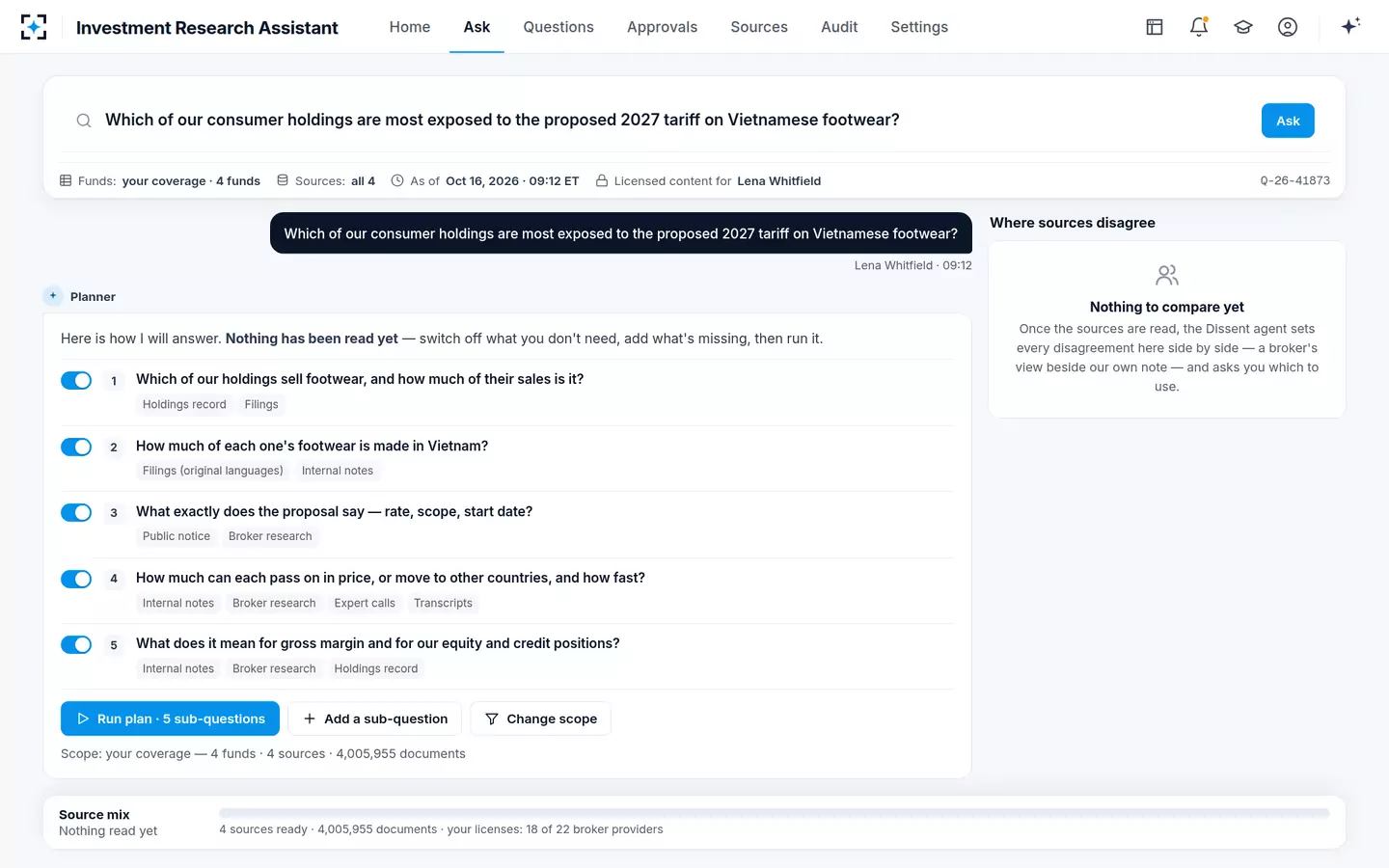
When she runs the plan, the reading happens inside the firm and under her permissions. In the sample run, 186 documents were read out of about four million, one broker report she is not licensed for was withheld and named rather than read, and one expert call on compliance hold was skipped. The answer came back 74 seconds later with all 14 sentences cited to their pages. When she asked next about a company on the restricted list, the agents did not search at all.
A follow-up answered with footnotes, and a restricted issuer blocked
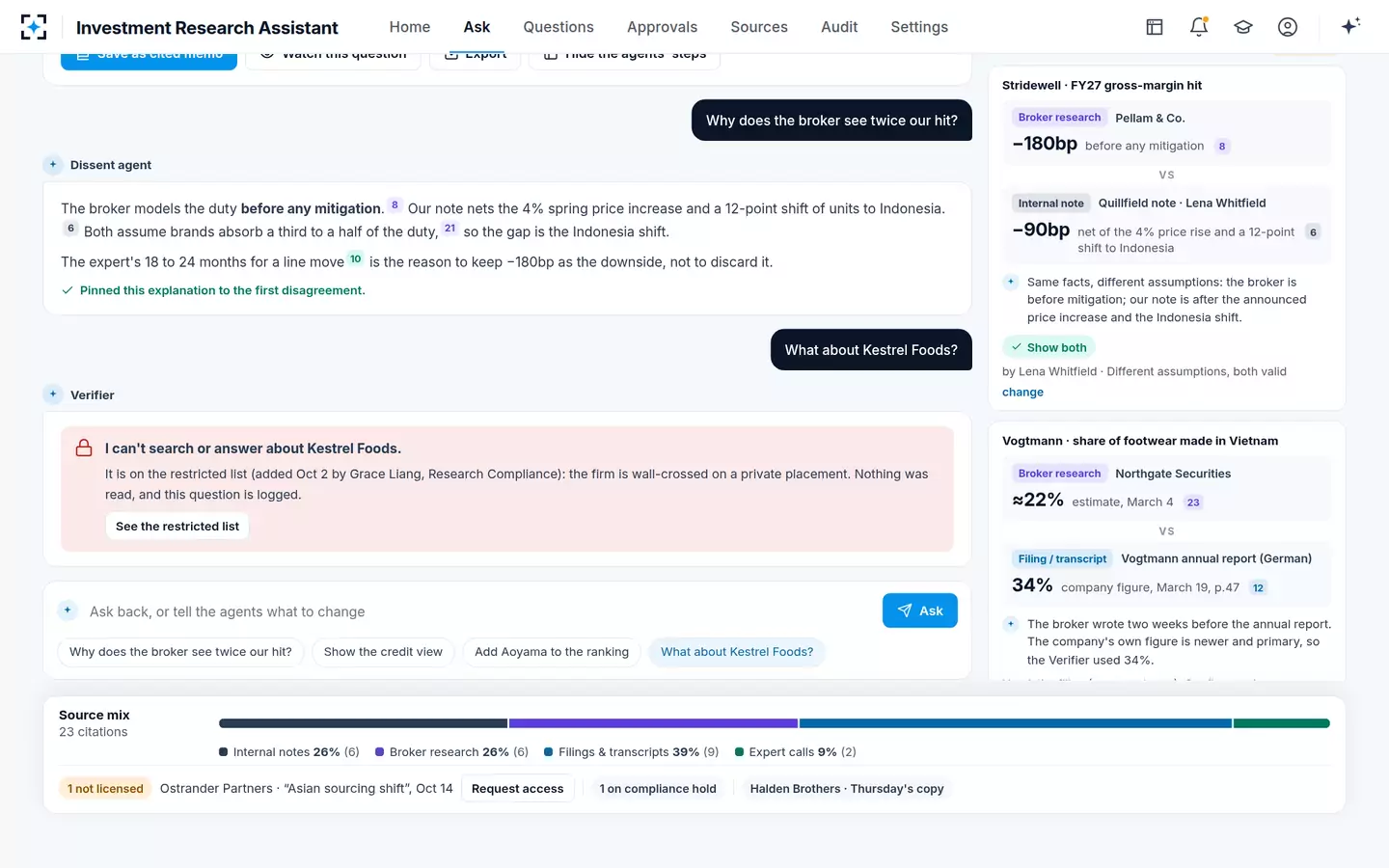
None of this makes a public chatbot useless. It makes it one tool among several, kept for the public, checkable work it does well. The firm-controlled assistant handles the questions that cross licences and walls, and the same tariff question, traced step by step shows what happens inside it. To see it on your own notes and licensed research, start from Investment Research Assistant.
Questions people ask
Is ChatGPT good for stock research?
It is good at reading and summarising public documents you give it and at explaining concepts, and weak at anything that depends on figures it has not been shown. Human audits of AI search tools found only about half of generated sentences fully supported by their citations. Use it to speed up reading, never as the source of a number.
Can I use ChatGPT for equity research reports?
Only as a private drafting aid, with every sentence checked and sourced before the report goes anywhere. CFA Institute's Standard I(C) treats research built from multiple sources without acknowledging them as misrepresentation, and the SEC's books-and-records rule keeps written communications about recommendations for five years. The finished report has to stand on cited sources, not on the chatbot.
Can my firm see what I type into ChatGPT?
Not if you use a personal account, which is exactly the problem: the firm cannot supervise, keep or produce what it cannot see. ESMA expects firms to control staff use of third-party AI tools in any form, and FINRA expects its rules on supervision and recordkeeping to apply however a tool is reached. Use the tool your firm has approved, under its policy.
Is it allowed to upload a 10-K to ChatGPT?
A 10-K is a public filing, so uploading it raises no confidentiality issue, though your firm's policy may still limit which tools you use. The care needed is in the output: check each figure against the filing's page, because the model can misread units, periods or a reconciliation line. Your firm's own notes about the company are a different matter and should not go with it.
What is the difference between ChatGPT and an AI research assistant built for investment firms?
The difference is the controls around the model: whose licences it reads under, which internal sources it can reach, whether restricted issuers are blocked before anything is read, and whether every sentence is cited and kept. Investment Research Assistant checks each reader's broker licences at retrieval and again at sharing, and keeps every question, passage and viewer in an append-only trail.