Broker research reports are the analysis that brokers and investment banks publish on companies, sectors and markets for their institutional clients: initiations, earnings notes, models, ratings and price targets. They are written under sell-side rules on conflicts and certification, paid for by asset managers under UK and EU rules that were rewritten between 2024 and 2026, and supplied under licences that name who may read them. That last point is why broker research is hard to use with AI. A tool that reads every report and answers anyone breaks the licence, and a tool that cannot read them misses a large share of the evidence. Botminds' Investment Research Assistant reads broker research only as the person asking, checks each recipient again when an answer is shared, and keeps every viewer in its audit trail.
One broker report through Investment Research Assistant, from licence to memo
Agent
Licences syncedEach morning the provider licence files and the identity directory set who holds a seat with each broker, team by team.
Never: keep serving broker text if the sync fails: it shuts off instead
Agent
Broker Research RetrieverSearches broker research for the analyst's question and checks her licence with each provider before reading.
Never: read a provider the reader is not licensed for; it names what it withheld, never its text
Agent
VerifierRe-reads every cited passage and confirms the sentence says what the broker said, with source, date and licence on the footnote.
Never: let a broker quotation run past 40 words
A person decides
Analyst decidesReads the answer with the broker's view and the firm's side by side, chooses, and approves the memo text.
Agent
Memo & Sharing agentChecks every recipient's licences and replaces passages a recipient may not read with a reference.
Never: share before the author approves, or outside the team without the Director of Research
A person decides
Director of Research approvesSees what licensed readers see beside what the recipient will see, and approves with a reason code.
What are broker research reports? Sell-side research, written under sell-side rules
A broker research report is a written analysis of a company, industry or market produced by a broker-dealer's research department and distributed to its clients. In the United States, FINRA Rule 2241 defines an equity research report as a written or electronic communication analysing individual companies or industries that gives enough information to base an investment decision on, and requires member firms to manage the conflicts around it, from investment banking influence to quiet periods after offerings (FINRA Rule 2241). Regulation AC requires each report to carry the analyst's certification that the views expressed are their own (17 CFR 242.501).
Those rules govern the producer. They say nothing about what the buy-side reader may do with the report, and they do not make it public. The buy side, which manages money rather than selling research, receives the reports as an input to its own analysis. A typical asset manager reads several brokers on the same company, each with its own estimates, rating scale and assumptions, which is why reconciling them is a large part of an analyst's week.
Who governs a broker report at each end
The producer: a broker's research department: FINRA Rule 2241: written policies on banking influence, quiet periods, rating definitions in every report.
The reader: an asset manager's research team: Advisers Act duties and the firm's code of ethics; the report is one input to the firm's own view.
The producer: a broker's research department: Regulation AC: the analyst certifies the views are their own.
The reader: an asset manager's research team: No certification; the firm's analyst signs the firm's memo, not the broker's note.
The producer: a broker's research department: Receives payment for research separately or with execution, depending on the client's regime.
The reader: an asset manager's research team: UK and EU rules decide how it may pay: own resources, a research payment account, or jointly with execution.
The producer: a broker's research department: Sets terms in the licence: who may read, whether it may be redistributed.
The reader: an asset manager's research team: Bound by those terms; must know who holds a seat before forwarding or quoting.
The producer: a broker's research department: Broker-dealer recordkeeping duties.
The reader: an asset manager's research team: Rule 204-2 keeps written communications received that relate to recommendations, for five years.
Who can read broker research? Named readers, seats and licences
Broker research can be read by the people the broker has licensed to read it, usually named individuals or seats within named teams, and by nobody else. These terms come from the commercial agreement between the broker and the asset manager, not from a regulation, so no regulator publishes them and they differ from provider to provider. In practice a research operations team keeps a licence file per provider and matches it to the people in the firm's directory.
That arrangement is manageable when people read research one portal at a time, because each portal enforces its own log-in. It breaks when research is pooled. A shared drive of downloaded PDFs, a research management system that indexes everything, or an AI tool connected to all of it removes the check the portal used to do. The licence has not changed; the control has disappeared.
What licence bookkeeping looks like: 22 brokers, 1,912 readers
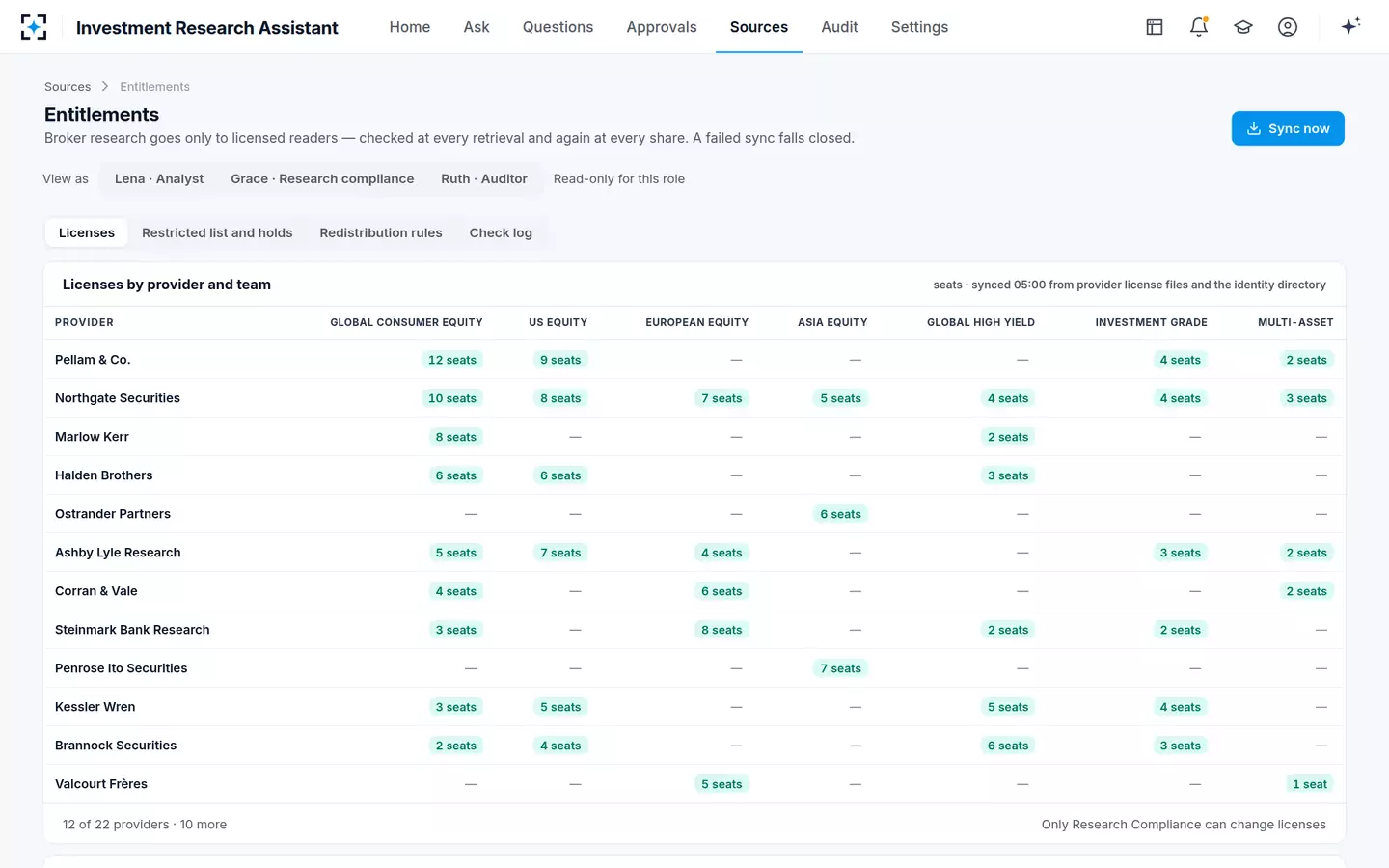
Licence bookkeeping means matching every seat with every provider to a person and a team, every day, and the sample firm in Investment Research Assistant shows its scale. It takes research from 22 brokers. Its consumer analyst holds seats with 18 of them. One credit analyst in London holds none for a broker the consumer team relies on. The licence file is synced every morning at 05:00 for 1,912 readers, and on the morning of the sample three seats had changed overnight.
One firm's broker licences, as Investment Research Assistant sees them
22
broker research providers, each with its own licence file
18 of 22
providers one consumer analyst is licensed to read
1,912
readers whose seats are synced each morning, with 3 seats changed overnight
40words
longest broker quotation allowed in any answer
Broker research licences by provider and team, synced each morning
How do asset managers pay for broker research? Three routes, now in both the UK and EU
Asset managers pay for broker research in one of three ways: from their own resources, from a research payment account funded by a charge to clients, or, since the recent reforms, jointly with the commissions they pay for trade execution. MiFID II had required the first two from 2018. The UK added the joint-payment option from August 2024 for investment firms and in May 2025 for fund managers; the FCA's rules set conditions on it, including a written policy, a research budget and disclosure to clients (FCA PS24/9, July 2024; FCA PS25/4, May 2025).
The EU followed through the Listing Act. The European Commission's delegated directive of February 2026, which sets the detailed conditions, requires member states to apply them from 6 June 2026 (Commission Delegated Directive C(2026) 994, Council document 6830/26). Whichever route a firm uses, both regimes keep an annual assessment of what the research was worth. The dates, the conditions and what each regime now asks a research budget to show are in what changed in MiFID II research unbundling, 2024–2026.
Can broker research be shared? Inside the team, across teams, with clients
Broker research can usually be shared with other licensed readers, may be quoted in internal work only as the licence allows, and generally cannot go to clients or outside the firm. Each step outward needs a fresh check, because the person receiving the text may not hold the seat the author held. The table below sets out the common cases; the licence agreement decides each one.
Who may see a passage from a broker report, case by case
| Recipient | Usually | What a well-run process does |
|---|---|---|
| The licensed analyst who retrieved it | Yes | Shows the passage with source, date and licence on the footnote. |
| A portfolio manager in the same team with a seat | Yes | Shares the memo after the author approves the final text. |
| A colleague in another team with no seat for that broker | Reference only | Replaces the quotation and any sentence repeating its figure with a reference to the report. |
| The investment committee | As licensed | Checks every member; a second person approves materials leaving the team. |
| A client or anyone outside the firm | No | Blocks broker text by default; any client use needs Research Compliance. |
| A third-party AI service | No | Keeps the text inside the firm's own controlled systems. |
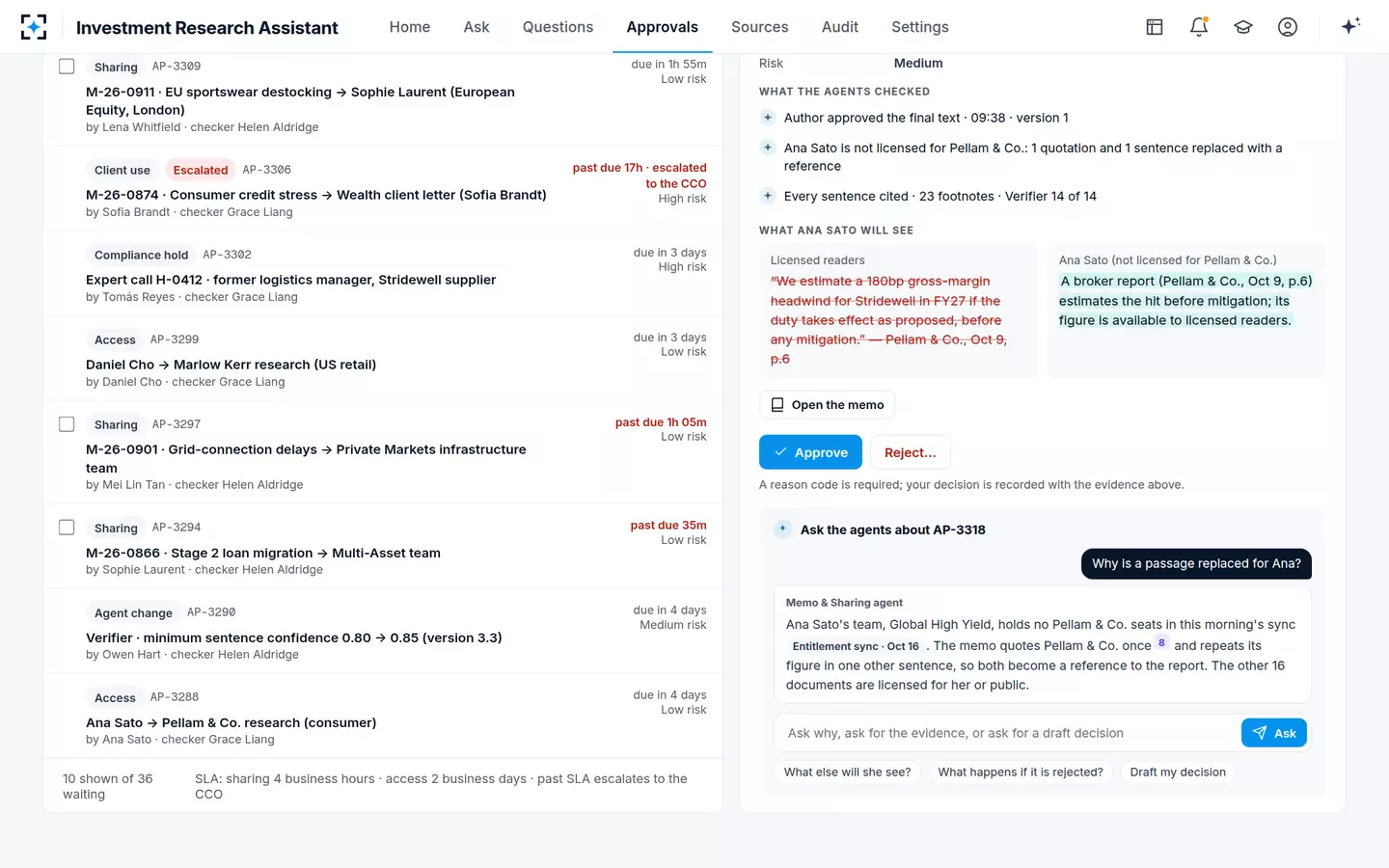
The sample shows the third row at work. The analyst's memo on a proposed footwear tariff was approved for her own team and then sent to a high-yield credit analyst in London, whose team holds no seats with the broker quoted. Before the share, the Memo & Sharing agent replaced one quotation and one sentence repeating the broker's figure with a reference to the report. The Director of Research saw both versions side by side, asked why, and approved with the reason code "Research use, internal". The author could not approve her own request.
What licensed readers see, beside what the recipient will see
Do you have to cite broker research? Yes, and diligence comes with it
You have to acknowledge broker research when you use it, under the profession's own standards, and you are expected to judge whether it is sound before relying on it. CFA Institute's Standard I(C), Misrepresentation, defines the failure that uncited use invites.
“Plagiarism is defined as copying or using in substantially the same form materials prepared by others without acknowledging the source of the material or identifying the author and publisher of such material.”
CFA Institute, Standards of Practice, Standard I(C) Misrepresentation, updated April 2024
The same guidance lists practices that fall within it, including "citing specific quotations as attributable to “leading analysts” and “investment experts” without naming the specific references". A memo that says "brokers expect a 180bp hit" without naming which broker, in which report, on which page, is that practice in miniature.
Standard V(A), Diligence and Reasonable Basis, covers the other half. It describes third-party research as research by entities outside the firm "such as a brokerage firm, bank, or research firm", and among its recommended procedures asks firms to "Develop measurable criteria for assessing outside providers, including the quality of information being provided, the reasonableness and adequacy of the provider’s information collection practices, and the accuracy of the information over time" (CFA Institute, Standard V(A)). That is hard to do for a broker whose research reaches the firm's decisions through untraceable copy and paste, and straightforward when every use is footnoted.
Can AI read licensed research without breaking the licence?
AI can read licensed broker research without breaking the licence if it reads as the person asking, uses only what that person may read, and checks again whenever its output moves to someone else. The failure is a tool that reads everything with one system account and answers anyone. NIST's generative AI profile asks organisations for measures "to prevent, flag, or take other action in response to outputs that reproduce particular training data", naming "licensed content or trade secret material" among its examples (NIST AI 600-1, MG-3.1-004). A research tool that retrieves licensed reports at question time faces the same risk with fresher text.
Four design rules make the difference. Permissions come from the licence file and the directory, not from the tool's own account. The check runs at retrieval for the reader and again at sharing for every recipient. What was withheld is declared, so the reader knows the answer is incomplete and can request access. And the trail records which passage each person saw under which licence, so a licence audit is a query rather than an investigation.
On the sample question the Broker Research Retriever read 72 reports under the analyst's licences and withheld one report from a broker she is not licensed for, shown under the answer as "1 not licensed" with a button to request access. It never showed the report's text. When the trail was asked later for the licence checks on that question, it listed 26: the 22 broker providers plus her note permissions, the expert-call hold list, the transcript licence and the restricted list.
Evidence of use: what research budgets now have to show
Broker research now has to be shown to be worth its cost, whichever way it is paid for. In the UK, a firm paying jointly must at least once a year judge the value, quality and use of the research it bought that way, and what it added to investment decisions (FCA PS24/9, COBS 2.3B.25R(7)). The EU's new text requires the annual assessment, however research is paid for, to rest on robust, objective quality criteria (C(2026) 994, new Article 13(10)). The two regimes are compared side by side in MiFID II research unbundling after 2024.
Use is the part firms have historically estimated by survey. When every answer footnotes its sources, use becomes a count: which providers were cited in answers, by whom, and in which memos that reached a decision. Investment Research Assistant reports broker research used in answers by provider for exactly that purpose. In the sample answer, 6 of the 23 citations came from broker research, beside internal notes, filings and expert calls.
Eight questions before connecting broker research to any AI tool
- Whose identity does it read under?
The person asking, or one service account that sees everything? Only the first respects a seat-based licence.
- Where do permissions come from?
The provider licence files and your identity directory, synced on a schedule you can see.
- What happens when the sync fails?
Broker text should shut off, not fall back to yesterday's permissions.
- Is the check repeated at sharing?
Every recipient, every time, with passages swapped for references where needed.
- How long may a quotation be?
A word limit, or references only, set by Research Compliance rather than by each user.
- Is withheld research declared?
The reader should see that a provider was excluded and why, without seeing its text.
- Does the text stay inside your controls?
No broker report should be sent to an outside model service your licence does not cover.
- Can you answer "who saw this passage"?
Viewer by viewer, with the licence that allowed it, for as long as you keep research records.
The broader question of when a public chatbot is acceptable for research at all is in how to use ChatGPT for investment research, and where it stops. To see licensed reading on your own broker files, start from Investment Research Assistant.
Questions people ask
What is the difference between broker research and independent research?
Broker research comes from a broker-dealer that also earns from trading, underwriting or both, which is why FINRA Rule 2241 and Regulation AC regulate its conflicts and certification. Independent research providers sell research without an execution business. The UK's joint-payment rules require firms to set out how payments are allocated between both kinds of provider.
Are broker research reports free?
Not to institutional clients: they are paid for, either from the asset manager's own resources, through a research payment account, or jointly with execution where UK or EU rules now allow it. Some brokers publish summaries or selected reports more widely, but the full reports are licensed to named readers.
How long must an adviser keep broker research it used?
Rule 204-2 requires SEC-registered advisers to keep originals of written communications received that relate to recommendations they make, for five years from the end of the fiscal year of the last entry, the first two in an appropriate office. Many firms keep research longer by policy; the sample firm keeps seven years.
Can I forward a broker report to a client?
Generally not; licences commonly restrict use to the firm's licensed readers, and client communications carry their own review duties. In the sample firm, broker research is blocked for anyone outside the firm by default, and any client use needs approval from Research Compliance.
What is a research payment account?
A research payment account is a dedicated account funded by a specific research charge to clients, used to pay for third-party research under a budget the firm sets. MiFID II introduced it in 2018 as one of two ways to pay for research separately from execution; the EU's 2026 text keeps it, with disclosure of the budget and the research charge.