Buy side research is the investment research an asset manager, pension fund, insurer or hedge fund does for its own portfolios: analysts study companies, sectors and securities to support decisions the firm itself makes, rather than to publish research for clients as a broker's sell-side department does. Its raw material is everything the firm can lawfully read, from filings and the firm's own notes to broker research it pays for and expert calls compliance has cleared. Its hardest work is joining those sources into one view and keeping control of who sees what. Agents now take much of the reading and reconciling. That changes the operating model of a research team more than its size, and Botminds' Investment Research Assistant is designed around the new division: agents plan, read under each reader's licences, compare and verify; people choose, approve and answer for the result.
Buy side and sell side research, side by side
Sell side research: Analysts at broker-dealers and investment banks.
Buy side research: Analysts at asset managers, pension funds, insurers and hedge funds.
Sell side research: The broker's institutional clients, and often the market.
Buy side research: The firm's own portfolio managers and investment committee.
Sell side research: Published reports with ratings, price targets and models.
Buy side research: Internal notes, memos and recommendations; rarely published.
Sell side research: FINRA Rule 2241 on conflicts; Regulation AC certification.
Buy side research: Advisers Act Section 204A on nonpublic information; books-and-records rule 204-2.
Sell side research: By clients, separately or with execution, depending on their regime.
Buy side research: From the firm's budget; in the UK and EU under research payment rules.
Sell side research: Client votes, trading and banking relationships.
Buy side research: The quality of the firm's own investment decisions.
What is buy side research?
Buy side research is analysis done inside an investment manager to inform the manager's own decisions about what to buy, hold or sell. A buy-side analyst covers a list of companies or a sector, builds and maintains models, meets management, reads broker research and filings, and writes notes and recommendations for the portfolio managers who decide. The work is private: a buy-side note rarely leaves the firm, and when it does, it is usually to clients and under review.
The US Bureau of Labor Statistics does not separate buy-side from sell-side analysts. Both sit in its financial and investment analyst occupation, whose reported job titles include "Equity Research Analyst", "Investment Analyst", "Portfolio Manager" and "Securities Analyst" (O*NET 13-2051.00, BLS 2025 data). That occupation held about 377,200 jobs in 2025 at a median wage of $102,740 (BLS Occupational Outlook Handbook).
The financial and investment analyst occupation, in US public data
377,200
financial and investment analyst jobs, 2025
$102,740
median annual wage, May 2025
7%
projected growth for financial analysts, 2025–35, much faster than average
29,500
openings a year projected for financial analysts, on average
What is the difference between buy side and sell side research?
The difference is who the research is for: sell side research is produced by brokers for their clients, while buy side research is produced by investment managers for their own decisions. That one difference drives everything else. A sell-side analyst publishes and is regulated as a publisher: FINRA Rule 2241 governs conflicts around research reports (FINRA Rule 2241) and Regulation AC requires the analyst to certify that the views are their own (17 CFR 242.501).
A buy-side analyst consumes the sell side's output and is regulated as part of an adviser. Section 204A of the Advisers Act requires written policies to prevent misuse of material nonpublic information (15 U.S.C. 80b-4a), and the books-and-records rule keeps written communications relating to recommendations for at least five years (17 CFR 275.204-2). The buy side's distinctive problem is therefore control: of who may read licensed broker research, of nonpublic information from expert calls, and of what leaves the team.
How is a buy side research team organised?
A buy side research team is usually organised by sector or region, with analysts each covering a list of names for one or more portfolio managers, under a Director of Research, and with research compliance and internal audit alongside. Larger firms add associates who maintain models, a research librarian or operations team that manages broker relationships and licences, and separate credit analysts who look at the same companies' bonds.
Two features shape how agents fit. The first is that coverage lists are long and uneven: in the sample firm, a consumer analyst covers 41 names across four funds, and a single tariff question can touch a dozen of them. The second is that the same company is often owned in equity and credit funds, so an equity analyst's finding about margins may matter to a high-yield analyst in another team, who may not hold the same broker licences. Both features make sharing, not reading, the place where the operating model is tested.
What does a director of research do?
A Director of Research sets the research agenda, allocates coverage, assesses the quality of analysts and outside research, and signs off what research leaves the team, including investment committee materials. Under the UK and EU research payment rules, the annual assessment of which broker research was used and what it was worth often falls to the director's team.
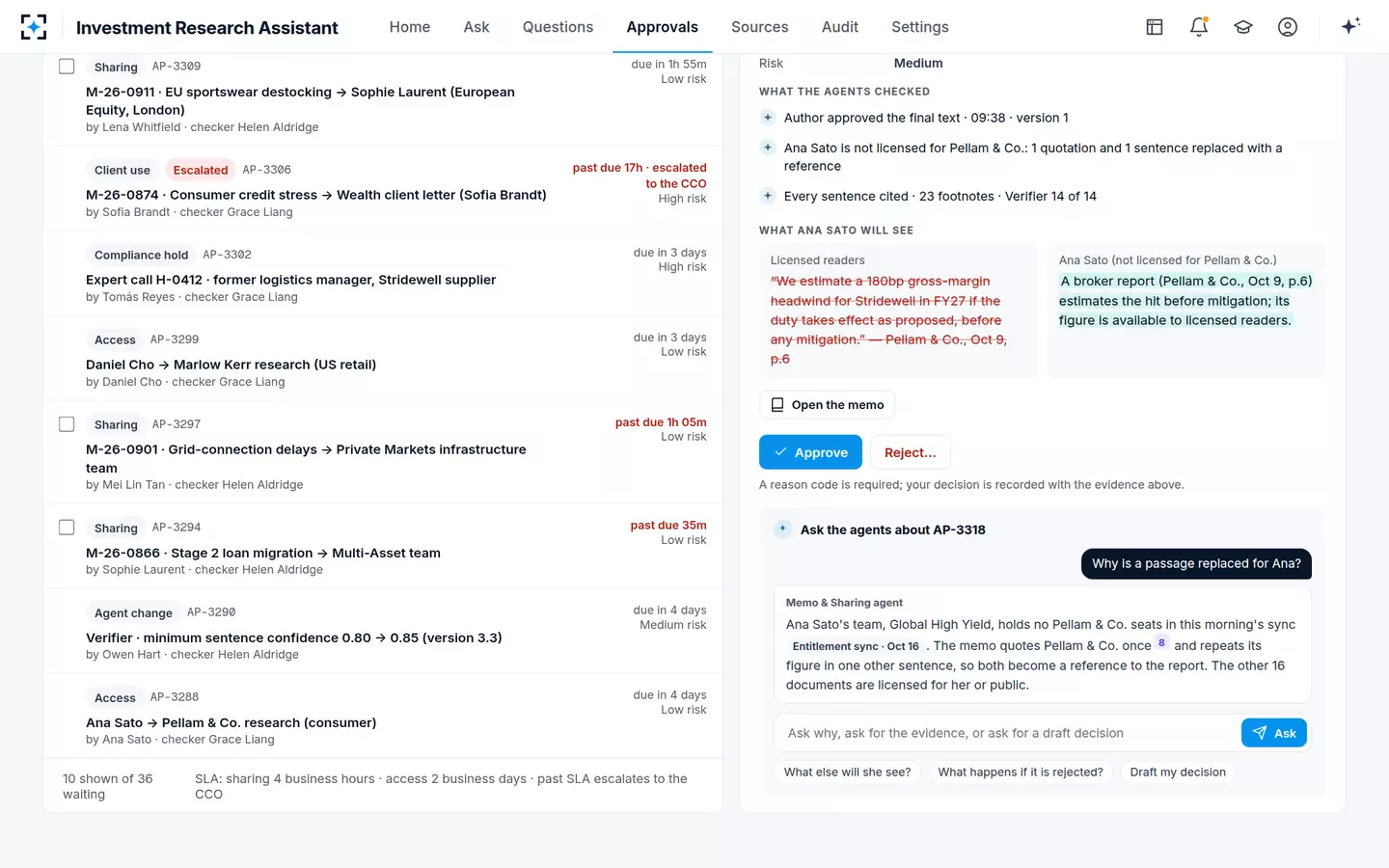
In an operating model with agents, the director's role tilts toward approval and assessment. In Investment Research Assistant the Director of Research is the second person on anything shared outside the author's team: the approval screen shows what licensed readers see beside what the recipient will see, lists what the agents checked, and requires a reason code. The director can ask the agents why a passage was replaced and get a cited answer before deciding.
The Director of Research's approval, with both versions side by side
Who approves research sharing? Decision rights in a team with agents
Research sharing is approved in layers: the author approves the final text, the Director of Research approves anything leaving the team, and research compliance approves any use with clients. Nobody approves their own request, and agents approve nothing. Writing those rights down before agents arrive is the most useful single step in redesigning a team, because agents make sharing fast, and fast sharing without clear rights is how licensed text reaches the wrong reader.
Decision rights in a buy side research team using Investment Research Assistant
| Decision | Agents | Who decides |
|---|---|---|
| Which sub-questions and sources to use | Propose a plan; read nothing until it is approved | Analyst |
| Which broker research a reader may see | Check the reader's licence with each provider; declare what is withheld | Research compliance, through the licence files |
| Which estimate to rely on when sources disagree | Set both side by side and explain the difference | Analyst, with a reason code |
| Whether a sentence stays in the answer | Delete what cannot be supported; send low-confidence sentences to the analyst | Verifier, then analyst |
| The final text of a memo | Draft from the cited answer | Analyst (author) |
| Sharing outside the author's team | Check each recipient's licences; propose replacements | Director of Research |
| Any use with clients | Block broker text by default | Research compliance |
| Changes to an agent or its settings | None | Platform administrator, with a second approver |
| Testing that the controls work | Answer questions about the trail | Internal audit |
The same principle runs through supervisors' statements on AI. ESMA's 2024 statement holds a firm's management body responsible for its decisions whether people or AI tools take them (ESMA public statement, May 30, 2024), and in the Bank of England and FCA's 2026 survey, UK firms most often placed accountability for AI outputs with business-area owners and users (94%) and executive leadership (90%) (Bank of England and FCA, October 26, 2026).
How will AI change buy side research? Reading moves to agents, judgment stays
AI will change buy side research by moving the reading, matching and first drafting to agents, while the choice between views and the accountability for the result stay with people. Adoption in research is still early. In the Bank of England and FCA survey, 13% of responding firms reported AI agents deployed for decision support in research, and none reported agents with more autonomy than constrained execution there; across asset management the figure for decision support was 23%.
The research on analysts and machines points the same way. Cao, Jiang, Wang and Yang built an AI analyst that beat most human analysts at stock price forecasts, but its edge shrank over time as analysts gained alternative data and in-house AI of their own, and the combination of the two did best (Journal of Financial Economics, vol. 160, 2024; NBER Working Paper 28800). The professional standard already assumes that research is a team effort with defined reliance.
“Members and candidates may rely on others in their firm to determine whether secondary or third-party research is sound and use the information in good faith unless they have reason to question its validity or the processes and procedures used by those responsible for the research.”
CFA Institute, Standards of Practice, Standard V(A) Diligence and Reasonable Basis
Agents become one more party the analyst relies on, which is why their limits have to be written down as clearly as a colleague's role. For a research team, the gain is capacity: the same analysts covering more names, or covering the same names more deeply, because hours move from portals to judgment. The design target in Investment Research Assistant is 20 to 30% more names per analyst on the same research budget. How the tasks inside an equity note divide between agents and analysts is broken down in the equity research process, re-divided between agents and analysts.
Five people, one tariff question
An operating model is easiest to judge on a real question. In the sample firm, a portfolio manager asks his consumer analyst on a Friday morning which holdings a proposed 25% duty on Vietnamese footwear would hit, before the investment committee meets. Five people touch the answer, and each one's week changes differently.
One research question, five people: their week before agents, and with them
Today
Opens broker portals one at a time, then the firm's notes, the filings and the expert-call library, and reconciles them by hand.
With agents
Approves a plan, reads a ranked and cited answer with the disagreements beside it, and decides what it says.
Still theirs: The choice between sources and the final text
Today
Waits for the analyst's ranking before the investment committee, with the broker's view and the firm's in different places.
With agents
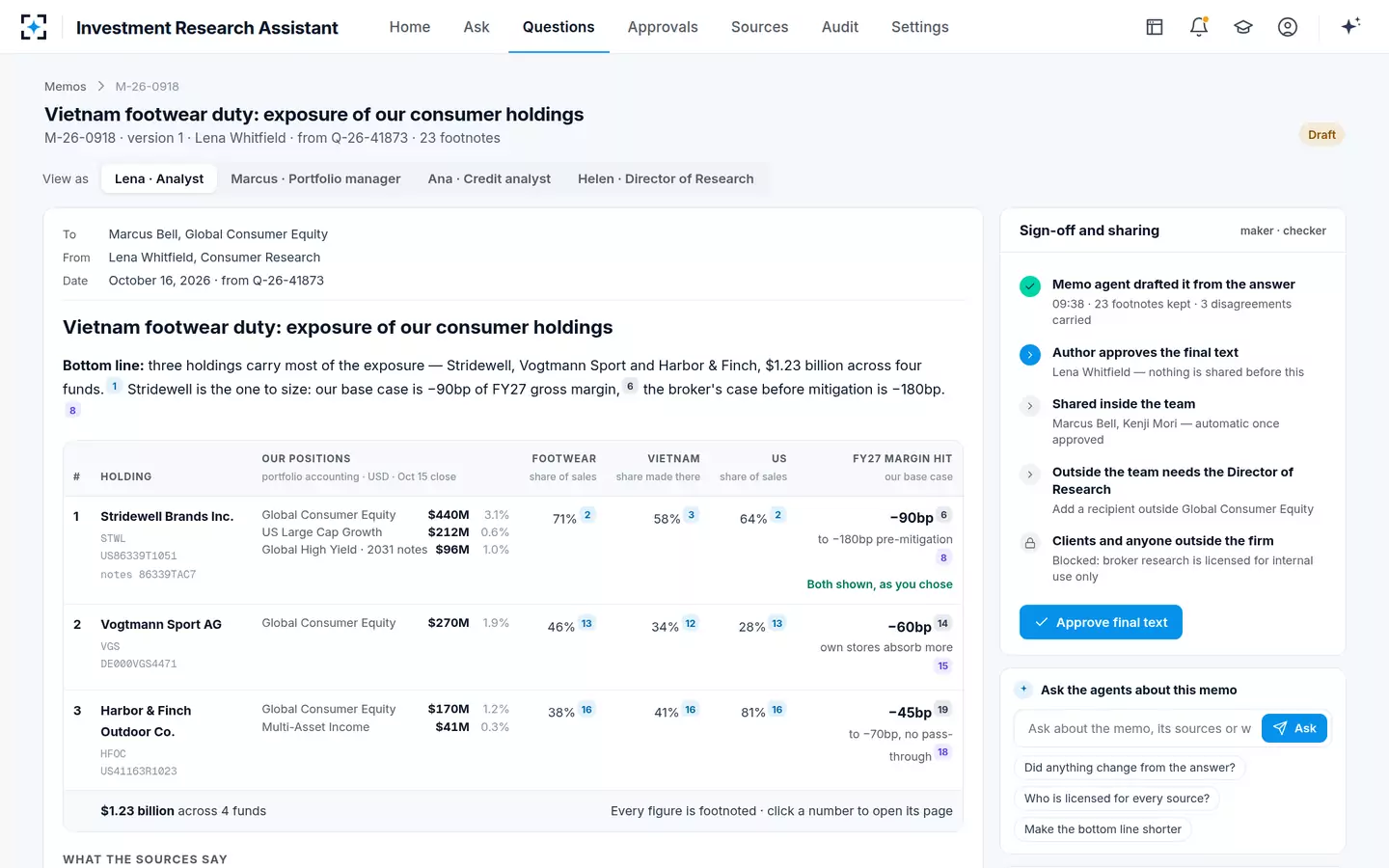
Reads a cited memo with the ranking, the range and both margin cases, under his own licences.
Still theirs: The investment decision
Today
Cannot see which licensed broker text is in a note before it leaves the team.
With agents
Sees what each recipient will see and what the agents checked, then approves with a reason code.
Still theirs: Approval of anything leaving the team
Today
Polices licences, the restricted list and expert-call holds, and keeps licensed research away from general AI tools.
With agents
Keeps licences by provider and team synced from the licence files; a failed sync shuts off broker text.
Still theirs: Licences, holds, the restricted list and client use
Today
Rebuilds by hand who saw which research, from which source, under which licence.
With agents
Filters an append-only trail of questions, licence checks, viewers and decisions, and exports a sealed evidence file.
Still theirs: The test of the controls
Where the analyst's time goes now
With agents reading, the analyst's time does not disappear; it moves to reading the answer, deciding between sources and approving text. In the sample, the analyst ran the plan at 09:12, had a cited answer 74 seconds later, and saved the memo at 09:38. Nearly all of those 26 minutes were hers: checking the ranking, choosing how to show a broker's 180-basis-point margin hit beside the firm's 90, asking why the two differed, adding a company to the ranking, and approving the text.
From question to cited memo in 26 minutes: who spent them
Sample question, 09:12 to 09:38
- Agents read 186 documents and verify · 74 s · 5%
- Analyst reads, decides, asks back, approves · ≈ 25 min · 95%
That proportion is the point of the operating model. A research team's scarce resource is judgment, and the agents' job is to hand the analyst a ranked, cited, contested answer quickly enough that her time goes on the parts only she can do. The records follow automatically: CFA Institute's Standard V(C) recommends keeping research records "for at least seven years" in the absence of other guidance (CFA Institute, Standard V(C)), and the sample firm keeps every question, decision and viewer for seven years by default.
The portfolio manager's view in Investment Research Assistant: a cited memo, both cases shown
Whether the shift pays for itself is a question for pricing a research tool programme and its six KPIs. To see the roles on your own team's questions, start from Investment Research Assistant.
Questions people ask
What does a buy side research analyst do?
A buy-side analyst covers a list of companies or a sector for the firm's own portfolio managers: building and updating models, reading filings and broker research, meeting management and writing recommendations. The analyst's view feeds the firm's decisions directly and is rarely published. BLS counts these analysts with sell-side analysts in one occupation, with a median wage of $102,740 in May 2025.
Do buy side analysts read sell side research?
Yes; broker research is one of the main inputs to buy-side work, read under licences that name who may see each provider's reports. UK and EU rules govern how managers pay for it and require an annual assessment of its value and use, which is easier when every use of a broker's research is cited.
Is buy side research better paid than sell side?
Public data cannot say: the BLS reports one occupation for financial and investment analysts, with a median of $102,740 and a top tenth above $180,860 in May 2025, and does not split buy side from sell side. Compensation surveys by recruiters and trade bodies fill that gap, but they are not independent statistics.
Will AI replace buy side analysts?
The evidence points to a change in work rather than replacement. A peer-reviewed study found an AI analyst's edge over humans shrank when analysts had alternative data and in-house AI, with the best forecasts from combining the two. Supervisors also expect named people to remain accountable for decisions made with AI.
Who should own AI tools in a research team?
The Director of Research should own how the tool is used and approve what leaves the team, research compliance should own licences, holds and the restricted list, and a platform administrator should own settings, with a second approver for any change. Internal audit tests the controls on a schedule.