The equity research process on the buy side runs from idea to thesis to model to recommendation, and every quarter it is re-tested by an earnings note: catch the release, update the model, check the numbers, compare them with the estimate and the thesis, write the note and have it signed and released to portfolio managers. Split into its tasks, that note is about a dozen steps, and they divide cleanly into two kinds. Catching, reading, keying, tying and drafting are mechanical and verifiable; estimates, thesis calls, ratings and the signature are judgment. Botminds' Equity Research Automation gives the first kind to a crew of seven AI agents and leaves the second with the analyst and the Director of Research, which is also how supervisors in the UK describe most agents in production today: the agent recommends, a person decides.
This guide lays out the process task by task, shows what moves and what stays, and looks at what the evidence says about AI and analysts. The examples come from the solution's fictional sample firm, Quillfield Capital; research and rule figures are linked where they appear.
Twelve tasks inside one earnings note, and who does each in Equity Research Automation
1
Know the report calendar and catch the release
AgentRelease Watcher
Personreviews only if asked
2
Confirm the release is final and match the 8-K
AgentRelease Watcher
Personreviews only if asked
3
Read the release, deck and filing, in the original language
AgentExtractor
Personreviews only if asked
4
Write reported actuals into the analyst's own model
AgentExtractor, as a new draft version; forecast cells untouched
PersonAssociate checks values under 97% confidence
5
Re-add segments, compare history, find recasts
AgentTie-out Reviewer, with a second model; holds on any tie it cannot explain
PersonAnalyst confirms any rebase
6
Compare with the house estimate, consensus and thesis
AgentVariance agent proposes
Personreviews only if asked
7
Change estimates
AgentProposed in a separate block
PersonAnalyst approves, edits or rejects
8
Move a thesis claim
AgentMarked on track, at risk or broken, with evidence
PersonAnalyst decides
9
Draft the note
AgentNote Drafter, every sentence cited
Personreviews only if asked
10
Check restricted list, sources and expert-call content
AgentCompliance Sentinel blocks
PersonResearch Compliance clears
11
Sign the note
Agentnone
PersonCovering analyst, as the maker
12
Release to portfolio managers; approve rating or large target changes
Agentnone
PersonDirector of Research, as the checker
What is the equity research process?
The equity research process is the sequence by which an analyst forms, documents and maintains a view on a stock: study the company and industry, build a model, write a thesis with testable claims, set estimates and a rating, and then re-test all of it each time the company reports. Most writing about the process stops at the initial report. On a buy-side desk the recurring work matters more, because a covered name produces four earnings notes a year for every initiation.
The profession's own standard frames the bar for every step. CFA Institute Standard V(A) requires a reasonable and adequate basis, supported by research and investigation, for any analysis or recommendation (CFA Institute Standards of Practice, V(A)). The same standard names "results from quantitative models" among the resources an analyst balances, and requires members to test the output of models and other preprogrammed tools before relying on them. An agent that drafts part of a note is such a tool. The standard does not forbid it; it puts the burden of testing on the people who use it.
Which parts of equity research can be automated?
The parts that can be checked against a source can be automated: catching the release, reading it, writing reported figures into a model, re-adding segments, comparing with history and drafting cited sentences. Each produces an output a second reader can verify on the page it came from. The parts that cannot be checked against a source, such as whether a margin miss breaks the thesis or whether a rating should change, are judgment, and they stay with people.
The difference shows in where an analyst's season goes. On the solution's own estimate for one analyst covering 38 names over a five-week season, the mechanical tasks (watching for releases, keying actuals and checking totals) take 6 of 15 working days by hand. With the agents doing them, the analyst's total falls to about 3.7 days, and four-fifths of what is left is variance, writing and sign-off: the decisions.
Where one analyst's season goes: by hand, the mechanical tasks are 40%; with agents, the decisions are 81%
By hand, 15 working days
- Watch, key and check · 40%
- Variance · 20%
- Write and sign · 40%
With Equity Research Automation, 3.7 days
- Watch, key and check · 18.9%
- Variance · 27%
- Write, edit and sign · 54.1%
What the analyst keeps: estimates, thesis calls, ratings and the signature
Four things never leave the analyst in this design: changing an estimate, moving a thesis claim, changing a rating or price target, and signing the note. The agents may propose each of them with the evidence; none of them may do it. The Note Drafter "never changes a rating or price target" and never sends a note; the Variance agent "never changes an estimate or a thesis claim; proposes only".
The reason is accountability, not technical limits. ESMA put it plainly to EU investment firms in May 2024: decisions stay the responsibility of a firm's management body whether a person or an AI tool takes them (ESMA public statement on AI and investment services, May 30, 2024). A research note carries a recommendation. If the person who signs it did not make the calls in it, the firm cannot say who did.
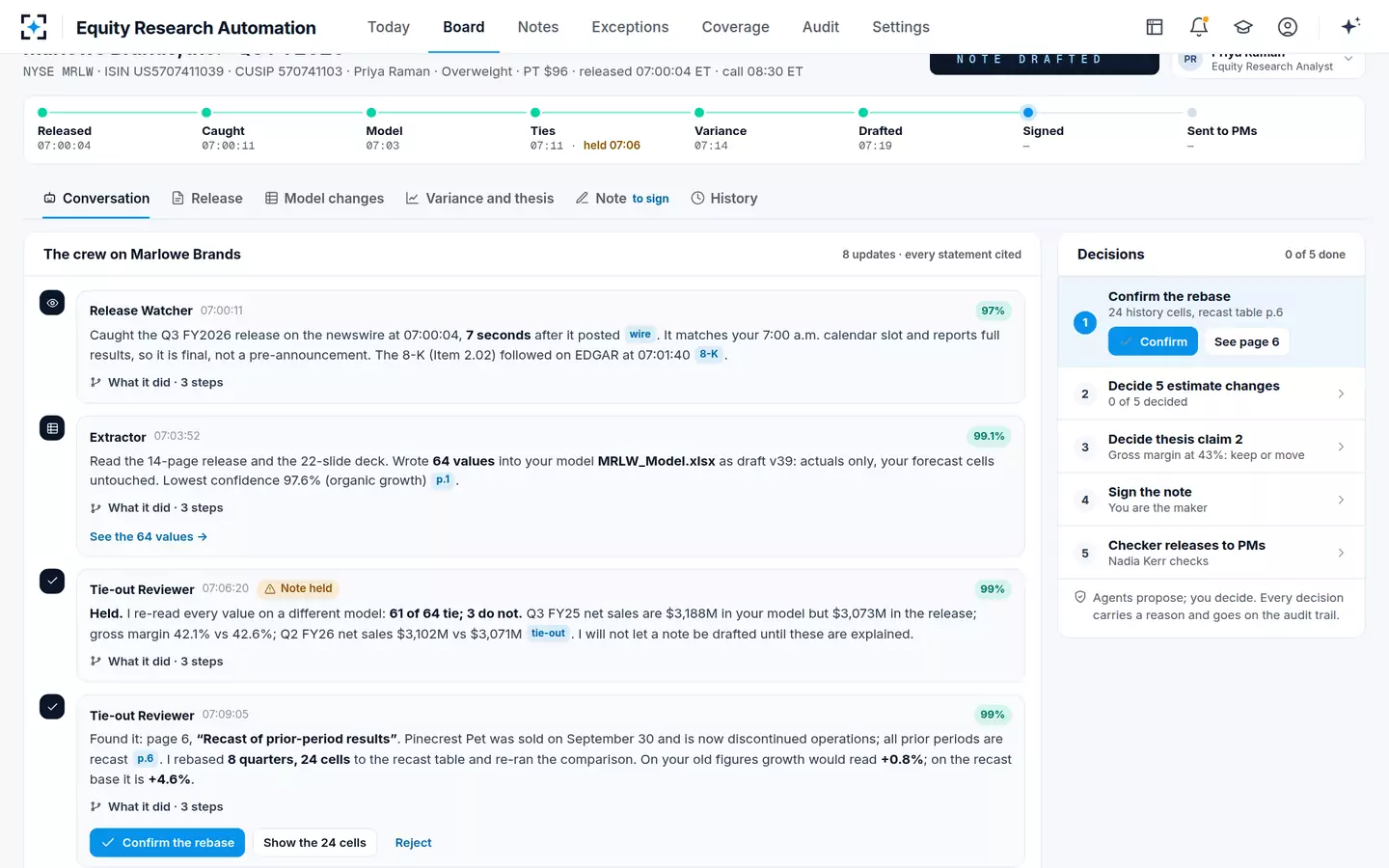
Take the sample morning. Marlowe Brands reported at 7:00 a.m. on Thursday, November 5, 2026. By 7:19 the agents had written 64 values into Priya Raman's model, found that page 6 recast last year's figures after a divestiture, rebased 24 history cells, and drafted a seven-sentence note with 11 citations. What they had not done was decide anything. The draft proposed raising the fiscal 2026 EPS estimate from $5.22 to $5.34; it asked whether the gross margin claim should move from the fourth quarter to the second quarter of fiscal 2027; it said, in the Note Drafter's words, "Rating and price target unchanged; that is your call."
The crew's conversation: each step with its source, and a hold
Who signs an earnings note?
On a buy-side desk the covering analyst signs the earnings note, and a second person checks and releases it; the firm's own policy, not a federal rule, sets that sequence. Regulation AC's analyst certification is a sell-side rule: it applies when "a broker or dealer or covered person" publishes, circulates or provides a research report to a US person, and requires "a clear and prominent certification by the research analyst" that the views "accurately reflect the research analyst's personal views" (17 CFR 242.501, eCFR current to Oct. 23, 2026). A covered person is defined as an associated person of a broker or dealer (17 CFR 242.500).
FINRA Rule 2241, also a broker-dealer rule, governs sell-side research conflicts and ratings, and requires that a member "clearly define in each research report the meaning of each rating in the system" (FINRA Rule 2241(c)(2)). A buy-side reader meets both rules in the broker notes on the desk, not in the house note. That does not make the house signature lighter: it is what tells a portfolio manager, an auditor or an examiner who made the call.
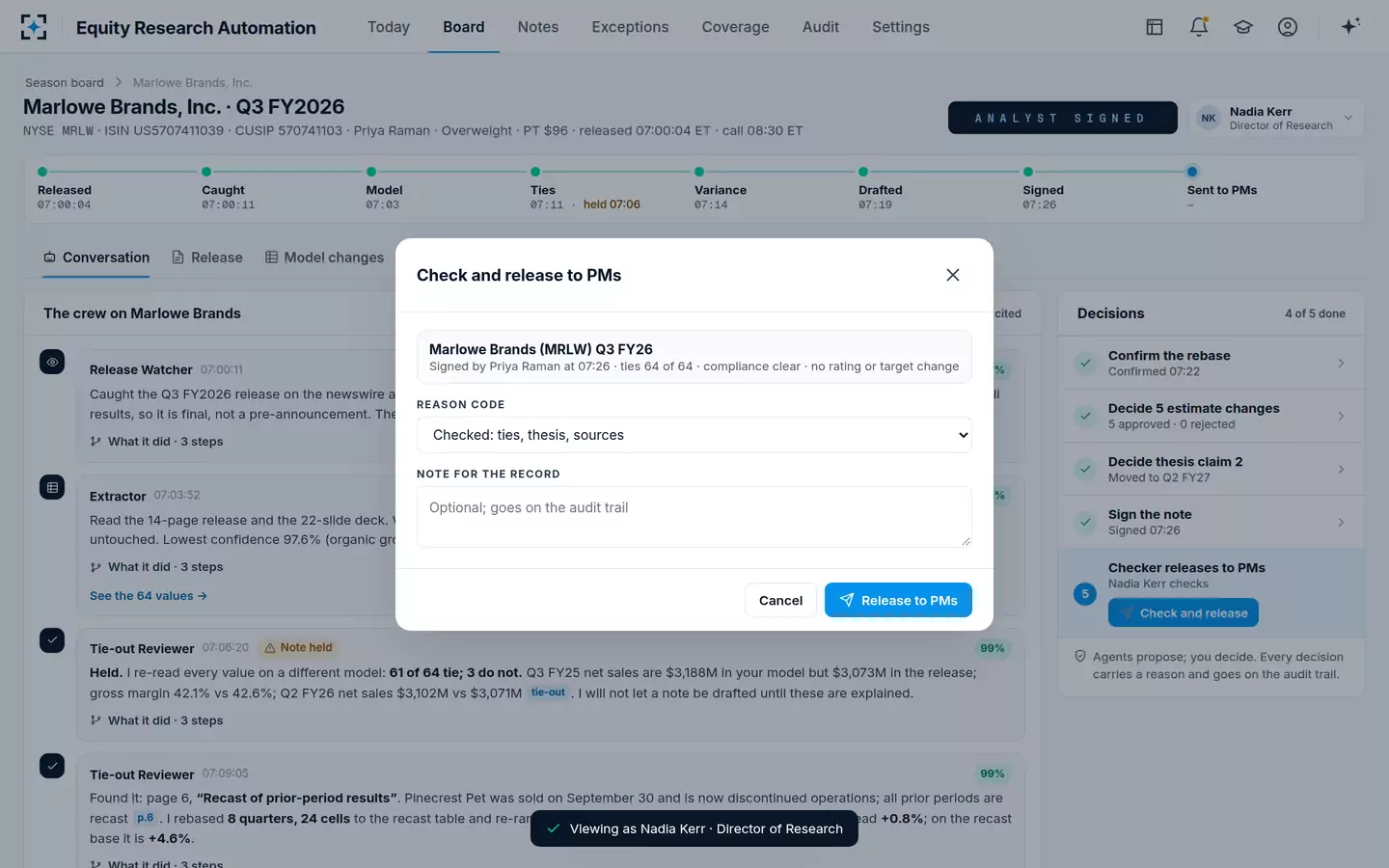
In the solution the analyst signs as the maker with an attestation, "I have read the note and its sources; the views are my own and I hold no position in MRLW", and a reason code. The Director of Research then checks and releases it as the checker; the checker can never be the maker, and a rating change or a price-target change over 10% needs the Director's co-sign. On the sample morning Priya Raman signed at 7:26, 26 minutes after the release, and Nadia Kerr released the note at 7:29.
The checker sees who signed, the tie count and the compliance result
How much autonomy do firms give AI agents? Supervisors' numbers
Very little, so far. The Bank of England and the FCA asked UK financial firms in 2026 how their AI agents in production work, using four levels: "decision-support" (agents recommend actions, humans decide and execute), constrained execution "within predefined limits and rules", conditional autonomy, where agents "require human approval for certain actions", and broad autonomy "with limited real-time human involvement" (Bank of England and FCA, Artificial intelligence in UK financial services, October 26, 2026).
AI agents in production at UK financial firms, by level of autonomy
The equity research process maps onto those levels without strain. Catching a release, writing actuals into a draft version of the model and drafting a note are constrained execution: the agent acts, inside fixed limits, on things a person reviews before they count. Estimates, thesis claims, ratings and the signature are decision support: the agent recommends, the analyst decides. Nothing in the process needs broad autonomy, and nothing in the solution has it.
One earnings note in Equity Research Automation: agents act inside limits, people decide
Agent
Release WatcherCatches the release from the newswire, EDGAR, exchange feeds and IR pages, and confirms it is final.
Never: log in to a paywalled site, or treat a pre-announcement as final
Agent
ExtractorWrites reported actuals into the analyst's own model as a new version, every cell cited to its page.
Never: touch a forecast cell, or guess a value below 97% confidence
Agent
Tie-out ReviewerRe-reads every value with a different model, re-adds segments, compares history, finds recast tables.
Never: fix a value by guessing; a tie it cannot explain holds the note
Agent
Variance agent and Note DrafterCompare with estimate, consensus and thesis; draft the cited note and propose estimate and thesis changes.
Never: change an estimate, rating, price target or thesis claim, or send a note
A person decides
Covering analystConfirms the rebase, decides each estimate and thesis change with a reason code, edits and signs as the maker.
Agent
Compliance SentinelChecks the restricted and watch lists, public sources only, expert-call content cleared, disclosures present.
Never: clear a restricted name
A person decides
Director of ResearchChecks and releases the signed note to portfolio managers; co-signs rating changes and target changes over 10%.
Will AI replace equity research analysts?
The evidence so far points to fewer hours on mechanics, not fewer analysts. The US Bureau of Labor Statistics projects employment of financial analysts to grow 7% from 2025 to 2035, a rate it classes as much faster than average, from 443,100 jobs in 2025, and adds: "Financial analysts also will be needed to assess growing volumes of data" (BLS Occupational Outlook Handbook, financial analysts, last modified August 27, 2026). The projection does not separate equity research from other analyst roles.
The best-known study of AI against analysts reaches the same place from the other side. Cao, Jiang, Wang and Yang built an AI analyst that beat most human analysts at stock price forecasts, and found where each side wins.
"Our paper portraits a future of 'machine plus human' (instead of human displacement) in high-skill professions."
Cao, Jiang, Wang and Yang, NBER Working Paper 28800 (2021); published in the Journal of Financial Economics, 2024
The machine's advantage, they report, "is stronger when the firm is complex, and when information is high-dimensional, transparent and voluminous"; and the AI's lead over human analysts, they write, "declines over time when analysts gain access to alternative data and to in-house AI resources" (NBER w28800; JFE 160, 2024). In plain terms: the AI is strongest on exactly the voluminous, transparent material an earnings release is, and analysts who use AI close the gap. The design target in the solution follows from that: 20 to 30% more names per analyst on the same research budget, not fewer analysts. It is a target, not a measured result.
Where the claim that AI already beats analysts comes from, and why its best-known source was withdrawn, is the subject of financial statement analysis with large language models, tested.
Earnings preview and earnings recap: before and after the release
An earnings preview is what the analyst writes or prepares before a company reports, and an earnings recap is the note after; the same split between agents and people runs through both. Before the release, the preview work is setting the questions: which thesis claims this quarter tests, what the estimate assumes, what to ask on the call. After, the recap is the earnings note, followed by an addendum if the call changes the view.
In the sample, the before-work is visible in the analyst's calendar: one company "reports at 16:05, call at 17:00", and "3 thesis claims will be tested". The after-work includes the call: when Priya Raman tells the crew to add a question for the 8:30 call, about fourth-quarter resin contract pricing, the agents add it to her call list and undertake to read the transcript when it posts and draft an addendum if the answer moves the margin claim. The call itself is covered in the guide to AI earnings call analysis; the decision about the claim, as ever, is hers.
To see the whole process on your own coverage, start from Equity Research Automation.
Questions people ask
What are the steps in equity research?
For a covered company: study the business and industry, build a model, write a thesis with claims that can be tested, set estimates, a rating and a price target, then re-test all of it each quarter when the company reports. The quarterly cycle is where most of the hours go: catch the release, update the model, check the figures, compare with estimates and thesis, write the note, sign and release.
What does an equity research analyst do during earnings?
Catches each covered company's release, updates the model with actual results, checks the figures, compares them with the house estimate, consensus and the thesis, listens to the call and writes a note for portfolio managers, ideally before the open. In the solution's sample, one analyst had four names report at 7:00 a.m. and calls from 8:30.
Can AI write an equity research report?
It can draft one. In the solution, the Note Drafter writes the earnings note in the house template with every sentence cited and proposes estimate and thesis changes, but it never changes a rating or price target and never sends a note. The analyst edits and signs; a second person checks and releases.
What is maker-checker in research?
Two different people on every note: the maker, usually the covering analyst, signs it, and the checker, such as the Director of Research, reviews and releases it. In the solution the checker can never be the maker, and the system records both signatures with reason codes.
Does Regulation AC apply to buy-side analysts?
Regulation AC's certification applies when a broker or dealer, or an associated person defined as a covered person, publishes, circulates or provides a research report to a US person. A buy-side firm's internal note to its own portfolio managers is governed by the firm's policies and its obligations as an adviser rather than by Regulation AC.
How do supervisors expect firms to oversee AI agents?
As tools whose decisions remain the firm's. ESMA said in 2024 that decisions remain the responsibility of management bodies whether people or AI take them, and the Bank of England and FCA's 2026 survey found human approval reported as a control by more than 90% of respondents.