AI earnings call analysis uses software agents to read a company's results call as it happens: they tag guidance and key statements, compare them with last quarter and the analyst's own model, and draft a research note, so the analyst starts the evening from a cited draft rather than a raw transcript. The question a director of research should ask is not whether the agents can read a call, because reading and extracting are what this generation of tools does best, but who checks them. Botminds' Earnings Call Analysis answers with a maker-checker design: the agent that reads a call is never the one that argues against it, a separate skeptic agent must search the same call for counter-evidence before any thesis pillar moves, the analyst decides, a second analyst confirms any broken pillar, and only the covering analyst signs. This guide explains why that separation matters, what regulators say about agents, and what to ask any vendor.
"80% reported having AI agents in production that provided decision support (ie, AI agents recommend actions, humans decide and execute)."
Bank of England and FCA, Artificial intelligence in UK financial services, October 26, 2026
Can AI analyze earnings calls?
Yes, for the reading: tagging statements, extracting figures, comparing them with prior guidance and drafting cited summaries are the uses firms report most. FINRA's 2026 oversight report says "the top GenAI use case among FINRA member firms is 'Summarization and Information Extraction'" (FINRA, December 9, 2025). In the EU, ESMA's survey of firms in securities markets found the most common application was "drafting and summarising information", 239 use cases or 29% of the total (ESMA, February 20, 2026).
The judgement is a different matter, and the evidence is mixed. Cao, Jiang, Wang and Yang built an AI analyst that beat most human analysts at stock price forecasts, yet found "human analysts remain competitive when critical information requires institutional knowledge" and that "combining AI's computational power and the human art of understanding soft information produces the highest potential in generating accurate forecasts" (NBER working paper 28800, 2021; published in the Journal of Financial Economics, 2024). On simple questions about filings, the FinanceBench test found GPT-4-Turbo with retrieval "incorrectly answered or refused to answer 81% of questions" (arXiv 2311.11944, 2023 models; not peer reviewed). And two widely shared papers claiming a large language model outperformed analysts at financial statement analysis have been withdrawn by their own authors (arXiv 2407.17866, arXiv 2306.10224), so their results should not be relied on.
How firms deploy AI agents: they recommend, people decide
80%
of responding UK financial firms have agents in production that recommend while people decide
2%
of respondents have deployed agents with broad autonomy
≤9%
expect agents to execute trades or approve customer outcomes, even including plans
>90%
use human approval as a control on data risk in AI systems
How does AI earnings call analysis work?
It works as a chain of narrow agents, each with one job and a limit on what it may do, handing to people at the points where a decision is made. In Earnings Call Analysis there are seven agents. Intake matches each call on the earnings calendar to the coverage list, joins the firm's recording line and attaches the vendor transcript when it lands; an issuer match under 90% goes to a person. The listener tags guidance and key statements as the call runs, in the language spoken. The translator puts English beside every line and checks every figure in both languages. The comparer holds each statement against last quarter's guidance and the analyst's model and proposes cell changes. Then come the check, the draft and the compliance review.
AI earnings call analysis in Earnings Call Analysis: who makes, who checks, who decides
Agent
Listener and comparer (the makers)Tag guidance live with metric, value, period, speaker and timestamp; compare with last quarter and the model; propose which pillar moved.
Never: use a line under 80% confidence before a person checks it, or write to the model
Agent
Skeptic (the checker)Before any pillar moves to Weakened or Broken, searches the same call for the strongest counter-evidence, weighs it and states the pillar’s break rule.
Never: decide; it only proposes
A person decides
Covering analystAccepts, changes or rejects each proposed move with a reason code; approves model changes cell by cell.
A person decides
Second analystConfirms or sends back any pillar marked Broken; a senior analyst reviews rating and target changes. Never the pillar’s author.
Agent
Note writer and compliance agentDraft the note with every claim cited; check restricted lists and that every source is public; hold anything from a private meeting.
Never: send before the analyst signs, or release a hold
A person decides
Covering analyst signsThree attestations: read every cited line, every source public, views labelled. Only then do portfolio managers see the note.
What is a maker-checker control?
A maker-checker control separates the person or process that prepares a change from the one that approves it, so that no single actor can both produce a result and certify it. Payments and limit changes are the classic uses in banking; research teams have long used an informal version when a senior analyst reviews a rating change. Applied to AI earnings call analysis, it means three separations: the agent that proposes a pillar move is not the agent that searches for the case against it; the agents that propose are not the people who decide; and the analyst who marks a pillar Broken is not the analyst who confirms it.
The last separation is enforced by the software rather than by goodwill. In the sample, the confirmation reads: "Maker-checker complete. Marked by Dana Whitlock, confirmed by Tomás Aguirre. The same person can never do both."
A Broken pillar, its counter-evidence, and the second analyst's confirmation
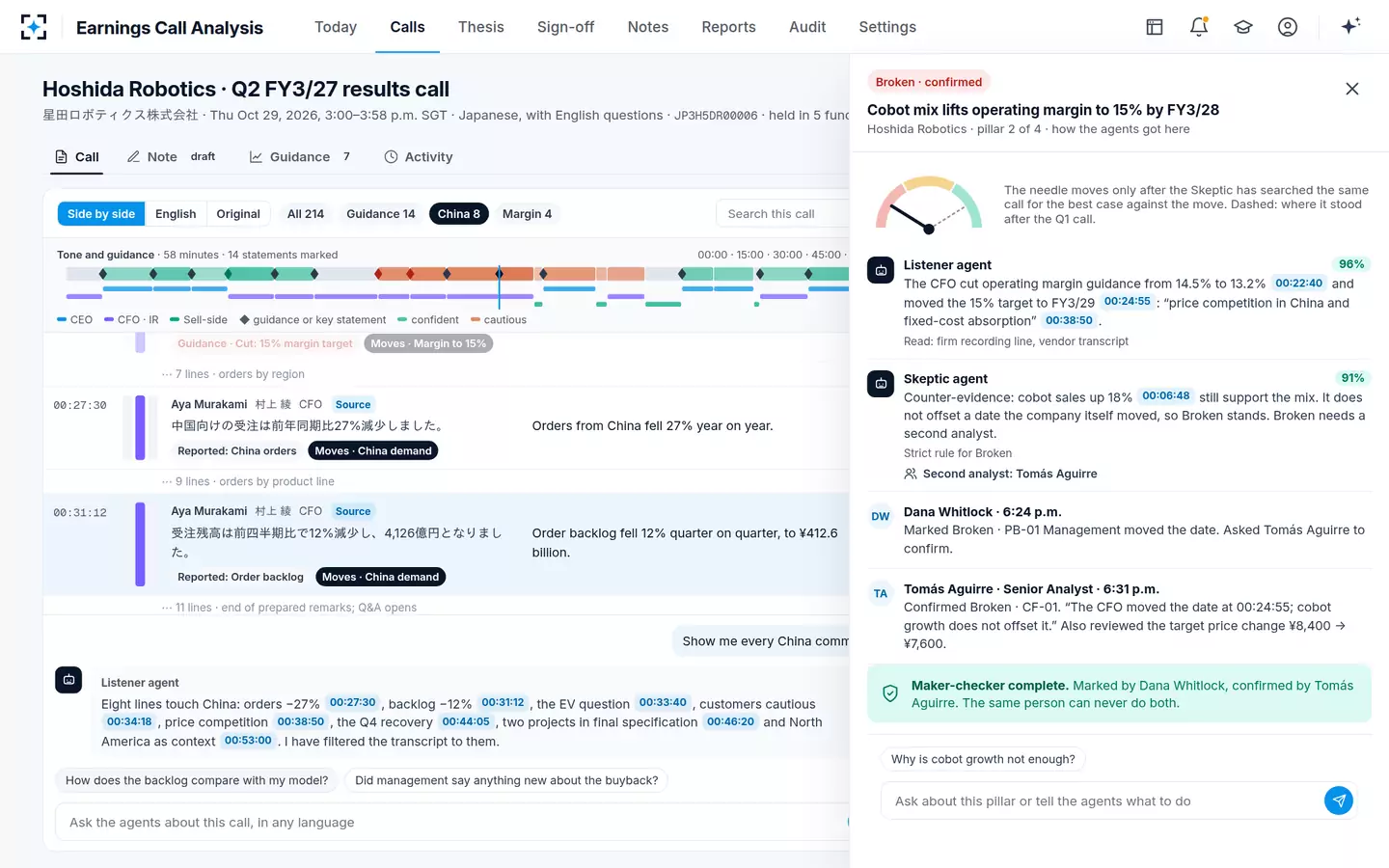
Why the reader is never the checker
Because a reader tends to find what it was looking for, and a model asked to explain why a pillar moved will explain it. An analyst reading alone tends to read the call to confirm the view already held; an agent prompted with a hypothesis has the same tilt, and it is harder to see, because it writes fluently and cites real lines. A second pass by the same agent repeats the first. The check has to come from a process whose only job is to find the strongest case against the move, run over the same call, before anything is decided.
On the fictional Hoshida Robotics call, the listener and comparer had good reason to propose that the China demand pillar was breaking: orders down 27% year on year, backlog down 12% to ¥412.6 billion, 9.3% under the analyst's model. The skeptic searched all 214 lines and found two against it, both in the Q&A: the chief executive's expectation that China orders recover in the fourth quarter as large electric-vehicle projects restart, and two projects in final specification. It stated the pillar's own break rule, China orders below −20% for two quarters or backlog under ¥400 billion, and the proposal stopped at Weakened. Across the sample season the skeptic held back 17 proposed moves this way.
How the agents got to a proposal, and the analyst's choice
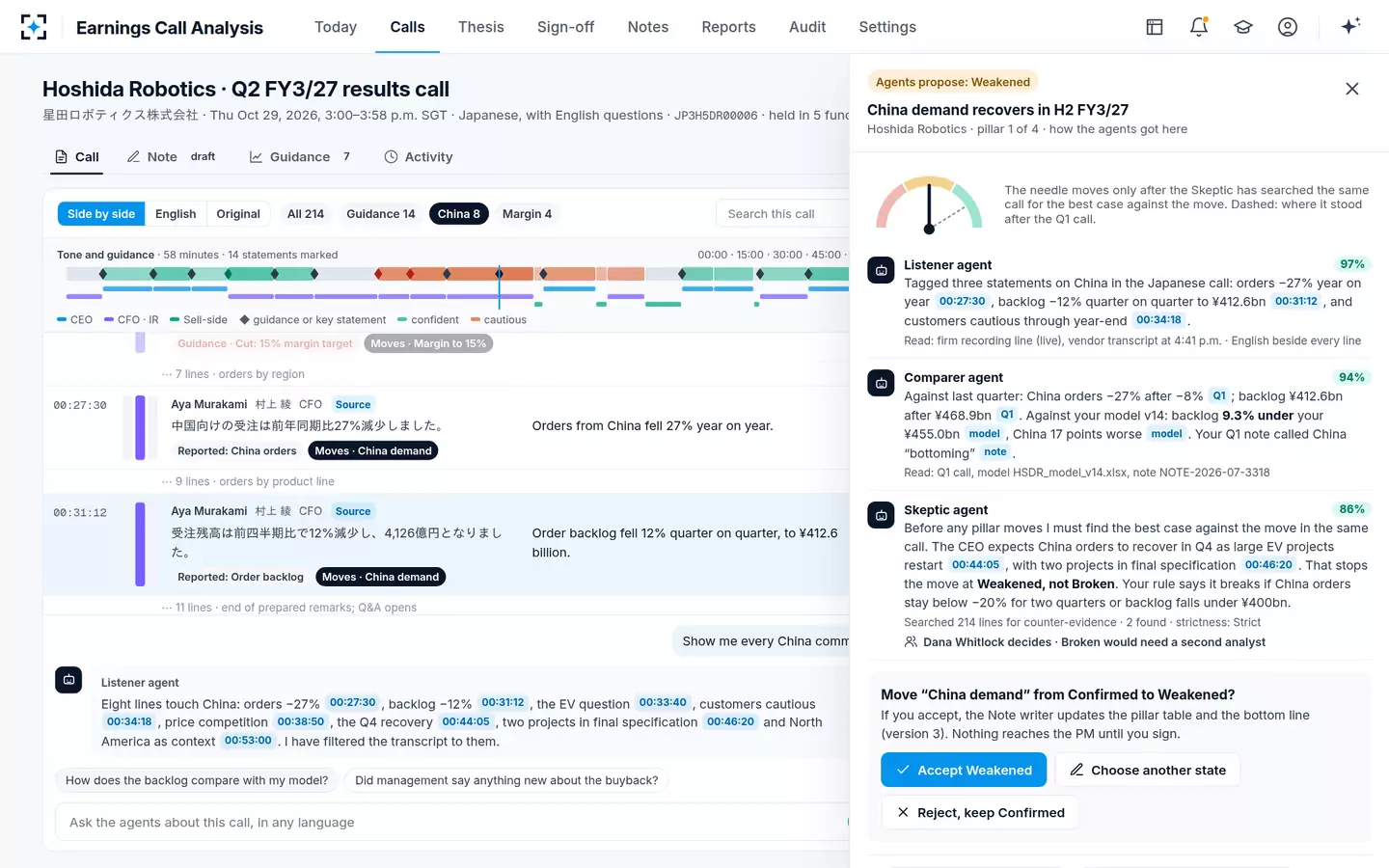
Who approves an AI-drafted research note?
A person, and in a well-run team more than one. The covering analyst decides each pillar move and signs the note; a second analyst confirms any Broken pillar; a senior analyst reviews rating and target changes; research compliance clears anything resting on a private source. Regulators place the responsibility in the same place regardless of who drafted. ESMA's 2024 statement says "firms' decisions remain the responsibility of management bodies, irrespective of whether those decisions are taken by people or AI-based tools", and that this extends to staff using third-party tools such as ChatGPT "with or without the direct knowledge and approval of senior management" (ESMA, May 30, 2024). FINRA intends its rules "to be technologically neutral" (Regulatory Notice 24-09, June 27, 2024).
For a US adviser, the review is part of the compliance program the firm must "adopt and implement" and review "no less frequently than annually" (Rule 206(4)-7, eCFR current to Oct. 23, 2026). A note-signing process with named roles and recorded reason codes is evidence that the program exists in practice, not only on paper.
What do regulators say about AI agents in finance?
They describe agents as tools that recommend while people decide, and they name the failure modes a buyer should test for. FINRA defines AI agents as "systems or programs that are capable of autonomously performing and completing tasks on behalf of a user" and lists their risks; the Bank of England and FCA found agents overwhelmingly deployed for decision support; and the SEC's Division of Examinations, in its fiscal 2027 priorities of October 23, 2026, says registrants are "using generative SI tools to support research, drafting, coding, and client communications", using its own term, super intelligence (SEC, Fiscal Year 2027 Examination Priorities). The Division "will also prioritize examinations of policies and procedures relating to monitoring SI". There is no SEC rule on advisers' use of AI pending: the 2023 predictive data analytics proposal was withdrawn on June 12, 2025 (90 FR 25531).
The agent risks FINRA names, and the control that answers each in Earnings Call Analysis
FINRA's description of the risk: "AI agents acting autonomously without human validation and approval."
The control in Earnings Call Analysis: Agents propose; the analyst decides each pillar move with a reason code; nothing reaches a portfolio manager before a signature.
FINRA's description of the risk: "Agents may act beyond the user’s actual or intended scope and authority."
The control in Earnings Call Analysis: Each agent has written limits: the comparer never writes to the model; the compliance agent holds but never releases.
FINRA's description of the risk: "Complicated, multi-step agent reasoning tasks can make outcomes difficult to trace or explain."
The control in Earnings Call Analysis: Every claim cites its line, release or model cell; every read, proposal, decision and signature is on a hash-chained trail, kept seven years by default.
FINRA's description of the risk: "General-purpose AI agents may lack the necessary domain knowledge."
The control in Earnings Call Analysis: The analyst’s own pillars and break rules frame every proposal; lines under 80% confidence wait for a person.
What to ask a vendor of AI earnings call analysis
Ask how the product is checked, not how well it reads. Every serious tool reads a transcript; the differences are in what happens between the reading and the note. The questions below are the ones that separate a summariser from something a research team can put its name to.
Ten questions for any AI earnings call analysis vendor
- Does every claim cite a timestamped line, the release or a model cell?
And can the analyst play the line from its timestamp before signing?
- Who checks the reader?
Is there a separate counter-evidence search before a conclusion, or does the same model review itself?
- Can the tool write to my model?
It should propose changes cell by cell and wait for approval, keeping the earlier version.
- What happens to a line it is unsure of?
A confidence threshold you set, below which lines wait for a person rather than averaging in.
- Does it read the call in the language spoken?
Or only the English transcript, hours later? Are figures checked across both languages?
- Can a portfolio manager see a draft?
If drafts leak, the review step is decoration.
- How are private-meeting sources handled?
A note citing a one-on-one should be held for compliance automatically.
- Is a second person required for the big calls?
A broken pillar, a rating or a target change, confirmed by someone other than the author.
- What does the audit trail record, and for how long?
Who, what, when, why and the evidence, including agent versions; five years at least for advisers’ records.
- Who can change the settings?
Thresholds and clocks should be versioned and approved, not edited by whoever is busy.
Where AI earnings call analysis fits, and where it does not
It fits a buy-side team that covers more names than it can read by hand in the peak weeks, holds written theses, and wants each note's claims traceable. It fits best when calls arrive in several languages and the English transcript lags. It is not a trading signal: the agents in this design never trade, and the Bank of England and FCA found no more than 9% of firms expect agents to execute trades even with a year's plans included. It is not a replacement for a sell-side analyst's published research, which carries its own certification under Regulation AC and its own conflict rules. And it does not supply a thesis: a team without written pillars and break rules gets a well-cited summary, which is useful but is not a test.
The setup reflects that. Going live starts with the team's coverage list, thesis pillars, note template and a sample of past notes, through a guided conversation with the agents in six steps, each approved before the next. How to write an investment thesis you can test every quarter covers the pillars; the transcripts page covers the data. The Earnings Call Analysis page walks one evening through every screen.
Questions people ask
Can AI change my investment thesis?
It should not be able to. In a maker-checker design the agents propose a pillar move with the lines behind it and the counter-evidence weighed, and the analyst accepts, changes or rejects it with a reason code. Editing the pillars themselves is the analyst's job, recorded like any other decision.
How do you stop AI confirmation bias in research?
By making disagreement a separate step: a checker whose only task is to search the same call for the strongest case against a proposed move, run before anyone decides. In the fictional sample season that step held back 17 proposed moves. A second analyst for broken pillars adds a human check on top.
Is AI earnings call analysis allowed for investment advisers?
No US rule forbids it, and the SEC withdrew its proposed rule on predictive data analytics in June 2025. Existing obligations apply as they would to any tool: books and records, MNPI policies under Section 204A, the compliance program under Rule 206(4)-7, and accurate statements about what the firm's technology does.
How accurate is AI at reading earnings calls?
Accurate enough to tag and extract when each output cites its source and low-confidence lines go to a person, and not accurate enough to trust uncited. On simple questions about filings, a 2023 test found a leading model with retrieval wrong or silent on 81% of questions, which is why citations and human checks matter more than the model's name.
Do regulators require a human in the loop for AI agents?
No rule sets a single standard, but supervisors expect one where it matters. FINRA asks firms to consider "where to have 'human in the loop' agent oversight protocols or practices", and the Bank of England and FCA found over 90% of firms use human approval as a control.