Earnings calls usually last about an hour: in the one peer-reviewed study that timed them, 20 large companies' results calls averaged 64 minutes, ranging from 35 to 95, with 23 minutes of presentation and 41 of questions. The hour is fixed by the company. The hours that follow are not, and for a buy-side research team they are where the cost sits: the analyst re-reads the transcript, updates the model, writes the note and gets it reviewed, while the portfolio managers wait for a view they can act on. Botminds' Earnings Call Analysis is software that reads every covered call while it runs and drafts a cited thesis-impact note for the analyst to decide and sign, built to close that gap the same evening; this guide sets out how long the call takes, where the hours after go, and what research says about the price of being late.
Research figures are linked where they appear. Figures about Quillfield Capital, its analysts and Hoshida Robotics are fictional sample data from the solution; the hour-by-hour split of an analyst's evening is our own estimate, labelled where it is used.
The call is an hour; the work after it is the variable
64min
average results call in the study, from 35 to 95 minutes
48hours
the window after a furnished release in which the call keeps its Form 8-K exemption
70%
higher delayed price response to earnings announced on a Friday
24hours
default deadline in the solution for a signed note after the call, then escalation
How long is a typical earnings call?
A typical earnings call runs close to an hour, and the variation is mostly in the questions. In the Dutch study of the 20 non-financial companies in Amsterdam's AEX index, the presentation averaged 23 minutes and the Q&A 41, so about 36% of the call went to the script and 64% to analysts. Presentations ranged from 8 minutes to about 45; the Q&A from 21 minutes to 62 (Meirkulov, Pavlides, Pronk and Roelofsen, 2024).
The study is small and covers one market and one quarter, so treat its averages as a reasonable expectation rather than a law. The same paper counted an average of nine analysts and 19.3 questions per call, from 10 to 33 questions, with 60% of calls taking between 16 and 22. A longer Q&A is usually a busier one: more analysts in the queue, more follow-ups, more topics the presentation did not cover.
Most of an earnings call is questions, not the script
Average of 20 AEX calls (64 min)
- Presentation · 36%
- Q&A · 64%
Fictional Hoshida Robotics call (58 min)
- Prepared remarks (approx.) · 57%
- Q&A (approx.) · 43%
How often are earnings calls, and why do they bunch together?
Earnings calls follow results, and US domestic companies report four times a year. A domestic company files a Form 10-Q for each of its first three fiscal quarters (17 CFR 240.13a-13, eCFR current to Oct. 23, 2026) and a 10-K for the year, which is why there is no 10-Q for the fourth quarter. A results call, where the company holds one, follows each release. The SEC proposed in May 2026 to let companies report semiannually on a new Form 10-S; on October 27, 2026 that is still a proposal, not a rule (Federal Register, May 7, 2026).
The call is tied to the release by the 8-K exemption: the presentation must initially occur "within 48 hours after" a results release already furnished on Form 8-K (Form 8-K, Item 2.02(b)(1)). Because most companies share calendar quarter-ends and similar filing clocks, releases crowd into a few weeks, and the calls crowd with them. For a covering analyst that means several calls on the same afternoon. Companies outside the US often report twice a year, which the guide to foreign private issuers' calls explains.
One analyst's Thursday in the peak weeks
A single call is an hour; a covering analyst's results day is several of them, overlapping, in more than one language. Take the fictional Dana Whitlock, who covers 38 Asian industrial and automation names for Quillfield Capital from Singapore. On Thursday, October 29, 2026 her screen shows four calls, in Japanese, Korean, German and English. Hoshida Robotics ran from 3:00 to 3:58 p.m.; a German drive-technology company's margin guidance cut was being read at 5:58 p.m.; another company reports at 8:30 p.m.; and a note on another name, from yesterday's call, is due by 9:10 p.m. under the team's 24-hour rule.
Four calls, four languages, and what is waiting for the analyst
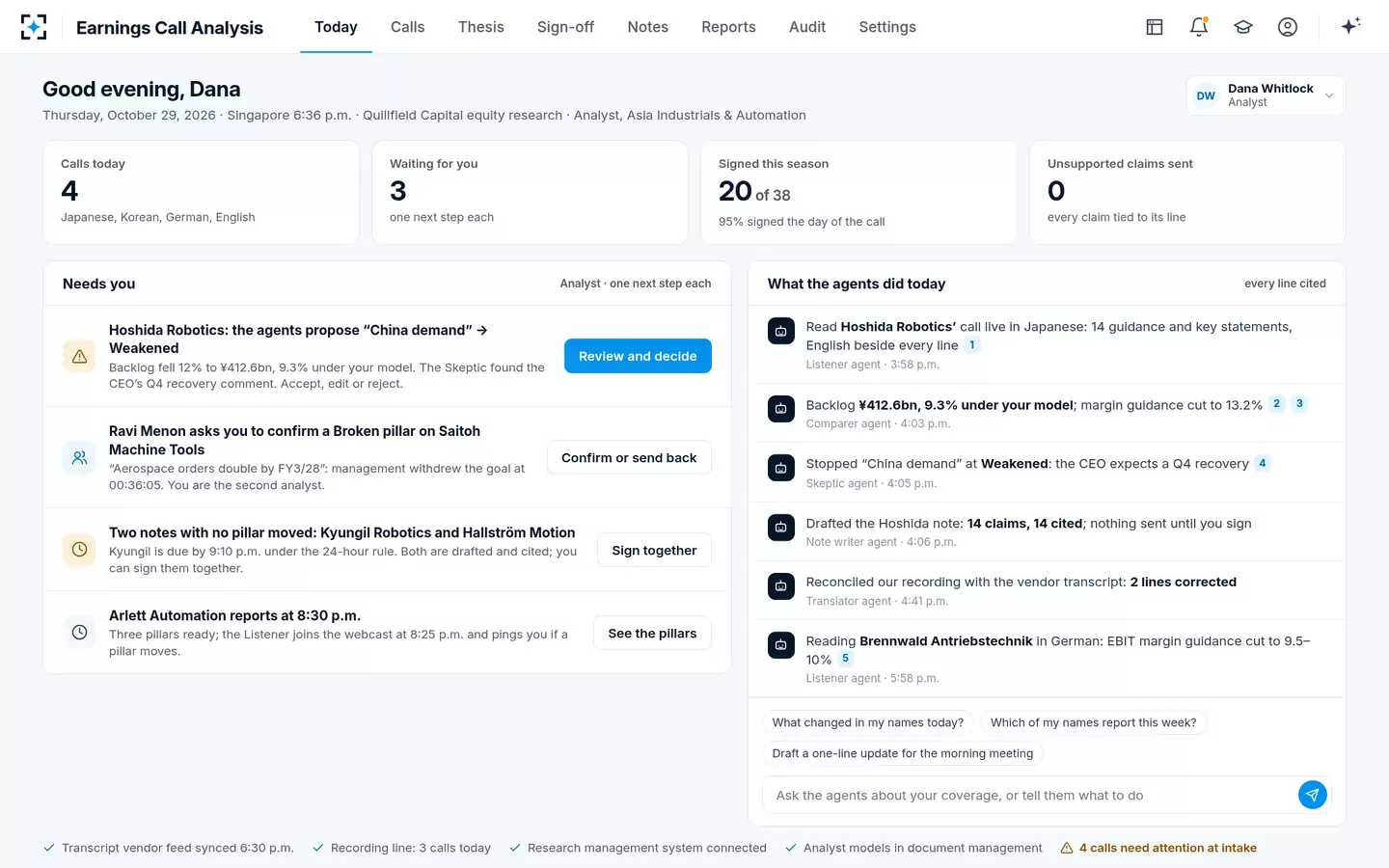
The timestamps in the agents' log show where the hours went on the sample call. The listener finished reading the Hoshida call at 3:58 p.m., the minute it ended; the comparer had checked it against her model by 4:03, the skeptic had searched it for counter-evidence by 4:05, and a draft note with 14 claims, each cited, existed at 4:06. The vendor's English transcript arrived at 4:41. By hand, the evening would have started there.
What happens after an earnings call?
After the call the analyst turns an hour of speech into a decision: re-read the transcript or wait for the English one, update the model and the variance table, write the note, get it reviewed and send it. Our estimate for one covered company, done by hand, is about two hours after the call ends, on top of 45 minutes of preparation and the hour of the call itself. That estimate is ours, not a study's; no regulator or peer-reviewed source we found measures the analyst's side of the evening.
One name's results evening, by hand and with Earnings Call Analysis
- Prepare45 min
- Listen and take notes60 min
- Re-read or wait for English30 min
- Update the model45 min
- Write the note30 min
- Review and send15 min
- Prepare6
- Listen18
- Check lines6
- Approve model6
- Note9
- Sign6
The by-hand lane is not slow because analysts are slow. Each step waits for the one before: the model waits for the transcript, the note waits for the model, the review waits for the note. On an evening with four calls, two of them in other languages, the queue is the cost. The second lane removes the waits rather than the judgement. The draft exists when the call ends; what is left is the analyst reading the lines behind each proposed change and deciding.
Why do stocks move after earnings calls?
Because the call adds information the release did not carry, and some of it takes time to be absorbed. Matsumoto, Pronk and Roelofsen found that both the presentation and the discussion "have incremental information content over the accompanying press release", with the discussion the more informative part (The Accounting Review, 2011). Bowen, Davis and Matsumoto found that conference calls increase analysts' ability to forecast earnings accurately, and that analysts with weaker forecasting records benefit most (The Accounting Review, 2002).
The SEC made the same point about the release itself in its 2026 semiannual proposal: studies find "markets generally react to the information when it is first disclosed, but less so when it is subsequently repeated", so a significant reaction to the earnings release may be followed by none to the 10-Q a week later (Federal Register, May 7, 2026). The first hours are where the information is priced, which is why a research team cares about them.
What is post-earnings announcement drift?
Post-earnings announcement drift is the tendency of prices to keep moving in the direction of an earnings surprise for weeks after the announcement, as if the market under-reacted on the day. It is the measurable cost of slow attention. Kimbrough found that when firms began holding conference calls, two measures of investor under-reaction fell: the drift itself, and the share of the total market reaction that was delayed (The Accounting Review, 2005). The effect was concentrated in the smallest, least traded firms, where drift was most severe.
For a buy-side team the reading is practical. A call does not settle the price on the night; part of the reaction arrives later, and more of it when attention is thin. A note signed the same evening lets portfolio managers act while that part is still to come; a note signed two days later reports on a reaction that has already happened.
Do Friday earnings get less attention? Crowded days and Fridays
Yes, and so do earnings released on crowded days. DellaVigna and Pollet found that "Friday announcements have a 15% lower immediate response and a 70% higher delayed response" (Journal of Finance, 2009). Hirshleifer, Lim and Teoh found that "the immediate price and volume reaction to a firm's earnings surprise is much weaker, and post-announcement drift much stronger, when a greater number of same-day earnings announcements are made by other firms" (Journal of Finance, 2009).
Friday earnings: a smaller reaction on the day, a larger one later
Put the two findings next to an analyst's calendar and the cost of delay has a shape. The days when the market reads earnings most slowly are the days the analyst also has the most calls, because crowding is what slows the market. A research team that falls behind on its busiest evening falls behind exactly when a timely, correct reading is worth most.
How soon after the call should an analyst publish?
No rule sets a deadline for a buy-side note; it is the research team's policy. What a policy can do is make the deadline visible and measured. In Earnings Call Analysis the default is a signed note within 24 hours of the call, after which it escalates to the Director of Research, and a pillar marked Broken must be confirmed by a second analyst within 4 hours; both are settings the Director approves, from 2 to 48 hours.
A season report: calls read, notes signed the same day, the 24-hour rule
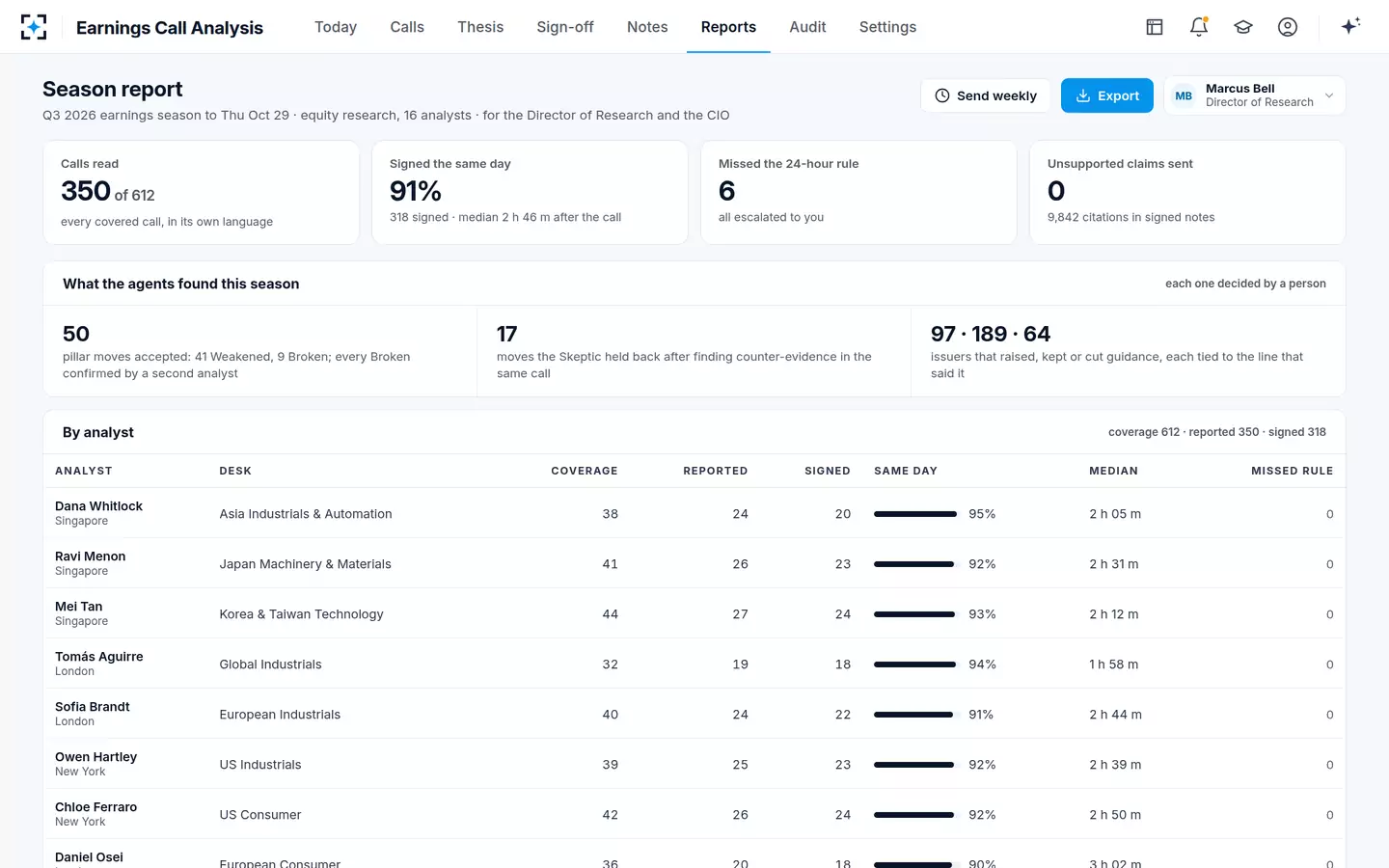
In the sample season, 350 of the 612 covered companies had reported by October 29; 91% of the notes were signed the same day, with a median of 2 hours 46 minutes from the end of the call to signature, and six notes missed the 24-hour rule and were escalated. Those are figures from fictional sample data, not a customer's result. What they show is the kind of measure a director can hold a team to once the time is recorded per note rather than remembered.
What the hours cost, and what a director can change
A director cannot shorten the call or move the calendar. Three things are in reach. The wait for the English transcript can be removed by reading the firm's own recording of the call in the language spoken, with the vendor transcript reconciled when it arrives. The model update can be proposed cell by cell while the call runs, for the analyst to approve rather than type. And the review can be made a step with a clock, instead of an email that waits overnight.
Where the hours after the call go, by hand and in Earnings Call Analysis
By hand: Wait for the vendor; for a call in Japanese, Korean or German, wait longer for the English.
With Earnings Call Analysis: Read live from the firm’s recording line in the language spoken; the vendor transcript is reconciled when it lands and each correction logged.
By hand: Re-key guidance and actuals after the call.
With Earnings Call Analysis: The comparer proposes changes cell by cell, each with its line; nothing is written until the analyst approves.
By hand: Written from notes and memory; sources added if there is time.
With Earnings Call Analysis: Drafted from the decided pillars with every claim cited; an unsourced sentence blocks signing.
By hand: An email to a colleague, answered when they see it.
With Earnings Call Analysis: A Broken pillar goes to a second analyst with a 4-hour clock; the note escalates after 24 hours.
The difference is not that the analyst works faster. It is that the steps which waited on each other now run while the call does, so the evening starts at the decision rather than at the transcript. How to listen to an earnings call covers what to catch during the hour, and why the reader is never the checker covers the review step. The full evening is on the Earnings Call Analysis page.
Questions people ask
How long are earnings calls typically?
About an hour. The 20 calls timed in a 2024 peer-reviewed study averaged 64 minutes, with the shortest at 35 and the longest at 95, and in general the Q&A ran longer than the presentation.
How long is the Q&A part of an earnings call?
In the same study the Q&A averaged 41 minutes against 23 for the presentation, and ranged from 21 to 62 minutes. The average call took 19.3 questions from about nine analysts.
When do earnings calls happen?
Soon after the results release. A US company keeps the call outside its own Form 8-K requirement only if the call begins within 48 hours of a release it has already furnished, is open to the public, and was announced with instructions on how to join.
Why does an earnings call matter if the results are already out?
Because the call adds information the release does not carry. Peer-reviewed research finds both the presentation and the Q&A add information beyond the press release, the Q&A more so, and that calls make analysts' forecasts more accurate.
Is a later note less useful?
Often, because part of the market's reaction to earnings is delayed and that part is larger on Fridays and crowded days. A note signed after the delayed reaction has played out tells a portfolio manager what happened rather than what to do.