Is there a 10-Q for Q4? No. A US public company files a quarterly report on Form 10-Q for each of its first three fiscal quarters only; the form's own instructions say "no report need be filed for the fourth quarter of any fiscal year" (SEC, Form 10-Q, General Instruction A.1). The fourth quarter is covered by the annual report on Form 10-K, which presents the full year, so an analyst who wants Q4 subtracts the nine months reported in the third-quarter 10-Q from the 10-K's annual figures. For revenue that takes a minute. For cash flow, earnings per share and any company that recast its segments or sold a business during the year, the subtraction gives a wrong number unless it is done on the same basis. Botminds' Financial Data Extraction derives missing quarters this way inside the analyst's own model, and every derived cell shows its arithmetic and the pages behind it.
The rules below are the SEC's own, as they stand in October 2026. The worked examples are illustrative arithmetic or, where marked, fictional sample data from the solution.
Four reporting periods, three 10-Qs: what each one prints
Q1
Form 10-Q
The quarter, which is also the year to date
Due 40 or 45 days
Q2
Form 10-Q
The quarter and six months; cash flow for six months only
Due 40 or 45 days
Q3
Form 10-Q
The quarter and nine months; cash flow for nine months only
Due 40 or 45 days
Q4
No 10-Q
The full year, audited, in the 10-K. The quarter is printed nowhere unless the company chooses to
Due 60, 75 or 90 days
Is there a 10-Q for Q4?
No. Exchange Act Rule 13a-13, whose history in the Federal Register runs back to 1977, requires a 10-Q "for each of the first three quarters of each fiscal year" and nothing for the fourth (17 CFR 240.13a-13, eCFR current to October 23, 2026). The 10-K covers the year and carries audited annual statements; the three 10-Qs carry unaudited interim statements that an independent accountant reviews. A company that wants to talk about its fourth quarter does so in its earnings release. The release, though, is furnished on Form 8-K rather than filed, and nothing obliges the company to print every line of a fourth-quarter income statement in it, let alone a fourth-quarter cash flow statement.
Three groups do not file 10-Qs at all. The rule excludes registered investment companies, asset-backed issuers and foreign private issuers, which furnish reports on Form 6-K under Rule 13a-16 instead (Rule 13a-13(b)). For a German or Japanese issuer the question is not where Q4 is, but whether the home market publishes quarters at all, and in what form.
How do you calculate Q4 from a 10-K?
Take each annual figure from the 10-K and subtract the nine-month year-to-date figure for the same line from the third-quarter 10-Q. That works because a 10-Q's income statement must cover both the quarter and the year to date: Regulation S-X requires interim statements of comprehensive income "for the most recent fiscal quarter, for the period between the end of the preceding fiscal year and the end of the most recent fiscal quarter, and for the corresponding periods of the preceding fiscal year" (17 CFR 210.10-01(c)(2)). The nine-month column of the third-quarter 10-Q is therefore always there to subtract.
Deriving a fourth quarter, line by line
| Line | Full year (10-K) | Nine months (Q3 10-Q) | Fourth quarter | How |
|---|---|---|---|---|
| Net sales | 3,201.3 | 2,377.7 | 823.6 | Subtract |
| Operating income | 528.4 | 387.0 | 141.4 | Subtract |
| Cash from operations | 432.9 | 301.7 | 131.2 | Subtract; the quarter is printed nowhere |
| Cash, end of period | 231.4 | 212.3 (at Q3) | 231.4 | Take the year-end balance sheet; never subtract |
| Diluted EPS | $5.46 | $4.02 | Recompute | Q4 net income ÷ Q4 weighted diluted shares |
The method is the same for any line that measures a flow over a period: revenue, costs, operating income, interest, tax, net income, and each line of the cash flow statement. It is wrong for anything measured at a point in time, and for anything that is a ratio of two flows with different weights, which the next sections take in turn.
How do you convert year-to-date cash flow to quarterly?
Subtract the prior year-to-date figure from the current one, for every quarter after the first, because the 10-Q never prints a quarterly cash flow statement. Regulation S-X asks for interim statements of cash flows only "for the period between the end of the preceding fiscal year and the end of the most recent fiscal quarter", and for the same period a year earlier (17 CFR 210.10-01(c)(3)). So the second-quarter 10-Q shows six months, the third shows nine, and the 10-K shows twelve. The second quarter's cash from operations is six months less three; the third is nine less six; the fourth is twelve less nine.
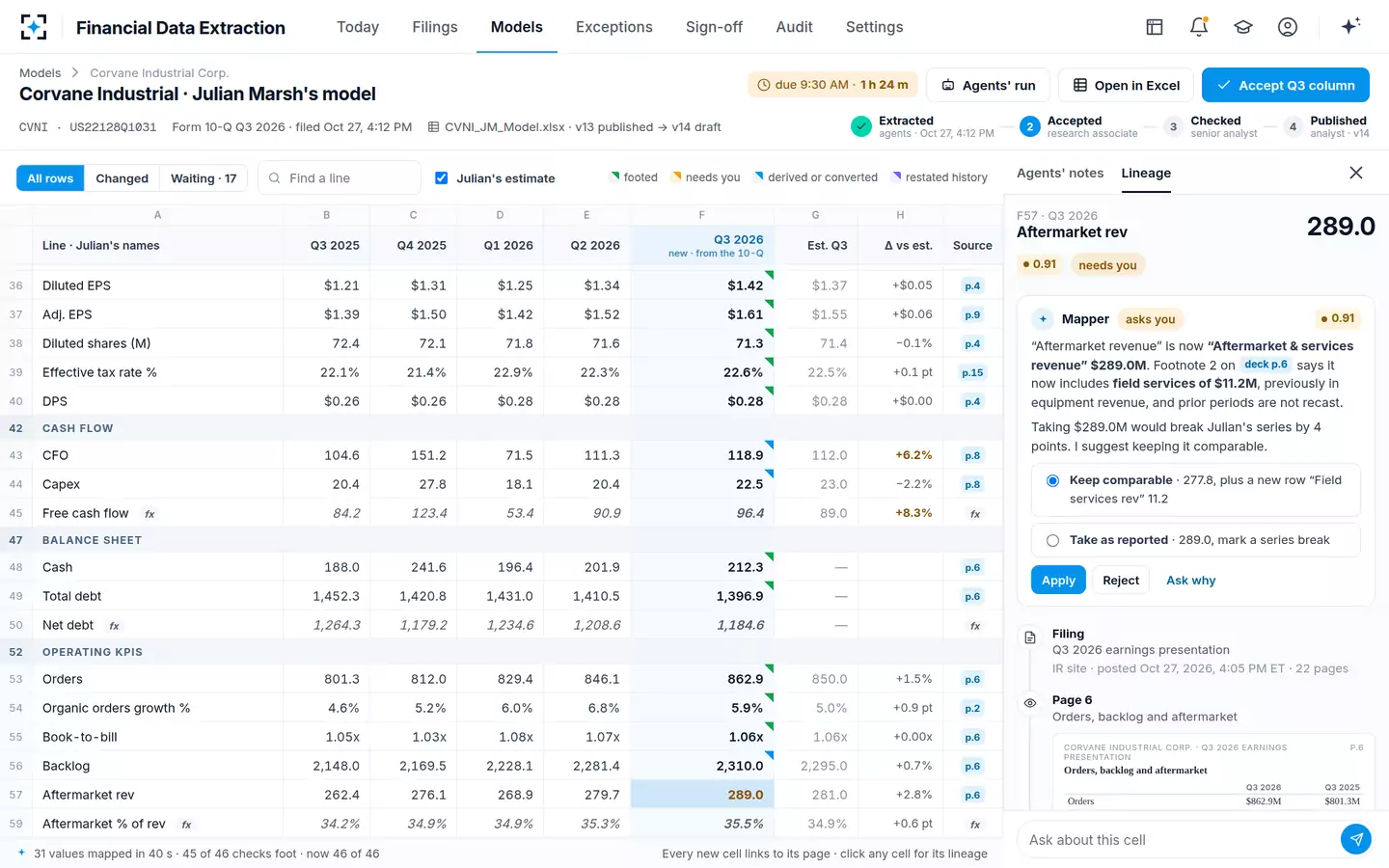
It is one of the checks a research associate runs by hand on every model, because the error is easy to make: the nine-month figure lands in the third-quarter column, cash conversion looks spectacular, and nobody notices until the fourth quarter looks terrible. In Financial Data Extraction's fictional sample, Corvane Industrial's third-quarter 10-Q printed cash from operations of $301.7 million for nine months and $182.8 million for six months a quarter earlier; the agents wrote 118.9 into the analyst's third-quarter column, marked as derived, with "301.7 − 182.8 = 118.9" on the cell. A year-to-date figure is never entered as the quarter.
A derived quarter in Financial Data Extraction, marked as derived
What cannot be derived by subtraction
Some figures look subtractable and are not. The table below is the short list a model builder should keep beside the derivation.
Subtract, take as reported, or recompute: the fourth quarter by line type
What goes wrong if you subtract: A balance is a position at a date, not a flow. Year-end cash less third-quarter cash is a change, not a fourth-quarter balance.
What to do instead: Take the 10-K balance sheet as the fourth-quarter balance. Derive the change only if the model shows movements.
What goes wrong if you subtract: Each period divides by its own weighted average share count, so the year's EPS less nine months' EPS is not the fourth quarter's EPS.
What to do instead: Derive fourth-quarter net income, then divide by fourth-quarter weighted shares, derived from the annual and nine-month counts or from the release.
What goes wrong if you subtract: Subtracting a full-year margin from a nine-month margin gives a meaningless number.
What to do instead: Recompute from the derived numerator and denominator.
What goes wrong if you subtract: Annual adjusted EBITDA less nine months' adjusted EBITDA is a fourth quarter only if the company used one definition all year.
What to do instead: Check the definition in each release first; if it changed, derive from the reconciling items on one basis.
What goes wrong if you subtract: If the 10-K re-presents the year for a segment change or a discontinued operation, the nine months in the 10-Q are on the old basis.
What to do instead: Subtract only figures on the same basis; take the recast nine months when the company publishes them.
The earnings-per-share row catches experienced people. A company that bought back stock through the year has a lower share count in the fourth quarter than the annual average, so its fourth-quarter EPS will differ from the annual EPS less nine-month EPS. The difference may be small, but an earnings surprise is measured in cents.
When the 10-K has moved history: recasts and discontinued operations
If anything changed the basis of reporting between the third-quarter 10-Q and the 10-K, the subtraction mixes two bases. The SEC staff's Financial Reporting Manual names three events that require prior statements to be retrospectively revised when they are reissued: a discontinued operation, a change in reportable segments, and a retrospective change in accounting principle (SEC, Division of Corporation Finance, Financial Reporting Manual, Topic 13). A 10-K that presents a business as discontinued restates the whole year without it. The nine months in the old 10-Q still include it. Subtract one from the other and the fourth quarter absorbs nine months of a business that no longer exists in the numbers.
The fix is to find the nine months on the new basis. A company may file recast statements on Form 8-K, as the staff's manual contemplates, and the following year's 10-Qs must show the prior-year quarters on the new basis; in the manual's words, "Retrospectively revised quarterly information is required in Form 10-Qs filed with post-event financial statements." Until those figures exist, a model should mark the derived fourth quarter as mixed-basis rather than present it as clean. How a recast differs from a restatement, and what each does to a model's history, is worked through separately.
What the SEC dropped in 2021, and what it kept
Until 2021, many larger companies printed selected quarterly data in the 10-K, which put the fourth quarter on paper. Item 302(a) of Regulation S-K required it. In November 2020 the Commission streamlined the item (SEC Release 33-10890), effective February 10, 2021 and mandatory for fiscal years ending on or after August 9, 2021. The release records the trade-off. Supporters said fourth-quarter information "is easily derived, such as by subtracting the third quarter from year-to-date amounts"; the Commission itself noted that the old item "requires separate disclosure of certain fourth quarter information, which is not otherwise required to be disclosed."
For "a significant number of companies, fourth quarter results cannot be derived from annual results."
SEC Investor Advisory Committee, as recorded in SEC Release 33-10890 (2020)
What survived is narrower and more useful to a careful modeler. Item 302(a) now applies when there are retrospective changes to the statements of comprehensive income for any quarter in the two most recent years that are material, individually or together, and then requires an explanation and summarized figures "for each affected quarterly period and the fourth quarter in the affected year" (17 CFR 229.302(a)). Smaller reporting companies and foreign private issuers are exempt. In other words, the fourth quarter is printed for you precisely in the case where your own subtraction would mix bases, and only when the change is material.
What is the 10-Q deadline, and when does the 10-K arrive?
A 10-Q is due 40 days after the quarter ends for large accelerated and accelerated filers and 45 days for all other registrants (Form 10-Q). The 10-K is due 60 days after the year ends for large accelerated filers, 75 days for accelerated filers and 90 days for everyone else (Form 10-K). Filer status turns on public float: a large accelerated filer has $700 million or more held by non-affiliates.
The fourth quarter is the last to be filed: days after the period ends
For a December year-end company, the third-quarter 10-Q is due by early to mid-November and the 10-K by early March at the soonest. Many companies report sooner, in a release, so the fourth quarter often reaches the model from the release weeks before the 10-K and is checked against the 10-K when it is filed. The guide to when companies release earnings follows that calendar in detail.
What happens to Q4 if a company reports semiannually?
Nothing yet, because semiannual reporting is a proposal. On May 5, 2026 the SEC proposed letting companies choose a new Form 10-S instead of the 10-Q; a company that elects it "would file one semiannual report and one annual report for each fiscal year in lieu of three quarterly reports and one annual report" (SEC press release 2026-42). Comments closed on July 6, 2026, and at the end of October 2026 the SEC's rulemaking page still listed only the proposed rule (SEC, File S7-2026-15).
If it is adopted and a company opts in, the derivation changes shape. The model would hold a first half from the Form 10-S and a second half equal to the year less the half, and quarterly figures would exist only where the company chose to publish them, typically in releases. A model that already derives periods from year-to-date figures, and marks each derived cell, needs a new period rule, not a rebuild.
Period derivations in Financial Data Extraction's exceptions, each with its page
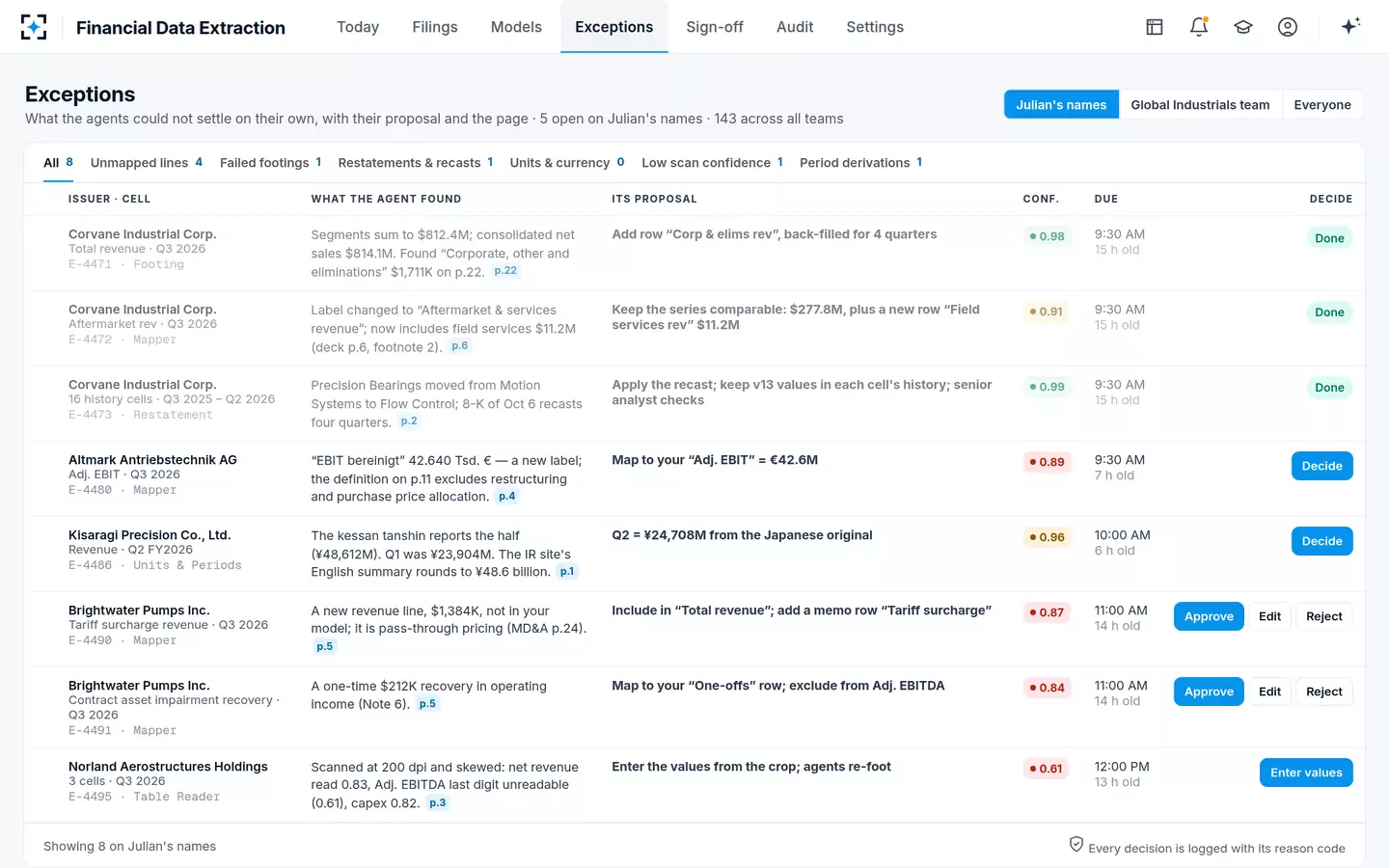
The derivation also matters for every issuer that reports on a different rhythm: a Japanese company's half, a European company that publishes a short trading statement for its first and third quarters, a private issuer whose noteholder report is year to date. Financial Data Extraction keeps each issuer's fiscal calendar and reporting pattern, derives the periods the analyst models, and puts the arithmetic on the cell, so that the SEC's own data sets and a hand calculation can both be checked against it.
Questions people ask
Why is there no fourth-quarter 10-Q?
Because the 10-K covers the full fiscal year, the SEC has never required a separate quarterly report for the fourth quarter. Rule 13a-13 and Form 10-Q's instructions limit the 10-Q to the first three quarters, and the 10-K's audited annual statements take the fourth quarter's place.
Do companies report fourth-quarter results anywhere?
Often in the earnings release furnished on Form 8-K, which many companies use to show the quarter beside the year. Since 2021 the 10-K itself must show fourth-quarter figures only when material retrospective changes affect the quarters of the past two years, under the streamlined Item 302(a).
Is Q4 audited?
The full year is audited and the three 10-Q quarters are reviewed, but a fourth quarter derived by subtraction is neither on its own. The SEC's 2020 release recorded commenters' concern that streamlining Item 302(a) meant investors "losing the benefit of having an auditor review of the fourth quarter".
Can I get Q4 from the SEC's XBRL data?
Not as a filed quarter: the 10-K's tagged statements present annual values. Q4 has to be derived from the annual and nine-month facts, and the frames API slots facts to the nearest calendar quarter, so a company with an unusual fiscal calendar needs care. The SEC notes that company calendars can "change in length from quarter to quarter" (EDGAR APIs).
How do you derive Q2 or Q3 cash flow?
The same way as Q4: current year to date less the previous year to date. Q2 is six months less three, Q3 nine less six. Cash flow is the line most often entered wrongly, because the 10-Q prints only the year-to-date column.