An equity research associate supports one or more research analysts by building and maintaining their financial models, updating them when covered companies report, checking the numbers, and preparing the data, charts and drafts the analyst's research rests on. It is a common entry point into equity research, on the sell side at a broker or on the buy side at an asset manager, and the most consequential part of it is the least visible: on the night a company files, the associate decides whether each new number in the model is right before the analyst, the portfolio managers or clients rely on it. That means more than typing thirty-odd figures. It means catching the segments that do not add up, the cash flow entered for nine months instead of one quarter, the recast history and the relabeled KPI. Botminds' Financial Data Extraction is built around that seat: its agents put each new quarter into the analyst's own model with every number linked to its page, and the associate decides what they could not settle and accepts the column.
The people and companies in the worked example are fictional sample data from the solution. Pay and employment figures are the US Bureau of Labor Statistics', and the rules are FINRA's and the CFA Institute's, as they stand in October 2026.
Five seats around one model, before and with Financial Data Extraction
Today
Types thirty-odd numbers per filing into the analyst's models and checks them by hand, six to ten filings a night in season.
With agents
Opens each model with the column already filled, footed and linked to its pages; decides the few things the agents could not settle, and accepts.
Still theirs: accepting the column, the maker's signature
Today
Owns the models and the estimates; when a portfolio manager asks where a number came from, someone reopens the PDF.
With agents
Gets the model refreshed the day each name files and publishes a checked, numbered version with every cell's page one click away.
Still theirs: the estimates, the definitions and the view
Today
Restated history could be overwritten without a trace; a model could reach portfolio managers before anyone checked it.
With agents
Checks every recast cell and footing decision before a version is shared, old and new values side by side.
Still theirs: the check, which the maker can never do
Today
Owns the line-name dictionary, templates and thresholds, changed by email and memory.
With agents
Sets thresholds and unit rules once; each change is approved by a second administrator and versioned.
Still theirs: the rules
Today
Answers exam requests about who changed which cell, when and from which page.
With agents
Filters every event by person, agent and issuer and exports one evidence pack per model version.
Still theirs: oversight, read only
What does an equity research associate do?
Four things, in rough order of hours: models, data, drafts and checks. The associate keeps each covered company's model current, adding actuals when the company reports and adjusting the structure when the company changes how it reports. They gather data for the analyst's work, from filings, releases, presentations and industry sources. They draft parts of notes and build charts and tables. And they check: that segments foot to the total, that units are right, that history has not moved, that the analyst's estimate and the reported figure are compared like for like.
In earnings season the model work dominates. In the solution's fictional sample, an analyst covers 46 companies in the US, Europe and Japan, and his associate types thirty-odd numbers per filing into his models, six to ten filings a night. The associate's own description of the job is the one most associates would recognise: "I don't want to type numbers. I want to know the three that are wrong."
Equity research associate vs analyst: what is the difference?
The analyst owns the view and the associate owns the numbers under it. The analyst sets estimates, writes the investment case, talks to portfolio managers or clients and to company management, and signs the research. The associate makes sure the model the view rests on is complete and correct, and increasingly does analysis of their own on the way to becoming an analyst.
On the sell side the difference has a regulatory edge. FINRA requires a person associated with a member firm who functions as a research analyst to register as one, and defines a research analyst as "an associated person whose primary job function is to provide investment research", primarily responsible for preparing the substance of an equity research report or whose name appears on one (FINRA Rule 1220(b)(6)). Registrants since October 1, 2018 must pass the Securities Industry Essentials exam and the Research Analyst qualification examinations, the Series 86 and 87, with the analytical Series 86 waivable for candidates who have passed Levels I and II of the CFA examination. An associate whose name goes on reports therefore registers; one who supports in the background may not need to. Buy-side associates at an investment adviser that is not a FINRA member are outside the rule.
A results night, hour by hour
The associate's hardest hours fall after the market closes. A company files its 10-Q and release after 4 PM; the analyst wants the model refreshed for the next morning's meeting. By hand, our estimate is about two hours per company: fetching the documents, typing values under the analyst's line names, footing segments and checking units and periods, handling recasts and relabels, and tracing numbers back for questions. Six filings in a night is a twelve-hour shift.
One company's update: two hours by hand, or a short morning of decisions
- Pulling documents15 min
- Typing values45 min
- Footing, units and periods30 min
- Recasts and relabels15 min
- Tracing for a PM15 min
- Decide8 min
- Wait for checker17 min
- Check, publish11 min
- Published before the 9:30 meeting48 min
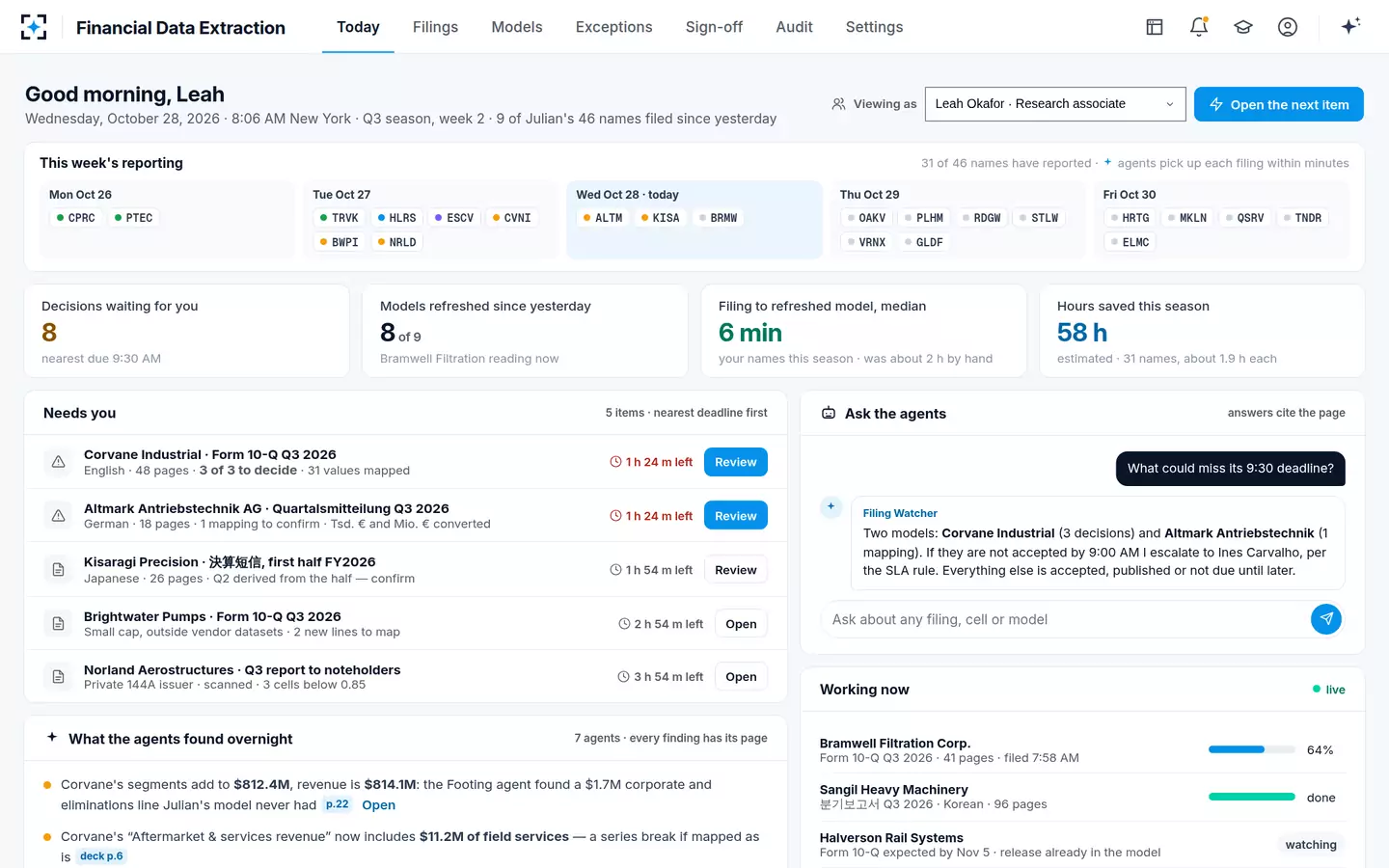
In the sample morning, the associate opens her day at 8:06 to eight decisions, the nearest due at 9:30, with the agents' overnight findings each linked to its page. On Corvane Industrial she adds a corporate and eliminations row the model never had, keeps a redefined aftermarket line comparable, and accepts the column at 8:14: 33 values, 46 of 46 checks footing, her name recorded as the maker. A different person, a senior analyst, checks the recast history and the footing decision at 8:31, and the analyst publishes version 14 at 8:42, after the restricted list is checked.
The associate's morning in Financial Data Extraction: what needs her, and what the agents found
What skills does an equity research associate need?
Accounting fluency first, then modeling, then judgement about what does not look right. The associate has to read a 10-Q the way its preparers wrote it: which statement shows the quarter and which only the year to date, where the segment note reconciles to the total, what a non-GAAP reconciliation adds back, and when a change in comparatives is a recast and when it is a correction. They need to build and audit spreadsheets fluently. And they need the instinct, built quarter by quarter, that a number which moved for no reason has a reason somewhere in the filing.
Skills an equity research associate is hired for, and checked on
- Reading the three statements and the notes
Especially the segment note, the cash flow statement's periods and the non-GAAP reconciliation.
- Building and auditing models in Excel
Formulas that survive a new row; links that can be traced.
- Knowing when history moved
Recasts for segments or discontinued operations versus restatements of errors.
- Footing everything
Segments to the total, subtotals to their parts, adjusted measures to the reconciliation.
- Reading foreign and scanned documents
Local number formats, scale words, and the discipline not to guess a digit.
- Writing for the analyst and the PM
Short, sourced notes on what changed and why.
Recasts are the skill that separates a good associate from a fast one, because a recast moves history without changing totals and passes every footing check. The guide to recasts and restatements works through one cell by cell.
How much do equity research associates earn, and how many hours do they work?
There is no government series for research associates; the BLS counts them with financial analysts. For that occupation, the BLS reports a 2025 median of $103,570 a year, or $49.79 an hour, across 443,100 jobs, and projects employment to grow 7% from 2025 to 2035; a bachelor's degree is the typical entry requirement (BLS Occupational Outlook Handbook, financial analysts). The largest employer group for financial and investment analysts is the securities and investment industry, with 24% of the jobs.
Financial analysts, the occupation research associates belong to
$103,570
median annual pay, 2025
443,100
jobs in 2025, including financial risk specialists
7%
projected employment growth, 2025 to 2035
24%
of financial and investment analysts work in securities and investments
On hours, the BLS says only that "Most financial analysts work full time, and some work more than 40 hours per week." Research associates know the seasonal truth behind that sentence: the hours bunch into the weeks when covered companies report, and into the evenings after they do. The guide to earnings season for research teams shows how tightly those weeks are packed.
Where the associate's time goes, before and after
The seat shrinks in hours and changes in kind. By our estimate, typing is the largest single block of an associate's two hours per company; with the agents, the remaining minutes are mostly spent on the checks that need judgement. The split below uses Botminds' estimates for both, the same ones behind the solution's sample season, and should be replaced by a team's own timing.
An associate's time per company per quarter: what it is spent on
By hand, about 120 minutes
- Pulling documents · 12.5%
- Typing values · 37.5%
- Footing, units, periods · 25%
- Recasts, relabels · 12.5%
- Tracing · 12.5%
With the agents, about 8 minutes
- Pulling · 7.7%
- Values and line names · 23.1%
- Footing, units, periods · 38.5%
- Recasts, relabels · 23.1%
- Tracing · 7.6%
Footing, periods, recasts and relabels rise from three-eighths of the associate's time to more than three-fifths. That is the seat this guide's title describes: fewer hours, nearly all of them spent deciding whether the model is right.
The checks only an associate catches
Some errors pass every automated check and are caught only by someone who knows the model. A recast that moves revenue between segments without changing the total. A KPI renamed with a widened definition in a slide footnote. An analyst's adjusted EBITDA that adds back restructuring while the company's, or a vendor's, does not. A fourth quarter derived from a nine-month figure on a basis the 10-K has since changed. These are the cases where the associate's knowledge of the analyst's definitions is the control.
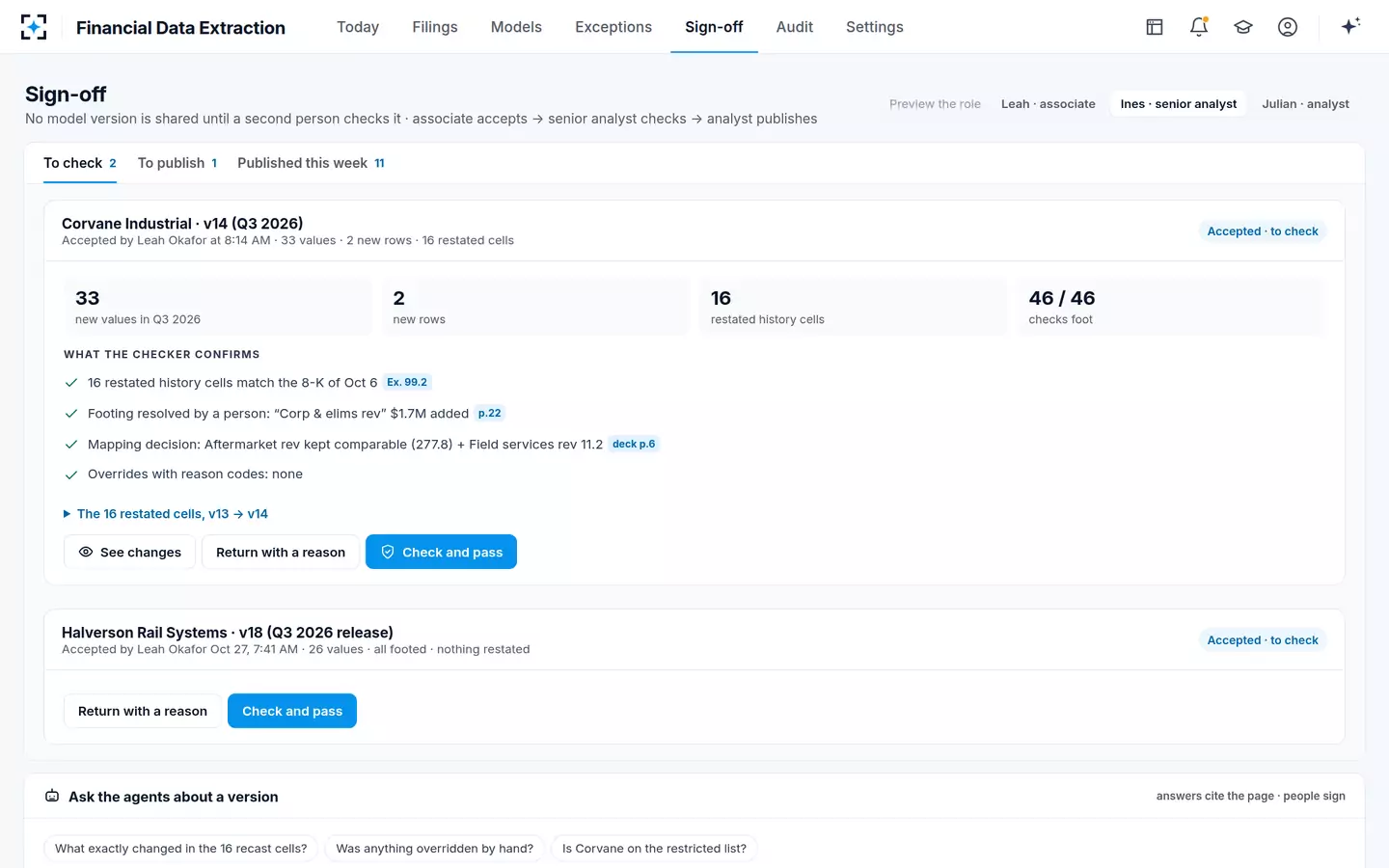
The design question for any tool is whether it leaves those cases with the associate or hides them. In Financial Data Extraction the agents surface each one with its page and a proposal, and refuse to settle it alone: the Mapper always asks on a changed definition, Footing never plugs, the Restatement agent never overwrites published history. The associate's decision is recorded as the maker's, and a senior analyst checks it, because "You accepted this column, so you cannot check it."
Maker and checker in Financial Data Extraction: the associate accepts, a senior analyst checks
Will AI replace research associates?
The evidence so far supports a different seat, not an empty one. A peer-reviewed study that pitted an AI analyst against human analysts found the machine's advantage shrank as analysts gained alternative data and AI tools of their own, and its authors argue for machine plus human rather than replacement (Cao, Jiang, Wang and Yang, NBER Working Paper 28800, published in the Journal of Financial Economics, 2024). The typing is what goes. In the solution's sample season, the median time from a filing to a refreshed model was six minutes, against about two hours by hand; what remains for the associate is deciding what the agents could not settle and putting a name to the column.
That remaining work is also the record. The CFA Institute's Standards of Practice treat the research file as the firm's: "records created as part of members' and candidates' professional activity on behalf of their employer are the property of the firm" (CFA Institute, Standard V(C)). An associate's decisions, each with its page and reason, become that file rather than living in a workbook only they understand. The guide to AI financial modeling in the analyst's own model covers how the agents write into the model without taking the associate's or the analyst's decisions.
Questions people ask
Is equity research associate an entry-level job?
It is a common first seat in equity research. The BLS lists a bachelor's degree as the typical entry requirement for financial analysts, the occupation associates are counted in, and many associates work toward the analyst seat.
Do equity research associates need a license?
On the sell side, a person who functions as a research analyst at a FINRA member firm must register and pass the SIE and the research analyst examinations, the Series 86 and 87. Associates who do not prepare the substance of reports or appear on them may not need to; buy-side associates at investment advisers that are not FINRA members are outside the rule.
What is the difference between a buy-side and sell-side research associate?
A sell-side associate supports an analyst whose research is published to clients of a broker-dealer, under FINRA's research rules. A buy-side associate supports an analyst whose research serves the firm's own portfolio managers, and works under the investment adviser's own policies and recordkeeping.
How many companies does an equity research associate cover?
There is no standard figure; it depends on the analyst's coverage and the team. In the solution's fictional sample, one associate supports an analyst covering 46 companies across the US, Europe and Japan, and faces six to ten filings a night at the height of the season.
Will AI tools make associates' checks unnecessary?
No. Agents can read, convert and foot, but a recast, a redefined KPI or a definition the analyst disagrees with needs someone who knows the model, and the maker-checker control needs two people. The work moves from typing to deciding.