AI financial modeling means using artificial intelligence to build or maintain financial models, and for a research team the useful version is the second: keeping each analyst's existing Excel model current as companies report, rather than generating a new model from a template. An analyst's model encodes years of decisions — which lines to track, how to define adjusted EBITDA, where segments are split, which formulas drive the forecast — and a tool that replaces it with a standard layout throws that away. The approach that works writes each new quarter's actuals into the analyst's own workbook, under the analyst's own line names, leaves every formula and forecast alone, and keeps a numbered version that a second person checks before anyone else sees it. Botminds' Financial Data Extraction does this: seven agents read each filing, map every figure to the analyst's lines and foot every subtotal, an Excel add-in writes the accepted column with a link and a note on each cell, and an associate, a senior analyst and the analyst accept, check and publish.
The examples are fictional sample data from the solution. The research and regulatory sources are linked where they appear.
In a live model, what the agents may write, and what they never touch
The agents may
- Write the new quarter's actuals into a new draft column, under the analyst's line names
- Propose a new row, back-filled, when a reconciling line is found
- Propose recast history, with the old values kept in each cell's history
- Put a link, a note and a status corner on every cell it writes
- Prepare the version diff and the evidence for the checker
The agents never
- Overwrite the analyst's formula cells or forecasts
- Add or remove a row without a person
- Overwrite published history
- Plug a difference to make a total foot
- Accept, check or publish a version
What is AI financial modeling?
The phrase covers two different jobs. One is generating a model: given a company or a prompt, produce a three-statement template with history filled in and a forecast scaffold. The other is maintaining a model: take the analyst's existing workbook and, each time the company reports, add the new period's actuals, catch recasts and relabels, and leave the analyst's judgement where it is. Most published demonstrations show the first. Most of a research team's hours go to the second, quarter after quarter, across every name it covers.
Financial Data Extraction does only the second. It does not build a new model from a template; it keeps the analyst's model current. The analyst still owns the estimates, the definitions and the view.
Can AI build a financial model?
It can build a scaffold: lines, history and formulas in a standard shape. What it cannot supply is what makes an analyst's model worth keeping, the institutional knowledge of how this company's numbers behave and what this analyst believes. The best-known peer-reviewed study of AI against analysts makes the division explicit. Cao, Jiang, Wang and Yang built an AI analyst that beat most human analysts in stock price forecasts, then found that its edge narrowed as analysts gained alternative data and AI tools of their own, and that people and machine together forecast best; they read their results as complementing analysts rather than displacing them (NBER Working Paper 28800; published in the Journal of Financial Economics, 2024).
For a research team, the practical consequence is to point AI at the parts of the model that are mechanical and checkable, the actuals, and keep people on the parts that are judgement, the forecasts and definitions. A generated model also inherits a vendor's or a prompt's definitions of every adjusted line, which is the problem the KPI extraction guide traces on a single relabeled metric.
A generated template model and the analyst's own model, kept current
AI-generated template: The template's standard items
The analyst's own model, updated by agents: The analyst's own, learned from the workbook and every decision
AI-generated template: A standard definition, the same for every company
The analyst's own model, updated by agents: The analyst's definition, tied to the company's reconciliation
AI-generated template: Generated, to be rebuilt by the analyst
The analyst's own model, updated by agents: Untouched; formula cells are never overwritten
AI-generated template: Whatever the source holds today
The analyst's own model, updated by agents: Versioned; recasts proposed with old values kept
AI-generated template: Analysts rebuild their views in a new layout
The analyst's own model, updated by agents: Analysts keep working in the model they know
Can AI update an Excel financial model without breaking it?
Yes, if it is constrained to write only what a person accepted, only into cells that hold actuals, and never into formulas. A financial model breaks in predictable ways when software writes into it: a hard-coded number overwrites a formula, a row is inserted and every reference below shifts, a recast silently replaces published history, or a column is written in the wrong units. Each has a rule that prevents it, and each rule is written into the agents' limits in the solution.
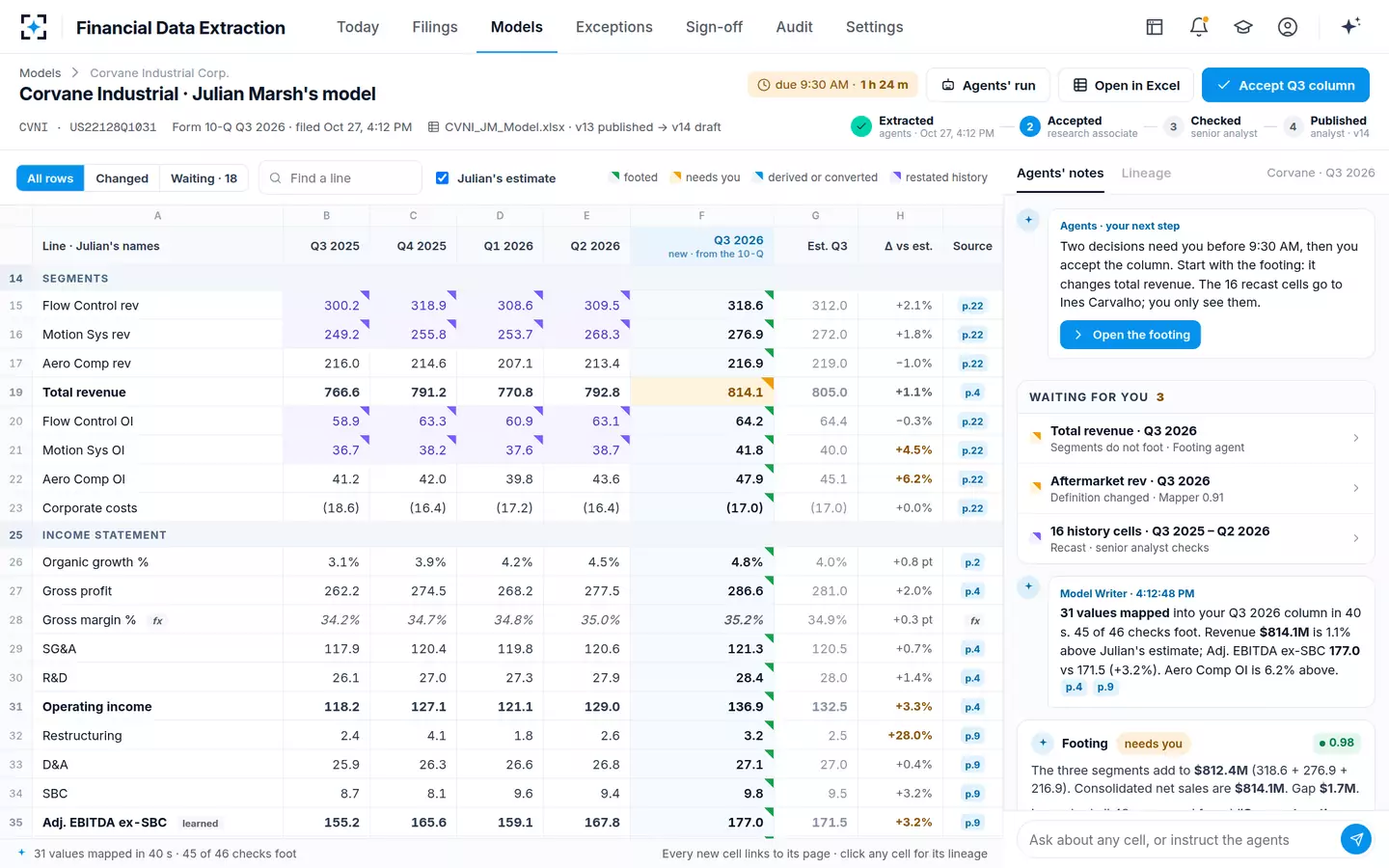
The agents also mark what they wrote. Every new cell carries a colored corner saying whether it footed, needs a person, was derived or converted, or is restated history, and a link to its lineage. In the fictional sample, Corvane Industrial's third-quarter column arrives in the analyst's own workbook, CVNI_JM_Model.xlsx, beside four quarters of history, the analyst's estimate and the difference: revenue $814.1 million, 1.1% above his $805.0 million; adjusted EBITDA ex-SBC 177.0 against 171.5. The gross margin row, a formula, shows the "fx" mark and is not written.
A new quarter in the analyst's own grid, written by Financial Data Extraction
Will AI replace financial modeling?
The evidence points to a division of labour rather than a replacement. The man-plus-machine finding above is one strand. Regulators describe the same arrangement in practice: in the Bank of England and the FCA's 2026 survey of UK financial firms, 80% of respondents reported AI agents in production that provide decision support, recommending actions for people to decide and carry out, and even counting plans for the next twelve months no more than 9% expected agents to approve or decline customer outcomes, execute trades, or change limits, thresholds and controls (Bank of England and FCA, Artificial intelligence in UK financial services, 2026).
FINRA's 2026 oversight report names a risk that bears directly on writing into models: an agent can act outside the scope and authority its user meant to give it (FINRA, 2026 Annual Regulatory Oversight Report; the regulators' other agent risks are set against a research workflow in AI earnings call analysis: why the reader is never the checker). In a model, scope is concrete: which cells, which rows, which versions. The limits in the figure above are that scope, written down. What changes is the analyst's and associate's week, which moves from typing to deciding, the shift followed in the guide to the equity research associate's seat.
The go-live plan: four weeks from workbook to first published version
Going live is a sequence of proofs, each on the team's own material, before the agents write anything into a live model. The solution's first-time setup already follows it: connect a workbook, review the mapping, pick the coverage, set the checks and run a trial on last quarter against what the team typed. The four-week plan below is our suggestion for one analyst's coverage; a team adds analysts in waves once the first has passed.
Going live with AI financial modeling, one analyst's coverage at a time
- Connect the workbook and sources; review the line mappingWeek 1
- Replay last quarter against what the team typed, with seeded errorsWeek 2
- Run in parallel on live filings; people still typeWeek 3
- Cut over: agents draft, people accept, check and publishWeek 4
Week one is mostly reading the analyst's model. The Mapper proposes how each issuer's labels map to the analyst's lines, and the analyst or associate confirms or corrects the first mappings; every correction teaches it. Week two is the replay: last quarter's filings run through the agents and the output is compared, line by line, with what the team typed, plus planted errors that the team knows the answers to. Week three runs on live filings while people still do the work by hand, so differences can be examined without risk. Week four switches the order: the agents draft, people decide.
Timing matters more than the calendar. A team that starts in the middle of earnings season has no slack for parallel running; the weeks between seasons are when to start. Thresholds, footing tolerance and the people allowed to accept, check and publish are settings, each changed only with a second administrator's approval.
Three decisions the model still needs a person for
Even with the actuals written for them, an analyst's model needs people for the changes that alter its meaning. In the solution's fictional sample quarter, three came up on one company in one morning, and each shows where the line sits between what the agents do and what people decide.
A line the model never had. Corvane Industrial's three segments added to $812.4 million against net sales of $814.1 million. The Footing agent searched the 48-page filing and found a "Corporate, other and eliminations" line of $1,711 thousand in the segment note on page 22, which the analyst's model had never carried; the four prior quarters had been short by 1.2, 1.9, 1.4 and 1.6 for the same reason. It proposed a new row, back-filled for four quarters, and did not plug the gap. Adding a row changes the model's structure, so the associate decided.
A metric whose meaning moved. The deck widened "Aftermarket revenue" to include $11.2 million of field services. Keeping the series comparable at $277.8 million with a new field services row, or taking $289.0 million and marking a break, is a choice about what the analyst's series means, so the agents set out both options and the associate chose.
A definition the analyst might change. Asked to treat restructuring as recurring for this company, the agents worked out the consequence before doing anything: adjusted EBITDA ex-SBC would stop adding back restructuring, the third quarter would become 173.8 instead of 177.0, and the four prior quarters would change too. Because that changes the analyst's own definition, it needs the analyst's approval. That is the right default for any AI working in someone else's model: it can do the arithmetic of a change instantly, and it still asks the owner.
How do you keep version history in a financial model?
Number every published version, keep the diff, and never overwrite a published value in place. A saved-over workbook loses the answer to "what did the model say last month, and why did it change?", which is the question both a portfolio manager and an examiner ask. The CFA Institute's Standards of Practice list "computer-based model input parameters" and model outputs among the records that support an investment recommendation (CFA Institute, Standard V(C) Record Retention), and advisers' books-and-records rule requires written communications relating to recommendations to be kept for five years (17 CFR 275.204-2).
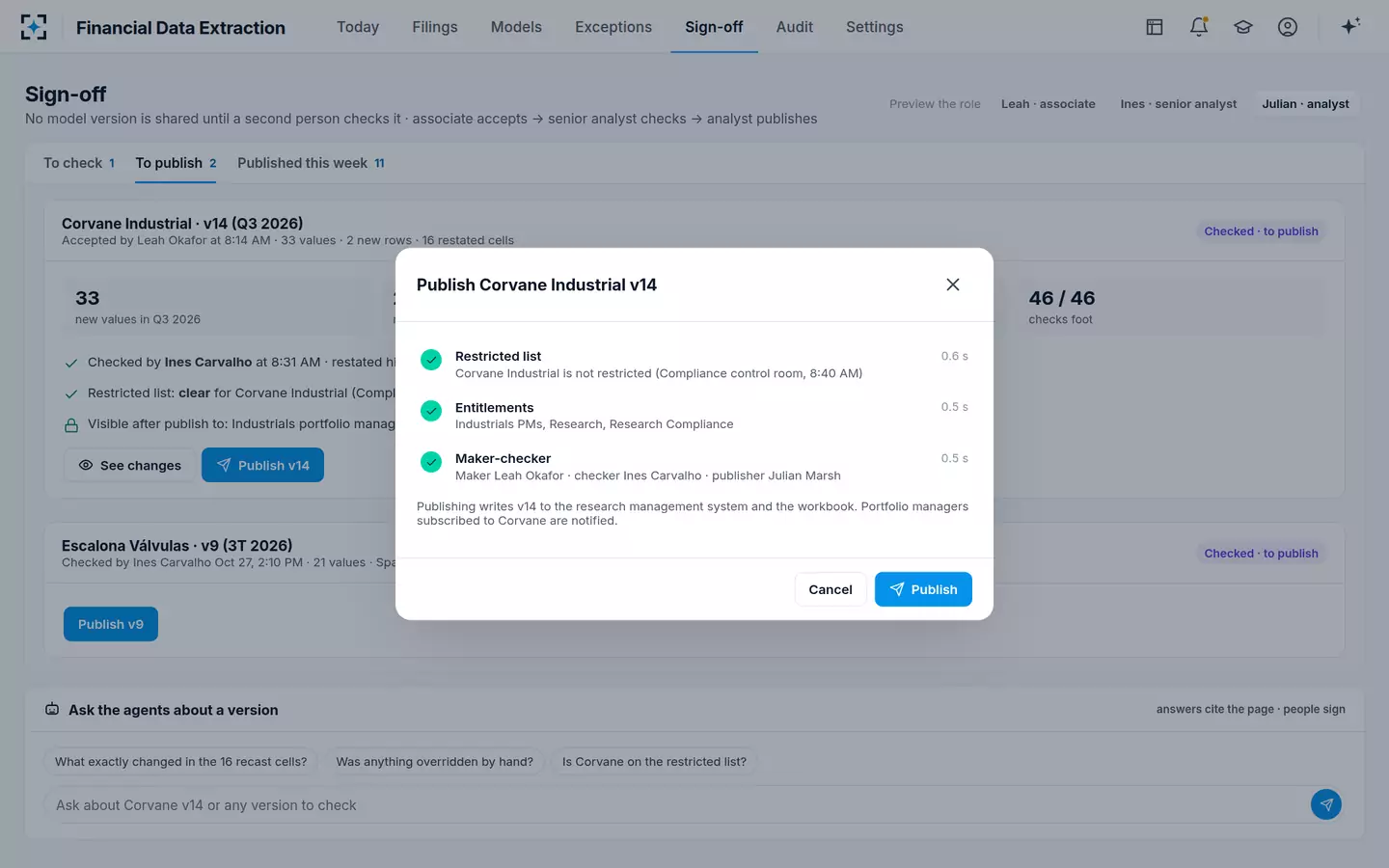
In the solution, each publish creates a numbered version: in the sample, version 14 goes to the research management system and the analyst's workbook after the restricted list and entitlements are checked and maker-checker is confirmed, and portfolio managers who follow the company are notified. The version diff, the lineage of every cell, the page images, the decisions and the agent versions make up an evidence pack research compliance can export for that version.
Publishing a checked version of the analyst's model in Financial Data Extraction
What to check before it writes to a live model
Before any AI writes into an analyst's live workbook
- It writes drafts, never published versions
A person accepts each column; a different person checks; the analyst publishes.
- Formula and forecast cells are off limits
Ask for a demonstration on a model with dense formulas, not a flat table.
- Rows change only with a person
A new reconciling line or KPI is a proposal, back-filled, never an insertion on its own.
- Every written cell links to its page
The analyst should answer a PM's question in one click.
- Old values survive every change
Recasts and corrections keep the published value in the cell's history.
- The line map is the analyst's
It learns from each analyst's decisions; it does not impose a house template.
- It passed a replay of last quarter
On your names, with planted errors, before it wrote anything live.
- Third-party output is diligenced
CFA Institute Standard V(A) expects reasonable and diligent efforts to determine that third-party research is sound; treat a tool's output the same way.
The same principle, keep the template the analyst or credit officer already uses and fill it, applies in lending; keeping a bank's spreading template covers it for credit memos. For the cost side of the decision, see what financial data extraction software really costs.
Questions people ask
Can AI build financial models in Excel?
It can generate a template with history and formulas. For research teams, the more valuable use is maintaining the analyst's existing model: writing each new quarter's actuals under the analyst's own line names, without touching formulas or forecasts, with each cell linked to its page.
Does AI change my forecast cells?
It should not, and in Financial Data Extraction it cannot: the agents never overwrite the analyst's formula cells and write only what a person accepted. Forecasts and estimates remain the analyst's; the new column is shown beside the estimate with the difference.
What is the best AI financial modeling tool?
For a research team, the one that keeps your models and definitions, links every value to its page, never writes formulas, versions every publish and passes a replay of last quarter with planted errors. Choose on those tests rather than on demonstrations of generated templates.
Is AI financial modeling accurate?
The model is only as accurate as the actuals in it, so test the extraction: plant scale, period, recast, segment, sign and relabel errors in last quarter's filings and count what the system catches. Footing checks and a second person's review catch most of what reading alone misses.
How long does it take to go live?
Our suggested plan is about four weeks per analyst's coverage: connect and map, replay last quarter, run in parallel, then cut over. Start between earnings seasons, when there is time to run in parallel.