To recast financial statements is to present past periods again on the basis a company uses today: when it reorganizes its reportable segments, classifies a business as discontinued, or adopts an accounting principle retrospectively, the earlier quarters and years are revised so that they compare with the new ones. A recast does not say the old numbers were wrong. A restatement does: it corrects an error in financial statements already issued, either by reissuing them (a "Big R" restatement) or by correcting the comparatives in the next report (a "little r" revision restatement). For an analyst both events rewrite history in the model, but they mean different things, arrive in different filings and deserve different notes. Botminds' Financial Data Extraction compares every prior period a new filing re-reports against the published model, proposes the update with the old value kept, and sends it to a senior analyst before any model version is shared.
The rules and staff guidance below are the SEC's, as they stand in October 2026. The worked example is fictional sample data from the solution.
Recast and restatement: two reasons the past changes
Recast (retrospective revision): The company changed how it reports: its segments, a business held for sale or discontinued, an accounting principle applied retrospectively.
Restatement (error correction): The previously issued statements contained an error.
Recast (retrospective revision): No. They were right on the old basis.
Restatement (error correction): Yes. They should not have been reported as they were.
Recast (retrospective revision): Revised comparatives in later 10-Qs and the 10-K; sometimes recast statements filed on Form 8-K.
Restatement (error correction): Big R: an Item 4.02 non-reliance notice on Form 8-K and reissued statements. Little r: corrected comparatives, disclosed, in the next report.
Recast (retrospective revision): Often none at consolidated level: a segment recast moves revenue between segments.
Restatement (error correction): Changes the totals the error touched.
Recast (retrospective revision): The new basis, the old values, and the filing that moved them.
Restatement (error correction): The corrected values, the old values, the kind of restatement and the filing; a flag on every ratio built on them.
What does it mean to recast financial statements?
A recast re-presents prior periods so that every period in a filing is on the same basis. The SEC staff's Financial Reporting Manual, the Division of Corporation Finance's guide to its own practice, puts segment changes this way: "If management changes the structure of its internal organization in a manner that causes the composition of its reportable segments to change, the corresponding information for prior periods should be retrospectively revised if practicable in accordance with ASC 280" (SEC, Financial Reporting Manual, 13310.1). The same topic lists discontinued operations and retrospective changes in accounting principle as the other common triggers. The manual is staff guidance, not a rule; it describes how the staff applies the rules.
The word in everyday use is looser than the staff's "retrospectively revised", and analysts use "recast" for any revision of history that is not a correction. That looseness is harmless as long as the model records the reason. A recast segment series is comparable across periods again; an unrecast one compares two different businesses.
Recast vs restatement: what is the difference?
The difference is whether anything was wrong. A recast changes the presentation of correct numbers; a restatement corrects wrong ones. The SEC's Acting Chief Accountant spelled out the second case in 2022: when an error is material to previously issued statements, "the error must be corrected by restating the prior-period financial statements" (Paul Munter, SEC, March 9, 2022). The same statement makes the point a model needs: both the reissuance method and the revision method "constitute restatements to correct errors in previously-issued financial statements".
The staff manual keeps the two apart even when they arrive together. A company that amends its 10-K to correct a material error may also reflect later segment or accounting changes, but then "the financial statements in the Form 10-K/A should clearly distinguish the effects of the material error from those of any subsequent accounting change" (Financial Reporting Manual, 13110.6). A model should do the same. A cell that moved because of a recast and a cell that moved because of an error tell a portfolio manager two different stories.
What is a little r restatement, and what is a Big R?
Both correct errors; they differ in whether the error was material to the statements already issued. If it was, the company restates those statements and reissues them, a Big R restatement. If the error was not material to the old statements but correcting it, or leaving it, would be material to the current period, the company corrects the comparative figures in its current report and discloses the error, a little r or revision restatement (SEC OCA, 2022).
Big R, little r and a recast, side by side
| Big R restatement | Little r restatement | Recast | |
|---|---|---|---|
| Trigger | An error material to previously issued statements | An error immaterial to the old statements but material to the current period if left or corrected there | A change in segments, a discontinued operation or a retrospective accounting change |
| Old statements | No longer to be relied on; reissued | Left in place; comparatives corrected in the current report | Correct on the old basis |
| Form 8-K | Item 4.02 non-reliance notice | None required for the correction itself | None required; recast statements may be filed under Item 8.01 |
| What an analyst sees first | The 8-K notice, then amended filings | A note in the next 10-Q or 10-K, and changed comparatives | Changed comparatives in the next report, or a recast 8-K |
Which filing tells you: an Item 4.02 notice, a recast 8-K, or a quiet revision
A Big R restatement announces itself. Form 8-K Item 4.02 requires a company to disclose when its board, a board committee or authorized officers conclude that previously issued financial statements "should no longer be relied upon because of an error in such financial statements", with the date of that conclusion, the periods affected and a brief description of the facts (SEC, Form 8-K, Item 4.02). Like most 8-K items, it is due within four business days.
A recast may or may not have its own filing. Once statements covering the new basis have been filed, the staff manual says a company "may elect (if reissuance is not required) to file under cover of Form 8-K (Item 8.01) audited retrospectively revised financial statements for the pre-event periods" (13110.5). Otherwise the revised history simply appears as comparatives in the next 10-Q or 10-K. In the interim statements, Regulation S-X adds a disclosure duty for a "material retroactive prior period adjustment" (17 CFR 210.10-01(b)(7)), and Item 302(a) of Regulation S-K requires quarterly figures in the 10-K when material retrospective changes affect the past two years' quarters (17 CFR 229.302(a)).
A little r restatement is the quietest of the three. It is disclosed in the notes of the next report, with the comparatives already corrected. An analyst who updates only the new column never sees it. The comparison that catches it is mechanical: every prior period the new filing prints, against the value the model holds for that period.
How a segment recast moves a model, cell by cell
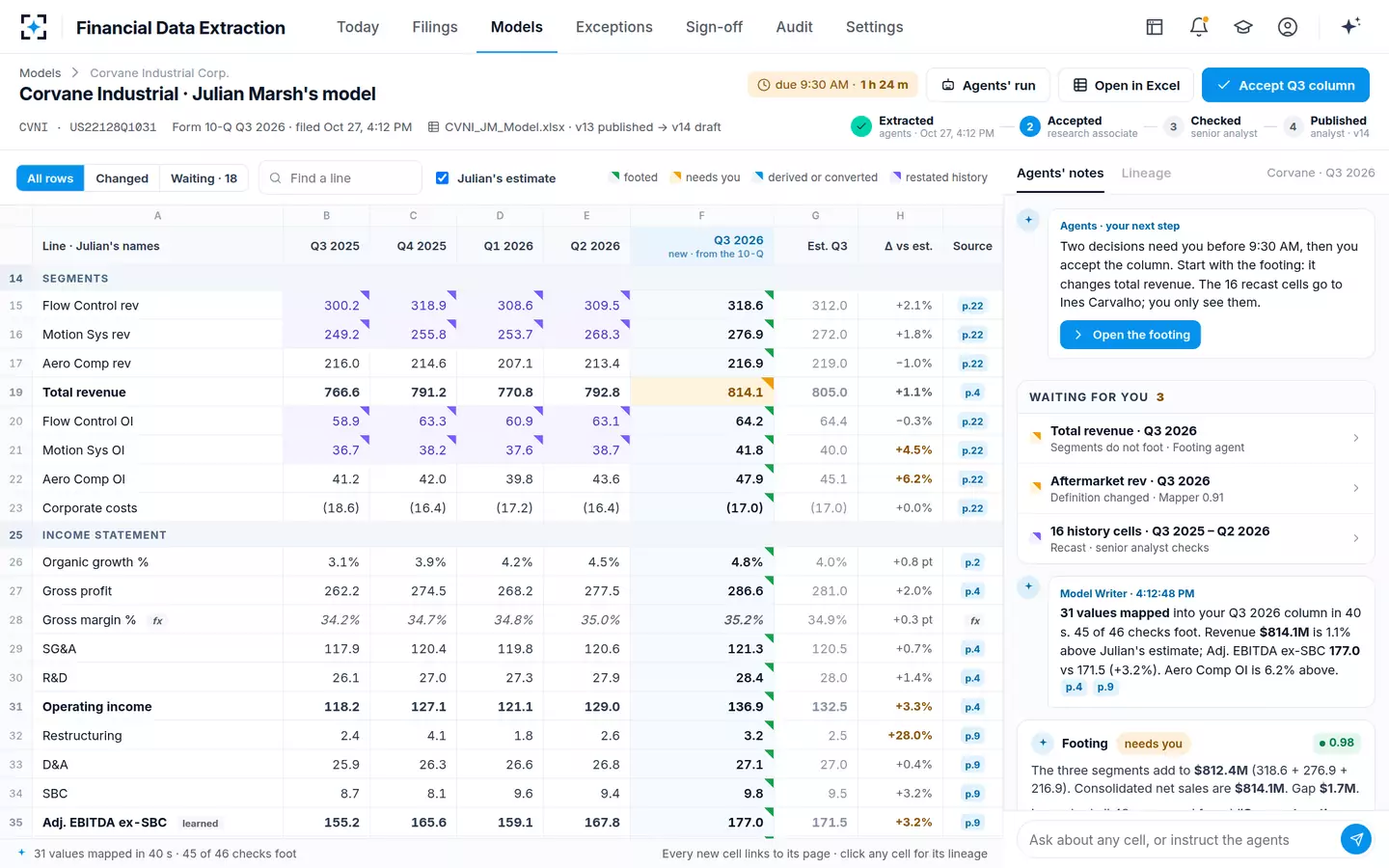
Take a sample company as it runs through Financial Data Extraction. Corvane Industrial, a fictional large accelerated filer with three segments, moved its Precision Bearings business from Motion Systems to Flow Control, and on October 6 filed an 8-K whose Exhibit 99.2 recast four quarters. In the third quarter of 2025, Flow Control revenue went from $287.4 million to $300.2 million and Motion Systems from $262.0 million to $249.2 million. The two segments still add to $549.4 million, which is why a model that checks only totals would never notice.
One recast, one quarter: what moved and what did not
| Line | Before (model v13) | After (8-K of October 6) | Change |
|---|---|---|---|
| Flow Control revenue, Q3 2025 | 287.4 | 300.2 | +12.8 |
| Motion Systems revenue, Q3 2025 | 262.0 | 249.2 | −12.8 |
| The two segments together | 549.4 | 549.4 | 0.0 |
| Cells re-reported across four quarters | — | 16 | Revenue and operating income, two segments, four quarters |
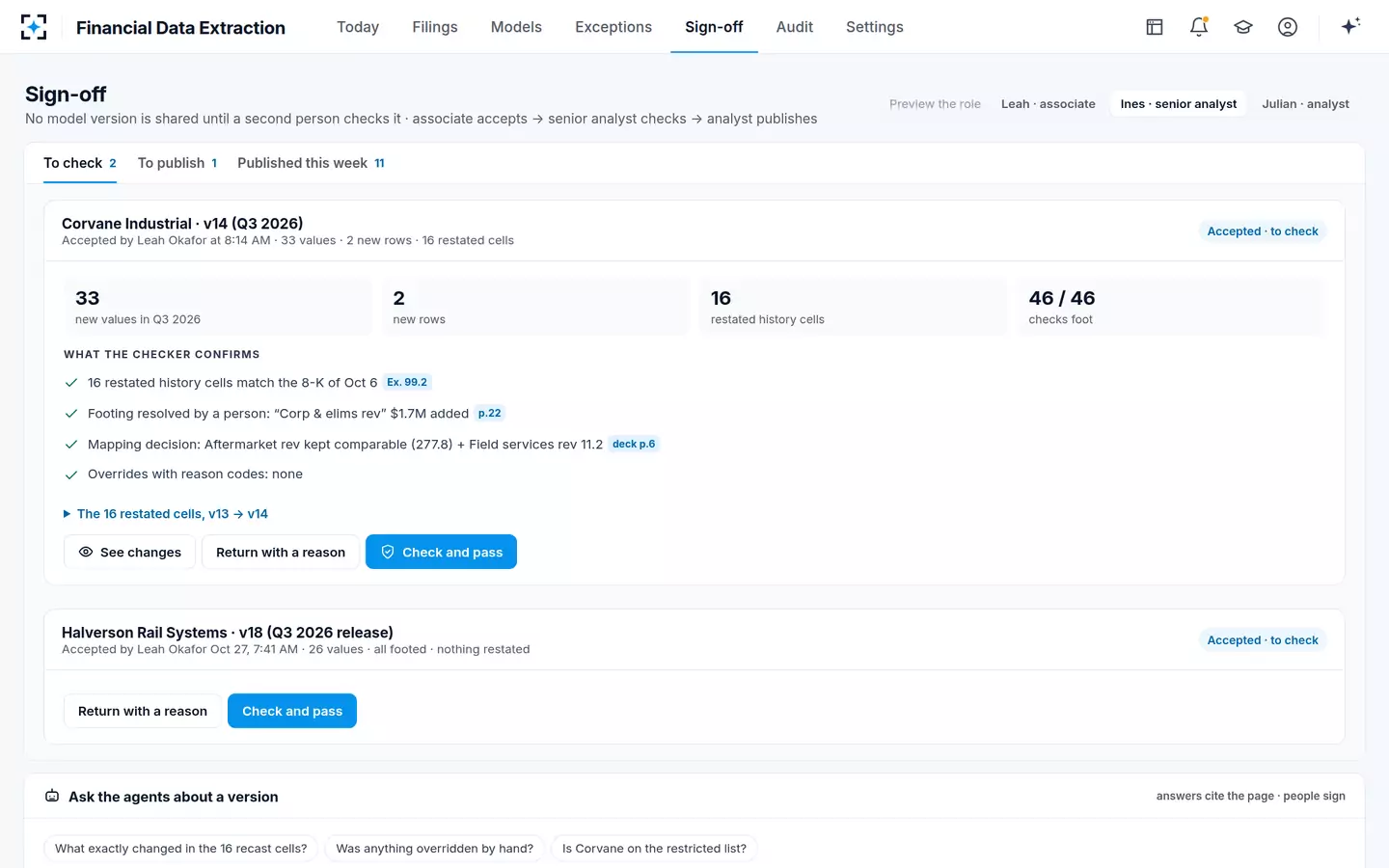
The agents' handling is deliberately conservative. The Restatement agent compares every re-reported period with model version 13, finds the sixteen changed cells, and proposes the update with the old value kept in each cell's history. It never overwrites published history. A recast always goes to a senior analyst, who confirms that each cell matches the exhibit before the new version can be shared.
The senior analyst's check of a recast in Financial Data Extraction
Why most restatements are now little r
Restatements did not disappear; they moved to the quiet form. The SEC's Acting Chief Accountant reported in 2022 that "“little r” restatements as a percentage of total restatements rose to nearly 76% in 2020, up from approximately 35% in 2005", while the total number of restatements declined each year from 2013 to 2020 (SEC OCA, March 9, 2022).
Little r restatements as a share of all restatements
The statement went on to warn that some materiality analyses "appear to be biased toward supporting an outcome that an error is not material to previously-issued financial statements". For a model, the consequence is practical. Three in four corrections arrive without an 8-K headline, inside the comparatives of a routine filing. Markets are not good at noticing quiet changes either: Cohen, Malloy and Nguyen found that changes in the wording of companies' repeated 10-K and 10-Q filings drew no reaction when they were filed, yet predicted later returns and earnings (Journal of Finance 75(3), 2020).
How do you update a model after a recast?
Replace the history only when the new basis is the one you will model going forward, keep the old values where you can see them, and note why each cell moved. A segment recast usually means the old basis is gone for good, so the model should move with it; but estimates built on the old segments, and every ratio and growth rate that spans the change, need a second look.
Updating a model after a recast or a restatement
- Compare every re-reported period, not just the new one
A little r restatement changes comparatives without an announcement.
- Name the reason on the cell
Recast for segments, discontinued operation, accounting change, or error: four different notes.
- Keep the old value in the cell's history
A published model is a record; the version before the change must stay readable.
- Check that the total is unchanged when it should be
A segment recast should not move consolidated revenue. If it does, something else changed too.
- Re-run growth rates and margins that span the change
Year-over-year growth on a recast segment needs recast prior-year numbers on both sides.
- Send it to a second person
Changing published history is a judgment; the person who accepted the new column should not also approve the old one.
Recasts also break simpler things. A relabeled KPI is a recast of a single line, and the KPI extraction guide shows the same decision, keep the series comparable or take the new definition, on Corvane's aftermarket revenue. A discontinued operation that arrives in the 10-K changes how the fourth quarter is derived, because the nine months in the third-quarter 10-Q are on the old basis. And an earnings surprise measured against an unrestated prior year can turn a miss into a beat, the problem one wrong number in the earnings surprise works through.
Recast history in the analyst's own grid, marked cell by cell
"Recast" in valuation and lending means something else
Outside public-company research the word has other meanings, and a search for "recast financial statements" mixes them. In private-company valuation and some lending, the word is also used for adjusting a company's statements to remove owner-specific or one-time items before measuring its earnings. In mortgages, a recast re-amortizes a loan after a lump-sum payment. Neither has anything to do with SEC filings. This guide uses the word as research teams do: a company's own re-presentation of its reported history on a new basis.
Questions people ask
Is a recast the same as restated financial statements?
No. A restatement corrects an error; a recast re-presents correct numbers on a new basis. The SEC staff's manual even asks a company that does both in one amended 10-K to separate the effects of the error from those of the later accounting change.
What is Form 8-K Item 4.02?
It is the item a company uses to tell investors that previously issued financial statements should no longer be relied upon because of an error, or that its auditor has said so. It is the public signal of a Big R restatement and is generally due within four business days.
Does a recast need a new audit?
When previously issued annual statements are reissued on the new basis, for example in a registration statement or a recast 8-K under Item 8.01, they are audited statements and the auditor's report covers the revision. Comparatives revised inside a later 10-Q are reviewed, like the rest of the interim statements.
What triggers a segment recast?
A change in the structure of a company's internal organization that changes the composition of its reportable segments. The SEC staff expects prior-period segment information to be retrospectively revised, if practicable, under ASC 280.
How do I know if a filing restated prior periods quietly?
Compare every prior-period value the new filing prints with the value your model holds. A little r restatement is disclosed in the notes, not in an 8-K, and the SEC's Acting Chief Accountant reported that little r corrections were nearly 76% of restatements by 2020.