Management-defined performance measures, or MPMs, are subtotals of income and expenses that a company uses in its public communications outside the financial statements, such as adjusted operating profit or adjusted EBITDA, to show management's view of its financial performance. Under IFRS 18 Presentation and Disclosure in Financial Statements, which replaces IAS 1 for annual periods beginning on or after 1 January 2027, a company that uses such a measure must explain it in a single note of its financial statements and reconcile it to an IFRS-defined subtotal, with the income tax and non-controlling interest effect of each reconciling item. IFRS 18 also adds two required subtotals to the income statement, operating profit and profit before financing and income taxes. For research teams covering IFRS reporters, that means the line map of every global model needs re-checking before the first IFRS 18 quarter. Botminds' Financial Data Extraction keeps that map per analyst, reads each new note and release, and asks a person whenever a label or definition the model depends on moves.
The rules and research figures below are the IFRS Foundation's, as published in October 2026. The worked example is fictional sample data from the solution.
From IAS 1 to IFRS 18: what changes in the statements analysts model
Under IAS 1: Few required subtotals; companies chose their own, under many names.
Under IFRS 18, from 1 January 2027: Income and expenses in five categories: operating, investing, financing, income taxes, discontinued operations.
Under IAS 1: Profit or loss; operating profit only if a company chose to show it.
Under IFRS 18, from 1 January 2027: Operating profit, and profit before financing and income taxes, for most companies.
Under IAS 1: Outside the statements, in releases and presentations, reconciled as local rules required.
Under IFRS 18, from 1 January 2027: MPMs explained in one note of the financial statements, reconciled with tax and minority effects.
Under IAS 1: No specific requirement for adjusted measures.
Under IFRS 18, from 1 January 2027: IAS 34 amended: MPM disclosures in interim financial statements too.
Under IAS 1: —
Under IFRS 18, from 1 January 2027: Applied retrospectively: the prior year's comparatives are restated, including in interim statements in the first year.
What are management-defined performance measures?
They are a company's own profit subtotals, used in public, that IFRS does not define. The IASB's project summary describes them as "alternative or non-GAAP performance measures (that is, measures that are not defined by IFRS Accounting Standards) that are related to the statement of profit or loss" (IASB, IFRS 18 project summary). Three conditions make a measure an MPM: it is a subtotal of income and expenses; it is used in public communications outside the financial statements; and it communicates management's view of an aspect of the financial performance of the company as a whole.
Public communications are defined broadly but not limitlessly. They include "management commentary, press releases and investor presentations"; for identifying MPMs, they do not include "oral communications, written transcripts of oral communications or social media posts". And the standard presumes the second and third conditions go together: a subtotal a company puts in its public communications is presumed to represent management's view, unless the company has reasonable and supportable information to show it does not.
When is IFRS 18 effective?
For annual reporting periods beginning on or after 1 January 2027, with earlier application permitted (IFRS Foundation, IFRS 18). The IASB issued it in April 2024 and gave companies close to three years. Two transition rules make the first year heavier than the date suggests. Companies must apply the new requirements "in interim financial statements in the initial year of application", and must restate comparative information for the prior year, applying IFRS 18 retrospectively (IFRS 18 project summary).
IFRS 18 for a calendar-year company: the comparative year is already running
- Issued; companies prepareApr 2024 – Dec 2025
- 2026: restated later2026
- 2027: first IFRS 18 year2027
- Report2028
For a model, the 2026 column is the trap. Figures typed from 2026 reports under IAS 1 will be re-presented under IFRS 18 when the 2027 reports arrive, with new subtotals and possibly new groupings. The difference between a recast and a restatement applies here: the 2026 numbers were not wrong, they move to a new basis, and a model should record them as recast history with the old values kept.
What does IFRS 18 change in the income statement?
It imposes a structure. Income and expenses are classified into operating, investing and financing categories, plus income taxes and discontinued operations, and most companies must present operating profit and profit before financing and income taxes. The IASB is explicit that the operating category is broad: "It is not meant to measure only 'persistent' or 'recurring' operating performance", and it is the default category for anything not classified elsewhere (IFRS 18 project summary).
That breadth is the reason adjusted measures survive. A company that wants to show operating profit before restructuring or acquisition amortization cannot change the IFRS subtotal; it presents its own measure, and if that measure is a subtotal it uses publicly, it is an MPM with disclosures attached. Banks and insurers apply the categories differently, because investing and financing are their main business; the IASB notes that "In most cases, banks would not present the 'profit before financing and income taxes' subtotal."
What must a company disclose about an MPM?
Four things, in a single note. The IASB's summary lists them: a reconciliation between the measure and the most directly comparable subtotal listed in IFRS 18 or required by IFRS Accounting Standards, "including the income tax effect and the effect on non-controlling interests for each item disclosed in the reconciliation"; a description of how the measure communicates management's view and how it is calculated; an explanation of any changes in the MPMs or how they are calculated; and a statement that the measure reflects management's view "and is not necessarily comparable to measures sharing similar labels or descriptions provided by other companies" (IFRS 18 project summary).
The tax and minority effects are the part analysts will use most. The IASB's effects analysis says that information "will enable investors to calculate an adjusted version of the MPM if they disagree with an adjustment that the company has used in its calculation" (IASB, IFRS 18 effects analysis). An analyst who keeps an EBITDA definition of their own can rebuild it from the reconciling items, net of tax, without guessing the tax rate on a restructuring charge.
The disclosure also moves into the audited statements. Under IAS 1 an adjusted measure lived in the release and the presentation; under IFRS 18 its reconciliation is in the notes, and the effects analysis expects that "in many jurisdictions, these disclosures will generally be subject to audit". The same disclosures apply to interim financial statements when the company uses an MPM in its interim communications.
What is not an MPM
A measure that is not a subtotal of income and expenses is outside the definition, however prominent. The IASB's own examples of performance measures that cannot be MPMs are free cash flow, return on equity, net debt, number of customers and customer satisfaction (IFRS 18 project summary, Figure 3). Subtotals that IFRS itself specifies, such as operating profit, or operating profit before depreciation, amortization and impairments within the scope of IAS 36, are also not MPMs, because they are not management-defined.
That leaves a gap analysts should notice. A company's cash conversion, net debt and operating KPIs remain outside IFRS 18's MPM disclosures, and in Europe still fall under ESMA's guidelines on alternative performance measures, which ask that an APM's "definition and calculation" be "consistent over time" and that a redefinition come with restated comparatives (ESMA/2015/1415). The extraction discipline for those lines is the one in the KPI extraction guide.
What the IASB found before it wrote the rule
The IASB studied 100 listed companies with large market capitalizations across 26 jurisdictions, and the findings explain the design. Operating profit was common and inconsistent: 61 of the 100 presented a subtotal labelled operating profit or similar in the income statement, "using at least nine different definitions" (IASB, IFRS 18 effects analysis). Adjusted measures were mostly outside the audited statements and loosely reconciled.
What the IASB found in 100 large listed companies
61of 100
presented an operating profit subtotal, with at least nine definitions between them
59%
of the adjusted measures observed were given only outside the financial statements
14%
of the measures it examined came with no reconciliation at all
75%+
of those measures were also disclosed for interim periods
How the measures were reconciled to IFRS figures before IFRS 18
Investors told the IASB what that meant in practice: "We don't have enough information to make adjustments when we disagree with items adjusted for in these measures." The items that most often appeared in reconciliations were restructuring costs, gains or losses on disposals, impairments, amortization of intangible assets including those recognised in business combinations, fair value remeasurements, acquisition-related costs and legal expenses. Those are the lines an analyst's own adjusted definition usually turns on.
The pattern is old. In US data, Bradshaw and Sloan documented "a dramatic increase in the frequency and magnitude of cases where 'GAAP' and 'Street' earnings differ" over the twenty years their study covered (Journal of Accounting Research 40(1), 2002). The US answer was Regulation G in 2003, which requires a reconciliation wherever a non-GAAP measure is disclosed (17 CFR part 244). IFRS 18 is the IFRS answer, two decades later, and it goes further on tax effects and on putting the reconciliation inside the financial statements.
How will IFRS 18 affect analysts' models?
Three ways. First, labels change: a company that showed "EBIT" or "operating result" under its own definition will show IFRS operating profit and, if it keeps its own measure, an MPM beside it. A model mapped by label will map the wrong one. Second, comparatives are restated, so the year typed from IAS 1 reports moves. Third, the MPM note gives a model something it never had for most IFRS reporters, a reconciliation with tax effects inside the reviewed or audited statements, which can become the check behind every adjusted line.
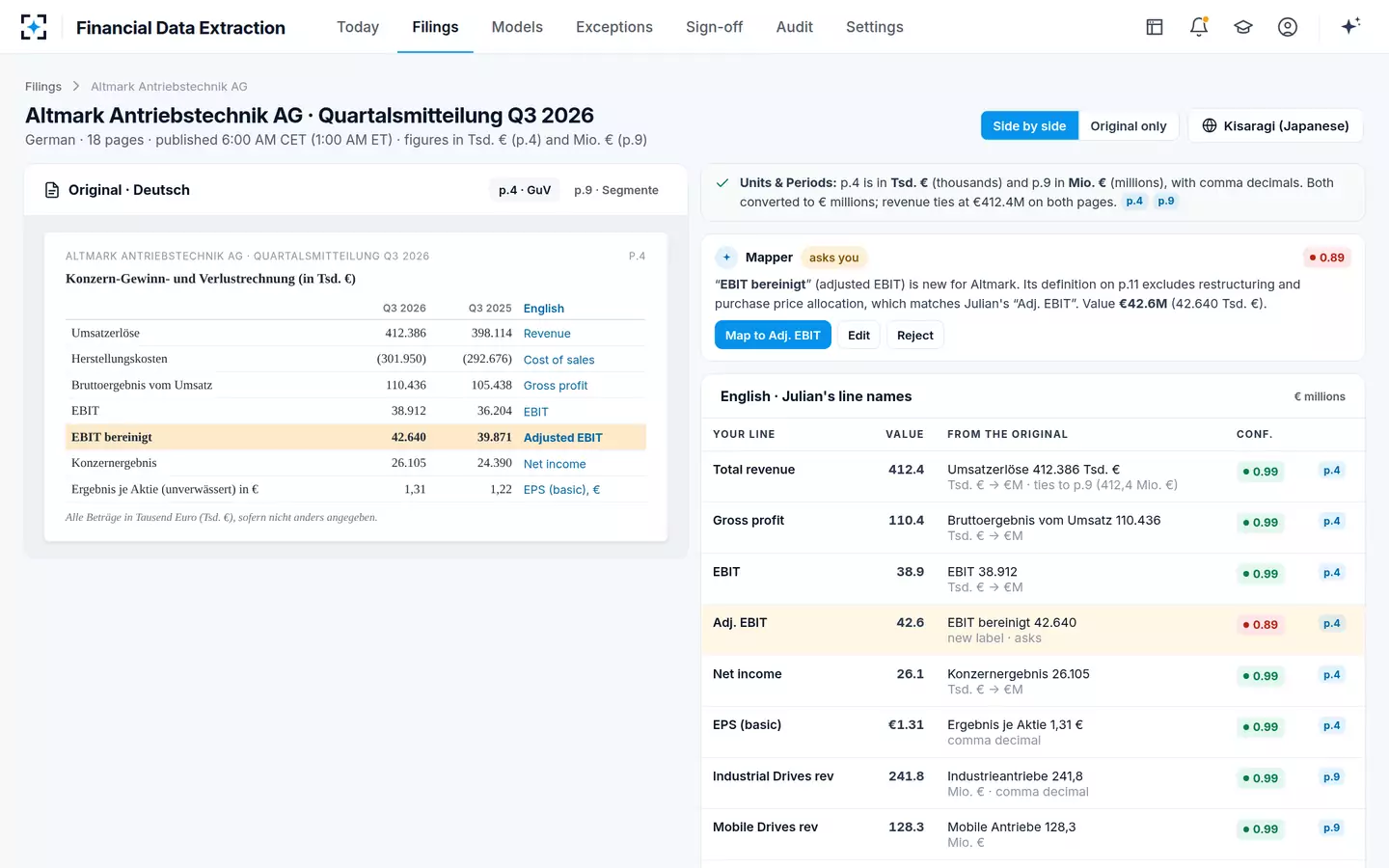
In Financial Data Extraction's fictional sample, a German issuer's quarterly statement shows the kind of line that will be affected. Altmark Antriebstechnik's Quartalsmitteilung introduced "EBIT bereinigt", adjusted EBIT, whose definition on page 11 excludes restructuring and purchase price allocation, matching the analyst's own adjusted EBIT at €42.6 million. Because the label was new, the Mapper's confidence was 0.89, below the 0.92 threshold, and it asked a person rather than map it. Under IFRS 18, the same measure in a company's annual or interim financial statements would come with a reconciliation to the most directly comparable IFRS subtotal, likely operating profit, and the tax effect of each item, which the agents would read as the check.
A new adjusted-EBIT label, held for a person in Financial Data Extraction
The re-mapping is a one-time cost per issuer, but it falls in the same weeks for every IFRS name a team covers. The guide to AI financial modeling in the analyst's own workbook covers how new line names and versions are written without disturbing the analyst's formulas.
A readiness checklist for the first IFRS 18 quarter
Before the first IFRS 18 report lands in your models
- List every adjusted line in every IFRS model
Adjusted EBIT, adjusted EBITDA, underlying profit: each is a likely MPM and will gain a note and a reconciliation.
- Record today's definition for each, with its page
The first MPM note will say how each measure is calculated; compare it with what the model assumed.
- Map by definition, not by label
IFRS operating profit and a company's old "EBIT" may share a name and differ in content.
- Plan for restated 2026 comparatives
Keep the IAS 1 values in each cell's history and mark the re-presented year as recast, not as an error.
- Use the tax and minority effects
They let the model rebuild the analyst's own adjusted figure from the company's reconciling items.
- Watch interim reports in 2027
IAS 34 now asks for MPM disclosures in interim financial statements; the first ones arrive with the first 2027 interims.
Questions people ask
Does IFRS 18 replace IAS 1?
Yes. IFRS 18 replaces IAS 1 Presentation of Financial Statements; requirements from IAS 1 that were not changed were carried into IFRS 18 or moved to other standards, such as IAS 8. The IASB focused its changes on the statement of profit or loss.
What is operating profit under IFRS 18?
The total of all income and expenses classified in the operating category, which is the default category for everything not classified as investing, financing, income taxes or discontinued operations. It includes volatile and unusual items, so it is not a measure of recurring performance.
Are MPMs audited under IFRS 18?
The MPM disclosures sit in the notes to the financial statements, so where the statements are audited the disclosures generally are too; the IASB expects that "in many jurisdictions" they will be subject to audit. The measures themselves remain the company's own.
Is free cash flow an MPM?
No. An MPM must be a subtotal of income and expenses, and the IASB lists free cash flow, net debt and return on equity among measures that cannot be MPMs. In Europe, ESMA's guidelines on alternative performance measures still apply to them.
Does IFRS 18 affect US companies?
Not companies reporting under US GAAP, whose non-GAAP measures fall under the SEC's Regulation G and Item 10(e) of Regulation S-K. It does affect companies that report under IFRS, including foreign private issuers that file IFRS statements with the SEC.
What are examples of management-defined performance measures?
Adjusted profit, adjusted operating profit and adjusted EBITDA are the IASB's own examples, when a company uses them in its public communications. In the IASB's sample, adjusted profit or loss was the most frequently observed adjusted measure, followed jointly by adjusted operating profit and adjusted EBITDA.