A financial statement spreading template is the bank's chart of accounts for borrowers: a fixed list of lines, each with a code, into which every borrower's statements and returns are mapped so that two analysts spreading the same borrower produce the same numbers, and the ratios mean the same thing across the portfolio. It embodies the lending policy's choices about cash flow, leverage and coverage, which is why replacing it to suit a tool is a bad trade. Botminds' Commercial Financial Spreading maps every figure to a line of the bank's own spread. The analyst confirms, re-maps or splits lines; each re-map becomes a rule for that borrower and its related entities, so the next spread maps it the same way. The template, the ratio definitions and the credit policy stay where they were: with the head of credit.
What the template change does to each role, and what stays theirs
Today
Owns the standard, but each analyst’s spreadsheet applies it a little differently.
With agents
Sets the template, global cash flow method and coverage floors once; every spread is built on them.
Still theirs: the template, the ratio definitions and every change to them.
Today
Keys each line into the template and remembers each borrower’s quirks.
With agents
Confirms, re-maps or splits the lines the agents mapped, with the page beside each.
Still theirs: every mapping decision, and her name on the rules it creates.
Today
Trusts the mapping because he cannot see it.
With agents
Sees which lines were re-mapped and why, and the rules carried from earlier spreads.
Still theirs: the second signature.
Today
Receives a spreadsheet and a memo, with no link between them.
With agents
Receives a signed spread with every figure linked to its page and every spread version kept.
Still theirs: the credit file.
Why the spreading template is credit policy, not software
Because the regulators ask the policy to decide what the template encodes. The Federal Reserve's examination manual expects the lending policy to "define the financial-statement requirements for businesses and individuals at various borrowing levels" (CBEM §2010.1). For credit unions, the NCUA requires underwriting standards that address "The level and depth of financial analysis necessary to evaluate the financial trends and condition of the borrower and the ability of the borrower to meet debt service requirements" (12 CFR 723.4(f)). SBA names its ratio benchmarks: "Current Ratio, Debt/Tangible Net Worth, Debt Service Coverage, and any other ratios the Lender considers significant" (SOP 50 10 8.1).
A template answers those requirements in detail. Where does rent paid to an affiliate go? Is a loan to a shareholder an asset or a deduction from tangible net worth? Which statement leads when both a return and a reviewed statement exist? Is global cash flow combined at the entity or built from distributions? Change the template and every ratio in the portfolio shifts, every trend line breaks at the change, and every covenant written against the old definitions has to be read again. That is too high a price for adopting a tool.
What does spreading financial statements mean? Mapping, not copying
Spreading financial statements means restating each borrower's statements and returns in the bank's own lines, year beside year, so they can be compared with each other and with every other borrower. The hard part is not the typing but the mapping: a CPA's "selling, general and administrative" line, a return's line 8 salaries and wages and a management interim's "payroll" may all need to land on different template lines, or the same one, depending on what the template is built to show.
The Federal Reserve's examination manual lists what the credit file should let a reviewer see: "income statement, balance sheet, reconciliation of equity, cash-flow statements, and applicable notes to financial statements", and it sorts the analysis into "operations management, asset management, and liability management" (CBEM §2080.1). A good template is organised so that those three readings, and the ratios that go with them, fall out of the lines without re-work, and so that equity rolls forward from one year to the next as a check on the keying.
How to spread financial statements in Excel, and where the template breaks
By hand, the method is the same in every bank: set up a column per period, map each statement line to a template line, foot every total, roll equity forward from last year, tie the result to the tax return, and let the ratio block calculate. A financial spreading template in Excel does the last step well. It does the others only as well as the person keying, because nothing in a spreadsheet knows which page a number came from.
The failures are familiar to anyone who has inherited a workbook. A formula is overwritten with a typed number to make a total agree, and the plug survives into next year's copy. Two analysts copy the master template at different times and the lines drift apart. The reason a line was mapped somewhere unusual lives in one analyst's head. The sample borrower's history shows the pattern: the fiscal 2024 annual review and the fiscal 2023 credit note were keyed in Excel by a previous analyst, Owen Pritchard, with no figure linked to its source, and two of his mapping decisions were sound enough to keep only because someone could read them back out of the workbook.
None of this is an argument against the template. It is an argument for keeping the template and moving the keying and the record of each decision out of the spreadsheet, which is the design described next.
What the agents write into, and what they never change
The agents write figures into lines; they never change the lines. The sample bank's template is a 214-line commercial spread, with separate templates for agricultural borrowers and real estate holding companies. The statement spreader maps audited, reviewed, compiled and interim statements to it "by the uniform method", foots every statement and rolls equity forward. The tax return reader maps the returns, each value cited to its form, page and line.
Who owns what in a spread
| Element | Set by | Agents may | Agents may not |
|---|---|---|---|
| Template and chart of accounts | Head of credit, in settings | Map each figure to a line | Add, remove or redefine a line |
| Which statement leads | Credit policy | Spread the leading source and tie the other to it | Switch sources for a borrower |
| Tie tolerance | Credit policy ($1,000 in the sample) | Raise an exception beyond it | Plug a difference within or beyond it |
| Global cash flow method | Credit policy | Apply it, eliminate payments between entities | Count pass-through income without a K-1 |
| Ratio definitions and swing thresholds | Credit policy | Compute and flag | Change a threshold |
| A borrower’s mapping rules | The analyst who made them | Apply them to that borrower and its related entities | Apply them to another borrower |
| The signature | Analyst; senior underwriter above the limit | Prepare the summary | Sign |
Chart of accounts mapping: confirm, re-map or split
Every mapped line is one of three cases. Most are confirmed: the agent mapped them correctly, the page agrees, and the analyst moves on. Some must be re-mapped to a different line, and some must be split because one source line holds what the template keeps apart. In each case the figure keeps its pin to its page.
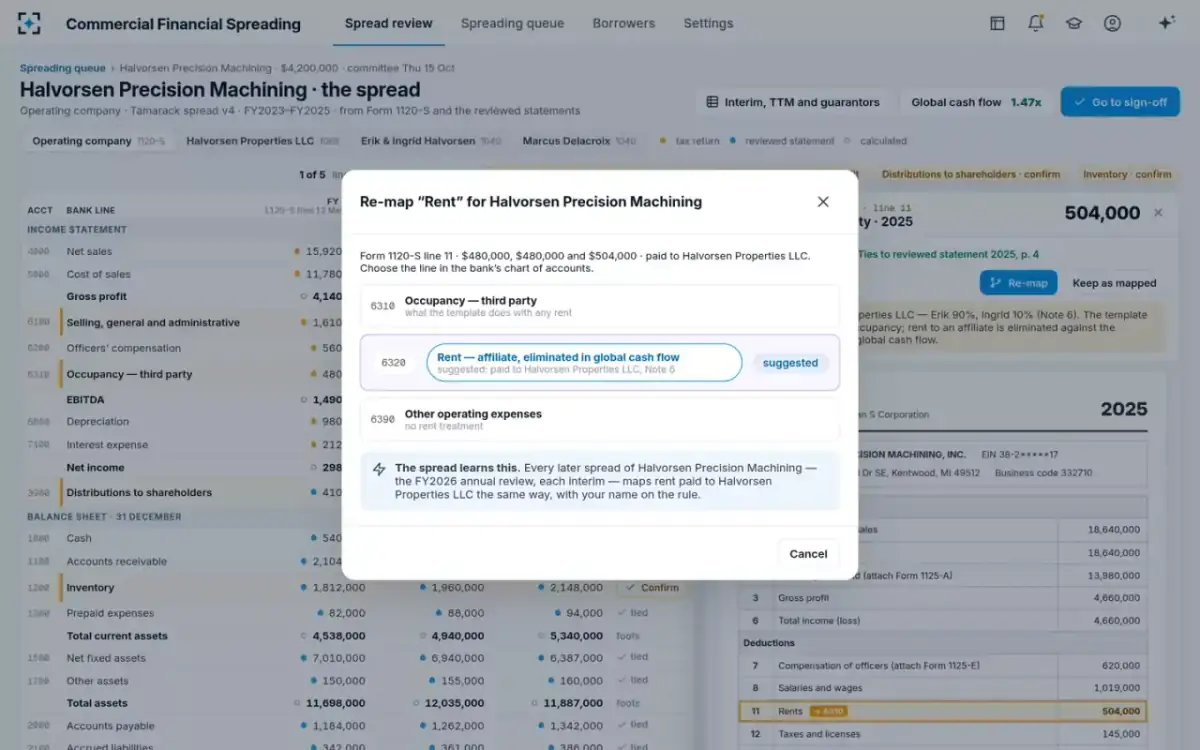
The sample borrower shows a re-map. Halvorsen Precision Machining's Form 1120-S, line 11, shows rent of $480,000, $480,000 and $504,000 over three years, paid to Halvorsen Properties LLC, which the owners also own. The template's default put it in 6310, occupancy paid to a third party. Rent to an affiliate belongs in 6320, which global cash flow eliminates against the property company's income. Global cash flow, line by line explains why that elimination matters.
Re-mapping a line in the bank’s chart of accounts
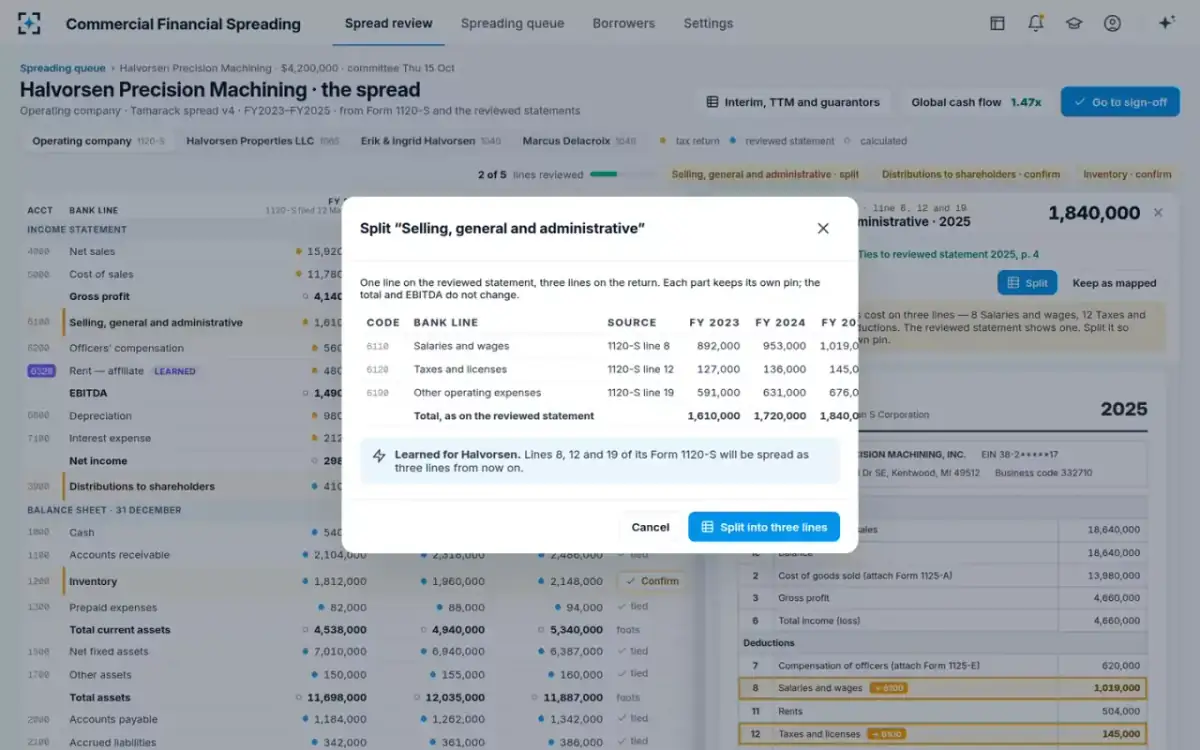
A split runs the other way. Selling, general and administrative expense is one line on the reviewed statement and three on the return. For fiscal 2025 the analyst splits $1,840,000 into salaries and wages of $1,019,000 (line 8), taxes and licenses of $145,000 (line 12) and other operating expenses of $676,000 (line 19), with the earlier years split the same way. Each part keeps its own pin; the total and EBITDA do not change.
Splitting one statement line into three template lines
Learned rules: the borrower's quirks, written down with a name on them
Every analyst learns each borrower's peculiarities, and in most banks that knowledge leaves with the analyst. The Federal Reserve's Berger and Udell made the general point about relationship lending two decades ago: "Because the loan officer is the repository of this soft information, agency problems are created throughout the organization" (FEDS 2001-36). Mapping knowledge is a smaller version of the same problem.
In the solution, a re-map or split becomes a rule at the top of "What this borrower's spread has learned", with the analyst's name and the date. It applies to that borrower and its related entities only, starting with the next spread. On Halvorsen, two rules came from the previous analyst's Excel spreads: Form 1125-A line 3, cost of labor, goes to cost of sales rather than salaries and wages; current maturities of long-term debt go to account 2300 rather than the line of credit. With the analyst's rent re-map there are three, and they will map their lines on the fiscal 2026 annual review package, due 15 March 2027, before anyone opens it.
A learned rule is a mapping decision someone already made, kept with their name on it, applied only where it belongs.
Can spreading software use our own template? Fill versus replace
Some spreading tools come with their own chart of accounts and ask the bank to adopt it, or to maintain a mapping between the two. The trade-offs are concrete.
Two ways to adopt spreading software
Tool fills the bank’s template: Continuous with past spreads.
Bank adopts the tool’s template: Break at the change; history must be re-spread or footnoted.
Tool fills the bank’s template: Still computed the way the loan agreements assume.
Bank adopts the tool’s template: Must be checked against new line definitions.
Tool fills the bank’s template: Head of credit edits the template and methods.
Bank adopts the tool’s template: Changes depend on the vendor’s release cycle.
Tool fills the bank’s template: The same lines and codes as before.
Bank adopts the tool’s template: A new chart of accounts to learn.
Tool fills the bank’s template: Same policy, applied more consistently.
Bank adopts the tool’s template: A policy change to document and justify.
What comes in, what goes out, and who approves each
The solution sits between the borrower's documents and the credit memo. Packages come in through the borrower portal or are added by the analyst; the agents spread them into the template; the analyst and, above her limit, a senior underwriter sign; and the signed spread goes to the credit memo with each figure linked to its page. Requests to the borrower are drafted by the agents and sent only by the analyst.
Data in and out of the spread
Agent
Package inReturns, K-1s, CPA statements, interims, personal financial statements, through the borrower portal or added by the analyst.
Agent
Spread into the templateEvery figure mapped to the bank’s line and pinned to its page; learned rules applied.
Never: changes the template.
A person decides
Analyst reviews and signsConfirms, re-maps or splits; decides exceptions; signs “Spread complete and tied to source”.
A person decides
Co-signature above the limitSenior underwriter co-signs “Approved for the credit memo”.
Agent
Spread outThe signed spread and its source links go to the credit memo; requests go to the borrower once the analyst sends them.
Never: sends a request without the analyst.
Questions to settle before go-live
- Which templates, and how many lines
Commercial, agricultural, real estate holding: each a setting, with its version.
- Which source leads, and the tie tolerance
Written down once, applied to every spread started after.
- The global cash flow method and living expenses
Combined entity or distributions; per-dependant or flat.
- Swing thresholds and coverage floors
Business and global, and whether SBA’s floors apply to a programme.
- Signing limits
Up to what exposure an analyst signs alone; who co-signs above.
- Where the signed spread goes
To the credit memo with its source links; how versions are kept for the credit file.
- Which past spreads to learn from
Earlier spreadsheets can seed borrower rules, each attributed to the analyst who made the decision.
Because the arithmetic of a spread and its mapping rules are deterministic, the revised model risk guidance of April 2026 excludes them from its definition of a model (OCC Bulletin 2026-13); whether spreading software is a model works through the rest. For the cost side of the decision, see what one commercial spread costs, and for the whole solution, Commercial Financial Spreading.
Questions people ask
How many lines should a spreading template have?
As many as the policy's ratios and covenants need, and no more. The sample bank's commercial template has 214 lines; fewer lines means more judgement hidden in each mapping, more means more splits that no source supports. A line that no ratio, covenant or review ever reads is a candidate for removal.
Should agricultural and real estate borrowers have their own template?
Usually, because their statements are built differently: a farm reports on Schedule F with crop and livestock lines, and a real estate holding company's story is rents, operating expenses and debt by property, often from Form 8825. The sample bank keeps three templates, commercial, agricultural and real estate holding, each a setting with its own version.
Who should be allowed to change the template?
The person who owns credit policy, usually the head of credit or credit analysis, through a versioned change that applies to spreads started afterwards. Analysts change mappings for one borrower; only the template owner changes what a line means for everyone.
What happens to our historical spreads?
They stay where they are and remain part of the relationship's history; the sample borrower's earlier Excel spreads are listed as versions beside the new one. Their mapping decisions can carry forward as rules attributed to the analyst who made them.
Does a learned rule ever apply to another borrower?
No. A rule applies to the borrower and its related entities only. A change meant for every borrower is a change to the template, made by the person who owns it.