K-1 distribution vs income is the whole question when a lender reads a Schedule K-1: separate its two kinds of number. The income boxes, box 1 for ordinary business income and box 2 for rental real estate, show the owner's share of the entity's taxable profit; the distribution box, box 16 code D on an S corporation's K-1 and box 19 code A on a partnership's, shows the cash the owner was paid. A lender spreading the business already counts its profit at the entity, so the income boxes are a check, not a source of extra cash, and the distribution box is cash only under a method that leaves the entity out. Commercial Financial Spreading, Botminds' spreading solution for commercial lenders, reads every K-1 in a borrower package, ties each to the entity's Schedule K and the owner's Schedule E, and keeps taxable income apart from K-1 cash.
The K-1 is the hinge between the business and its guarantors, and lenders see a great many of them. Pass-through entities file most business returns, and every owner of every one of them receives a K-1.
The K-1 is the commonest business tax document a lender reads
6.15M
S corporation returns (Form 1120-S) filed in fiscal 2025
5.22M
partnership returns (Form 1065) filed in fiscal 2025
30.2M
partners on partnership returns for tax year 2023, each with a K-1
2.35M
C corporation returns, which issue no K-1
K-1 1065 vs 1120-S: the same ideas in different boxes
The S corporation and partnership versions carry the same ideas in different boxes. Both report the owner's share of income by type, the items that change the owner's basis, and the owner's identity and share. The partnership version adds guaranteed payments, a capital account and the partner's share of liabilities, all of which matter to a credit analyst. The table lists the boxes a spread uses; the rest, credits, foreign items and alternative minimum tax, rarely move a credit decision.
The K-1 boxes a commercial spread uses
| What it shows | K-1 (1120-S) | K-1 (1065) | How the spread uses it |
|---|---|---|---|
| Owner’s share of trade or business income | Box 1 | Box 1 | A tie-out to the entity’s return; not added to entity cash flow |
| Rental real estate income | Box 2 | Box 2 | A tie-out to Form 8825; the property company’s cash flow is counted at the entity |
| Guaranteed payments to the owner | none (wages go on a W-2) | Boxes 4a–4c | The partner’s income, counted once on the guarantor side |
| Interest and dividends | Boxes 4, 5a | Boxes 5, 6a | Portfolio income; check it is not also on the 1040 from another source |
| Cash distributions | Box 16, code D | Box 19, code A | Cash to the owner; used only under a distributions method |
| Loans from the owner repaid | Box 16, code E | n/a | Cash to the owner that is not a distribution; read with the balance sheet |
| Ownership and capital | Part II, stock ownership % | Part II, profit, loss and capital %; capital account | Who owns what; which household guarantees which entity |
| Share of entity liabilities | n/a | Part II, item K1 | Part of the guarantor picture for the global analysis |
A partnership K-1, annotated
The figure below is a K-1 (Form 1065) reduced to the parts a credit analyst reads, with the five that matter most marked. The amounts are omitted on purpose: the point is where to look, and the Halvorsen numbers follow.
Five places to look on a partnership K-1
- 1
Part II · ownership
Whose K-1 it is, and what share
The partner’s profit, loss and capital percentages. They decide which household the cash belongs to, and they must add to 100% across the K-1s.
- 2
Box 1 / Box 2
Taxable income, not cash
Ordinary business income (box 1) and net rental real estate income (box 2). This is the entity’s profit seen from the owner’s side: never add it on top of the entity’s cash flow.
- 3
Box 4
Guaranteed payments
Paid “without regard to the partnership’s income”, like a salary. The partnership has already deducted them, so they count once, as the partner’s income.
- 4
Box 19, code A
Cash actually distributed
Money paid out to the partner during the year. The figure a distributions method of global cash flow uses.
- 5
Part II · capital and liabilities
What the partner put in and owes
The capital account roll-forward and the partner’s share of the partnership’s liabilities, which the guarantor analysis has to see.
The IRS instructions make the distinction plainly. Box 19 code A "is used to report the distributions the partnership made to you of money, that is, cash and certain marketable securities", and it excludes "deemed distributions of money", the code D amounts that arise when a partner's share of the partnership's debt falls (IRS). The income boxes are allocations of taxable profit whether or not any cash moved.
K-1 ordinary income vs distributions: the Halvorsen property company
The difference between box 2 and box 19A can be large, and it runs in the borrower's favour on paper. In the sample relationship, Halvorsen Properties LLC owns the plant and is owned 90% by Erik Halvorsen and 10% by Ingrid Halvorsen. For 2025 its partners carried $286,000 of income from it onto Schedule E. Its K-1s show $96,000 actually distributed in box 19, code A. The other $190,000 was taxed to the partners but stayed in the partnership.
A spreadsheet that adds the $286,000 to the guarantors' income, while the property company's own net operating income is also in global cash flow, counts the same rent twice. Last year's spreadsheet for this borrower did that with both entities' Schedule E income, $591,000 in all, and showed 1.84x global coverage where the tied-out figure is 1.47x. Global cash flow, line by line rebuilds the arithmetic.
Read across the K-1: what the owner is taxed on, and what the owner received
Income boxes (1, 2): The owner’s share of the entity’s taxable profit for the year.
Distribution boxes (16D, 19A): Money and marketable securities actually paid to the owner.
Income boxes (1, 2): Schedule E, page 2, on the owner’s Form 1040.
Distribution boxes (16D, 19A): Nowhere on the 1040; it reduces the owner’s basis.
Income boxes (1, 2): $286,000 carried to Schedule E
Distribution boxes (16D, 19A): $96,000 distributed
Income boxes (1, 2): None: the entity’s own cash flow is counted instead.
Distribution boxes (16D, 19A): None: the cash is already inside the entity’s cash flow.
Income boxes (1, 2): None.
Distribution boxes (16D, 19A): Counted as the guarantor’s cash from that entity.
What are guaranteed payments on a K-1, and where do they count?
Guaranteed payments are a partner's pay: in the IRS's words, "payments made by a partnership to a partner that are determined without regard to the partnership's income", which the partner reports "in column (k) of Schedule E (Form 1040), line 28" (IRS). They sit in box 4a for services and box 4b for the use of capital. The partnership deducts them before arriving at box 1, so the entity's cash flow is already after them.
For a lender that settles where they belong: once, on the partner's side, as income the partnership has already paid. The trap is the add-back. An analyst who normalises the partnership's earnings by adding guaranteed payments back as "owner compensation", and then also counts them in the guarantor's income, has counted the same dollars twice. If the add-back is right for the credit, because the payments could be cut, the guarantor side must lose them. Box 14, code A, net earnings from self-employment, usually carries them as well, which is a useful cross-check and a reminder that the partner pays self-employment tax on them.
An S corporation has no box 4 for this. Its owners who work in the business are paid wages on a W-2, and the company reports officers' pay on Form 1125-E. Halvorsen Precision Machining's 2025 return shows $620,000 of officers' compensation, $420,000 to Erik Halvorsen and $200,000 to Marcus Delacroix, already deducted from the company's EBITDA and counted on the guarantor side as wages. The logic is the same as for a guaranteed payment: one side or the other, never both.
Are K-1 distributions taxable? Not until they pass basis
Generally no: a distribution reduces the owner's basis and becomes taxable only to the extent it exceeds that basis. For a partner, cash received beyond "the adjusted basis of your partnership interest immediately before the distribution" is "treated as gain from the sale or exchange of your partnership interest" (IRS). The income was taxed when it was earned, through box 1 or box 2, whether or not it was paid out; the distribution is the later movement of cash that was already taxed.
That is why the distribution box is also an early warning. On the S corporation side the IRS tells shareholders that box 16D distributions reduce stock basis, and "If these distributions exceed the basis of your stock, the excess is treated as capital gain" (IRS). For a lender the simpler test is distributions against net income. Halvorsen Precision Machining paid $600,000 of distributions in 2025 against $305,000 of net income, 197%, and 215% the year before. Some of that is tax distributions on income that stayed in the business, which SBA names as a line a lender must justify: "Distributions for S-Corp taxes" (SOP 50 10 8.1). The rest is equity leaving a business that is asking to borrow.
The ratio shows up in the solution's ratios table beside the others, flagged as a worsening trend. It does not decide anything; it puts a question in front of the analyst while the borrower can still answer it.
Who is in the credit, drawn from the K-1s
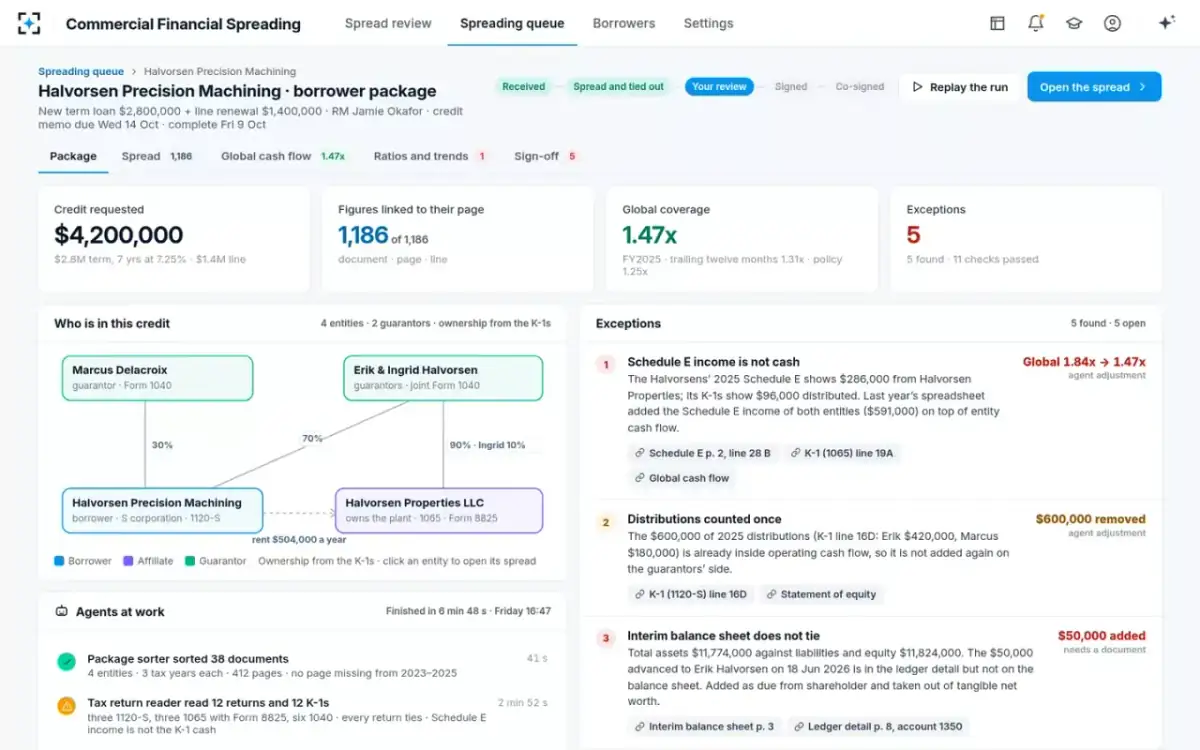
Each exception carries the pages it rests on; click one and the K-1 opens with the box marked.
How do lenders calculate K-1 income? Three readings of one form
A commercial lender reads the same K-1 three ways, and each reading answers a different question. As a tie-out, the income boxes confirm that the entity's return and the owner's Schedule E agree, and contribute no cash. As cash, the distribution box is the guarantor's income from that entity, but only under a distributions method and only for an entity left off the entity side. As a test of durability, distributions are set against the entity's earnings and its own balance sheet: cash paid out of retained earnings that the business needs is cash a guarantor cannot count on next year.
Residential mortgage underwriting uses K-1 income too, under the rules of whichever investor or insurer will buy or guarantee the loan, and those rules are written for a single household rather than a group of related entities. The commercial question is broader: whether the whole group, entities and owners together, can service the whole group's debt. That is why the commercial analyst starts from the entity and treats the K-1 mainly as evidence about it.
The three readings give three different numbers for the Halvorsen property company in 2025: $286,000 of income tied out and not counted, $96,000 of cash under a distributions method, and, under the sample bank's combined method, nothing on the guarantor side because the partnership's net operating income of $386,000 is counted at the entity. None of the three is wrong; mixing two of them is.
How the K-1s tie to the rest of the package
A K-1 is never read alone. In the solution, the tax return reader ties each set of K-1s three ways: across, the owners' K-1s must add to the entity's Schedule K; down, each owner's Schedule E, page 2, line 28 must carry the K-1 income; and over, the distributions must agree with the entity's statement of equity or its Schedule M-2. On the Halvorsen package that is 12 K-1s, two per entity for each of three years, each tied before the spread is shown to the analyst.
A K-1 that is missing is treated as missing cash. The sample bank's policy, which the solution enforces, is that without a K-1 no cash from that entity is counted. One package in the sample queue shows the effect: the 2025 K-1 for a trucking LLC in another borrower's credit had not arrived, and that package waits on the borrower rather than on a guess.
Reading a K-1 for a loan, in order
- Match it to its return, year and owner
Entity EIN, tax year (a fiscal-year entity’s K-1 can belong to a different calendar year) and the owner’s name.
- Check the ownership adds up
The percentages across all K-1s of one entity should total 100%. A change during the year shows as beginning and ending percentages.
- Tie the income boxes
To the entity’s Schedule K and to the owner’s Schedule E, page 2. Never add them to entity cash flow.
- Read the distribution box against net income
Box 16D or 19A. Distributions above earnings, year after year, need an explanation.
- Note guaranteed payments and loans repaid
Box 4 is the partner’s pay; box 16E on an S corporation K-1 is a loan being repaid, not income.
- Read the partner’s share of liabilities
Part II, item K1 on a partnership K-1: debt the guarantor is exposed to through the entity.
These are mechanical checks, and that is the reason to hand them to software that cites its pages: they are easy to skip at the end of a long keying day, and each skipped one tends to make the borrower look stronger. Where the returns and the CPA statements disagree, the question becomes which to believe; audited, reviewed, compiled or tax return takes that up. The Commercial Financial Spreading page shows the whole package spread.
Questions people ask
Why do K-1s arrive so late in the year?
Partnership and S corporation returns for calendar-year entities are due on 15 March, and a six-month extension moves that to 15 September; the K-1s come with the return. The owners' own returns can then be extended to mid-October, so a complete guarantor package for the prior year often arrives in the autumn, which is when many annual reviews pile up.
Does a K-1 show the owner's share of the entity's debt?
A partnership K-1 does, in item K1 of Part II, split into nonrecourse liabilities, qualified nonrecourse financing and recourse liabilities, at the start and end of the year. An S corporation K-1 does not, so a shareholder's exposure to the company's debt has to come from the company's balance sheet and from any personal guarantee. Either way, the guarantee itself is what puts that debt in the global denominator.
Is K-1 income the same as cash flow?
No. The income boxes are the owner's share of taxable profit, whether or not it was paid out; cash shows in the distribution box. In the sample, $286,000 of K-1 income from the property company came with $96,000 of cash.
Do lenders use K-1 distributions or the business's cash flow?
Either, by policy, but not both for the same entity. The combined method counts the business's cash flow; the distributions method counts the cash it paid its owners. The commonest error is to count the business's cash flow and its distributions together.
What if the guarantor's K-1 shows a loss?
A loss from an entity already in the credit is in that entity's cash flow. A loss from one outside it may be a paper loss from depreciation or a business the guarantor will have to support; the analyst needs that entity's return to tell which.