To reconcile tax returns with financial statements when a borrower's IRS transcript does not match, first find which two documents disagree: the statement and the return the borrower supplied, or that return and the one the IRS holds. Most differences are ordinary. Book income and taxable income differ by design and Schedule M-1 explains how; a return may have been amended after the transcript was cut; the statement may cover a different fiscal year or more entities than the return. A difference that none of these explains is a reason to stop. SBA makes the match a condition of its 7(a) and 504 programmes, and every lender has the same interest in it. Botminds' Commercial Financial Spreading ties each CPA statement to the borrower's return line by line, with both pages cited, so that when a transcript arrives the analyst already knows which side any difference sits on.
What SBA and the IRS set down about the tie-out
Before funding
SBA lenders must obtain tax return transcripts and reconcile any discrepancies with the applicant’s financial data first
3 years
of transcripts for the applicant where size is tested on the industry standard; two under the alternative standard
4506-C
the form lenders use to order transcripts through the IRS’s Income Verification Express Service (IVES)
As filed
a return transcript “does not reflect changes made to the account after the return is processed”
Does SBA require tax transcripts? Yes, reconciled before the money moves
SBA states the purpose of its tax verification directly: to determine whether "The Applicant filed business tax returns" and whether "The Applicant's financial statements provided as part of the application agree with the business tax returns submitted to the IRS." An applicant that has not filed required federal returns "is not eligible for SBA financial assistance." Then the rule itself: "Except for the SBA Express and Export Express Programs, SBA Lenders must obtain tax return transcripts and reconcile any discrepancies with the Applicant's financial data against the tax transcripts", for a 7(a) loan "prior to first disbursement of loan proceeds", and for a 504 loan before the request to fund the debenture (SOP 50 10 8.1).
The transcript can come two ways. Lenders may use the IRS's Income Verification Express Service, either by enrolling or through an IVES participant, with Form 4506-C; or a Form 8821 naming the lender as designee. SBA adds a condition that matters for the most common mismatch: "SBA Lenders must ensure the type of transcript requested contains any changes to the original return" (SBA). Banks outside SBA programmes are not bound by those words, but many write a similar test into their own policy for pass-through borrowers and guarantors, because the IRS copy is the one document in the package the borrower did not hand over.
Why don't the financial statements match the tax return? Seven reasons
Sort the difference before judging it. The table runs from the most common and benign to the one that ends a deal. Each cause leaves a recognisable trace, and most can be confirmed from documents already in the package.
Common causes of a statement-to-transcript mismatch
| Cause | What you see | What it usually means | What to do in the spread |
|---|---|---|---|
| Book-to-tax differences | Net income differs; sales and most expenses agree | Depreciation, meals, accruals and other items treated differently for tax | Tie book income to the return through Schedule M-1 or M-3; only the unexplained part is an exception |
| Amended return | The return in the package and the transcript differ by the amendment | A return transcript shows the return as first processed | Order a transcript type that carries changes, such as the record of account, and spread the amended figures |
| Fiscal year mismatch | Figures are close but shifted by months | The statement and the return cover different twelve-month periods | Match periods; the transcript request names the end date of the tax year |
| Different entities | Statement totals exceed the return’s | Consolidated statements against a single entity’s return, or a business reported on another entity’s return | Spread by entity; tie the consolidating schedule to each return |
| Not yet filed | “Record not found” or no current year | The return is on extension or simply late | SBA asks for the extension and evidence of estimated tax payments; note the gap |
| Preparer or keying error | One line or one schedule is off | A figure keyed wrongly into the statement or the spread | Find the page, correct the spread, cite both |
| Fabricated statements | Statements far stronger than every return | Documents made for the loan, not for the IRS | Stop. Escalate under the bank’s fraud procedures |
Does a tax return transcript show an amended return? No, and that is the trap
The trap here is in the transcript, not the borrower. The IRS instructions for Form 4506-C say a return transcript "includes most of the line items of a tax return as filed with the IRS" and "does not reflect changes made to the account after the return is processed." An account transcript shows later adjustments; a record of account combines the two and is available "for current year and 3 prior tax years" (IRS). A borrower who amended a return to fix an error, or whose partnership issued corrected K-1s, can show a perfectly legitimate return that no longer matches the return transcript.
That is why SBA's condition names the transcript type. The practical rule for an analyst: when the return in the package is marked as amended, or carries a different date from the transcript, order the transcript that includes changes before treating the difference as a problem. Note in the spread which version was spread and why.
How to do a book to tax reconciliation: Schedule M-1 is the bridge
The most frequent difference is not a mismatch at all. CPA statements follow accounting standards, and returns follow the tax code; depreciation alone can open a gap of hundreds of thousands of dollars in a capital-heavy business. The return itself reconciles the two. On Form 1120-S, Schedule L carries the balance sheets, which the IRS says "should agree with the corporation's books and records", and Schedule M-1 reconciles income per books with income per return; corporations with total assets of $10 million or more file Schedule M-3 instead (IRS).
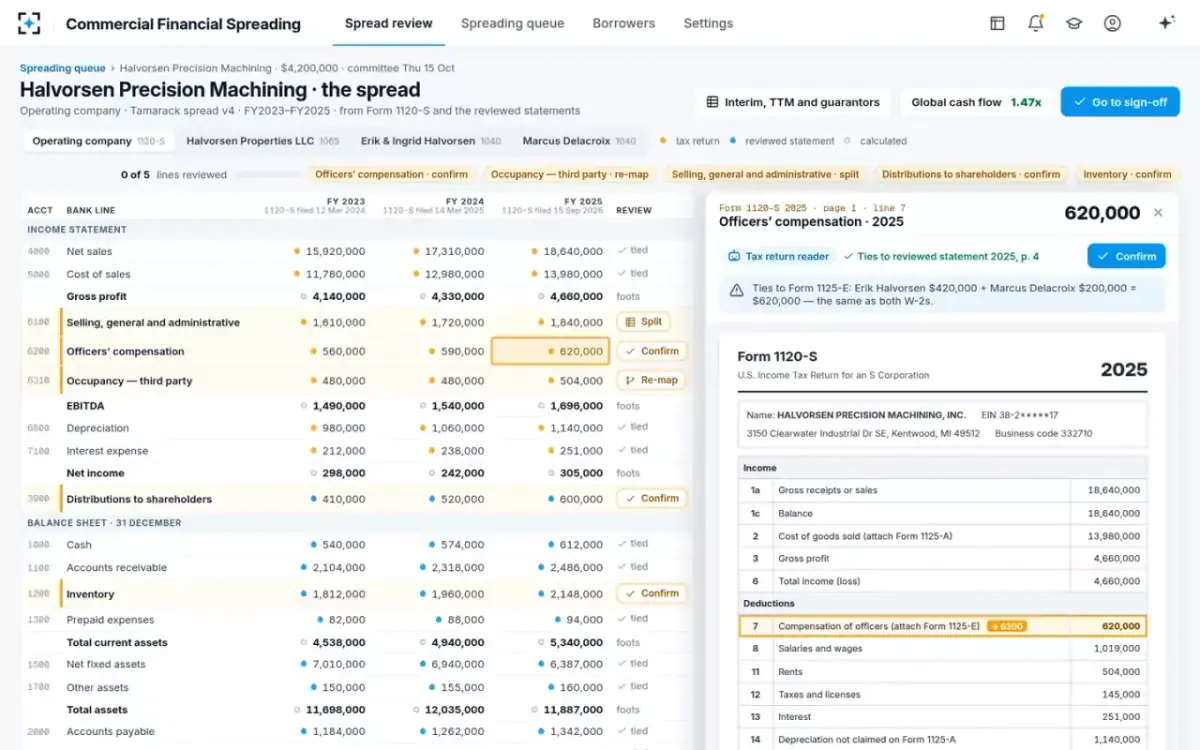
A spread that ties the CPA statement to Schedule L and M-1 has already done most of the transcript work, because the transcript is a copy of the return's line items. In Commercial Financial Spreading the tax return reader ties Schedule L to the CPA balance sheet and Schedule M-1 to book income for every return it reads, and cites both pages. If the transcript then disagrees with the return, the difference is between the return and the IRS, not between two sets of books.
A figure tied across sources, with the page beside it
Tax transcript vs tax return: what the IRS copy contains
A transcript is not a photocopy of the return. The Form 4506-C instructions describe three line 6 products: a return transcript, the line items as filed; an account transcript, which carries "payments made on the account, penalty assessments, and adjustments made by you or the IRS after the return was filed" but limits return information to "items such as tax liability and estimated tax payments"; and a record of account, "a combination of the Return Transcript and the Account Transcript" (IRS). Return transcripts exist only for the Form 1040 series, 1065, 1120, 1120-H, 1120-L and 1120-S.
Three mechanics trip analysts up. Each request names one tax form number, so an S corporation and its two owners are three requests, not one. The IRS must receive the form "within 120 days of the date signed by the taxpayer or it will be rejected", which matters when a package sits waiting for its last K-1. And a wage and income transcript, requested on line 7, gives the IRS's copy of the owners' W-2s, the independent check on officers' compensation that the return's Form 1125-E only restates.
What the transcript cannot show is the other half of the comparison. It holds no CPA statement, no Schedule L detail beyond what the return carries and nothing about the current year. Matching a transcript to the return proves the return is the one the IRS holds; it says nothing about whether the books behind the statements agree with that return. That is the job of the tie-out described above, and the reason it comes first.
How to work a mismatch, step by step
A disciplined order keeps the analyst from chasing the wrong document. Start from the largest lines, because a fabricated or mis-keyed statement usually shows first in gross receipts and total assets, and only then go to the reconciling schedules.
From transcript to resolved difference
Agent
Tie statement to returnSales to line 1a, cost of goods sold to Form 1125-A, Schedule L to the balance sheet, M-1 to book income, each with both pages.
Never: plugs a difference to make it tie.
A person decides
Compare return to transcriptGross receipts, total income, deductions and taxable income, line by line, for each year, starting from a return already tied to the books.
A person decides
Classify and decideBook-to-tax, amendment, period, entity or not filed: accept with the reason. Unexplained: request a document or escalate.
When the difference is the fraud
The rare case is the one the whole procedure exists for. A borrower who fabricates statements cannot easily fabricate the return the IRS holds. In March 2026 a real estate developer was indicted on the allegation that, to get a $3.8 million loan, he "sent the lender fabricated bank statements, leases, and checks" (FDIC OIG); the case is an allegation, not a finding. Statements made for a lender tend to be stronger than the returns made for the tax collector, and the gap is in the direction that flatters the borrower.
The tie-out also protects the bank afterwards. If a borrower files for bankruptcy and the bank seeks to keep its claim on the basis of false financial information, the FDIC's examination manual notes that the institution "must prove the written financial statement was materially false, it reasonably relied on the statement, and the debtor intended to deceive the institution. These assertions can be difficult to prove" (FDIC). A spread that shows what was read, from which page, and what it was tied to is the evidence of reliance.
Statements prepared for a lender and returns prepared for the IRS rarely err in the same direction. The comparison is the test.
SBA's rules for the hard cases: no record, amended, not yet filed
SBA's SOP spells out what to do when the transcript cannot simply be matched, and its answers are a good template for any bank's procedure. If the IRS "has no record on the Applicant or no record of any of the required years of transcripts, no disbursements may be made" until the issue is resolved, with one narrow relief: where three years are required, a "Record Not Found" for the middle year may be accepted if the other two are verified and the applicant shows a refund or tax payment for the missing year (SBA).
For an amended return whose transcript is not yet available, the lender must obtain "a copy of the signed amended return" and evidence of filing, such as an IRS acceptance report or a certified mail receipt. The most recent fiscal year is not required "if the fiscal year-end is within 6 months of the date SBA received the application". If the IRS does not respond within 10 business days, the lender resubmits marked "Second Request", and "Any significant differences must be resolved to the satisfaction of the SBA Lender."
The cost of skipping the step is stated too. A delegated 7(a) lender may close and disburse before the transcript arrives, but if it then cannot obtain and reconcile the transcript, "the guaranty may be subject to repair or denial". The reconciliation is, in effect, part of the guarantee.
Timing: the return is often the oldest document in the package
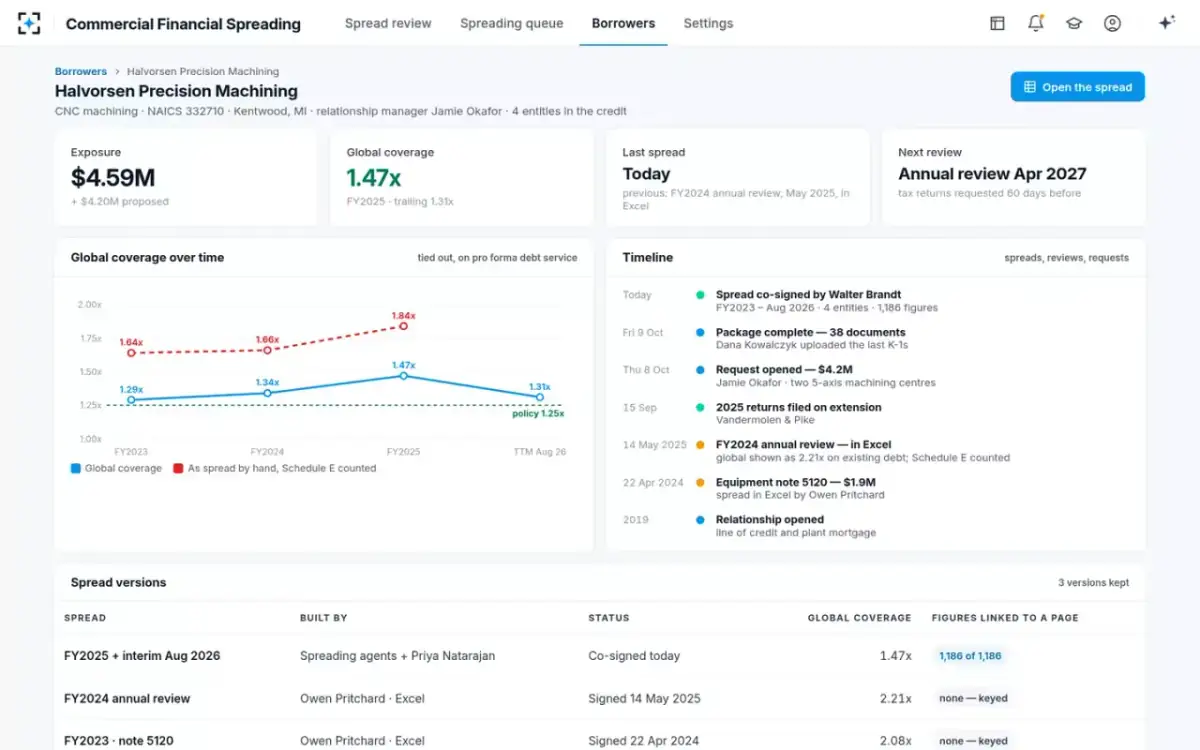
Transcripts confirm the past, and the past arrives late. The sample borrower's fiscal 2025 return was filed on 15 September 2026 under an extension, so a credit decided in October uses a return less than a month old and an interim to August. Earlier in the year the most recent return would be on extension and absent from any transcript; SBA's answer is "a copy of the extension along with evidence of payment of estimated taxes" (SBA). The current year rests on the interim, which no transcript will ever check, and that is where the spread's own tie-outs matter most: the sample interim's balance sheet was $50,000 out, traced to an advance to an owner in the general ledger detail.
The relationship over time: returns on extension, spreads kept by version
Before you call a transcript mismatch a problem
- Confirm the period
Fiscal year end on the statement, the return and the transcript request.
- Confirm the entity
One return per entity; consolidated statements need a consolidating schedule.
- Check for an amendment
And order a transcript type that shows changes to the original return.
- Reconcile through Schedule M-1 or M-3
Book-to-tax differences are expected; only the unexplained remainder is an exception.
- Start with the big lines
Gross receipts and total assets show fabrication first.
- Keep the evidence
Both pages, the difference and the decision, with the name of the person who made it.
The return and the statement are two of the four sources a lender can lean on; audited, reviewed, compiled or tax return compares all four. For the K-1s, where a mismatch most often hides in a guarantor's cash, see the annotated K-1, and for the solution itself, Commercial Financial Spreading.
Questions people ask
What is the difference between Form 4506-C and Form 4506-T?
Form 4506-C is the request used through the IRS's Income Verification Express Service, which lenders join directly or use through an IVES participant; the transcript goes to the participant named on the form (IRS). Form 4506-T is the general request for a transcript.
How many years of transcripts can a lender get?
Return transcripts cover the current year and returns processed during the prior three processing years; the record of account covers the current and three prior tax years, according to the Form 4506-C instructions.
Schedule M-1 vs M-3: which one will the borrower file?
It depends on size. Corporations with total assets of $10 million or more at year-end file Schedule M-3, which reconciles book and tax income in far more detail, line by line and by type of difference; smaller ones file the one-page M-1, and the smallest S corporations may skip it altogether. Either schedule ends at the same place, taxable income, so the spread ties book net income to whichever one the borrower filed.
Can the borrower's accountant order the transcript for the lender?
Not for an SBA loan. The SOP says "SBA will not permit the borrower or its own tax preparer or enrolled agent to file IRS Form 8821 for an SBA loan", and requires the lender, and any lender service provider, to be named as designee (SBA). The point is independence: a transcript routed through the borrower is no longer the one document the borrower did not hand over.
Does a mismatch always need the borrower's explanation?
Not if the documents already explain it, as Schedule M-1 does for book-to-tax differences. Anything the documents do not explain goes back to the borrower or the borrower's accountant, in writing, before funding.