A day in the life of a commercial credit analyst is mostly spent turning a borrower's paperwork into a spread: every line of the business tax returns, the CPA statements and the latest interim, keyed into the bank's template for the operating company, each affiliate and each guarantor, then tied out and combined into global cash flow and ratios. Only then does the analysis the job is named for begin. On a borrower with one affiliate and two guarantor households, our estimate is about three working days by hand, and most of that is data entry. Botminds' Commercial Financial Spreading exists to move that entry to agents that pin each figure to its page, so the analyst's hours go to the credit.
This page follows one such week. The borrower is fictional sample data used throughout the solution: Halvorsen Precision Machining, a CNC machine shop asking for a $2.8 million equipment term loan and a $1.4 million line renewal, with a property company that owns its plant and three owners who guarantee. The hours are our estimates for a package of this shape, not a survey. No independent study we found measures the time a spread takes, which is itself worth knowing when someone quotes you one.
The job, in public numbers
64,390
credit analysts employed in the United States, May 2025
$83,510
median annual wage for a credit analyst; the mean is $100,850
74–82%
of small banks rank the business’s financial position as the most important part of a loan application
What does a commercial credit analyst do all day?
Mostly, a commercial credit analyst prepares the numbers a lending decision rests on. The analyst reads the borrower's financial statements and tax returns, spreads them into the bank's template, computes cash flow, debt service coverage and leverage, explains the trends, and hands a signed spread to whoever writes the credit memo. In many banks the analyst also drafts that memo. The Bureau of Labor Statistics describes commercial loan officers as people who "analyze the finances of businesses applying for credit" and who "need to understand general business accounting, including how to read financial statements" (BLS). The analyst is the person who does that reading line by line.
The work matters because the bank leans on it. In the FDIC's survey of small business lending, most small banks, "74 to 82 percent", called the business's financial position the most important aspect of an application, regardless of loan size (FDIC). Examiners say the same thing from the other side: "Lending errors frequently result because of management's failure to obtain and properly evaluate credit information" (FDIC RMS Manual, Section 3.2). The spread is where that information is either evaluated or merely transcribed.
Is a credit analyst the same as an underwriter?
Not quite: in most commercial banks the analyst builds and explains the numbers, and the underwriter or credit officer recommends or approves the loan with delegated authority. The titles blur at smaller banks, where one person may do both. The BLS treats underwriting as a specialty inside its loan officer occupation, saying "Loan underwriters specialize in evaluating whether a client is creditworthy", and does not describe credit analysts on that page at all (BLS). The distinction that matters on the desk is authority, not title.
The OCC frames it the same way. Its 2026 lending booklet says the involvement of "an independent loan approval authority (such as a senior credit officer or credit risk management team) whose primary goal is credit quality can introduce more objectivity to the loan approval process", and tells examiners to check "that the documentation and analysis are sufficient to make an informed credit decision, and that the approver had sufficient authority" (OCC). The analyst produces the first half of that sentence; the approver supplies the second. In the sample bank an analyst signs a spread alone up to a $1,000,000 relationship, and a senior underwriter co-signs above it.
How long does it take to spread financials? About 24 hours for four entities
By our estimate, about 24 working hours for a borrower with one affiliate and two guarantor households, and roughly two-thirds of them are keying. The Halvorsen package holds 38 documents and 412 pages across four entities and three tax years: three Forms 1120-S for the operating company, three Forms 1065 with Form 8825 for the property company, six personal returns for two guarantor households, 12 Schedules K-1, three reviewed statements, an August interim and the personal financial statements. Sorting that and keying the returns takes about 1.3 working days. Keying the CPA statements and the interim takes another 0.6. Tying out, building global cash flow and computing ratios takes 0.8, and exceptions, requests and sign-off 0.3.
By hand, three days of the week go on one borrower; with agents, an afternoon
- Sort the package, key returns and K-1s10.4 h
- Key CPA statements and interim4.8 h
- Tie out, global cash flow, ratios6.4 h
- Exceptions, requests, sign-off2.4 h
- Review, decide, sign3 h
Read the top lane as a week rather than a block. Few analysts get three uninterrupted days. The spread is keyed between calls from the relationship manager, other packages arriving and a memo due for another committee. A spread that needs 24 hours of attention can easily occupy five calendar days, and the borrower, who sent everything on Friday, asks why it takes a week.
Monday and Tuesday: the pages nobody sees decide the length
The returns take longest because the pages behind page 1 do. A Form 1120-S is five pages, but the spread needs Form 1125-A for cost of goods sold, Form 1125-E for officers' compensation (required, the IRS says, once total receipts "are $500,000 or more"), Schedule L for the balance sheet, Schedule M-1 or M-3 to reconcile book and tax income, and Schedule K with a K-1 for every shareholder (IRS). The property company's Form 1065 adds Form 8825 for rental income. Each personal Form 1040 brings Schedule E, where the K-1 income lands, and W-2s for the owners' wages.
The analyst has to match all of this before keying it. Which K-1 belongs to which return, for which year, and for which owner? Halvorsen's 12 K-1s are two per entity per year, because the operating company is owned 70% by Erik and Ingrid Halvorsen and 30% by Marcus Delacroix, and the property company 90% by Erik and 10% by Ingrid. A missing page is discovered here, usually after an hour has been spent on the rest of the return. The figures in the K-1s matter more than their number suggests, as the annotated K-1 explains: two boxes carry the difference between taxable income and cash.
Most of the hand-built spread is keying, not analysis
By hand · 24 hours
- Keying returns, K-1s, statements · 63%
- Tie-out, global cash flow, ratios · 27%
- Exceptions, sign-off · 10%
With agents · 3 hours
- Reviewing what was keyed · 50%
- Checking the tie-out · 25%
- Deciding, signing · 25%
Wednesday: keying the CPA statements and the interim
The reviewed statements arrive as PDFs in the accountant's layout, not the bank's. The analyst maps each line to the bank's chart of accounts, foots the statement, rolls equity forward from last year and checks that the balance sheet balances. The interim is harder. It is usually a management-prepared trial balance or a two-page report, with no notes, and it is where things go wrong quietly.
Halvorsen's August interim shows how. Total assets read $11,774,000 against liabilities and equity of $11,824,000. By hand, the temptation is a plug, a $50,000 line called "other" so the sheet balances and the spread can move on. The difference is a $50,000 check to Erik Halvorsen on 18 June 2026, booked to general ledger account 1350, which the interim template never picks up. It belongs on the balance sheet as due from shareholder and out of tangible net worth. A plug would have hidden a loan to the owner.
Thursday: tying out, and the one number everyone reads
Tying out is where an analyst earns the title. The tax return is compared with the CPA statement line by line; officers' compensation on the return with Form 1125-E and the W-2s; Schedule L with the reviewed balance sheet; and the K-1s with Schedule K and with the owners' Schedule E. Then come the combination steps: the operating company, the property company and the two households become one global cash flow, set against the debt service with the new loan in it.
This is the step that a spreadsheet makes easy to get wrong. Last year's Halvorsen spread added the owners' Schedule E income, $591,000, on top of the entities' own cash flow and showed global coverage of 1.84x. Counted once, at the entity, the same year covers 1.47x. Both numbers look plausible; only one is right, and the wrong one is the one a committee would like to see. Global cash flow, line by line walks through the arithmetic.
“I key for two days and get one afternoon to think.” That is how the sample analyst puts it, and the arithmetic above agrees.
Friday afternoon: the part of the job that is judgement
The judgement fits into the hours that are left. With the spread tied out, the analyst reads it as a credit: margin fell to 21.8% for the eight months against 25.2% a year earlier; inventory rose 32% to $2,840,000; the line is 94% drawn; on the trailing twelve months business coverage is 1.16x against a 1.20x policy. Those four lines are the beginning of a conversation with the relationship manager and the borrower's controller about a fixed-price supply contract and mill surcharges. They are the reason the bank employs an analyst, and by Friday afternoon of a keying week there is little time for them.
The same week touches four people, and each loses something to the keying. The senior underwriter co-signs a spread he cannot trace back to a return. The head of credit analysis cannot be sure two analysts would produce the same number. The relationship manager waits a week for a package the borrower finished on Friday.
Four people carry the same spread, and each week looks different once the keying moves
Today
Keys returns, K-1s and statements for two days; one afternoon for the credit itself.
With agents
Opens a spread already keyed and tied out, works down the flagged lines with each page beside its figure.
Still theirs: every mapping decision, every exception, the signature.
Today
Co-signs spreads he cannot trace back to the return they came from.
With agents
Sees each exception with its pages and each adjustment with its reason before co-signing.
Still theirs: the second signature above the analyst’s limit.
Today
Owns the spreading standard but cannot see how each analyst applied it.
With agents
Sets the template, the global cash flow method and coverage floors once; every change is versioned.
Still theirs: the credit policy and the template.
Today
Explains to a borrower who sent everything on Friday why the bank needs a week.
With agents
Sees the package spread minutes after it is complete, with the requests to the borrower drafted.
Still theirs: the borrower conversation.
Is credit analyst a stressful job? The pressure is the calendar
The pressure in the job comes less from any single spread than from the clock it runs against. In the FDIC's survey of small business lending, "Three in ten banks, including more than half of large banks, can approve a small and simple loan within one business day" (FDIC). A borrower with an affiliate and two guarantor households is not a small and simple loan, but the borrower and the relationship manager compare it with the ones that are, and the spread is the one step in the process that cannot be hurried without risk.
The second source of pressure is the signature. A signed spread is the analyst's statement that the numbers are tied to their source, and the OCC lists "inadequate financial analysis" among the underwriting weaknesses examiners look for (OCC). Halvorsen shows how the two pressures meet: the package arrived at 16:40 on a Friday, the memo is due the following Wednesday, and the committee sits on Thursday. Under that calendar the step most likely to be rushed is the one that decides whether the coverage ratio is real, the tie-out.
The workload is also lumpy. In many banks annual reviews bunch up after tax season, because extended S corporation and partnership returns are due in September and extended personal returns in October, and new requests do not wait for them. The sample queue on a Monday in October holds nine packages, 27 entities and four memos due for one committee. Each package is a separate set of returns to key, which is why the queue rather than the borrower sets the length of the analyst's day.
The same week with the keying moved to agents
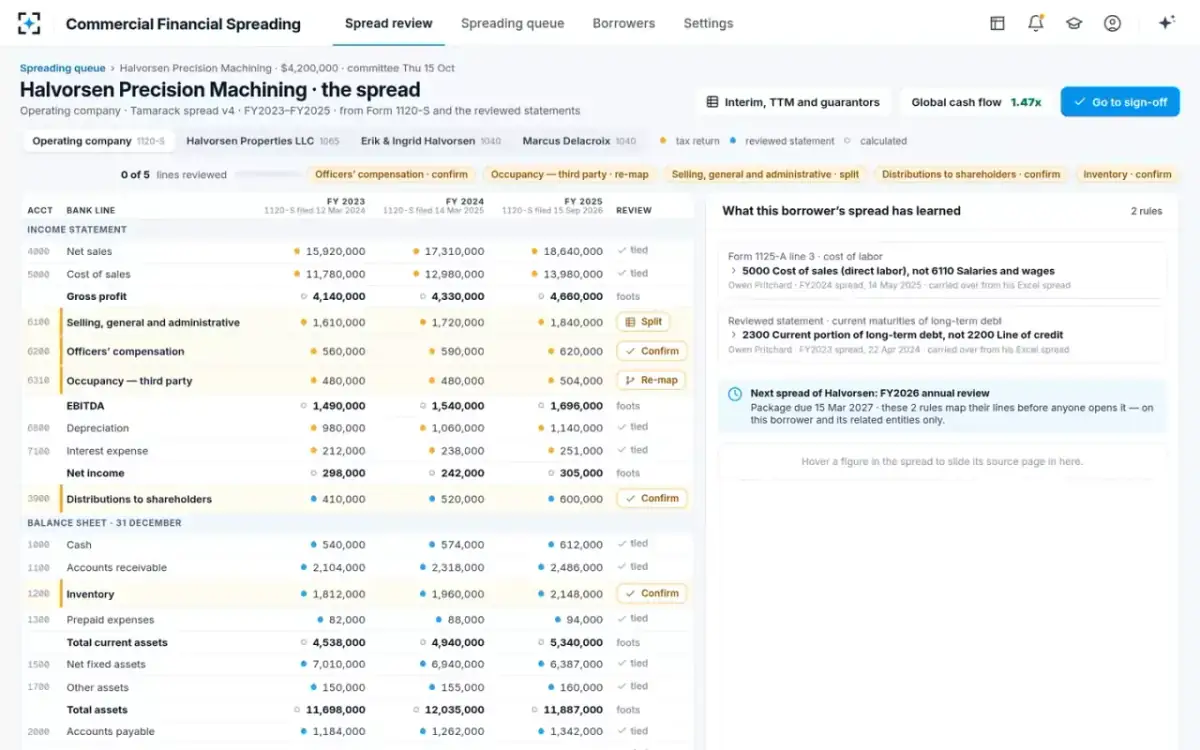
In Commercial Financial Spreading, six agents do the sorting and keying the moment a package is complete. On the Halvorsen package the run took 6 minutes 48 seconds on Friday afternoon: the package sorter matched 38 documents to four entities and three tax years, the tax return reader read 12 returns and 12 K-1s, the statement spreader spread the reviewed statements and the interim, and the exception writer wrote five exceptions, each with its pages. 1,186 figures went onto the spread, each pinned to its document, page and line. The run, step by step traces what each agent did and what it would not do.
Monday morning: the queue is ranked by when the memo is due
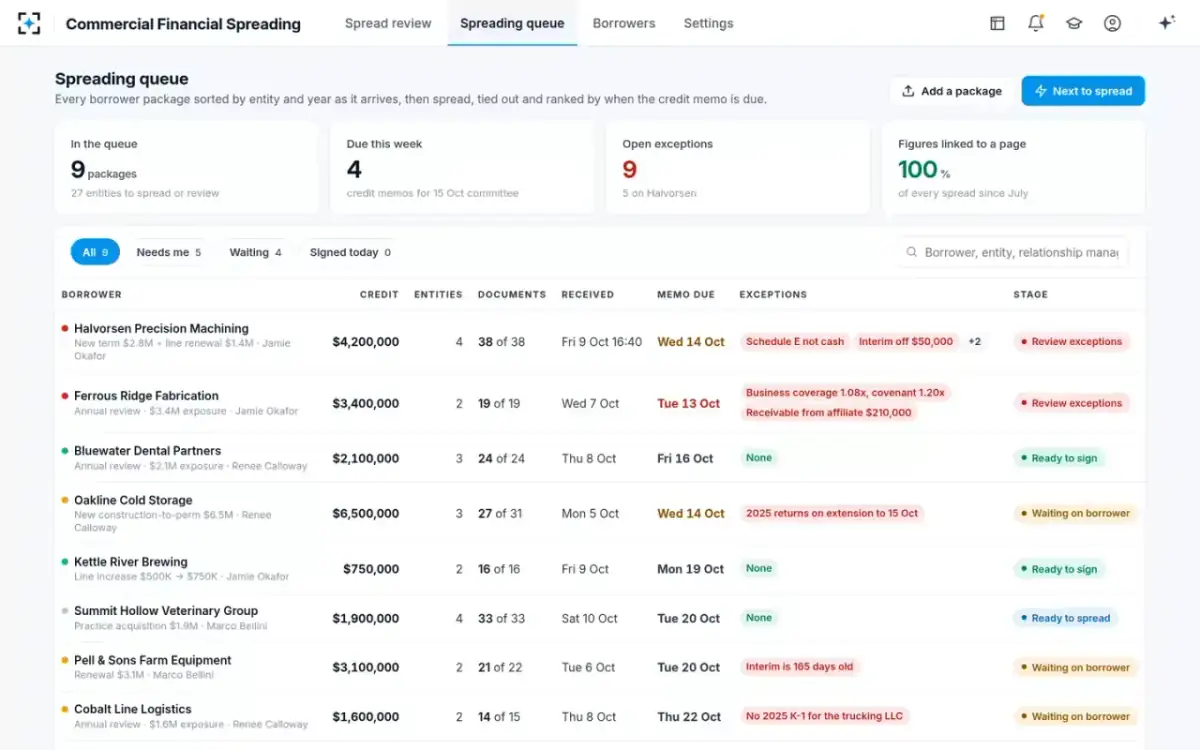
Halvorsen is at the top because its memo is due Wednesday, not because it arrived first.
Monday then looks different. The analyst opens the operating company's spread, three years in the bank's template, with five lines flagged: confirm officers' compensation, re-map the rent paid to the owners' property company, split selling, general and administrative expense into three return lines, confirm distributions, confirm inventory. Hovering any figure slides its source page in beside the grid with the line boxed. The analyst's work is to agree or disagree with what was keyed, and to decide the five exceptions.
The spread opens with five lines to review, not 1,186 to key
What still needs the analyst, and why the role grows rather than shrinks
The agents never sign, never send a request to the borrower without the analyst, and never plug a statement to make it tie. Everything that takes judgement stays with a person: whether rent paid to an affiliate is an expense to eliminate, whether a 19-month-old personal financial statement can still be relied on, whether a margin squeeze is temporary. Above the analyst's signing limit a senior underwriter co-signs. On Halvorsen the relationship is above $1,000,000, so Walter Brandt's signature follows Priya Natarajan's.
What changes is the proportion. Our design target is under three hours of analyst time for a signed four-entity spread like this one, against about 24 by hand. That frees time rather than people, and the question for a head of credit is what to do with it: deeper analysis on the borrowers that need it, faster answers on the ones that do not, or more relationships per analyst. What one spread costs turns the same hours into money with your own numbers.
A week audit any analyst can run on their own spreads
- Log one package from arrival to signature
Note the hours spent sorting, keying returns, keying statements, tying out and on exceptions. Our split is an estimate; yours is the number that counts.
- Count the pages you keyed that nobody else will read
K-1s, Form 8825, Form 1125-E, Schedule L. They set the length of the spread.
- Count every plug
Each balancing line named "other" is a question the spread did not answer.
- Check whether global cash flow uses Schedule E or K-1 cash
If it adds Schedule E income to entity cash flow, the same dollars are counted twice.
- Time the afternoon of judgement
If it is the smallest block in the week, the job is upside down.
Questions people ask
What is financial spreading?
Financial spreading is copying a borrower's financial statements and tax returns into the bank's standard template, year beside year, so that every borrower is measured on the same lines and ratios. The template's lines are the bank's chart of accounts, not the accountant's or the IRS's, so each figure has to be mapped as well as keyed. The spread is the input to cash flow, coverage, leverage and the risk rating.
How many hours do credit analysts work?
The BLS does not publish hours for credit analysts specifically; for loan officers it says "Most loan officers work full time, and some work more than 40 hours per week" (BLS). On the analyst's desk the long weeks tend to follow the committee calendar and the autumn rush of extended tax returns.
How much does a credit analyst make?
The credit analyst median shown at the top of this page sits above the $76,690 median the BLS reports for loan officers in May 2025 (BLS). The analyst occupation also includes consumer and trade credit analysts, so commercial bank analysts are only part of it, and its mean runs about $17,000 above its median, a sign of a long upper tail of senior and specialist roles.
Is credit analysis mostly data entry?
For a hand-built commercial spread with pass-through entities and guarantors, a large share is, by our estimate about two-thirds of the hours. The share falls for a single C corporation with audited statements and rises with every affiliate and guarantor, because each brings its own returns and K-1s.
Will spreading software replace credit analysts?
The BLS expects loan officer employment to grow only 1% from 2025 to 2035, partly because of "productivity-enhancing technology in loan processing" (BLS). In Commercial Financial Spreading the analyst still decides every mapping question and signs every spread; the agents do the keying and the tie-out arithmetic.
What does SBA require an analyst to spread?
For an existing business, SBA's SOP 50 10 8.1 asks for "the three most recent years of historical financial information (tax returns or balance sheet with debt schedule and income statement) plus an interim financial statement", a debt service coverage of at least 1.15 on the business and 1:1 globally (SBA). The Commercial Financial Spreading settings carry those floors as an option alongside the bank's own.