Audited vs reviewed vs compiled financial statements, for a commercial loan: an audited statement carries the most assurance, a reviewed statement limited assurance, a compiled statement none, and a tax return none from an accountant but a different strength: it is what the business told the IRS, and a lender can verify it against an IRS transcript. No federal rule sets one standard for every loan. The regulators require the bank's own lending policy to say which statements it needs at which borrowing level, and examiners test the bank against that policy. A careful spread uses more than one source and ties them to each other, which is how Botminds' Commercial Financial Spreading works: one source leads, by the bank's setting, and the others are tied to it line by line.
What the rules ask a lender to know about a borrower’s statements
4
kinds of statement examiners record: audited, reviewed, compiled or prepared by the borrower, fiscal or interim
4
audit opinions they also note: unqualified, qualified, disclaimer or adverse
$1M
USDA’s guaranteed business loans: audited statements above this balance, compiled or reviewed at or below it
Annual
the Federal Reserve’s floor: the bank should obtain at least annual statements from a borrower
What level of financial statements does a bank need? Its own policy decides
The rules put statement quality inside the lending policy rather than in a fixed table. The Federal Reserve's examination manual says the policy "should define the financial-statement requirements for businesses and individuals at various borrowing levels. Specifically, requirements for audited, unaudited, annual, or interim balance sheets; income and cash-flow statements; statements of changes in capital accounts; and supporting notes and schedules should be included" (CBEM §2010.1). The NCUA writes the same duty into regulation for federally insured credit unions: the commercial loan policy must address "the financial statement quality and the degree of verification sufficient to support an accurate financial analysis and risk assessment" (12 CFR 723.4(f)).
The examination manual is candid about what examiners will actually find in the file: "Much of the financial information that examiners will review will not be audited; therefore, considerable understanding of general accounting principles is necessary to competently review an unaudited financial statement", and "The bank should obtain at least annual financial statements from a borrower" (CBEM §2080.1). When an examiner writes up a weak credit, the manual asks for a record of "whether the financial statements have been audited, reviewed, compiled, or prepared by the borrower, and whether they are fiscal or interim statements" (CBEM, Classification of Credits). Statement quality is part of the credit write-up, not a footnote to it.
SBA is the one federal programme that names the documents. For an existing business, a 7(a) lender's analysis rests on "the three most recent years of historical financial information (tax returns or balance sheet with debt schedule and income statement) plus an interim financial statement", and the statements must "agree with the business tax returns submitted to the IRS" (SOP 50 10 8.1). SBA, in other words, makes the tax return the check on the statements.
Do banks require audited financial statements? Above a size, or when collateral depends on them
Some loans, by policy: no federal rule requires an audit for an ordinary commercial loan, but one federal programme shows the logic most bank policies follow. USDA's rule for guaranteed business and industry loans requires annual audited statements from a borrower whose loan balance is "more than $1 million", and for $1 million or less accepts "statements compiled or reviewed by an accountant" instead (7 CFR 1980.445). It also lets the agency ask for more where the risk warrants it: "loans that depend heavily on inventory and accounts receivable for collateral will normally be audited, regardless of the size of the loan".
That second sentence is the useful one for a commercial lender, because size is a crude proxy. A loan secured by inventory and receivables relies on balance sheet numbers that a review never tests and a compilation never questions: nobody counted the stock or confirmed the customers. Halvorsen shows the case: inventory up 32% to $2,840,000 in the August interim and the revolving line 94% drawn. A bank lending against that inventory would usually lean on a field exam or an audit rather than on a reviewed statement's analytics.
The other usual triggers are complexity and change. Multiple entities with transactions between them, a new controller, a change of accountant or restated figures all argue for more assurance. The FDIC's examination manual, in its warning signs for reserve-based energy loans, lists "Frequent financial statement revisions or changes in chosen accounting method" (FDIC RMS Manual, Section 3.2), a sign that reads the same way in any industry.
Audited vs reviewed vs compiled financial statements, side by side
The four sources differ in who stands behind them, what work was done, and what a lender can check afterwards. An audit is the only one in which the accountant tests the numbers against outside evidence and the business's controls. A review is analytical: the accountant asks questions and looks for numbers that do not make sense. A compilation is the business's numbers put into proper form. A tax return is prepared under tax rules rather than accounting standards, but it is filed under penalty of perjury and leaves an IRS record the lender can obtain.
Four sources of the same numbers, and what each gives a lender
| Audited | Reviewed | Compiled | Tax return | |
|---|---|---|---|---|
| Accountant’s assurance | High, not absolute: an opinion | Limited: no material modifications found | None | None from an accountant; signed by the taxpayer |
| Work done | Inquiry, analytics, controls, verification and substantiation | Inquiry and analytical procedures | Form and presentation | Prepared under tax rules |
| Notes and cash flow statement | Yes | Usually | Often omitted | No; Schedule L balance sheet, M-1 or M-3 reconciliation |
| Independent check a lender can run | Accountant’s report | Accountant’s report | Little | IRS transcript through Form 4506-C |
| Typical weakness | Cost; arrives months after year-end | Analytical, so a consistent error can pass | Owner’s numbers, formatted | Tax-driven choices: depreciation, owner pay, timing |
| Typical use | Larger and more complex credits | Mid-sized commercial credits | Smaller lines and renewals | Every pass-through borrower and guarantor |
Reviewed vs compiled financial statements: what each leaves out
A review is analytical and a compilation is presentational, and neither tests the numbers against outside evidence. In a review the accountant asks management questions and compares the figures with prior years and with each other, and reports whether anything came to light suggesting the statements need material changes. That is limited assurance: nobody counted the inventory or confirmed the receivables. A reviewed statement in which inventory has been overstated consistently, year after year, can pass a review that compares ratios with prior years.
A compilation gives the lender the owner's numbers in a professional layout, with the accountant expressing no assurance at all, and it may omit the notes and the cash flow statement. That is not nothing: an accountant would not knowingly attach a name to obviously wrong statements. But for credit purposes a compiled statement is close to a management statement, and the interim figures most lenders rely on for the current year are usually less than that. SBA treats a reviewed statement as a form of verification in its own right: where tax transcripts cannot identify a division being bought, a lender may use "third-party CPA-prepared or reviewed financial statements" among other evidence (SOP 50 10 8.1).
The interim is often the least verified document in the package and the only current one, so it is where a spread most needs its tie-outs.
What does a qualified audit opinion mean for a lender?
It means the auditor found a problem serious enough to name: the report reads like a clean opinion but uses "except for" or similar wording. The Federal Reserve's manual describes the four types in its chapter on banks' own external audits, and the reading carries over to a borrower's. The unqualified report "states that the financial statements are 'presented fairly' in conformity with GAAP"; the qualified report signals "a lack of sufficient evidential matter, restrictions on the scope of audit work, or departures from GAAP"; an adverse report "concludes that the financial statements are not presented fairly"; and a disclaimer "expresses no opinion" (CBEM §4500.1).
The type is not printed as a heading. The manual notes that standard reports "will never have a heading or other statement in the report that identifies which type it is"; it has to be read from the wording. That is why the classification chapter tells examiners to record "the type of opinion expressed" and, where it is qualified, to "note the reason(s) given by the auditor" (CBEM, Classification of Credits). A spread built from audited statements should carry the opinion type beside the year, because a scope limitation on inventory and a going-concern disclaimer change what the numbers can bear.
Can a lender use tax returns instead of financial statements?
The tax return's strength is that it can be checked against the IRS, and the IRS asks it to agree with the books. Form 1120-S instructions say the Schedule L balance sheets "should agree with the corporation's books and records", and Schedule M-1 or M-3 reconciles book income to taxable income; corporations with total assets of $10 million or more must file the fuller M-3 (IRS). Those two schedules are the bridge between the CPA statement and the return, and a spread that ties them has tested both.
SBA allows it for the historical years, as quoted above, and many lenders spread smaller pass-through borrowers from returns alone. Its weaknesses are timing and purpose. The sample borrower's fiscal 2025 Form 1120-S was filed on 15 September 2026, under an extension, nearly nine months after year-end. And its numbers follow tax rules: depreciation, owners' compensation and the timing of expenses are chosen to manage tax, not to show cash flow. Small corporations can skip the balance sheet altogether; a corporation with total receipts and total assets each under $250,000 "is not required to complete Schedules L and M-1" (Form 1120-S).
Statement leads or return leads: the same borrower, two ways of building the spread
CPA statement leads, return tied: The reviewed or audited statement, mapped to the bank’s chart of accounts.
Tax return leads, statement tied: The return’s page 1, Form 1125-A, Schedule L and the K-1s.
CPA statement leads, return tied: The return: sales to line 1a, officers’ pay to Form 1125-E, Schedule L to the balance sheet, M-1 to book income.
Tax return leads, statement tied: The statement, where one exists, for detail the return lacks.
CPA statement leads, return tied: Accounting basis, notes and more detail on the balance sheet.
Tax return leads, statement tied: Verifiable against an IRS transcript; the same basis for every borrower.
CPA statement leads, return tied: Only as good as the level of the accountant’s work.
Tax return leads, statement tied: Tax-driven numbers; slow to arrive; thin balance sheet for small filers.
CPA statement leads, return tied: As exceptions with both pages cited.
Tax return leads, statement tied: As exceptions with both pages cited.
Why one source is never enough: two recent fraud cases
Fraud cases reach the spread through documents that look like any others. In March 2026 a federal jury convicted a former bank chief financial officer of bank fraud that used "fraudulent and inflated contractor invoices" and in which he "failed to disclose significant personal debts owed to family members" in a loan application (FDIC OIG). The same month a real estate developer was indicted on the allegation that, to get a $3.8 million loan, he "sent the lender fabricated bank statements, leases, and checks" (FDIC OIG); that case is an allegation, not a finding.
Neither case turned on audit level. Both turned on documents supplied by the borrower and not checked against an independent source. That is the argument for tying every source to every other: the statement to the return, the return to the IRS transcript, the K-1s to Schedule K and Schedule E, the personal financial statement to the guarantor's own return. When the statements do not match the transcript walks through what each kind of mismatch usually means.
How Commercial Financial Spreading spreads one source and ties the others
The solution's statement spreader maps audited, reviewed, compiled and interim statements to the bank's chart of accounts, foots each statement and rolls equity forward. The tax return reader reads 1120-S, 1065, 1120 and 1040 returns with their schedules and ties them: K-1s to Schedule K, Schedule E to the K-1s, Form 1125-E to the W-2s, Schedule L to the CPA balance sheet, Schedule M-1 to book income. Every value cites its form, page and line, and a statement that does not tie becomes an exception, not a plug.
On the sample borrower, officers' compensation of $620,000 for 2025 is read from line 7 of the Form 1120-S, tied to page 4 of the reviewed statement, and tied again to Form 1125-E, Erik Halvorsen $420,000 and Marcus Delacroix $200,000, which matches both W-2s. Four sources agree; the analyst confirms with the page beside the figure. Where they disagree, as the August interim's balance sheet did by $50,000, the difference is traced to the general ledger detail and shown with both pages.
One figure, four sources: officers’ compensation tied out
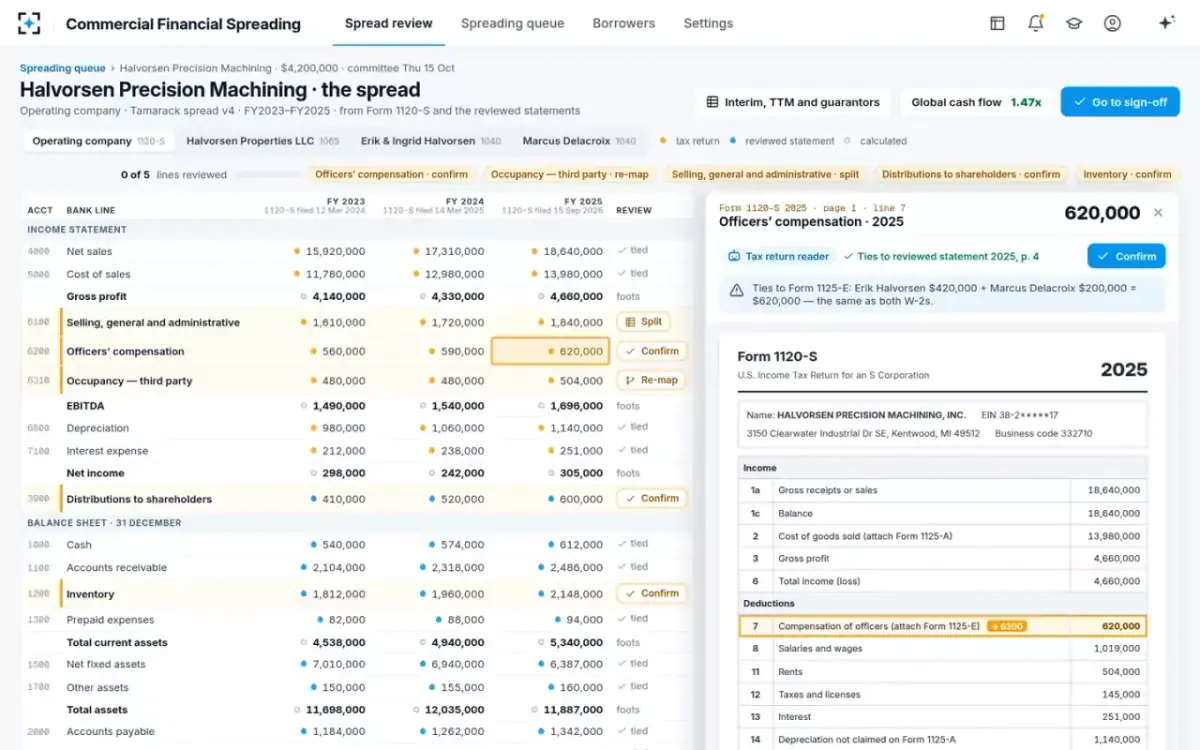
Hover any figure and its source page slides in with the line boxed.
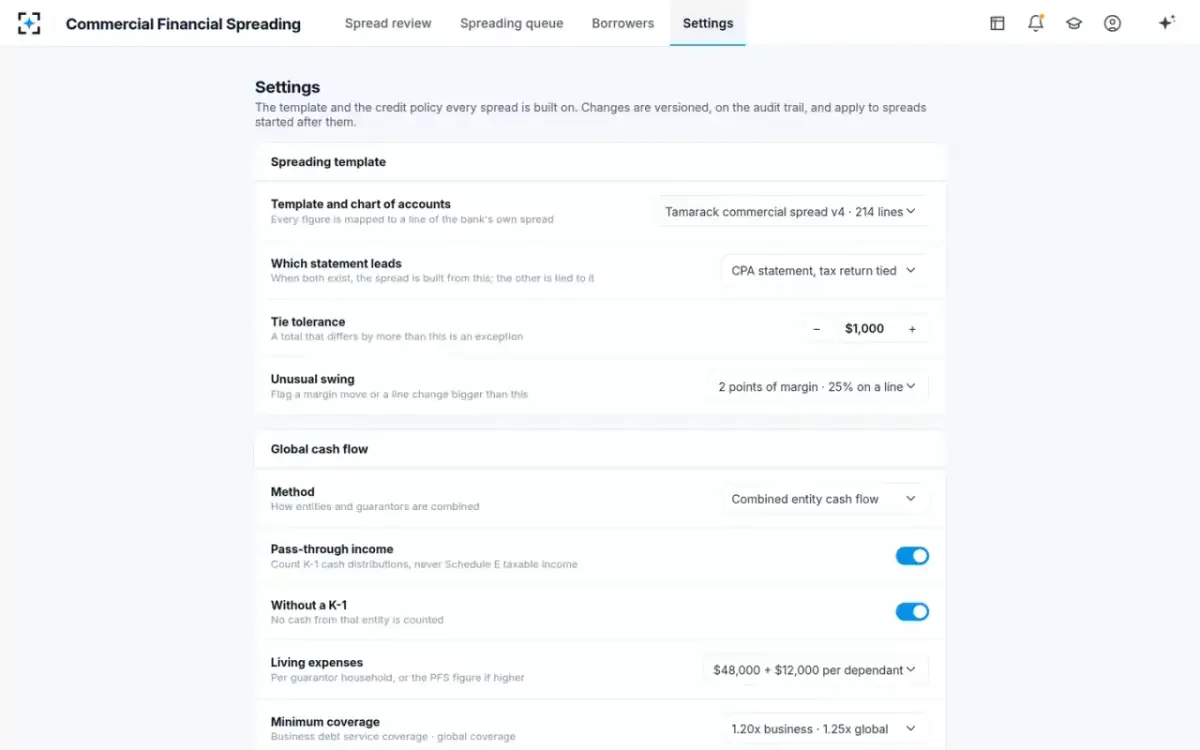
The settings say which source leads and how close counts as tied. The sample bank's tie tolerance is $1,000: a total that differs by more is an exception. Changing either is a versioned change of credit policy that applies to spreads started afterwards, which is the record an examiner asks for when testing a bank against its own policy.
The policy, as settings: which statement leads and how close is tied
What a lending policy should say about statement quality
- The level required at each borrowing level
Audit, review or compilation, by exposure and loan type, with the exceptions process for a borrower who cannot provide it.
- Which source leads the spread
Statement or return, so two analysts build the same spread the same way.
- What is tied, and to what tolerance
Sales, officers’ pay, the balance sheet and book income, within a stated dollar amount.
- When a transcript is required
SBA requires one; many banks require it above a size or for any pass-through guarantor.
- How stale is too stale
Age limits for the interim and the personal financial statement; SBA’s is 90 days for the PFS at approval.
- What happens when sources disagree
An exception, with both pages, decided by a named person rather than a plug.
Questions people ask
Does an unqualified audit opinion mean the borrower is a good credit?
No. The Federal Reserve's manual puts it bluntly for banks' own audits: an unqualified report means the balances follow GAAP, and "It does not mean that the transactions made business sense" or that the balances "can be recovered upon disposition or liquidation" (CBEM §4500.1). An audit tells a lender the numbers are fairly stated; the spread still has to say whether they can carry the debt.
Is a CPA-prepared statement the same as a compiled one?
Not necessarily. Statements on an accountant's letterhead can come from an audit, a review, a compilation or a plain preparation engagement with no report at all, and only the accountant's report, or its absence, says which. Spread the report page with the statements, because it is the evidence for the level the policy requires.
Does a borrower's audit cover the interim statements?
No. An audit or review covers the fiscal year it reports on; the interim a lender receives months later is usually prepared by management with no accountant involved. A spread therefore keeps fiscal and interim figures in separate columns, records which is which, and builds any trailing twelve months explicitly rather than adding a fiscal year to an interim.
When should a lender ask a borrower to move from a review to an audit?
When the loan comes to depend on balance sheet numbers a review does not test, such as a borrowing base of inventory and receivables; when the exposure crosses the policy's size threshold; or when the statements have been revised or restated. Ask early, because an audit adds cost and months to the borrower's year-end.
What if the CPA statement and the return disagree?
Expect some differences, which Schedule M-1 or M-3 should explain. A difference the reconciliation does not explain is an exception to resolve with the borrower's accountant before the spread is signed. The Commercial Financial Spreading page shows how those exceptions are written.