The case for financial spreading automation starts from what a commercial spread costs the bank today: the analyst hours it takes, times a loaded hourly cost, plus the second signature's time, plus two costs that rarely make it into a business case: the days the borrower waits and the errors the spread carries into the credit decision. For a borrower with one affiliate and two guarantor households, our estimate is about 24 hours of analyst time by hand. At the mean BLS wage for a credit analyst, loaded for benefits, that is about $1,660 a spread in time alone. Botminds' Commercial Financial Spreading is designed to cut the analyst's share to under three hours, a target rather than a measured result. Every number on this page is an input you should replace with your own; no public source from a regulator or academic body measures the time a commercial spread takes.
The inputs a cost model starts from
$100,850
mean annual wage of a US credit analyst, May 2025; the median is $83,510
70%
share of private-industry employer compensation cost paid as wages; benefits are the other 30%
≈ $69
loaded cost of an analyst hour: $100,850 ÷ 2,080 hours ÷ 0.70
≈ 24 h
our estimate of analyst time for a four-entity spread by hand
How long does it take to spread financials for a commercial loan?
It depends on the number of entities more than on the size of the loan. A single C corporation with audited statements is one set of statements, one return and no K-1s. A typical owner-managed borrower is not that. Most business returns are pass-through returns: in fiscal 2025 the IRS received 6,154,614 Forms 1120-S and 5,215,815 Forms 1065, against 2,350,205 C corporation returns (IRS Data Book). Each pass-through brings K-1s for its owners, each owner a personal return, and each affiliate its own return and K-1s.
The sample package in the solution is a fair middle case: four entities, three tax years, 38 documents and 412 pages. Our estimate for it by hand is 3.0 working days: 1.3 sorting and keying the returns and K-1s, 0.6 keying the CPA statements and interim, 0.8 tying out and building global cash flow and ratios, and 0.3 on exceptions, requests and sign-off. A single-entity borrower might take a third of that; a borrower with three affiliates and four guarantors, half as much again.
Where the cost of a hand-built spread sits
By hand · ≈ 24 h · ≈ $1,660
- Keying returns and K-1s · 43%
- Keying statements and interim · 20%
- Tie-out, global cash flow, ratios · 27%
- Exceptions, sign-off · 10%
Why the spread is paid for every year, not once
A commercial relationship is spread again at every renewal and annual review, so the cost per spread recurs for the life of the credit. The Federal Reserve's examination manual expects lending policy to include "the requirement for an annual review of borrowers, including a reassessment of the appropriateness of credit lines" (CBEM §2010.1). Short maturities force the same rhythm from the borrower's side: among firms with less than $50 million in assets, "three-quarters of credit lines have maturity of 1 year or less at origination" (Chodorow-Reich and others, NBER).
That changes the arithmetic of anything that shortens the second spread. By hand, next year's analyst starts from a blank template and re-learns each borrower's peculiarities. In Commercial Financial Spreading, the mapping decisions made this year become rules for that borrower: the sample borrower's fiscal 2026 annual review package, due 15 March 2027, will have its affiliate rent and its split expense lines mapped before anyone opens it. The saving on a renewal therefore tends to be larger than on a first spread, and a cost model that prices only new credits understates it.
Credit analyst hourly wage, loaded: $48 becomes $69
The BLS mean wage for a credit analyst, $100,850 a year, is about $48.49 an hour over 2,080 paid hours; the median, $83,510, is about $40.15 (BLS OEWS). Neither is what an hour costs the bank. In June 2026, wages were 70.0% of private-industry employer compensation costs and benefits the other 30.0%, on an average total of $46.89 an hour across all private jobs (BLS ECEC). Dividing the wage by 0.70 loads it for benefits: about $69.27 an hour at the mean and $57.35 at the median.
The loaded rate still leaves things out, deliberately. It excludes the cost of the desk, the systems, management time and the hours an analyst is paid but not spreading: training, meetings, leave. A bank that wants a fully loaded rate can add its own overhead factor, but the business case is easier to defend when the rate is conservative and the hours are measured. A rate that is too high flatters every saving on the page.
How much does a commercial spread cost a bank? Line by line
Put the pieces in a table and the arithmetic is simple. The point of writing it out is to see which inputs are yours to measure and which are only estimates.
One four-entity spread: cost by hand and with the target
| Cost line | By hand | With the solution (target) | Input to measure |
|---|---|---|---|
| Analyst hours | ≈ 24 | under 3 | Log ten packages from arrival to signature |
| Loaded hourly cost | $69 | $69 | Your own salary band and benefit load |
| Analyst cost | ≈ $1,660 | under $210 | Hours × loaded cost |
| Second signature | Not traceable to pages; time varies | Exceptions and adjustments with their pages | Senior underwriter minutes per co-signed spread |
| Days the borrower waits | Often a calendar week | Spread ready minutes after the package is complete | Package complete → spread signed, in days |
| Errors carried into the decision | Unmeasured | Caught as exceptions with pages | A seeded-error test on both processes |
| Software and set-up | None | Licence, configuration, testing | Vendor quote and your test plan |
Two rows are not money yet, and both matter. The days the borrower waits are the relationship manager's problem until a competitor answers first; the FDIC's survey of small business lending found that "Three in four banks approve their typical loan within ten business days" (FDIC), so a spread that occupies a calendar week uses half the bank's usual decision window. The errors are worse because they are invisible: in the sample, last year's spreadsheet method showed global coverage of 1.84x where the tied-out figure is 1.47x. A spread can be cheap and wrong.
How to calculate the ROI of spreading automation
The return on spreading software is the analyst time released, the second-signature time saved and the errors avoided, less the cost of the software, its set-up and the testing the bank must do before relying on it. Written as a sum:
Annual return on automated spreading, term by term
Analyst time released
spreads a year × (hours by hand − hours with the tool) × loaded rate
The hours by hand are the input to measure first; ours are an estimate.
Head of credit analysis
Review time saved
co-signed spreads × minutes saved × senior rate
From reviewing exceptions with their pages instead of re-tracing figures.
Senior credit officer
Errors avoided
catch rate on planted errors × errors in the current process × cost of an error
Measured with a seeded-error test on both processes.
Credit review
Software, set-up and testing
licence + configuration of templates and policy + validation time
Including the bank’s own testing before go-live.
Procurement, IT, model risk
Which inputs move the answer most
Volume and hours saved dominate. The bars below illustrate the first term for a bank of our own invention at $69 a loaded hour, under two assumptions about hours saved per four-entity-equivalent spread: 21 hours (our estimate of 24 by hand against the three-hour target) and a cautious 12. The point is the spread between them, not either figure.
Analyst time released per year, by volume and hours saved (illustrative)
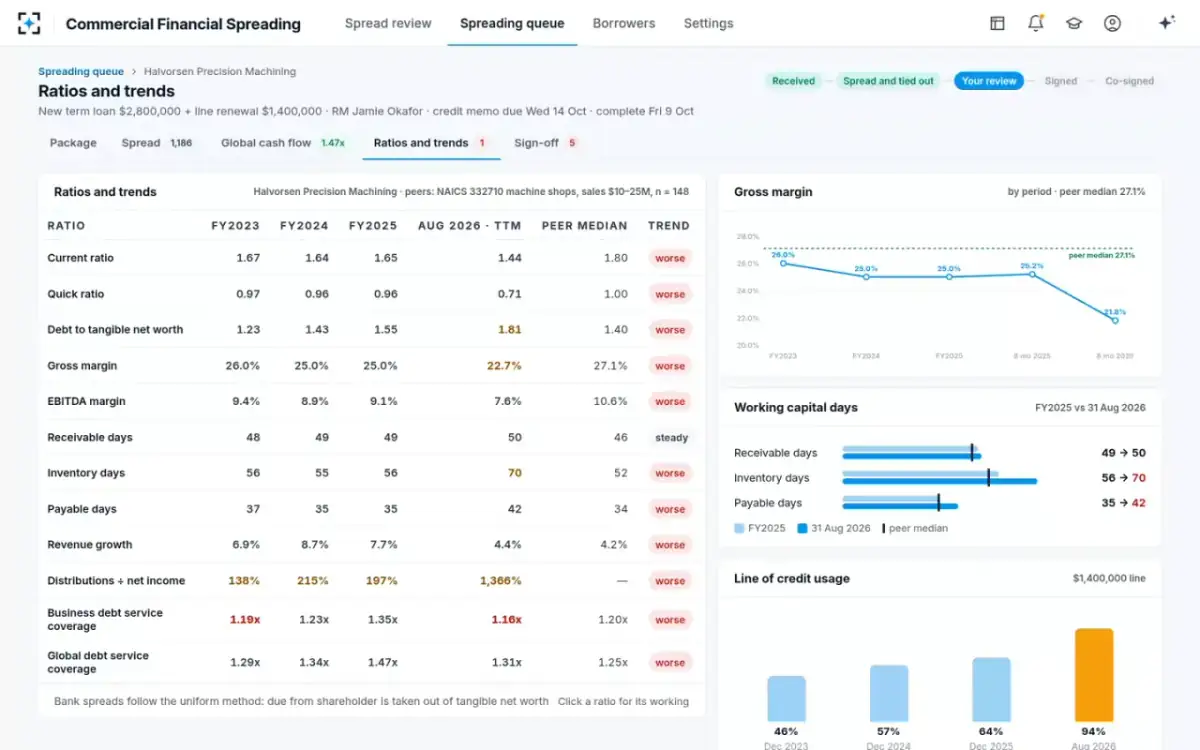
Released time is not a budget line until someone decides what it is for. For most credit teams the choice is between more relationships per analyst, faster answers to borrowers, and more of the analysis the job is supposed to be about: margin trends, working capital, the supply contract behind a falling margin. An analyst's week shows where that afternoon of judgement goes now.
What released time is for: the analysis after the keying
Is financial spreading automation worth it? Find the break-even volume
It is worth it when the hours released, priced honestly, exceed the full annual cost of the tool, and the simplest test is a break-even volume. At $69.27 a loaded hour, a spread that saves 21 analyst hours releases about $1,455 of time; one that saves a cautious 12 hours releases about $831. Every $100,000 of annual cost, licence plus set-up spread over its life plus the bank's own testing, therefore needs about 69 spreads a year at the higher saving, or about 121 at the lower, before the first term of the formula pays for it.
Count the spreads honestly. Annual reviews and renewals are spreads too, and a relationship with four entities is closer to four spreads of keying than one. A bank that spreads 200 owner-managed relationships a year at renewal and adds 60 new ones has a volume well above either break-even per $100,000; a bank that spreads 40 audited single entities a year probably does not, and should say so before buying anything. These are our illustrations; the price and the hours are the bank's to put in.
Spreads a year needed to release $100,000 of analyst time
What financial spreading automation does not save
It does not save the judgement, the borrower's delays or the review, and a business case that assumes otherwise will disappoint. The three hours left in the target are the analyst checking flagged lines, deciding exceptions and signing, and that time should stay. A package that arrives without its last K-1 waits for the borrower whatever tool spreads it; in the sample queue, one relationship is held because a trucking LLC's 2025 K-1 has not arrived.
Nor does it shorten the parts of the credit process after the spread: the memo, the committee, the closing. The FDIC's survey found that "Nearly three in four banks have at most three levels of approval, even for larger and more complex loans" (FDIC), and those levels take the time they take. What automation changes is that the spread stops being the longest item on that path, and that the figures arriving at each level carry their pages with them.
Costs that belong in the business case
A fair business case counts the bank's own effort as well as the vendor's price. Configuring the templates and the credit policy settings takes the head of credit's time. Testing the tool before relying on it takes credit review's time, and should: planting known errors is the way to measure the third term of the formula, and it measures the current process too. Third-party due diligence and, where the bank decides it applies, model risk review take the second line's time.
The ongoing cost is review. With the keying done by agents, the analyst still checks the flagged lines, decides the exceptions and signs, which is the target's three hours. That time is the part of the spread the bank should want to keep.
Measure these five before you build a business case
- Hours per spread, by entity count
Log ten packages of different shapes from arrival to signature.
- Spreads per year, weighted by entities
Annual reviews and renewals as well as new credits.
- Calendar days from complete package to signed spread
The number the relationship managers feel.
- Errors in the current process
Plant twelve kinds of error in packages for your own analysts and count the catches.
- Review minutes per co-signed spread
How long the second signature takes when every figure must be traced by hand.
The whole solution, from the queue to the co-signed spread, is on the Commercial Financial Spreading page. For what the bank keeps unchanged while the hours move, see keeping your spreading template.
Questions people ask
Is there an industry benchmark for time per spread?
Not from a regulator, a statistical agency or an academic study that we could find. Figures quoted in marketing material vary widely and rarely say what a spread contained. Measure your own.
Should the cost model use the median or the mean wage?
Use your own pay band if you can. Between the BLS figures, the mean ($100,850) is closer to a cost-to-employer view in banks that pay above the occupation's middle; the median ($83,510) gives about $57 a loaded hour instead of $69.
Can an SBA lender charge the borrower for spreading software?
Within limits. SBA's SOP lets a lender include "fees associated with technology services" for software used in "preparing SBA loan documents, underwriting, or closing" within a reasonable packaging fee, but adds that "Entities providing technology services that include underwriting are considered to be LSPs" needing an SBA-reviewed agreement, and a lender may not pass a lender service provider's fees through to the applicant (SOP 50 10 8.1). How a given tool is classified is a question for the lender's SBA counsel.
Should the business case count avoided credit losses?
Only with care. Across all insured institutions the net charge-off rate on commercial and industrial loans was 0.57% year to date at 30 June 2026 (FDIC Quarterly Banking Profile), so a loss term built from averages is small, and one built from a single bad credit is an anecdote. The defensible version prices measured catch rates by their effect on decisions, such as a coverage ratio that would have crossed the policy floor.
Does faster spreading reduce headcount?
That is the bank's choice. The design target frees about 21 hours on a four-entity spread; whether those hours go to more borrowers, faster answers or deeper analysis is a staffing decision, not a property of the software.