Yes, AI financial spreading works: AI can spread a borrower's statements and tax returns, and the useful question is how you would know it had done so correctly. In Botminds' Commercial Financial Spreading, six agents sort a borrower package by entity and year, read every tax return and CPA statement, map each line to the bank's chart of accounts, tie the sources to each other, build global cash flow and the ratios, and write up whatever does not tie. Every value carries its form, page and line. None of the agents signs a spread or sends anything to the borrower. This page traces one run, on fictional sample data, so that "AI spreading" becomes a sequence a head of credit can check step by step.
The package belongs to Halvorsen Precision Machining, a machine shop asking for $4.2 million: a $2.8 million equipment term loan and a $1.4 million line renewal. At 16:40 on a Friday the borrower's controller, Dana Kowalczyk, uploaded the last six K-1s. The package was then complete, and the run began.
One run, start to finish
38
documents in the package, 412 pages, for four entities and three tax years
6:48
minutes and seconds from the last upload to a spread ready for review
1,186
figures on the spread, each pinned to its document, page and line
5
exceptions written with their pages; 11 checks passed
Can AI spread financial statements accurately?
It can spread them fast; accuracy has to be shown figure by figure, which is why the design starts from citations rather than from a confidence score. The U.S. Treasury's 2024 report on AI in financial services warns that generative AI "can be susceptible to 'AI hallucinations,' producing confidently stated but incorrect output" (Treasury). A spreading agent that may not post a figure without the page it came from turns that risk into something checkable: a figure with no page is not on the spread, and a figure with a page can be compared with it in a second.
Supervisors describe current bank use of AI in the same terms. The OCC's Spring 2026 Semiannual Risk Perspective found banks "taking a measured approach to the adoption of generative AI (genAI) and agentic AI, with usage generally limited to specific use cases with guardrails and human-in-the-loop accountability to manage risk" (OCC). A spread fits that description well: the inputs are documents, the outputs are numbers that can be compared with them, and a person signs. How to test automated spreading sets out a way to measure the accuracy before relying on it.
The run, second by second
The run has three phases of very different length. Sorting the package took 41 seconds. Reading the 12 returns and 12 K-1s took 2 minutes 52 seconds, the longest single step, because each return is read with every schedule and tied before it is passed on. The remaining 3 minutes 15 seconds covered the statement spreading, global cash flow, ratios and exceptions.
Where the 408 seconds went
- Sort 38 documents41 s
- Read and tie 12 returns, 12 K-1s2 min 52 s
- Spread statements, global cash flow, ratios, exceptions3 min 15 s
Step 1, the package sorter: 38 documents to four entities and three years
The package sorter identifies each document, the IRS form and its schedules, the CPA statement and its level, the interim, debt schedules, personal financial statements, and matches it to an entity by name and employer identification number, and to a tax year. On Halvorsen it found four entities with three tax years each and no page missing from 2023 to 2025. It drew the ownership from the K-1s: the operating company 70% Erik and Ingrid Halvorsen and 30% Marcus Delacroix; the property company 90% Erik and 10% Ingrid.
Two limits govern this step. The sorter never assigns a document to an entity it cannot match by name or EIN; it asks. And a missing page is always an exception. Most manual spreading errors that are not keying errors start here, with a K-1 attached to the wrong owner or a schedule from the wrong year.
Step 2: can AI read tax returns and K-1s? The tax return reader
The tax return reader read three Forms 1120-S, three Forms 1065 with Form 8825, and six Forms 1040, with their K-1s, Forms 1125-A and 1125-E, Schedules L and M-1. It ties as it reads: K-1s to Schedule K, Schedule E to the K-1s, Form 1125-E to the W-2s, Schedule L to the CPA balance sheet, Schedule M-1 to book income. It cites form, page and line for every value, never uses a figure from a page it has not seen, and keeps taxable pass-through income apart from K-1 cash. That last rule produced the run's most consequential finding, below.
Six agents, then two people: what each does and what each may never do
Agent
Package sorterIdentifies every document and matches it to its entity by name and EIN, and to its tax year.
Never: assigns a document it cannot match; it asks.
Agent
Tax return readerReads 1120-S, 1065, 1120 and 1040 returns with every schedule and K-1, and ties them to each other.
Never: uses a figure from a page it has not seen.
Agent
Statement spreaderMaps audited, reviewed, compiled and interim statements to the bank’s chart of accounts, foots them, rolls equity forward.
Never: plugs a statement to make it tie.
Agent
Global cash flow builderCombines the entities and households by the bank’s method, eliminates payments between them, sets cash against debt service.
Never: counts pass-through income without a K-1, or the same dollar twice.
Agent
Ratio and trend analystComputes ratios, the trailing twelve months and peer comparisons, flags swings beyond the threshold.
Never: changes a policy threshold.
Agent
Exception writerWrites each failed check with the figures on both sides and their pages, and drafts the request that would clear it.
Never: signs a spread or sends a request without the analyst.
A person decides
Credit analystConfirms, re-maps or splits lines with the page beside each figure, decides every exception, signs.
A person decides
Senior underwriterCo-signs above the analyst’s limit, seeing each exception and each adjustment with its reason.
Steps 3 to 6: statements, global cash flow, ratios and exceptions
The statement spreader spread three years of reviewed statements and the August 2026 interim into the bank's 214-line template. The interim did not balance: total assets of $11,774,000 against liabilities and equity of $11,824,000. The agent may not plug, so it looked in the general ledger detail and found a $50,000 check to Erik Halvorsen on 18 June 2026, booked to account 1350. It added the amount as due from shareholder and took it out of tangible net worth, citing the interim balance sheet page and the general ledger detail page.
The global cash flow builder combined the four entities under the bank's combined entity method and produced 1.47x for fiscal 2025. Last year's spreadsheet had shown 1.84x by adding $591,000 of the owners' Schedule E income on top of the entities' own cash flow; the agent is not allowed to count pass-through income that way, and it wrote the difference up as an exception rather than silently correcting it. Global cash flow, line by line shows the arithmetic. The ratio analyst computed the trailing twelve months, where business coverage is 1.16x against a 1.20x policy, and flagged the fall in gross margin from 25.2% to 21.8%.
The five exceptions the run wrote, and the pages behind each
| Exception | What it found | Pages cited | Effect |
|---|---|---|---|
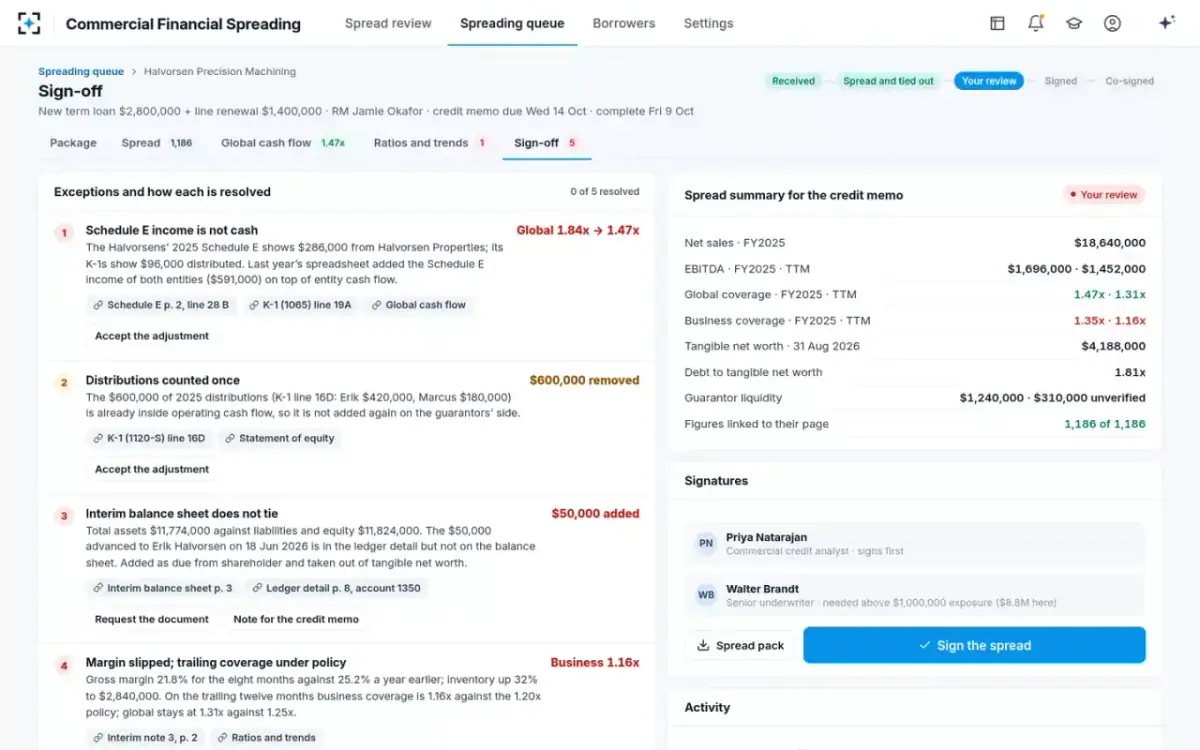
| Schedule E income is not cash | Property company: $286,000 on Schedule E, $96,000 distributed on the K-1s | Schedule E p. 2, line 28 B · K-1 (1065) line 19A | Global 1.84x → 1.47x |
| Distributions counted once | $600,000 of 2025 distributions already inside operating cash flow | K-1 (1120-S) line 16D · statement of equity | $600,000 removed |
| Interim balance sheet does not tie | $50,000 advance to an owner in the general ledger detail, not on the balance sheet | Interim balance sheet p. 3 · general ledger detail p. 8, account 1350 | $50,000 added as due from shareholder |
| Margin slipped; trailing coverage under policy | Gross margin 21.8% for eight months against 25.2%; inventory up 32% | Interim note 3, p. 2 · ratios | Business 1.16x vs 1.20x |
| Personal financial statement out of date | Guarantor’s statement dated 14 March 2025, 19 months old against a 12-month policy | PFS, signed 14 March 2025 | Liquidity unverified |
The package after the run: who is in the credit, what the agents did, what failed
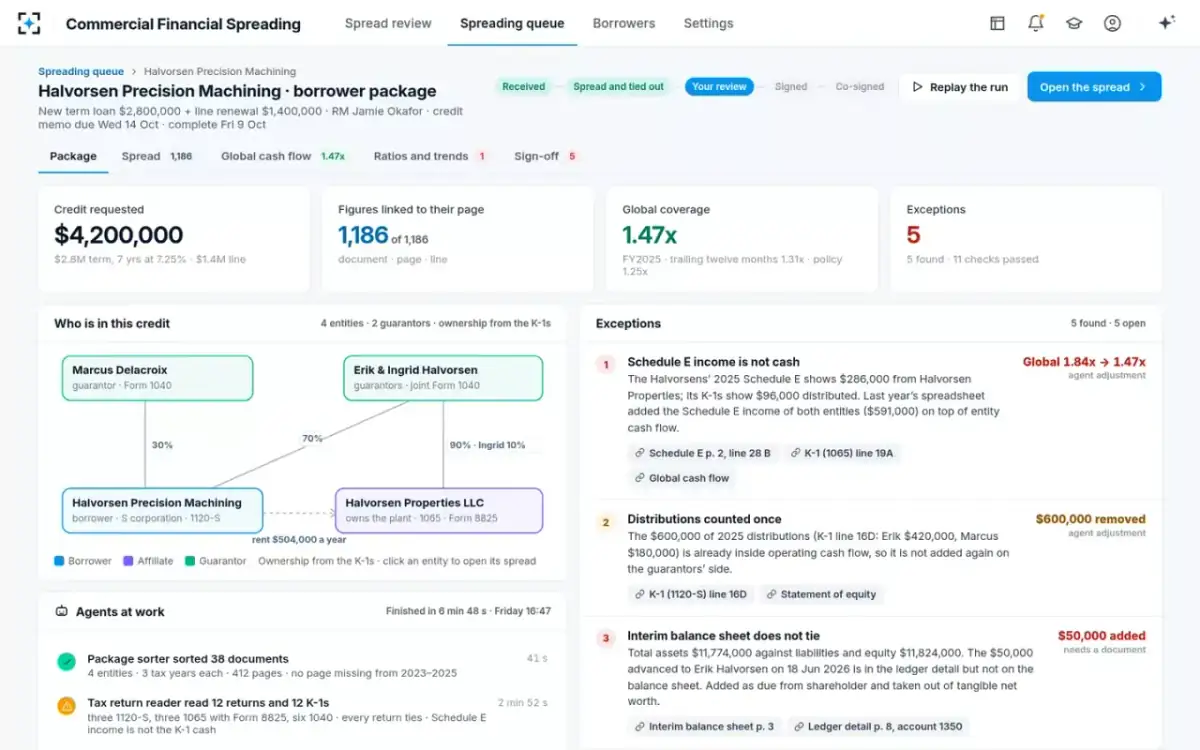
Look at the second agent line: “Schedule E income is not the K-1 cash” is the finding that moved global coverage.
Tax return spreading software vs AI that reads the whole return
Tax return spreading software can be built two ways. A template-based extractor works by position: it knows where a box sits on a given year's form and lifts the number from there. That works on page 1 and breaks on everything that makes a commercial return hard. The amounts a spread needs are spread across attachments whose presence depends on the filer: Form 1125-E only once total receipts "are $500,000 or more", Schedule M-3 instead of M-1 at $10 million of total assets, and no Schedule L or M-1 at all for a small corporation under $250,000 of receipts and assets (IRS). Statements from different accountants have no common layout at all.
The difference that matters to a credit officer is not reading but tying. Lifting 1,186 numbers correctly is half the job; the other half is noticing that two of them should agree and do not. On Halvorsen the most consequential finding was not a misread figure but a relationship: $286,000 on a Schedule E against $96,000 of cash on the K-1s behind it. A tool that extracts each page accurately but never compares pages would have reproduced last year's 1.84x, and every figure in it would have been correctly read.
What to look for in automated financial spreading tools
Judge a tool by what it does with the figures it cannot be sure of, not by its demonstration on clean ones. The checklist below is the one we would apply to any automated financial spreading tool, ours included; each item can be tested on a package of the bank's own before a contract is signed, and a planted-error test turns the list into a score.
Seven questions for any automated financial spreading tool
- Can every figure be opened at its source line?
Not a document link: the page and line, boxed. Pick twenty figures at random and time how long each takes to verify.
- Does it read the attachments, not just page 1?
Forms 1125-A and 1125-E, Schedules L, M-1 or M-3, K, the K-1s, Form 8825 and the owners’ Schedule E.
- Does it tie sources to each other?
Return to statement, K-1s to Schedule K, Schedule E to K-1s, officers’ pay to W-2s, with a stated tolerance.
- What happens when something does not tie?
An exception with both pages is right. A plug, a silent correction or a confidence score is not.
- Whose template and whose method?
The bank’s chart of accounts, global cash flow method and coverage floors as settings, versioned when changed.
- Who decides and who signs?
Mapping questions, exceptions and the signature stay with named people; the tool drafts but does not send.
- Can a run be replayed and explained to an examiner?
Agent steps, human decisions and spread versions kept on one trail.
Where Commercial Financial Spreading fits, honestly: it earns most on owner-managed borrowers that file pass-through returns, with affiliates and guarantors, where most of the hours go to K-1s, Schedule E and the tie-outs. A single C corporation with audited statements and no guarantors has far less to key and tie, and the case for any tool is weaker there. Under the third-party guidance the bank still has to do its own due diligence on whichever tool it chooses, and the checklist above is a reasonable place for that diligence to start.
Monday, 08:40: what the analyst sees first
The analyst, Priya Natarajan, opens the operating company's spread rather than a dashboard. Five lines wait for her. She hovers 2025 officers' compensation, $620,000, and page 1 of the Form 1120-S slides in with line 7 boxed, tied to the reviewed statement and to Form 1125-E. She confirms it. She re-maps the rent paid to the owners' property company from third-party occupancy to affiliate rent, and the re-map becomes a rule for this borrower's later spreads with her name on it. She splits selling, general and administrative expense into the three lines the return shows. Then she works the five exceptions: two adjustments accepted, the others noted for the credit memo, requests sent to the borrower for the September interim and an updated personal financial statement.
The agents decided nothing on this package. They put five decisions in front of the analyst, each with its pages.
Sign-off: each exception and how it was resolved, then two signatures
What AI financial spreading does not do
It does not decide anything about the credit. The trace shows three things a head of credit should take from that. First, the time saved is the keying, not the thinking: the run did in under seven minutes what our estimate puts at well over a day of an analyst's sorting and keying, and left the decisions where they were. An analyst's week sets those hours out. Second, each limit is testable. A reviewer can pick any of the 1,186 figures and open its page; a plug or an uncited figure would be visible as such. Third, the bank's policy drives the run. The method, the tolerances, the swing thresholds and the coverage floors are settings the head of credit owns, versioned when they change.
The responsibility does not move with the work. Interagency guidance on third parties says that "the use of third parties does not diminish or remove banking organizations' responsibilities to ensure that activities are performed in a safe and sound manner" (88 FR 37920). The spread is still the bank's, signed by the bank's people. Examiners have long expected banks to report on "automated financial statement spreads of borrowers" (CBEM §2010.1); what changes is that each automated figure now carries its page.
Questions people ask
What does the AI do when it cannot read a page?
It does not guess. A document it cannot match is a question to the analyst; a missing page is an exception; a value it has not seen on a page is not posted.
Does it work with our template?
Yes. Every figure is mapped to a line of the bank's own spread, and the analyst's re-maps become rules for that borrower. Keeping your spreading template covers how.
Does it learn from our past spreads?
It carries forward the mapping decisions people have made, as rules with a name, a date and a scope. On the sample borrower two rules came from the previous analyst's Excel spreads, such as Form 1125-A line 3, cost of labor, mapped to cost of sales; a new re-map applies to the same borrower's next spread and its related entities only.
Is AI spreading covered by model risk guidance?
Largely not. The April 2026 interagency guidance (OCC 2026-13, Fed SR 26-2) leaves spreadsheet-style arithmetic and deterministic rules out of its definition of a model, and puts generative and agentic AI outside its scope until the agencies' promised request for information. That leaves the governance of an AI reader to the bank's own risk framework; is spreading software a model? applies the definition step by step.
Is the run repeatable?
The run can be replayed from the package screen, and every spread version is kept with the agent steps and human decisions on its activity trail. See the Commercial Financial Spreading page for the full screens.