Earnings season is the stretch of roughly five to six weeks after each calendar quarter ends in which most US-listed companies publish their quarterly results, starting a couple of weeks after the quarter closes and peaking just before the SEC's 40- and 45-day deadlines for the quarterly report on Form 10-Q. In the June 2026 quarter, by our count of the SEC's own data, 79% of the 10-Qs for that quarter were filed in the two weeks from August 3 to 14. For a buy-side equity research team that crowding is the whole problem: every covered company reports in the same few mornings, each release has to be caught, keyed into the analyst's model, checked and written up for portfolio managers before the market opens. Botminds' Equity Research Automation is software in which a crew of AI agents carries that work across a whole coverage list while the analysts confirm, decide and sign.
This guide explains where the season comes from, how long it lasts in 2026 and 2027, what it does to attention in the market and in the research team, and how a team can plan for it. Research and rule figures are linked where they appear. Names such as Quillfield Capital, Priya Raman and Marlowe Brands are fictional sample data from the solution.
Earnings season in four numbers
5,976
companies required to file a Form 10-Q, by the SEC's count for 2024
45days
after quarter-end: the latest 10-Q deadline; 40 for larger filers
79%
of June-quarter 2026 10-Qs filed in the two weeks from August 3 to 14
675
10-Qs filed on the busiest day, Thursday August 6, 2026
What is earnings season?
Earnings season is the period when most public companies report results for the quarter just ended, and in the US it is set by the SEC's filing calendar rather than by any market convention. No rule names a season. What creates one is that most US companies share calendar quarter-ends, and the quarterly report on Form 10-Q is due a fixed number of days later: 40 days after quarter-end for large accelerated and accelerated filers, 45 days for all other registrants (SEC Form 10-Q, General Instruction A.1).
Many companies publish an earnings release before the 10-Q, often with a conference call, and furnish it to the SEC on Form 8-K under Item 2.02. The release is usually the moment the market prices; the 10-Q follows with the full interim financial statements. So the season a research team lives through runs from the first releases, two or three weeks after quarter-end, to the last of the 45-day filers. When companies release earnings, and the clock from 8-K to 10-Q goes through that sequence for a single company.
The filer categories matter because they set the order of the season. A large accelerated filer is a company with a public float of "$700 million or more"; an accelerated filer has "$75 million or more, but less than $700 million", both measured on the last business day of the second fiscal quarter (17 CFR 240.12b-2, eCFR current to Oct. 23, 2026). The largest companies have the shortest clock, so they set the pace of the season.
The clocks that make the season: days after the quarter or year ends
- Quarterly report due40
- Quarterly report due45
- Annual report due60
- Annual report due75
- Annual report due90
How long is earnings season, and when is earnings season in 2026?
A US earnings season lasts about five to six weeks per quarter, with the heaviest two weeks just before the 40- and 45-day deadlines. Earnings seasons fall in the months after each quarter-end: mid-January to early March for the fourth quarter (the annual report has longer deadlines), mid-April to mid-May, mid-July to mid-August and mid-October to mid-November.
For the third quarter of 2026, which ended on September 30, the 40-day deadline is Monday, November 9, and the 45-day deadline falls on Saturday, November 14, so those 10-Qs may be filed on Monday, November 16. The rule that moves a weekend deadline is the SEC's own: if the last day "falls on a Saturday, Sunday or holiday, such papers may be filed on the first business day following" (17 CFR 240.0-3(a)). The table below sets out the next three deadlines a research calendar should carry.
Earnings season deadlines for calendar-year companies, Q3 2026 to Q1 2027
| Report | Large accelerated | Accelerated | All others |
|---|---|---|---|
| Q3 2026 Form 10-Q (quarter ended Sept. 30, 2026) | Mon. Nov. 9, 2026 | Mon. Nov. 9, 2026 | Mon. Nov. 16, 2026 (day 45 is a Saturday) |
| FY2026 Form 10-K (year ended Dec. 31, 2026) | Mon. Mar. 1, 2027 | Tue. Mar. 16, 2027 | Wed. Mar. 31, 2027 |
| Q1 2027 Form 10-Q (quarter ended Mar. 31, 2027) | Mon. May 10, 2027 | Mon. May 10, 2027 | Mon. May 17, 2027 (day 45 is a Saturday) |
One proposal could change this calendar. In May 2026 the SEC proposed letting companies file a semiannual report on a new Form 10-S instead of quarterly 10-Qs; "the filing deadline for semiannual reports on Form 10-S would be 40 or 45 days" (Federal Register, May 7, 2026). Comments closed on July 6, 2026, and on October 27, 2026 the SEC's rulemaking page still lists only the proposed rule. Until it is adopted, the quarterly season stands.
Why do companies report earnings at the same time?
Companies report at the same time because they close their books on the same dates and face the same deadlines. Of the 5,976 companies the SEC counted filing domestic annual reports in 2024, "4,813 (81%) ended their fiscal year in December", and only 8% ended it in a month that is not a calendar quarter-end (Federal Register, May 7, 2026). The 40- and 45-day clocks start for most of them on the same day. Within that window a company chooses its date, but the choice is bounded: report too early and the books are not closed; report after the deadline and the company is late with the SEC.
The SEC's data shows the result plainly. In the third-quarter 2026 release of its Financial Statement Data Sets, which collect the financial statements in filings made from July to September, we counted 4,857 Forms 10-Q for quarters ending June 30, 2026. Each one carries the filer's status and its filing date.
Two weeks carry four in five quarterly reports: June-quarter 10-Qs by week filed
How many companies report earnings each quarter?
Roughly six thousand US companies file quarterly reports. The SEC estimates that 5,976 Exchange Act reporting companies filing on domestic forms in calendar 2024 were "required to file quarterly reports on Form 10-Q", and that the form draws 19,419 responses a year (Federal Register, May 7, 2026). The agency says it reviews "the disclosure and financial statements of more than 7,900 reporting companies" (SEC, FY2027 Congressional Budget Justification).
A research team covers only part of that universe, but its part reports in the same weeks. The sample firm in the solution, Quillfield Capital, covers 486 names with 14 analysts; its board for the third-quarter 2026 season runs from October 13 to November 20. On the morning of Thursday, November 5, fourteen of those companies released results at 7:00 a.m. Eastern, and four of them belonged to a single analyst.
The SEC's cost estimate is also a reminder of what each release represents. It puts the direct cost of preparing one Form 10-Q at $110,000, or 135.14 burden hours per response. That is the issuer's work, not the analyst's, but it explains why a quarterly report is dense: it is the product of weeks of closing, reviewing and tagging, and it reaches the reader in minutes.
Two weeks in August: four in five June-quarter 10-Qs
The data shows the season bunching on two specific dates. Large accelerated filers, with a 40-day deadline that fell on Sunday, August 9 and moved to Monday, August 10, filed most heavily from August 4 to 7; the busiest single day of the season was Thursday, August 6, with 675 Forms 10-Q. Non-accelerated filers, on 45 days, piled into August 12 to 14: 1,711 of their 2,534 June-quarter filings came in the week of August 10.
Two readings follow for a research team. First, most of the names a buy-side team covers, the large and accelerated filers, publish their 10-Qs in a single week, and their earnings releases in the two weeks before that. Second, the smaller names in a portfolio arrive in a separate, later surge, so a team that covers both runs two peaks a quarter, not one. A season plan that spreads work evenly across six weeks will be wrong twice.
Crowded days are read more slowly
The market itself reads less carefully on crowded days, and that is the case for keeping up. Hirshleifer, Lim and Teoh measured the information load investors face and found that a company's earnings news is absorbed more slowly, with a weaker immediate reaction and more drift afterwards, when many other companies report the same day. The effect is not uniform: "Industry-unrelated news and large earnings surprises have a stronger distracting effect" (Journal of Finance 64(5), 2009).
Fridays work the same way. DellaVigna and Pollet compared Friday announcements with other weekdays and found a smaller immediate price response and a larger delayed one, and "trading volume is 8% lower around Friday announcements" (Journal of Finance 64(2), 2009). The guide to how long earnings calls last sets out what these findings mean for the hours after a call.
For a buy-side team the implication cuts both ways. On the peak days the market is slower to digest results, so a correct, timely reading is worth more. But the same peak days are when the team has the least time per name. Analysts also ration their own attention: Harford, Jiang, Wang and Xie found that analysts "strategically allocate more effort to portfolio firms that are relatively more important to their careers" (Review of Financial Studies 32(6), 2019). Under load, the names that matter less to the analyst get less, which is where a crowded morning hides its errors.
What do analysts do during earnings season?
During earnings season a buy-side analyst catches each release for the names they cover, updates their own model with the actuals, checks the figures, compares them with their estimate, consensus and thesis, listens to the call and writes a note for portfolio managers, ideally before the market opens. Around them, four other seats carry the same morning.
Five seats in earnings season, before and with Equity Research Automation
Today
Four names at 7:00 a.m. and calls from 8:30; keys each release into the model by hand, and notes slip to the next day.
With agents
Opens each name already modeled, tied and drafted, with every sentence cited, and spends the morning on the thesis, the estimate changes and the call.
Still theirs: estimates, the thesis and the signature
Today
Re-keys figures from releases and chases readings for two analysts.
With agents
Checks only the values the agents were unsure of, below 97% confidence, and prepares drafts.
Still theirs: the second look at uncertain values; cannot sign
Today
Checks every note before portfolio managers see it and moves names by hand when an analyst is out.
With agents
Sees what is late, held and overloaded on one board, checks and releases each signed note, approves or rejects coverage moves.
Still theirs: release of every note and every coverage change
Today
Wants to know what changed and whether the analyst still believes it, and too often gets the note after the open.
With agents
Reads a digest of signed, checked notes for the fund's holdings, with weight, rating and estimate changes.
Still theirs: the position
Today
Keeps the restricted list and has to stop a note on a wall-crossed name before it leaves.
With agents
Sees drafting blocked on any restricted name; only Research Compliance can keep it blocked or clear it.
Still theirs: the restricted list and every clearance
The calendar decides where those seats feel the pressure. The analyst's peak is the morning a cluster of names reports; the associate's is the hour after, when values need checking; the Director's is the week when several analysts have overlapping mornings and someone is on leave.
One season on one board in Equity Research Automation
Equity Research Automation runs the season from a single board that lists every name reporting, its analyst, its status and its variance to the house estimate, so the Director of Research sees the whole season at once. Seven agents divide the mechanical work: a Release Watcher catches each release from the newswire, EDGAR, exchange feeds and investor relations pages; an Extractor writes actuals into the analyst's own model; a Tie-out Reviewer re-reads every value with a second model; a Variance agent compares results with the estimate and thesis; a Note Drafter writes the cited draft; a Compliance Sentinel checks the restricted list; and a Coverage Planner proposes who takes which names when a morning overloads.
The season board at 7:21 a.m. on a peak Thursday
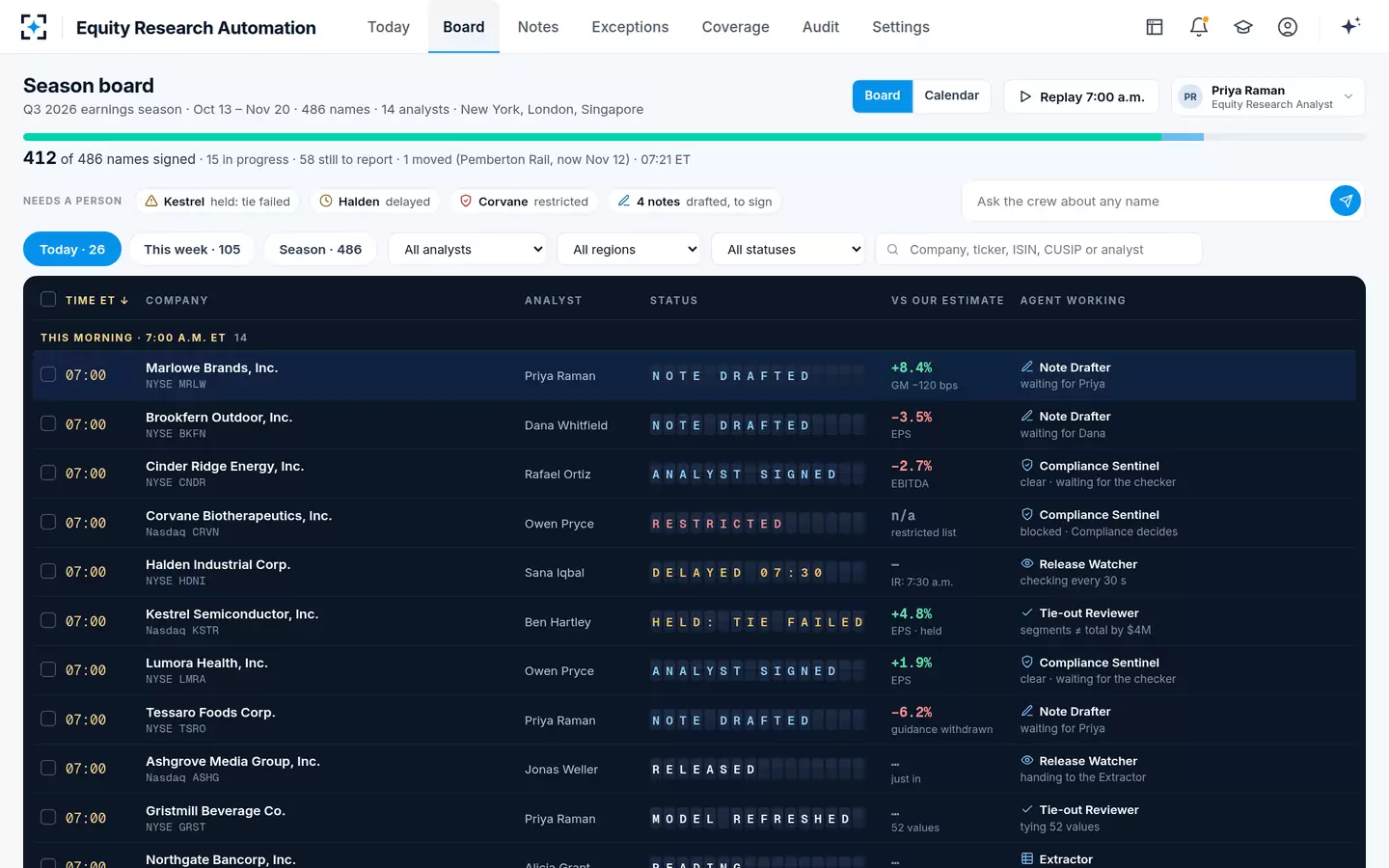
The board answers the Director's questions for a peak week: which notes are signed, which are waiting for an analyst, which are held because a figure did not tie, and which companies have moved their date. On the sample board, one company did not report on November 4 as expected; the Release Watcher found an 8-K moving its results to November 12, and the Coverage Planner proposed moving the calendar slot.
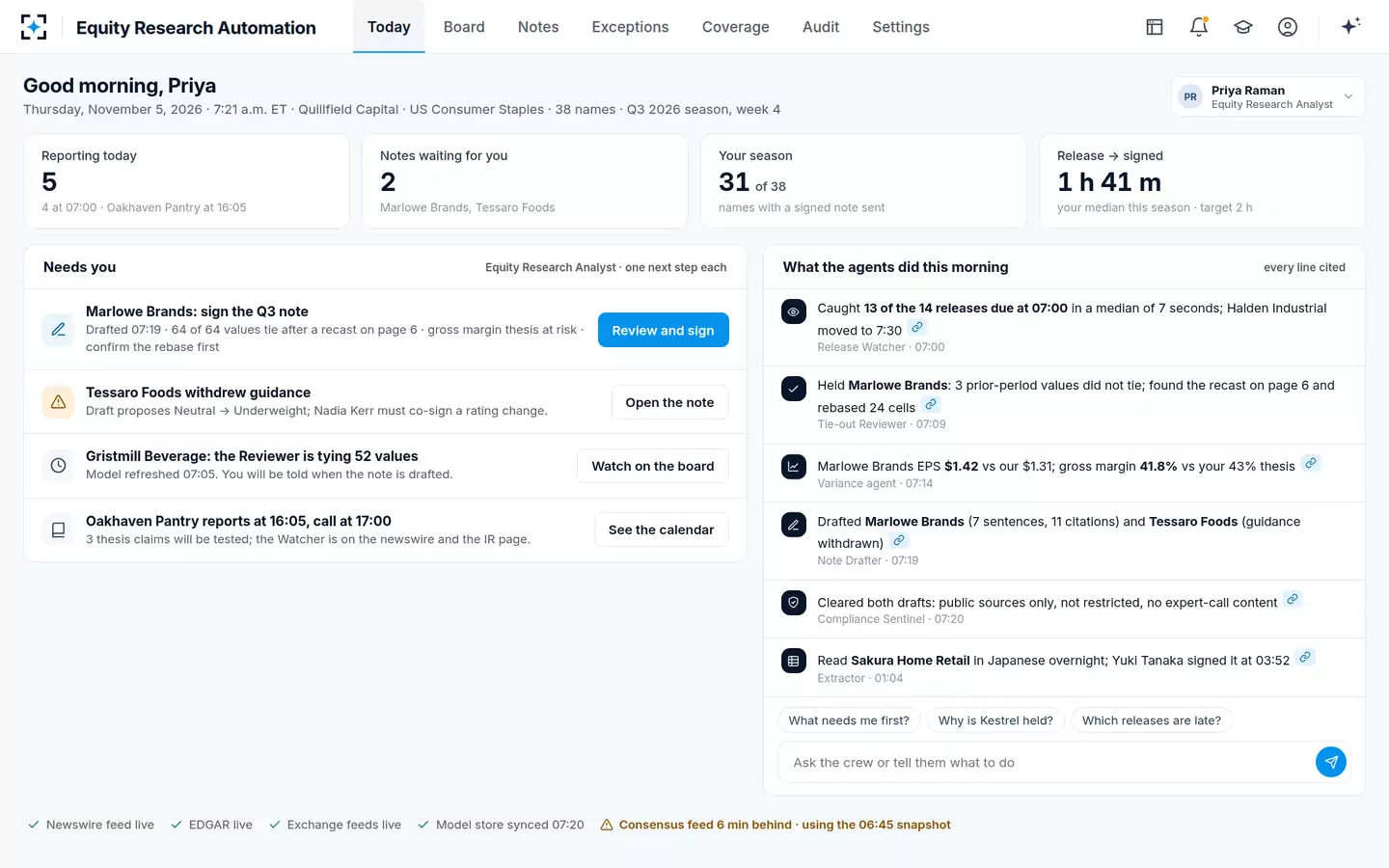
The analyst's morning: five names today, one next step each
Planning the next season before it starts
A research team can plan a season the way an operations team plans a peak: from the calendar, the load per person and the stand-ins. Three steps make most of the difference, whether the reading is done by people or by agents.
Map the calendar by morning, not by week. Report dates are usually announced ahead of time, and the SEC deadlines bound the rest. A list of each analyst's names by reporting morning shows the collisions: four names at 7:00 a.m. on one Thursday is a different problem from four names spread over a week. In the solution the Coverage Planner builds this calendar and each analyst's load from the report dates.
Decide the stand-ins before the peak. When an analyst is out on a heavy morning, someone has to own those names. A coverage move decided in advance, and approved by the Director, beats a reassignment made at 6:55 a.m. The solution's Coverage Planner proposes moves; the Director of Research approves each one.
Set the service level and measure it. "Before the open" is a target only if it is written down and timed. The sample firm sets two hours from release to signed note, and escalates an unsigned note to the Director after four. Priya Raman's median this season is 1 hour 41 minutes; 31 of her 38 names have a signed note. A team that knows its median can see which mornings broke it, and why.
The guide to consensus estimates covers one more planning decision: which consensus snapshot a note will be measured against when the feed lags on a busy morning, as it did at 6:45 a.m. on the sample board.
To see a season run on your own coverage list, start from Equity Research Automation.
Questions people ask
What months are earnings season?
For companies with calendar fiscal years, US earnings seasons run roughly from mid-January to early March, mid-April to mid-May, mid-July to mid-August and mid-October to mid-November. The edges are set by the 40- and 45-day 10-Q deadlines and, for the fourth quarter, the 60-, 75- and 90-day 10-K deadlines.
Who reports first in earnings season?
Large companies, broadly. Large accelerated filers, with a public float of $700 million or more, have the 40-day 10-Q deadline, and in the June 2026 quarter they filed most of their 10-Qs in the week of August 3, while non-accelerated filers mostly filed in the week of August 10. Within those weeks each company picks its own date.
Is there a 10-Q for the fourth quarter?
No. A domestic company files Forms 10-Q for its first three fiscal quarters only, and its 10-K covers the full year, due 60, 75 or 90 days after year-end depending on filer status. Fourth-quarter figures come from the earnings release, where the company publishes one, or are derived from the annual and nine-month figures.
Do foreign companies have the same earnings season?
Not by US rule. A foreign private issuer does not file Forms 10-Q or 8-K; it furnishes the reports its home market requires on Form 6-K (17 CFR 240.13a-11(b)). Its reporting calendar follows its home market's rules, which is why a global research team runs overlapping seasons.
How many earnings releases does one analyst cover in a season?
It depends on the coverage list; no regulator publishes an average. In the solution's sample firm, one analyst covers 38 consumer names, and on one Thursday four of them reported at 7:00 a.m., with calls from 8:30. The useful number for planning is the peak morning, not the season total.
What is an earnings season calendar?
A list of the dates on which covered companies have said they will report, with release times and call times. Companies typically announce these dates ahead of time; the SEC deadlines tell you the latest a 10-Q can arrive. A team's own calendar should add the analyst, the stand-in and the time each note is due.