AI earnings report analysis means software that reads a company's results release, writes the reported figures into the analyst's model, checks them and drafts the variance and the note, so the analyst starts from a checked draft rather than a blank page. Whether it is worth paying for depends on one unit: the analyst hours spent on each covered name each quarter. On our estimate for one analyst covering 38 names, a name costs about 3.2 hours a quarter by hand, of which about 1.3 are catching, keying and checking. With Botminds' Equity Research Automation the same name takes about 47 minutes of the analyst's time, nearly all of it on variance, writing and the signature. At the median US financial analyst wage, that is roughly $157 of time per name per quarter by hand and $39 with the agents, before benefits and overhead. The rest of this page shows the arithmetic, its assumptions, and what the hours are worth when they come back.
The hours are Botminds' estimate, not a measured customer result; wages are the Bureau of Labor Statistics'. Names such as Quillfield Capital and Priya Raman are fictional sample data from the solution.
The unit economics of one covered name
$103,570
median annual pay for US financial analysts, 2025 ($49.79 an hour)
3.2h
analyst time per name per quarter by hand, on our estimate for a 38-name list
47min
the same name with the agents doing the catching, keying, tying and drafting
20–30%
more names per analyst on the same budget: the solution's design target
Can AI analyze earnings reports?
Yes, for the parts of the analysis that can be checked against the report itself: reading the release in its own language, writing reported figures into the model, re-adding segments, comparing with the estimate and with consensus, and sizing what drove a beat or a miss. Whether a margin miss breaks the thesis, and what the estimate should be now, are judgments the analyst still makes.
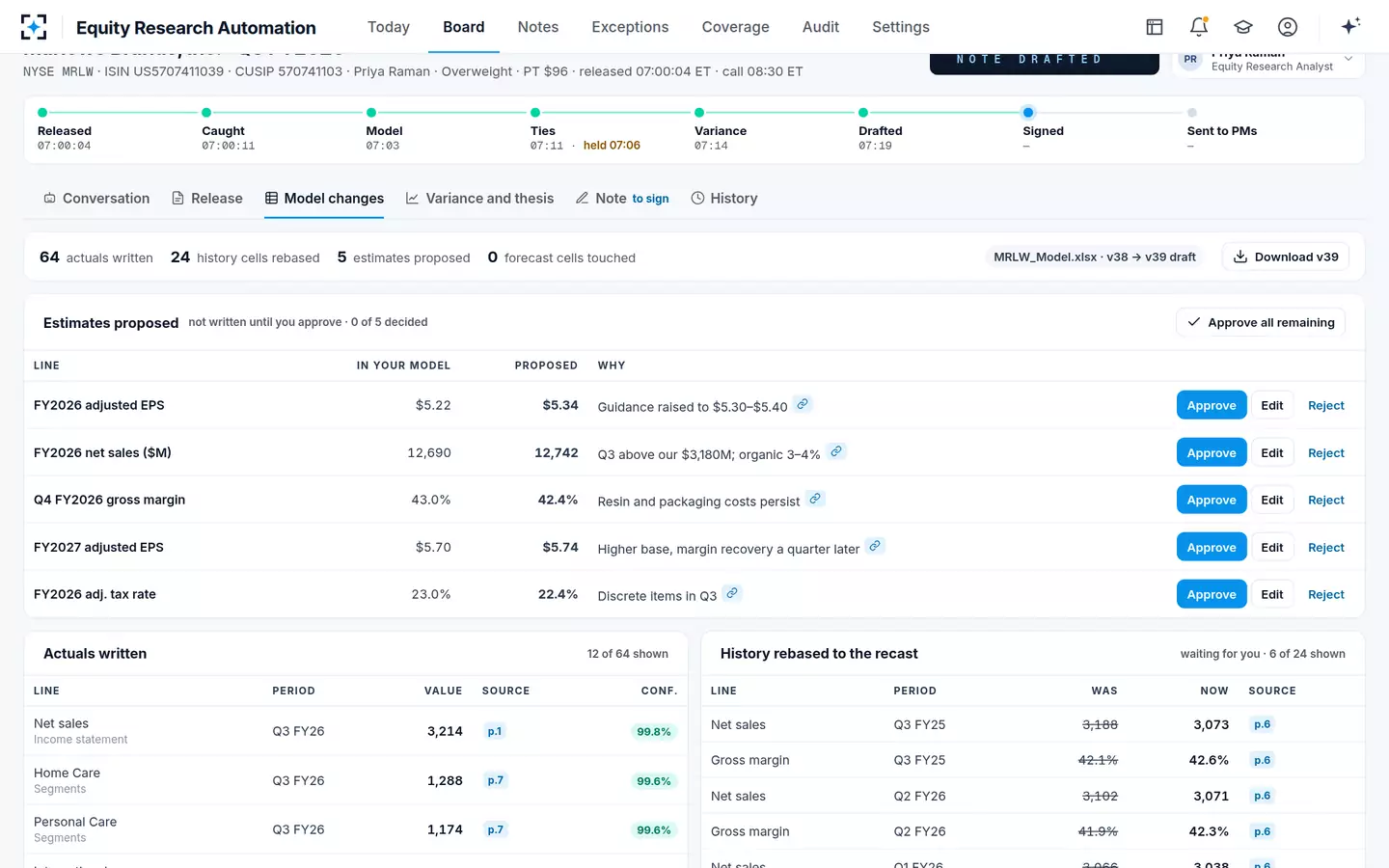
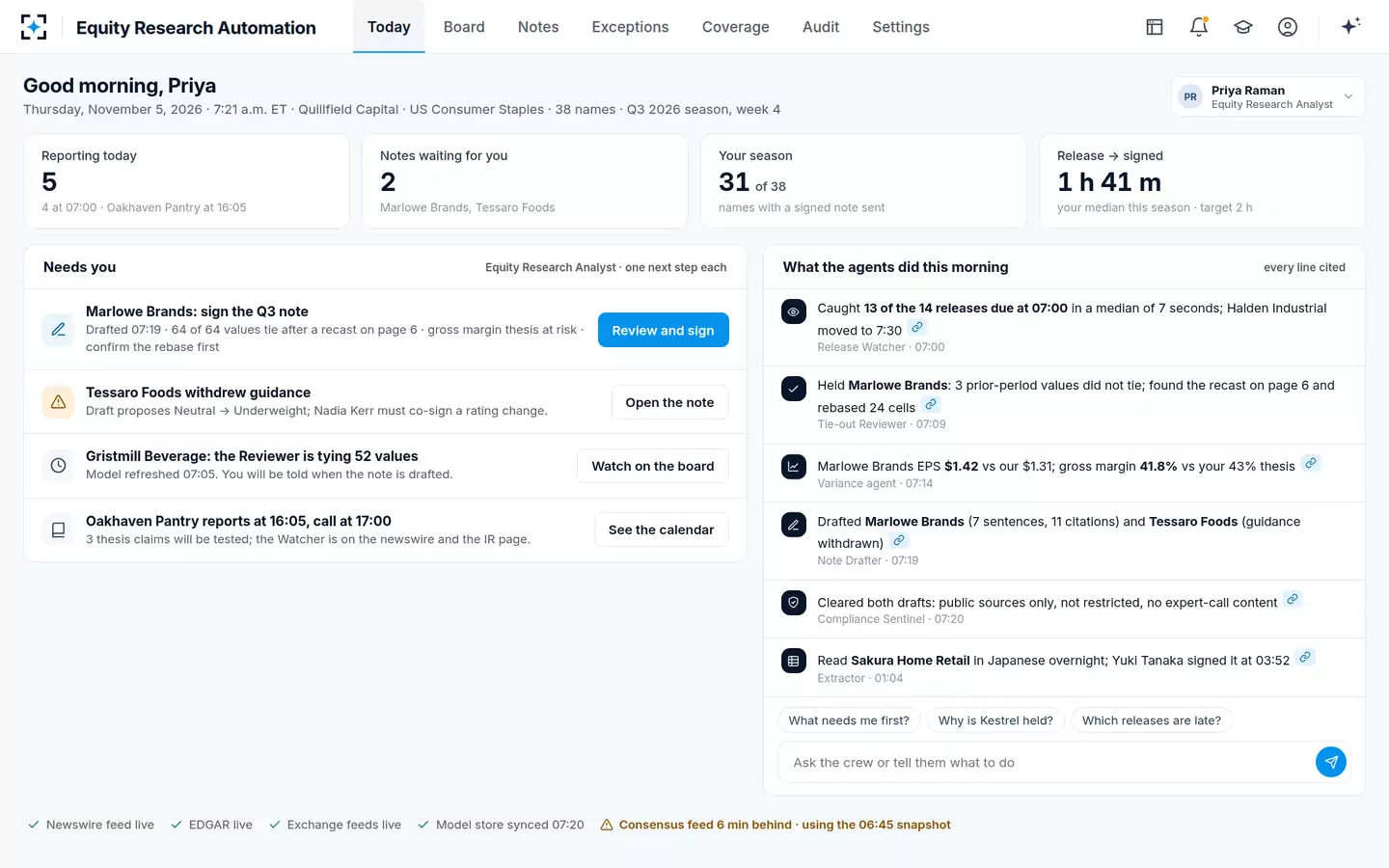
The sample morning shows the split. Marlowe Brands posted its third-quarter release at 7:00:04 a.m. on November 5, 2026. The agents picked it up 7 seconds later, wrote 64 values into the analyst's own model by 7:03, held the note when three values failed to tie, found a recast of last year's figures on page 6, and had a cited draft by 7:19. The variance work was done for her too: adjusted EPS of $1.42 against the house $1.31 and consensus of $1.33, with the $0.11 beat bridged into SG&A (+$0.13), tax (+$0.05), volume and price (+$0.02) and other (+$0.01), less gross margin (−$0.10). What the agents did not do was decide whether the margin claim in her thesis still stood.
How many hours does an earnings update take?
On our estimate, about three hours of analyst time per name per quarter by hand, spread across six tasks; for a 38-name list that is 15 working days in a five-week season. With the agents, about 3.7 days. No regulator or peer-reviewed study we found measures this for buy-side analysts, so the figures are ours and labelled as such; a team should replace them with its own, which a replay of last season will produce.
One analyst's five-week season: 15 of 25 days on earnings work by hand, under 4 with Equity Research Automation
By hand
- Earnings work, 15 days · 60%
- Everything else, 10 days · 40%
With Equity Research Automation
- Earnings work, 3.7 days · 14.8%
- Everything else, 21.3 days: calls, management, new ideas, more names · 85.2%
The by-hand figure is not an accusation of slowness. Each step waits for the one before: the model waits for the release, the check waits for the model, the note waits for the check. On a morning with four names at 7:00 a.m. and calls from 8:30, the waiting is the cost, and notes slip to the next day. The second row removes the waiting rather than the thinking.
Analyst minutes per covered name per quarter, by task: by hand, and with the agents
How much do equity research analysts make?
The US Bureau of Labor Statistics does not publish a separate figure for equity research analysts; it groups them with financial analysts, whose median pay in 2025 was $103,570 a year, or $49.79 an hour, across 443,100 jobs (BLS Occupational Outlook Handbook, financial analysts). The largest single employer group is "securities, commodity contracts, and other financial investments and related activities", with 24% of financial and investment analysts, and the BLS notes that many work longer than a 40-hour week. Much of that load lands on the seat beside the analyst, followed through a reporting week in the equity research associate guide.
A national median is not any one firm's cost of an analyst hour: it leaves out bonus, benefits and seat costs, and it mixes many kinds of analyst. We use it because it is the only government figure, and because it keeps the arithmetic conservative: a team that substitutes its own fully loaded cost per hour will find every figure below larger.
The cost of one name by hand, worked
The cost of covering one name for one quarter is the analyst hours it takes multiplied by the cost of an hour. With our estimate of hours and the BLS median wage, the arithmetic is short.
AI earnings report analysis per covered name: by hand and with Equity Research Automation
| Step | By hand | With Equity Research Automation |
|---|---|---|
| Analyst days per season, 38 names | 15 days | 3.7 days |
| Hours per name per quarter (8-hour days ÷ 38) | 3.16 hours | 0.78 hours (47 minutes) |
| Wage cost per name per quarter at $49.79 an hour | $157 | $39 |
| Per name per year, four reporting seasons | $629 | $155 |
| Per analyst per year, 38 names | $23,900 | $5,900 |
| Analyst time returned per year | — | about 362 hours, or 45 working days |
Three cautions keep the table honest. First, the wage cost understates the case: a fully loaded hour, with bonus, benefits and seat costs, costs a firm more than the median wage. Second, the saving is in hours before the open, which have a value the wage does not capture: a note signed at 7:26 a.m. reaches a portfolio manager before trading; the same note at 2 p.m. reaches them after. Third, the research associate's time moves too. In the sample, the associate checks only the values the agents were unsure of, below the 97% confidence line, instead of re-keying figures for two analysts.
For scale, the issuer's side of the same document is far larger. The SEC estimates the direct cost of preparing one Form 10-Q at $110,000, based on 135.14 burden hours per response (Federal Register, May 7, 2026). That is the company's work, not the analyst's; it is a reminder of how much is packed into the document an analyst reads in a morning.
How many stocks does an analyst cover?
No regulator publishes an average, and the right number depends on the sector, the strategy, the support an analyst has and how much of the work is mechanical. The sample analyst in the solution covers 38 consumer staples names; her team of 14 covers 486.
Research on analysts suggests the number matters less than how effort is spread across it. Harford, Jiang, Wang and Xie found that an analyst "makes more accurate, frequent, and informative earnings forecasts and recommendations for firms ranked higher within her portfolio based on proxies for importance to institutions" (Review of Financial Studies 32(6), 2019). The names at the bottom of the list get less. Taking the mechanical hours off every name is a way to lift the floor, not only to add names at the top.
What does an equity research associate do in earnings season?
An equity research associate supports one or more analysts: catching releases, re-keying figures into models, building comparison tables and chasing readings, so the analyst can focus on the view. In earnings season the associate's queue is the analysts' queue, multiplied. With agents doing the first read and the first write, the associate's job shifts to the second look: the values the agents flagged, the recasts that need checking, the drafts that need preparing. In the solution the associate cannot sign; only the covering analyst signs a note.
The model update: what the agents wrote, and what waits for the analyst
Which hours AI earnings report analysis removes, and which stay
It removes the hours spent moving numbers and keeps the hours spent deciding what they mean. In our estimate, keying and checking fall from about 63 minutes per name to about 8; watching for releases from about 13 to 1. Variance, writing and sign-off fall less, from about 114 minutes to 38, because the analyst still reads the evidence, decides each estimate change and edits the note before signing.
That shape matches the strongest evidence on AI and analysts. In Cao, Jiang, Wang and Yang's study, the AI analyst's advantage was largest where information was plentiful, transparent and complex, and smaller where it needed the institutional knowledge analysts carry (NBER Working Paper 28800, published in the Journal of Financial Economics, 2024). An earnings release is the first kind; a thesis is the second.
The analyst's morning: what the agents did, and the one next step for each name
What the saved hours buy: coverage, timing and attention
The saved hours can buy three things, and a research head should decide which before buying the tool. The first is coverage: the solution's design target is 20 to 30% more names per analyst on the same research budget, a target rather than a measured result. The second is timing: more notes signed before the open on crowded mornings, when the market itself is slowest to absorb results. The third is attention: more of each analyst's season on calls, management meetings and new ideas, and a higher floor for the names at the bottom of each list.
What it should not buy is less checking. The time with the agents is the analyst confirming, approving, editing and signing; if that time shrinks to nothing, the analyst is signing what they have not read. A sound business case counts the hours that stay as carefully as the hours that go.
Who pays for research, after the 2024 to 2026 rule changes
The budget that pays for research changed in Europe over 2024 to 2026, and it frames how firms judge any spending on research productivity. In the UK, the FCA has allowed asset managers to pay for research jointly with execution since 1 August 2024, beside the older routes of paying from the firm's own resources or from a research payment account (FCA PS24/9, July 2024); fund managers gained the same option from 9 May 2025 (FCA PS25/4, May 2025).
In the EU, Directive (EU) 2024/2811, part of the Listing Act of October 2024, lets investment firms choose again between paying for research jointly with execution or separately, from 6 June 2026 (ESMA technical advice, April 2025); the conditions on each route are in MiFID II research unbundling after 2024. Whatever the payment route, external research and internal analyst hours compete for the same pool, which is why a cost per covered name is a useful number to know.
To cost your own coverage list, we will run Equity Research Automation on last season's releases for your names.
Questions people ask
How much does it cost to cover a stock?
In analyst time, about $157 a quarter per name by hand on our estimate, at the 2025 BLS median wage of $49.79 an hour and about 3.2 hours per name; about $39 with agents doing the mechanical work. Fully loaded costs, data licences and the associate's time make the real figure larger.
Is AI earnings analysis worth it?
It is worth it where it returns analyst hours before the open and every figure stays checkable. On our estimate it returns about 45 working days a year for an analyst with 38 names. Whether that is worth the price depends on what the team does with the days: more names, faster notes, or deeper work on the names it has.
Does AI earnings report analysis replace the research associate?
It changes the job. In the solution's sample, the associate checks only the values the agents were unsure of, below 97% confidence, and prepares drafts, instead of re-keying figures for two analysts. The associate cannot sign a note.
How fast can AI read an earnings report?
In the solution's sample, the agents caught a release 7 seconds after it posted and wrote 64 values into the analyst's model about 4 minutes later. Speed is the easy part; the time that matters is to a checked, signed note, which in the sample was 26 minutes.
What is the biggest cost of covering a name by hand?
Writing the note, on our estimate: about an hour per name per quarter, followed by keying and variance at about 38 minutes each. The hidden cost is lateness: a note that misses the open reaches portfolio managers after the market has started to price the result.
Do research payment rules affect AI spending?
Indirectly. The UK allowed joint payment for research and execution from 1 August 2024, and the EU's Listing Act made separate payment optional from 6 June 2026; both changed how firms budget for external research, which competes with internal analyst time and tools for the same money.