A restricted list, in finance, is a list of securities that a firm's employees may not trade, and often may not publish research on, because the firm has or may receive material nonpublic information about the issuer, or because a rule restricts activity in it. A watch list, or grey list, is its confidential twin: names where someone inside the firm holds such information, which compliance monitors without telling the rest of the firm. For a buy-side research team the lists sit at the point where research and inside information meet: a name restricted because the firm sits on a creditors' committee or has been wall-crossed must not get an ordinary earnings note. US investment advisers must keep policies that prevent the misuse of material nonpublic information, and the SEC's cases show those policies failing at the point of use. Botminds' Equity Research Automation checks every draft against the restricted and watch lists before a word is written, and blocks a restricted name until Research Compliance clears it.
Product examples come from the solution's fictional sample firm, Quillfield Capital. The SEC staff reports and exam findings quoted below are staff views, not rules; nothing here is legal advice.
Four lists, what each blocks, and who can see it
Names the firm restricts outright, firm-wide, usually because it holds or could receive material nonpublic information, or for a legal reason.
BlocksTrading, and usually new research, until compliance removes the name.
Who sees itVisible to staff: the restriction itself is the point.
Names where a private-side group holds MNPI. The SEC staff found that all large broker-dealers keep one.
BlocksNothing visibly; compliance watches trading and research in the name quietly.
Who sees itConfidential to compliance: telling staff could itself tip them.
Restricts the group that has the information, often a desk that has gone private on a name, and watches everyone else.
BlocksThat group's trading; surveillance elsewhere.
Who sees itKnown to the restricted group; watched by compliance.
Restrictions imposed by a specific rule, such as Regulation M around an offering, rather than by possession of MNPI.
BlocksWhat the rule restricts, for as long as it applies.
Who sees itVisible to staff.
What is a restricted list in finance?
A restricted list is a firm's list of issuers whose securities its people may not trade, and often may not recommend or write about, while the restriction stands. When it adopted the adviser code of ethics rule, the SEC said advisers should consider including "restricted lists" of issuers about which the firm has inside information in their codes, and prohibiting trading in those securities while they remain on the list; its examination staff repeated the point in a 2022 risk alert (SEC Division of Examinations, risk alert, April 26, 2022).
The SEC's examination staff described what goes on such a list in its 2012 report on information barriers. Placement "is more common when the placement does not indicate that MNPI has been received but rather that it could be received", and sources can include companies "on which employees served as directors" or where traders accessed private loan information (SEC Office of Compliance Inspections and Examinations, staff summary report, September 27, 2012). For an investment adviser the typical sources are a seat on a creditors' committee, a private placement, a wall-crossing before an offering, or an expert or value-add investor who may have passed on inside information.
Restricted list vs watch list vs grey list: what is the difference?
A restricted list is visible and blocks activity; a watch list, also called a grey list, is confidential and triggers monitoring instead. The difference is deliberate. Putting a name on a visible restricted list tells everyone something is happening at the issuer, which can itself leak the information; a watch list lets compliance follow trading and research in the name without signalling anything.
The SEC staff found that "all large broker-dealers have a watch or grey list, which continues to capture instances in which a private-side group (and sometimes a public-side group) has possession of MNPI", and that firms also run hybrid lists that restrict one group and watch the rest (SEC staff report, 2012). The CFA Institute's standard on material nonpublic information names the same tools among the elements of an information barrier: "review of employee trading through the maintenance of 'watch,' 'restricted,' and 'rumor' lists" (CFA Institute Standard II(A)).
Who maintains the restricted list?
Compliance maintains it, usually a small control group or control room inside the compliance department, and the people who hold the information report into it. The SEC staff report found that "most broker-dealers centralize responsibility for managing the information barriers program into one group within the Compliance Department", commonly called the control group or control room. At an investment adviser, the chief compliance officer's team usually plays that role.
Two points from the 2012 report apply directly to a research team. First, the staff found compliance far more involved in deciding what goes on the watch list than in 1990; the list is a compliance judgment, not a business one. Second, the staff questioned how restrictions reach the people who must apply them: notice by email or an intranet list "is questionable for high volume traders who may not have time to consult a list (with several hundred names) prior to each trade". An analyst writing four notes before the open is in the same position.
What is Section 204A, and why does it make the list a policy?
Section 204A of the Investment Advisers Act requires every adviser subject to the Act's books-and-records section, Section 204, to have written policies and procedures against the misuse of material nonpublic information, designed "taking into consideration the nature of such investment adviser's business" (15 U.S.C. 80b-4a). The restricted list is one of the procedures; on its own it satisfies nothing. A list nobody checks, or checks only after the trade or the note, is a policy that exists without being enforced.
The code of ethics rule adds the personal-trading side: access persons must report holdings and transactions and pre-clear some investments (17 CFR 275.204A-1). The SEC's examiners, in the 2022 alert, listed the gaps they found most often under both: no policies, or unenforced ones, for alternative data, for "value-add investors" and for expert networks, and "instances where employees traded investments that were on the adviser's restricted list" (risk alert, April 26, 2022).
Three SEC cases where the policy, not the trade, failed
The SEC has charged advisers under Section 204A without alleging that the firm itself traded on inside information: the charge is that the policies did not fit the business. Three settled cases show the pattern, and each turned on a source of information the firm's controls did not address.
Settled Section 204A cases against advisers: civil penalties
Deerfield (2017) engaged research firms specialising in political intelligence. Its policies "required only an initial review of the research firms' own policies and procedures", and it "placed the burden on its own employees to police themselves by identifying issues and informing supervisors" (SEC press release 2017-146). Sound Point (2024) sat in lender groups and creditors' committees and traded CLOs holding the same companies' loans; it ran pre-trade reviews from 2019 but did not adopt a written policy for them until July 2022 (SEC press release 2024-106). Marathon (2024) regularly sat on ad hoc creditors' committees without policies "reasonably designed to address the specific risks" of receiving inside information there (SEC press release 2024-158).
The lesson for research is the same in each: the risk lived in a specific workflow, research vendors in one case, lender groups and committees in the others, and the controls did not reach into it. An earnings note is a workflow. If the note can be drafted on a name the firm has restricted, the control has a gap.
"Information within Research, such as the initiation of research coverage or changes in price targets, may be MNPI."
SEC Office of Compliance Inspections and Examinations, staff summary report on information barriers, September 27, 2012
Can an analyst publish on a restricted name?
Usually not without compliance's clearance, and never using the information that put the name on the list. The CFA Institute's standard is explicit about an analyst brought over the wall: "the analyst cannot use any information learned in the course of the project for research purposes and cannot share that information with colleagues in the research department" (CFA Institute Standard II(A)). Whether ordinary coverage can continue on public information while the name is restricted is a decision for compliance, case by case, and it should be recorded.
The sell side has rule-based versions. FINRA Rule 2241 sets quiet periods during which a member may not publish research on an issuer it has underwritten: "a minimum of 10 days following the date of an initial public offering" and "a minimum of three days following the date of a secondary offering" (FINRA Rule 2241(b)(2)(I)). The SEC staff report also notes that "information within Research", a rating change or a coverage initiation, can itself be inside information, so some broker-dealers send draft research reports to the control room before publication. A buy-side team can borrow the same discipline: no note on a listed name leaves drafting without a check.
The method: check the list before drafting, not after publishing
The control works when the check runs at the start of the work and the result is recorded, so that a restricted name never produces a draft that has to be recalled. That means the list has to be read from the compliance system at the moment of drafting, not copied into a spreadsheet the night before.
A restricted list method for a buy-side research team
- Read the live list at the moment of drafting
Restricted, watch and any hybrid lists, from the compliance system, with the time of the check recorded.
- Block a restricted name before the first sentence
No draft, no model change sent to portfolio managers, until compliance clears or keeps the block.
- Treat watch-list names quietly
Let the draft proceed if policy allows, but route it to compliance without telling the analyst why.
- Check the sources, not only the name
Public filings, releases and licensed data only; expert-call or private-meeting content needs clearance.
- Let only compliance clear a name
No analyst, director or software clears a restriction. The clearance and its reason go on the record.
- Keep the evidence with the note
Which list, checked when, with what result, so an examiner can see the control ran on every note.
- Review the misses each year
Rule 206(4)-7 requires an annual review of the compliance program; include every note that reached drafting on a restricted name.
How Equity Research Automation applies the restricted list
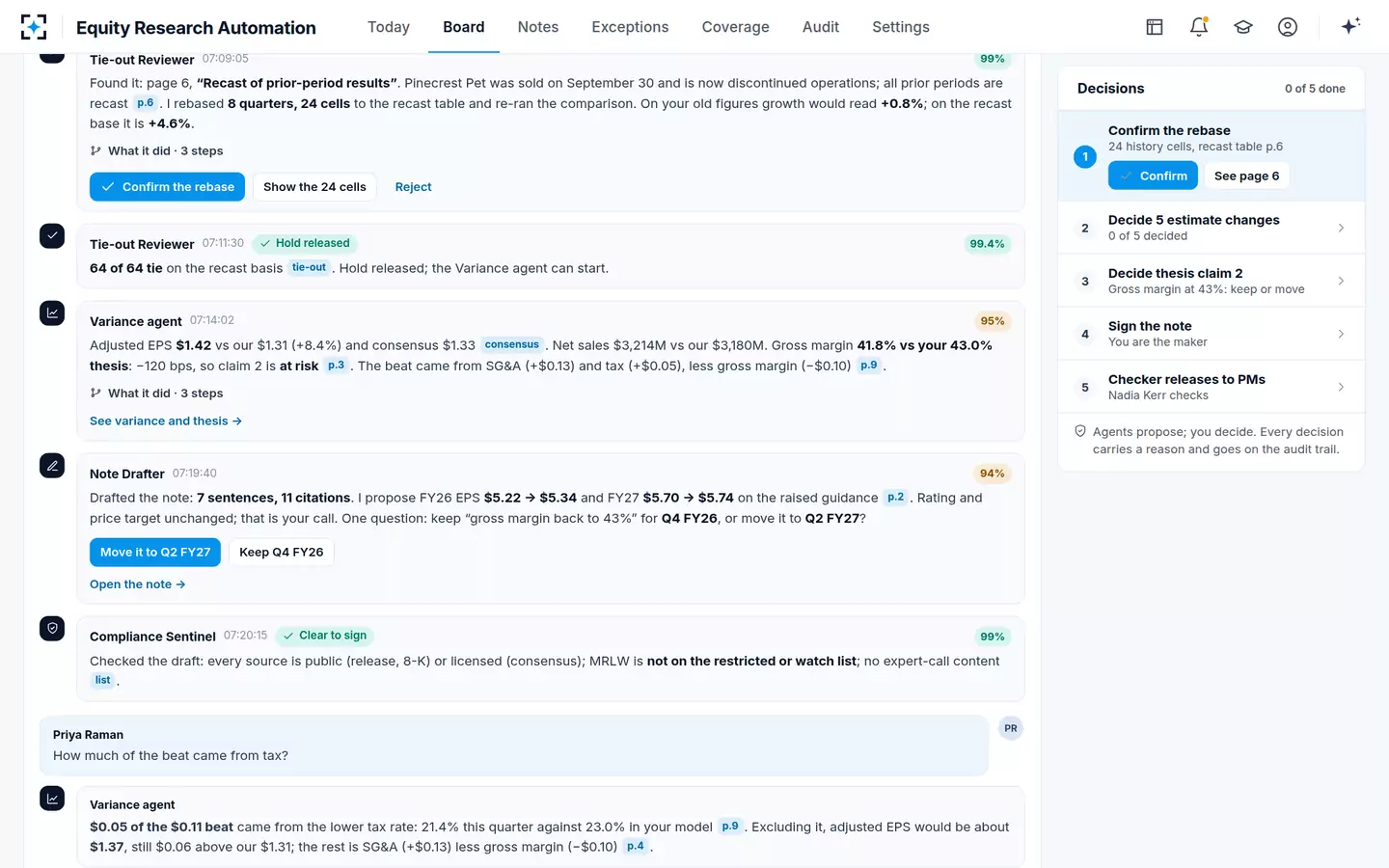
In the solution, the Compliance Sentinel reads the restricted list, the watch list and the expert-call log from the firm's compliance system and checks every note before release: restricted and watch lists, public sources only, expert-call content cleared, disclosures present. A restricted name is blocked before drafting, and the agent's written limit is that it "blocks; never clears a restricted name": only Research Compliance can keep a block or lift it. Every check is on the audit trail.
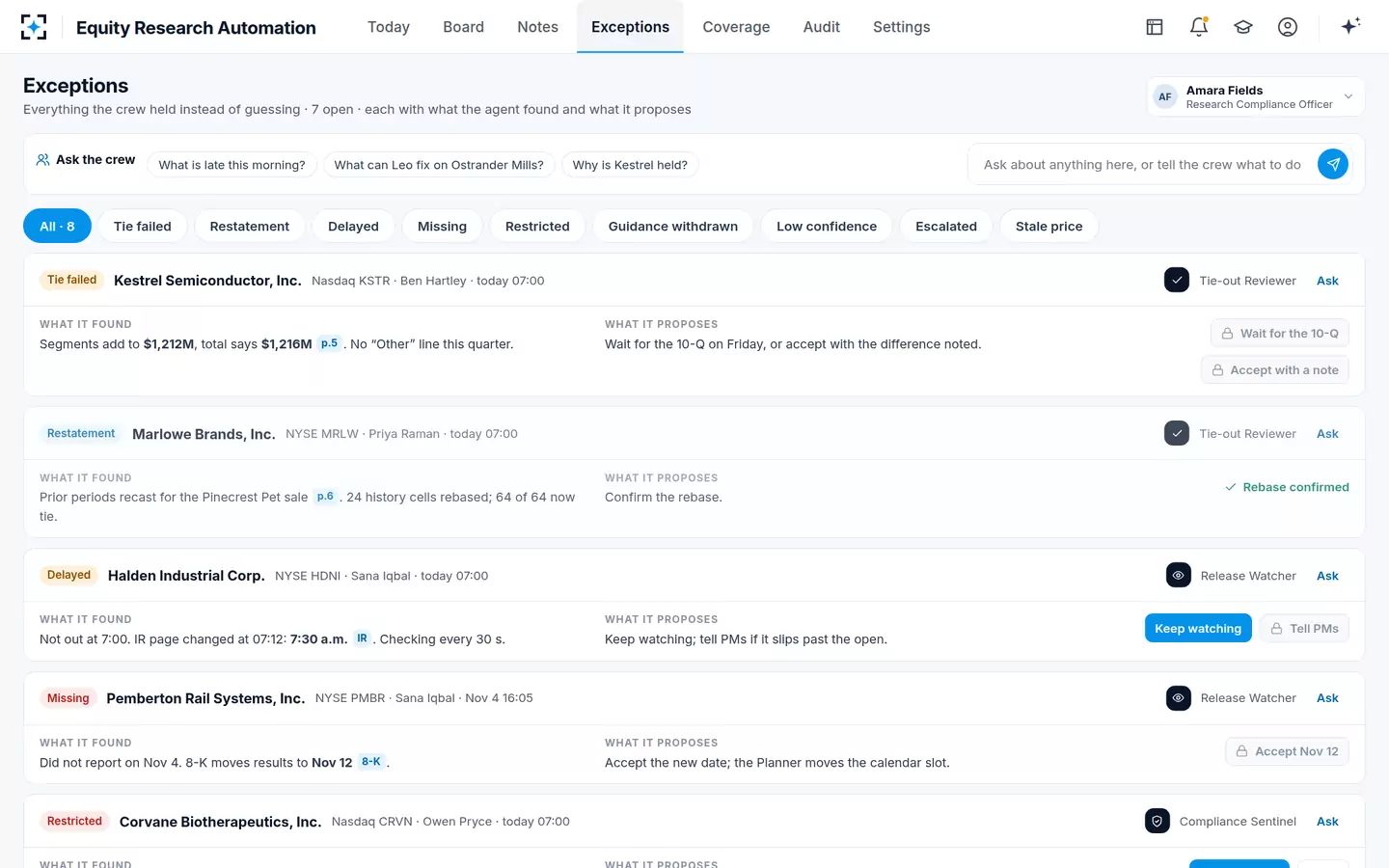
On the sample morning, one of the fourteen companies reporting at 7:00 a.m. was a biotech on the restricted list. Its row on the season board read "restricted" and its note was never drafted; the exception went to the research compliance officer, Amara Fields, who alone could keep it blocked or clear it. For Marlowe Brands the same check ran at 7:20 and cleared the draft: "every source is public (release, 8-K) or licensed (consensus); MRLW is not on the restricted or watch list; no expert-call content".
The compliance check in Equity Research Automation on a cleared draft
Exceptions: the restricted name sits with compliance, not in the analyst's queue
The design follows the cases. Deerfield's policy put the burden on employees to spot problems themselves; here the check is automatic and the clearance belongs to compliance. Sound Point's reviews ran for three years without a written policy; here the rule is a setting, versioned, and every application of it is recorded. The buyer's questions for AI research tools include two on exactly this point.
To see the check run on your own coverage and list, start from Equity Research Automation.
Questions people ask
What is a grey list in compliance?
Another name for a watch list: a confidential list of issuers about which someone in the firm holds material nonpublic information. Compliance uses it to monitor trading and research in those names without restricting them visibly, because a visible restriction could tip staff off. The SEC staff found that all large broker-dealers keep one.
What happens if you trade a stock on the restricted list?
It breaches the firm's code of ethics, and the consequences are whatever the code and the firm's policies set; if inside information was used, it may also be insider trading. The SEC's 2022 risk alert reported examiners finding employees who traded names on their own adviser's restricted list, and treated it as a deficiency in the adviser's controls.
Does the restricted list apply to research notes?
It should be checked before any note is written, because a note on a name the firm has inside information about risks using or signalling that information. The SEC staff found some broker-dealers send every draft research report to the control room for review before publication, and CFA Institute Standard II(A) bars an analyst brought over the wall from using what they learned for research purposes. Whether ordinary coverage continues is compliance's decision.
How often should a restricted list be updated?
Whenever the firm's information changes: a new committee seat, a wall-crossing, a completed deal. No SEC rule sets a frequency. What matters more is that every user reads the current list at the moment of use, rather than a copy taken earlier.
Is a restricted list required by law?
Not by name for advisers. Section 204A requires written policies to prevent the misuse of material nonpublic information, and the SEC has said advisers should consider restricted lists in their codes of ethics. Some lists are required by specific rules, such as Regulation M around offerings.
What is wall-crossing?
Bringing a person "over the wall" into possession of material nonpublic information, usually before a transaction, with compliance recording who was told what and when. The name then typically goes on the watch or restricted list, and the person may not use the information for research or trading until it is public.