The questions in an earnings call are asked mainly by sell-side equity analysts, the brokers' analysts who cover the company, joined by some buy-side analysts from investment firms, after the operator opens the line at the end of the prepared remarks. The company's chief financial officer, usually with the chief executive and investor relations, answers, and management decides which analysts in the queue are called. Most investors listen without asking. On the buy side, the answers then pass through several hands before anyone acts: the covering analyst, a second analyst, the portfolio manager, the director of research and research compliance. Botminds' Earnings Call Analysis is software that reads each call against the covering analyst's thesis and carries the result from seat to seat with every claim cited; this guide explains who is on the call, how they get there, and where the handoffs after it go wrong.
Who is on an earnings call, in one peer-reviewed count
9
analysts asked questions on an average call, from 4 to 18
19.3
questions per call on average, from 10 to 33
100%
of calls had the chief financial officer present
60%
of calls had the investor relations officer actively taking part
Who asks questions in an earnings call?
Mostly sell-side analysts. The Dutch study's authors note that "sell-side analysts are the most active in the question-and-answer part of the earnings conference call", and on their 20 calls an average of nine analysts asked 19.3 questions between them (Meirkulov et al., 2024). Sell-side analysts cover the company for a broker's clients and are expected to publish after the call, so the Q&A is part of their job.
Their access to management is valuable to them beyond the call itself. In a survey of 365 sell-side analysts, Brown, Call, Clement and Sharp found that "private communication with management is a more useful input to analysts' earnings forecasts and stock recommendations than their own primary research, recent earnings performance, and recent 10-K and 10-Q reports" (Journal of Accounting Research, 2015). That is one reason the public call matters to everyone else: it is where some of that access becomes public, under the eyes of Regulation FD.
Who runs an earnings call?
The company runs it, usually through its investor relations team, with an operator managing the line. In the Dutch study the chief financial officer was present on every call, the chief executive on 95%, and the investor relations officer actively took part in 60%; in half the calls all three spoke, in 30% only the chief executive and chief financial officer, and in 15% another executive joined. The investor relations officers interviewed for the study described a script for the presentation, a briefing of the speakers with anticipated questions, and talking points rather than word-for-word answers.
Who speaks for the company on an earnings call
How do companies choose which analysts ask questions?
Management decides whom the operator calls, and research finds the choice is not neutral. Mayew used post-Regulation FD transcripts to show that "the probability of an analyst asking a question during an earnings conference call is increasing in the favorableness of the analyst's outstanding stock recommendation", that downgrades are followed by less access, and that prestige moderates the effect (Journal of Accounting Research, 2008). The SEC had cited the same concern, analysts with negative views left out of calls and meetings, among its reasons for adopting Regulation FD in 2000 (Release 33-7881).
Cohen, Lou and Malloy found the choice is also a signal about the company. Firms that "cast" their calls by "disproportionately calling on bullish analysts tend to underperform in the future", with more negative earnings surprises and more restatements; a long-short portfolio built on the pattern earned up to 149 basis points a month, and the pattern held in calls from the UK, Canada, France and Japan (Management Science, 2020). The investor relations officers in the Dutch study said they do not choose analysts by how favourable their recommendation is, but divide them into tiers by the perceived impact of their analysis.
Do buy-side analysts ask questions on calls?
Yes, some, and when they do it tends to mean something. Jung, Wong and Zhang identified "3,834 buy-side analysts from 701 institutional investment firms who participated (i.e., asked a question) in 13,332 conference calls". Buy-side analysts were more likely to ask when sell-side coverage was low and sell-side forecasts were dispersed, when the company's information environment was poor; and their firms traded more of the stock in the quarters their analysts asked (Journal of Accounting Research, 2018).
Who does not ask is informative too. Jung, Wong and Zhang measured "analyst interest" by noticing analysts who do not cover a firm but join its call, and covering analysts who are absent; increases predicted better future fundamentals and returns over the next three months, and decreases the opposite (The Accounting Review, 2015). Most buy-side analysts, most of the time, listen. Their work starts when the call ends.
What analysts ask about on an earnings call
Mostly the business, and mostly what comes next. Of the 385 questions on the 20 Dutch calls, 41% were about financial information such as revenue, EBITDA, margins, capital expenditure and cash flow; the other 59% were about operations, marketing, governance and financing. The financial questions looked forward: 56% were about future developments and 26% about the current position. 41% concerned measures not defined by IFRS, and 79% concerned performance. The non-financial questions ran the other way, mostly about the present, and 81% were operational.
The split matters for whoever listens on the buy side. Financial questions mostly followed up topics from the presentation, 63% of them; non-financial questions were far more likely to open something new, with 42% of them on topics not addressed in the presentation or the annual report, against 19% of financial questions. Only two of the 385 questions were directly about sustainability. A buy-side analyst who wants to know what the sell side thinks matters can read it in the questions, before reading a single note.
Can investors ask questions on earnings calls?
Any investor can listen; asking is up to the company. Questions come through the operator's queue, and management decides whom the operator calls, which is the choice the research above examines. An investor who wants an answer but cannot get the line can watch whether the covering analysts ask it, and note what happens when someone does: Gow, Larcker and Zakolyukina found that about 11% of analyst questions draw non-answers (Journal of Accounting Research, 2021). How to listen to an earnings call covers what to listen for.
What does investor relations do on an earnings call?
Investor relations organises the call, prepares the script and the briefing, works with the operator on the queue, and often speaks: the investor relations officer actively took part in 60% of the Dutch calls. It is also the function the SEC's Regulation FD cases most often name. In the AT&T case it was investor relations executives who made private calls to analysts at about 20 firms; at First Solar, the head of investor relations. Regulation FD in plain words sets out those cases.
Five seats on the buy-side desk
On the buy side, a call's answers are worth something only when someone acts on them, and the action passes through five seats. The covering analyst reads the call and decides what it does to the thesis. A second analyst confirms any part of the thesis the first one says is broken. The portfolio manager decides what to do with the position. The director of research is accountable for coverage and the timeliness of notes across the team. The research compliance officer makes sure nothing in a note came from a private conversation it should not have. Take the fictional Quillfield Capital as it runs Earnings Call Analysis; its five people are characters in the solution's sample data.
The five seats that turn an earnings call into a decision, with Earnings Call Analysis
Today
Four calls on one Thursday, in four languages, one with no English transcript for hours, and a note due before New York opens.
With agents
Opens each call already read against her own pillars, decides each proposed move with the evidence in front of her, and signs.
Still theirs: the decision on every pillar and the signature
Today
Asked by email to look over a colleague’s call; rating and target changes approved informally.
With agents
Confirms or sends back a Broken pillar with the cited lines and a reason code; reviews target changes.
Still theirs: the check: never the pillar’s author
Today
Gets notes that mix fact and view, with claims that cannot be traced and no clear sign of who reviewed them.
With agents
Reads only signed notes on the fund’s holdings before the open, with each pillar’s state, who signed and who reviewed.
Still theirs: the position
Today
Answers for coverage across hundreds of calls a season and the 24-hour rule for notes, from memory and email.
With agents
Sees calls read, notes signed the same day and the rule’s breaches, and approves every change to the settings.
Still theirs: the policy: thresholds, clocks, retention
Today
Defends every source in every note; a one-on-one at a broker conference can carry material nonpublic information.
With agents
Sees any note citing a non-public source held with its paragraph, and releases it, removes the paragraph or blocks it.
Still theirs: the release decision on held notes
Where the handoffs fail, and what Earnings Call Analysis changes
The handoffs fail in three predictable ways. The analyst's reading reaches the portfolio manager as a view without its evidence, so the manager either trusts it or calls the analyst. The check on a big call, a broken pillar or a target cut, happens by email, if at all, and leaves no record of who confirmed what. And a line from a private meeting slips into a note because nobody looked at the sources before it went out. Each is a handoff problem, not a reading problem.
From an answer on the call to a portfolio manager's screen, seat by seat
Agent
Listener, comparer and skepticTag the answer with its timestamp, hold it against last quarter and the model, and search the same call for the case against any move.
Never: move a pillar themselves
A person decides
Covering analyst decidesAccepts, changes or rejects the proposed move with a reason code.
A person decides
Second analyst confirmsRequired for any pillar marked Broken, within 4 hours by default; a senior analyst reviews rating and target changes.
Agent
Note writer and compliance agentDraft the note with every claim cited; hold any paragraph citing a private meeting for research compliance.
Never: send before signature, or release a hold
A person decides
Analyst signs; portfolio manager readsThe signed note reaches portfolio managers with each pillar’s state, who signed and who reviewed; drafts stay locked.
The portfolio manager's seat: signed notes only, with who signed and who reviewed
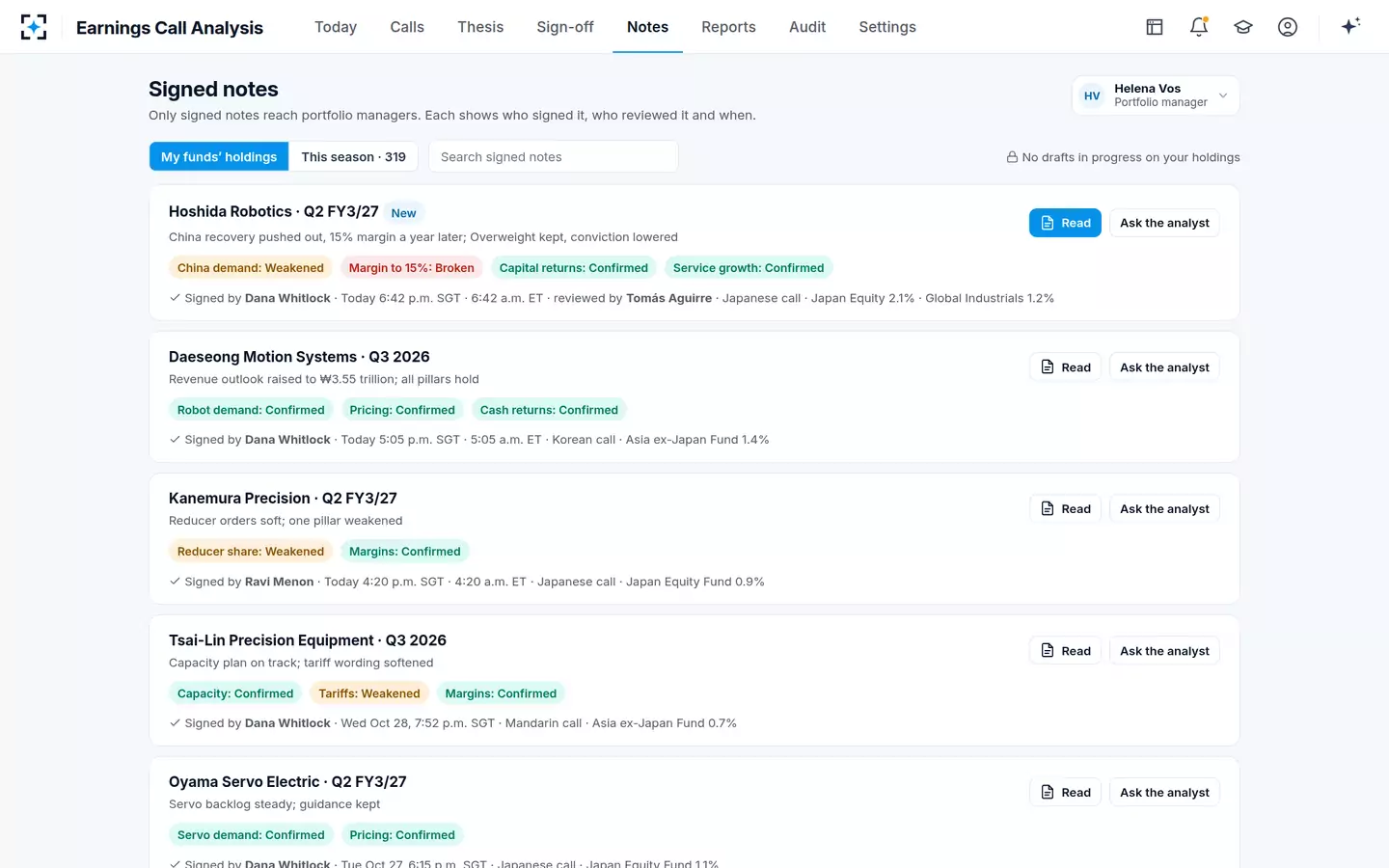
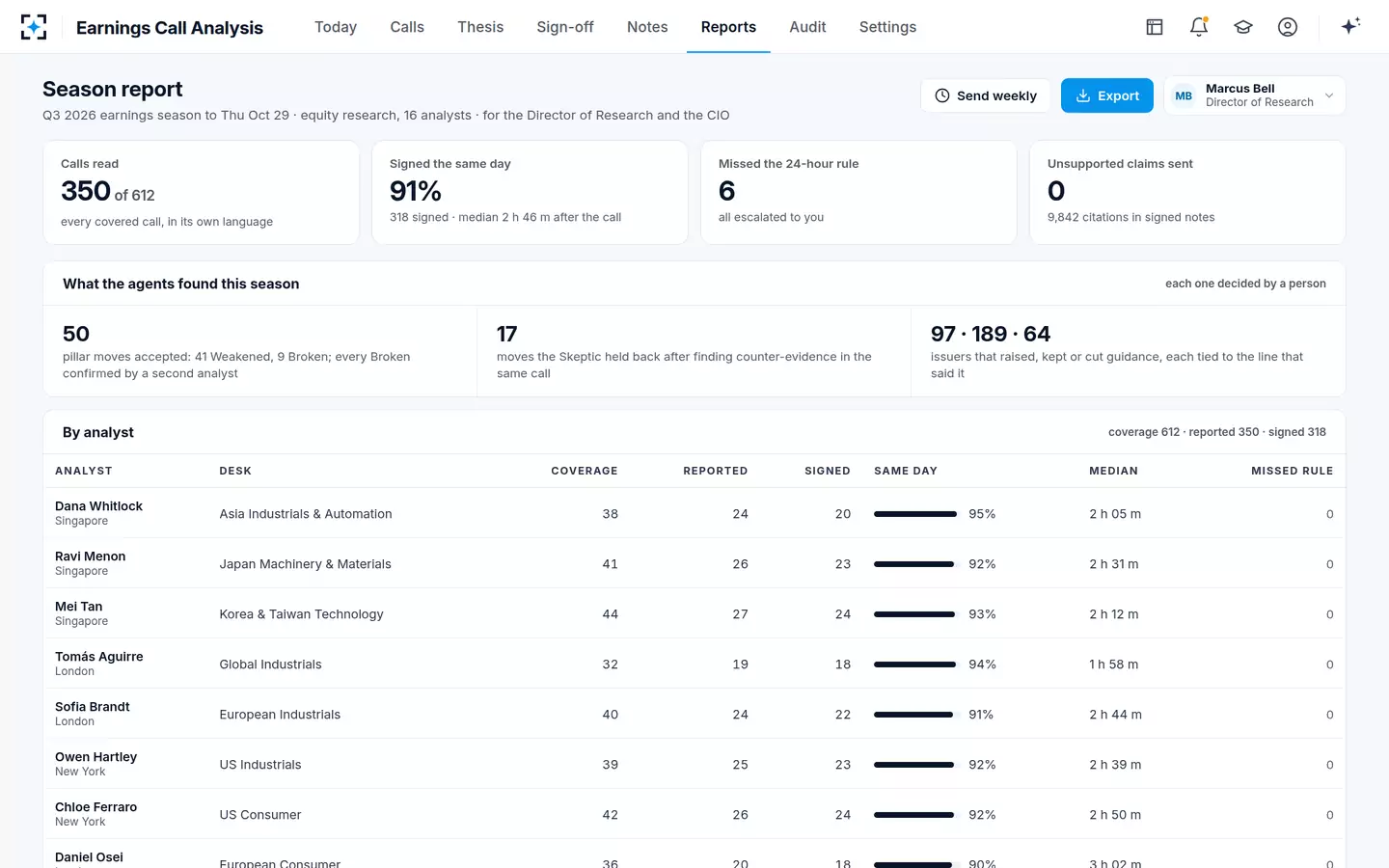
In the sample, the covering analyst in Singapore signed the Hoshida Robotics note at 6:42 p.m., after a senior analyst in London had confirmed the broken margin pillar at 6:31; the portfolio manager in New York read it at 6:42 a.m., before the open. The director of research sees the same evening in aggregate: the season report showed 91% of notes signed the same day, with a median of 2 hours 46 minutes from call to signature, all of it fictional sample data.
The director's seat: every analyst's calls, signatures and the 24-hour rule
The people on the call ask the questions; the people after it decide what the answers are worth. Earnings Call Analysis does not change who asks. It changes how fast and how traceably an answer reaches the person who acts on it. Why the reader is never the checker covers the second seat in detail, and the Earnings Call Analysis page follows the full evening through all five seats.
Questions people ask
What does it mean when a covering analyst skips the call?
It can be a signal. Jung, Wong and Zhang treated covering analysts who were absent from a call as a decrease in analyst interest, and found such decreases were negatively associated with later capital market activity and with stock returns over the following three months.
How many questions can an analyst ask on an earnings call?
The company sets the rule for its own call. On the 20 calls in the Dutch study, an average of nine analysts asked 19.3 questions, so about two each.
Do portfolio managers listen to earnings calls?
Some do, and the rest rely on the covering analyst's note. That is why the note's speed and traceability matter: a portfolio manager acting before the next open needs the analyst's signed view and the lines behind it, not the transcript.
Who decides the order of questions on an earnings call?
The company, through investor relations and the operator. Research finds the order is not first come, first served: analysts with favourable recommendations and prestige are more likely to be called, and firms that call disproportionately on bullish analysts later underperform.
Are buy-side analysts allowed to ask questions on earnings calls?
Yes. One study identified 3,834 buy-side analysts from 701 firms asking questions on 13,332 calls, more often when sell-side coverage was thin. Their firms tended to trade the stock more in those quarters.