To write an investment thesis, state in one sentence why the security is worth more or less than its price implies, then split that claim into three to five pillars: specific, checkable statements about the business, each with a rule for what would confirm it, a rule for what would break it, and the cell in your model that it drives. A thesis written that way can be tested every time the company reports, because each new figure either meets a rule or it does not. Botminds' Earnings Call Analysis is software that reads each earnings call against an analyst's thesis, pillar by pillar, and proposes which pillars moved and why, citing the line that moved them; it can only do that because the thesis is written to be tested. This guide shows how to write one, with a worked example on a fictional company.
The example uses Hoshida Robotics, a fictional Tokyo-listed robot maker covered by a fictional analyst at the fictional Quillfield Capital; every figure about it is sample data from the solution. Professional standards and rules are linked where they appear.
What is an investment thesis?
An investment thesis is the argument behind a position or a rating: what the market is missing, why, and what would prove it right or wrong. It is not the valuation and not the rating. The valuation turns the thesis into a price; the rating turns the price into a recommendation. The thesis is the part that can be wrong in a way a quarter's results will show.
The profession's standards describe what it must rest on. CFA Institute Standard V(A) requires members to "have a reasonable and adequate basis, supported by appropriate research and investigation, for any investment analysis, recommendation, or action" (CFA Institute Standards of Practice, V(A)). Standard V(B) adds that members must "distinguish between fact and opinion in the presentation of investment analysis and recommendations" (V(B), updated January 2024). A thesis that separates its facts, the reported figures, from its claims, the pillars, satisfies both by construction.
What should an investment thesis include?
A one-sentence claim, three to five pillars, and for each pillar five fields: the claim, the metric that measures it, a confirm rule, a break rule and the model cell it feeds. Add the price or value the thesis implies, the rating, and a conviction level. Everything else, such as industry background or management biographies, belongs in the supporting research, not in the thesis.
The anatomy of one testable thesis pillar, as Earnings Call Analysis reads it
Claim
China demand recovers in the second half of the year to March 2027.
A statement about the business, dated, that the market does not yet price.
Metric
China orders, year on year; order backlog at quarter end.
Figures the company reports, so the test uses its own numbers.
Confirm rule
China orders turn positive year on year by the fourth quarter.
What would make you more confident, in figures.
Break rule
China orders below −20% for two quarters, or backlog under ¥400 billion.
Written before the call, so the call cannot rewrite it.
Model cells
Orders!F9 China orders year on year; Orders!F23 quarter-end backlog.
Where a moved pillar changes the valuation.
The break rule is the field most theses leave out, and the one that matters most. Without it, a bad quarter is read as noise and a good one as proof, and the thesis survives every result. With it, the analyst has decided in advance what would end the argument, which is the only defence against reading the call to confirm the view.
An investment thesis example: four pillars, one quarter
The fictional analyst Dana Whitlock rated Hoshida Robotics Overweight with high conviction and a target of ¥8,400, on four pillars. Its second-quarter call on October 29, 2026, held in Japanese, tested all four. Two moved and two held, and the note that followed changed the target and the conviction but not the rating.
An investment thesis example: four pillars tested on one earnings call
| Pillar | What the Q2 call said | Outcome |
|---|---|---|
| China demand recovers in H2 FY3/27 | China orders −27% year on year; backlog −12% to ¥412.6bn, 9.3% under the model. The chief executive expects a fourth-quarter recovery as large EV projects restart; two projects in final specification. | Confirmed → Weakened. The break rule is not yet met; the counter-evidence is dated and specific. |
| Cobot mix lifts operating margin to 15% by FY3/28 | Margin guidance cut from 14.5% to 13.2%; the 15% target moved to FY3/29. Cobot sales up 18%. | Confirmed → Broken. A target moved a year is a target missed; confirmed by a second analyst. |
| Balance sheet funds ¥25bn+ of buybacks a year | A buyback of up to ¥30bn, November to March. | Confirmed, no change. |
| Service revenue grows 10%+ a year | Service revenue +11% to ¥64.2bn. | Confirmed, no change. |
The thesis sentence that ties the four together might read: "Hoshida's cobot mix will lift margins to 15% within two years while China demand recovers, and its balance sheet returns cash on the way; the market prices neither." After the call, half of that sentence is in doubt and one clause is wrong. The thesis did its job: it told the analyst exactly which half.
How to write a pillar's break rule
A good break rule is numeric, dated, uses the company's own reported metric, and allows for one bad quarter where the business is lumpy. "China weakens" is not a rule. "China orders below −20% for two consecutive quarters, or backlog under ¥400 billion" is: either condition can be checked against the next release in seconds, and the analyst wrote it before knowing the answer.
A pillar you can argue about, and a pillar you can test
Vague pillar: Margins will improve as the mix shifts.
Testable pillar: Cobot mix lifts operating margin to 15% by the year to March 2028.
Vague pillar: If the story changes.
Testable pillar: Margin guidance below 14% for the year, or the 15% target moved beyond FY3/28.
Vague pillar: Management sounded confident.
Testable pillar: The line at 22:40 cutting guidance to 13.2%; the line at 24:55 moving the target.
Vague pillar: Leaves room to read either way.
Testable pillar: Moves the pillar, with the two lines that moved it and the counter-evidence weighed.
Two traps recur. The first is the level that hides a delay: a target kept in size but pushed a year later is a miss, and a pillar's rule should say so. The second is the metric that quietly changes. The SEC expects a company that uses a key performance indicator in its MD&A to define it and to consider disclosing it when "a company changes the method by which it calculates or presents the metric" (SEC Release 33-10751, January 30, 2020). A break rule tied to a metric should note its definition, so a redefinition reads as an event rather than a pass.
Language changes too, and research shows the market misses them. Cohen, Malloy and Nguyen found that "changes to the language and construction of financial reports have strong implications for firms' future returns and operations", yet "we find no announcement effect, suggesting that investors are inattentive to these simple changes" (Journal of Finance, 2020). The habit of comparing this quarter's guidance wording with last quarter's, line by line, is how a thesis catches what a headline does not.
How long should an investment thesis be?
One page: a sentence for the claim, a short paragraph for each pillar with its rules, and the valuation and rating it implies. That is our recommendation rather than a standard, and the reason is practical. A thesis is reread every quarter, under time pressure, by the analyst and often by a portfolio manager and a reviewer. Anything longer than a page gets skimmed, and the break rules are the first thing skimmed past. The supporting research can run as long as it needs to; the thesis should not.
How often should you review an investment thesis?
At every reporting event, at a minimum, and whenever a material event is disclosed in between. For a US domestic company that means four times a year, because it files a Form 10-Q for each of the first three fiscal quarters and a 10-K for the fourth (17 CFR 240.13a-13; how analysts derive the fourth quarter). A foreign private issuer has no US quarterly report to file and follows its home market's reporting calendar, so its review dates come from there. A review that changes nothing still counts. CFA Standard V(C) says record retention "applies to decisions to buy or sell a security as well as reviews undertaken that do not lead to a change in position" (V(C), updated April 2024).
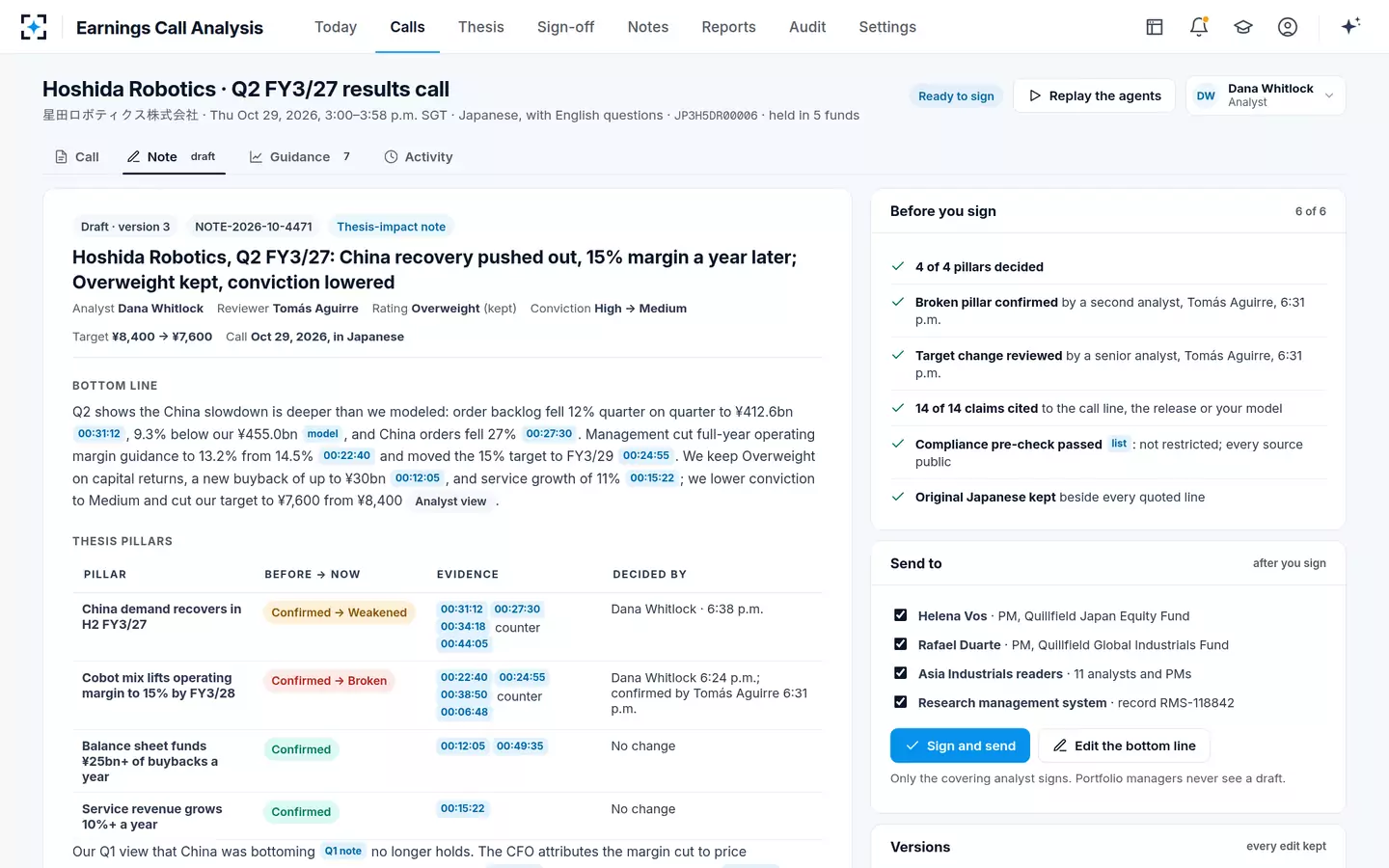
The thesis-impact note in Earnings Call Analysis: each pillar, its move and who decided
What is the mosaic theory, and how does it shape a thesis?
The mosaic theory is the principle that an analyst may combine public information with non-material nonpublic details into a conclusion that would have been material if a company had stated it directly, without breaking insider-trading rules. In the CFA Institute's words: "Under the 'mosaic theory,' financial analysts are free to act on this collection, or mosaic, of information without risking violation" (Standard II(A)). The SEC drew the same line when it adopted Regulation FD, as Regulation FD in plain words explains.
For a thesis, the mosaic theory is a reason to keep every pillar's evidence traceable. A pillar built from a channel check, a supplier's comment and a line in the 10-Q is defensible if each piece can be shown; the same pillar built from a conversation with the chief financial officer may not be. Writing the evidence beside the pillar, rather than in a separate folder, is what lets a reviewer or a compliance officer see which kind it is.
From a moved pillar to the rating, the target and the conviction
A pillar move is an input to three separate decisions, and a thesis should say which one each pillar feeds. A weakened pillar often changes conviction without changing the rating. A broken pillar changes the valuation through its model cells, which may or may not cross the rating's threshold. In the example, the broken margin pillar cut the target from ¥8,400 to ¥7,600 and the weakened China pillar lowered conviction from High to Medium, while the two intact pillars on capital returns and service growth kept the rating at Overweight.
Writing that chain down in advance does two things. It stops a single bad line on a call from turning into a downgrade the analyst did not mean to make, and it makes the review step concrete: a reviewer who sees which pillar moved, which cells changed and how far the target moved can confirm or challenge the result in minutes. In the sample, a pillar marked Broken needs a second analyst who is not its author, and a change of rating or target needs a senior analyst, so the chain is checked twice before a portfolio manager sees it.
Keeping the thesis on the record
A thesis and each review of it are records the firm keeps. An investment adviser must keep the written communications it receives and sends about any recommendation or advice for at least five years from the end of the fiscal year of the last entry, the first two in an appropriate office (17 CFR 275.204-2(a)(7) and (e)(1), eCFR current to Oct. 23, 2026). CFA Standard V(C) expects the supporting work to be kept too, meeting notes and model outputs among it, and recommends seven years where no rule or firm policy sets a period; how both apply to a research file is worked through in investment adviser recordkeeping requirements, applied to research.
Guidance against the model: the cells a pillar move would change
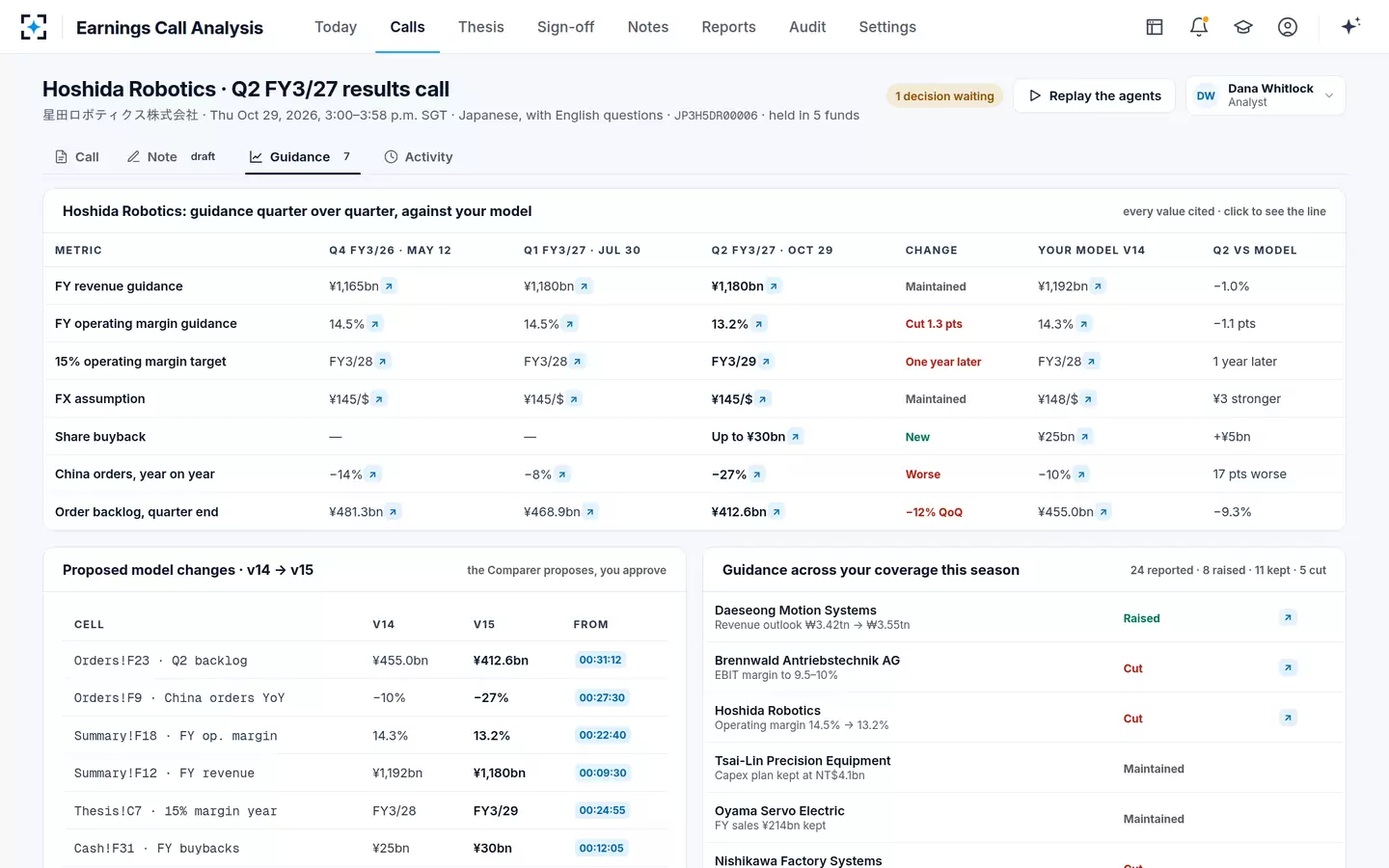
Earnings Call Analysis keeps the thesis, every pillar decision with its reason code, the lines behind it and the model version it changed, on a hash-chained audit trail for seven years by default; the period is a setting of five, seven or ten years. The pillars themselves live in the solution's thesis view, each with its confirm and break rules and the model cells behind it, so the next call is read against the thesis as it stands, not as the analyst remembers it. Why the reader is never the checker covers the second analyst who confirms a broken pillar.
Before you sign off a thesis: six checks
- One sentence states the whole claim
If it needs two, one of them is a pillar.
- Three to five pillars, each a dated, checkable statement
Fewer and the thesis rests on one bet; more and nobody rereads it.
- Every pillar has a break rule in the company’s own figures
Written now, before the next call can argue with it.
- Every pillar points to a model cell
So a moved pillar moves the valuation, not just the prose.
- Facts and views are labelled
CFA Standard V(B): distinguish fact from opinion. Reported figures are facts; pillars are views.
- The evidence sits beside the pillar
Public sources, cited; anything from a private conversation flagged for compliance.
Questions people ask
What is a thesis break?
A thesis break is the point at which the evidence meets a pillar's break rule, so the claim it made can no longer be held. In the example above the margin pillar broke when the company moved its 15% target a year later. A break does not force a rating change by itself; the analyst decides what the broken pillar means for the price.
What is the difference between an investment thesis and an investment memo?
The thesis is the argument, kept short and tested each quarter; the memo is the document that records a decision, with the thesis, the valuation, the risks and the sizing. A memo dates; a thesis is revised. Many teams attach the current thesis to each memo so the reasoning at the time is preserved.
How many pillars should an investment thesis have?
Three to five is a practical range. With one or two, the position is a single bet; with more than five, the pillars start to overlap and nobody rereads all of them under the time pressure of a results evening.
Should a thesis include the price target?
Include the value the thesis implies and the rating, but keep the valuation work in the model. The target should move when a pillar moves, which is why each pillar points to the model cells it drives.
Is there an investment thesis template?
The five-field pillar above works as one: claim, metric, confirm rule, break rule, model cell, repeated for three to five pillars under a one-sentence claim, with the valuation and rating at the foot. Keep the evidence for each pillar beside it, with sources.