A foreign private issuer is a company organised outside the United States that the SEC lets report under lighter rules, provided it is not majority-owned by US residents while also run from or based in the US. It files an annual report on Form 20-F rather than 10-K, furnishes current reports on Form 6-K rather than 8-K, files no quarterly 10-Q, and is outside Regulation FD altogether. For a buy-side analyst that last point matters most: what a foreign private issuer's managers may say privately to analysts, and how quickly they must publish it, is set by the company's home market. Botminds' Earnings Call Analysis is software that reads earnings calls for buy-side research teams in the language spoken, many of them from companies outside the US. This guide explains the foreign private issuer test, what changes for the earnings call, and which home rules apply instead.
Foreign private issuers filing with the SEC, by the SEC's own count
967
companies filed annual reports on Form 20-F for fiscal year 2023
33.3%
of them were incorporated in the Cayman Islands
22.6%
were headquartered in mainland China
≈55%
traded almost exclusively in US markets, up from about 44% in fiscal 2014
What is a foreign private issuer?
Under the SEC's definition, a foreign private issuer is any foreign issuer other than a foreign government, unless it meets two conditions together: more than 50 percent of its voting securities are held of record by US residents, and either a majority of its executive officers or directors are US citizens or residents, more than 50 percent of its assets are in the US, or its business is "administered principally in the United States" (17 CFR 240.3b-4(c), eCFR current to Oct. 23, 2026). A company that meets both conditions is foreign by incorporation but reports as a domestic company.
Two details matter for analysts. The test is applied once a year, "as of the last business day of its most recently completed second fiscal quarter", and a company that fails it switches to domestic forms from the first day of the next fiscal year. And foreign private issuer status matters for a company with SEC reporting obligations; some foreign companies held by global funds are not SEC registrants at all, trading in the US over the counter in reliance on an exemption, if at all. For those, no US disclosure rule applies to their calls.
The foreign private issuer test, step by step
The test is a short decision tree. A company whose voting shares are mostly held outside the US passes at the second step; the test bites on companies incorporated abroad whose shareholders, and also managers, assets or administration, are mostly American.
The foreign private issuer test in 17 CFR 240.3b-4
- 1Is it a foreign issuer, and not a foreign government?
Incorporated or organised under the laws of a foreign country. If not, it is a domestic issuer.
- 2Do US residents hold more than 50% of its voting securities of record?
Tested on the last business day of the second fiscal quarter. If no: it is a foreign private issuer.
- 3If yes, is any one of these true?
A majority of executive officers or directors are US citizens or residents; more than 50% of assets are in the US; the business is administered principally in the US.
- →Any one true: not a foreign private issuer.
It reports like a domestic company, with 10-K, 10-Q and 8-K, from the first day of the next fiscal year. None true: it remains a foreign private issuer.
The SEC asked in June 2025 whether the definition should change "in light of significant changes in the population of foreign private issuers since 2003" (SEC press release 2025-82, June 4, 2025): a shift toward companies incorporated in the Cayman Islands and headquartered in mainland China, and a rising share whose shares trade almost only in the US. The concept release floated options including a foreign trading volume test; comments closed on September 8, 2025, and the rulemaking page, last updated July 31, 2026, lists no proposal (SEC, File S7-2025-01). Any page that tells you the test has changed is ahead of the SEC.
Does Regulation FD apply to foreign private issuers?
No. Regulation FD applies to issuers with securities registered under Section 12 of the Exchange Act or reporting under Section 15(d), "but not including any other investment company or any foreign government or foreign private issuer" (17 CFR 243.101(b)). The SEC had proposed to include them in 1999 and dropped them from the final rule in 2000, explaining that it had "determined to exempt foreign private issuers at this time as it has in the past exempted them from certain U.S. reporting requirements such as Forms 10-Q and 8-K", pending a review of their reporting.
"In the interim, we remind foreign private issuers of their obligations to make timely disclosure of material information pursuant to applicable SRO rules and policies, and our expectation that the markets will enforce these obligations."
SEC, Release 33-7881, adopting Regulation FD, August 2000
The exemption is not a licence to tip. The same release reminded foreign issuers that they "remain subject to liability for conduct that violates, and meets the jurisdictional requirements of, the antifraud provisions of the federal securities laws". And it leaves the analyst exactly where Regulation FD in plain words describes: whether or not the issuer broke a rule, an adviser holding material nonpublic information must not misuse it, under its own written policies.
Do foreign companies file 8-K? What is a Form 6-K?
Foreign private issuers do not file Form 8-K. The 8-K duty "shall not apply to foreign governments, foreign private issuers required to make reports on Form 6-K" (17 CFR 240.13a-11(b)). Instead they furnish current reports on Form 6-K "promptly after the information in the report is made public", limited to what the company makes public under its home country's law, files with a stock exchange that publishes it, or sends to its security holders (SEC Release 33-11376, summarising General Instruction A to Form 6-K). The clock is the home market's; the 6-K follows it.
A domestic issuer and a foreign private issuer: the reports and rules that frame an earnings call
Domestic issuer: Furnished on Form 8-K under Item 2.02; the call need not be furnished if it meets the 48-hour, open-access conditions.
Foreign private issuer: Furnished on Form 6-K promptly after it is made public at home; no Item 2.02 exemption logic.
Domestic issuer: Form 10-Q for each of the first three quarters; 10-K within 60, 75 or 90 days of year-end.
Foreign private issuer: No 10-Q; annual report on Form 20-F within four months of year-end.
Domestic issuer: Regulation FD: public disclosure simultaneously, or promptly.
Foreign private issuer: Not covered by Regulation FD; home-market rules apply, plus US antifraud law.
Domestic issuer: Regulation G and Item 10(e) apply.
Foreign private issuer: Regulation G does not apply if listed abroad, the measure is not derived from US GAAP, and the disclosure is made outside the US.
Domestic issuer: Section 16 reports by directors, officers and 10% holders.
Foreign private issuer: Directors and officers must report under Section 16(a) since March 18, 2026; Section 16(b) still does not apply.
Domestic issuer: US GAAP.
Foreign private issuer: IFRS as issued by the IASB, US GAAP, or home GAAP reconciled to US GAAP.
What changed for foreign private issuers in 2025 and 2026
One rule changed and one review is open. The Holding Foreign Insiders Accountable Act, enacted on December 18, 2025, amended Section 16(a) "to require directors and officers of a foreign private issuer with a class of equity securities registered under Section 12" to report their holdings and transactions; the SEC's implementing amendments took effect on March 18, 2026, and the Act did not amend Section 16(b), the short-swing profit rule (SEC Release 34-104903). For analysts that is a new data source on foreign companies' insiders, not a change to their calls.
The eligibility review is the other. The June 2025 concept release asked whether the definition still fits the companies using it; it is not a rule and, as of October 27, 2026, has produced no proposal. Neither development brings foreign private issuers under Regulation FD.
Home rules for selective disclosure: Japan, Korea and the UK
Outside the US, a company's private conversations with analysts are governed by its home market's rules, and several markets have their own fair disclosure regime. Japan added one to its Financial Instruments and Exchange Act in Article 27-36, with the Financial Services Agency's guidelines finalised on February 6, 2018 and enforced from April 1, 2018 (FSA, February 2018). The guidelines apply the rule to "information of a precise nature which has not been disclosed and which, if it were disclosed, is likely to have a material influence on the value of securities", and treat mosaic information and detailed explanations of information already disclosed separately (FSA Fair Disclosure Rule Guidelines, provisional translation, April 2018).
Selective-disclosure and disclosure-timing rules a global research team meets
| Market | Rule | What it requires | In force |
|---|---|---|---|
| United States (domestic issuers) | Regulation FD, 17 CFR 243 | Public disclosure simultaneously for an intentional selective disclosure; promptly, by the later of 24 hours or the next NYSE open, otherwise. | Oct. 23, 2000 |
| Japan | Financial Instruments and Exchange Act, Art. 27-36 (fair disclosure rule) | A listed company that gives material information to a business associate must disclose it; the FSA guidelines set out what information to manage and how mosaic information is treated. | Apr. 1, 2018 |
| United Kingdom | UK MAR, Article 17 | "An issuer shall inform the public as soon as possible of inside information which directly concerns that issuer." | Retained EU text |
| Korea | FSC rules on English disclosure, approved Jan. 28, 2026 | KOSPI companies with assets of KRW2 trillion or more must disclose in English from May 2026, including fair disclosure items; KRW10 trillion or more on the same day in principle, newly covered companies within three days. | May 2026 |
Korea's change matters for timing as much as language. The FSC's revised rules widen mandatory English disclosure from 111 companies to 265, and the regulator will seek to extend it to all KOSPI-listed companies, 848 of them, from March 2027 rather than May 2028 (FSC, January 28, 2026). Until then, for many Korean companies the authoritative text of a disclosure is the Korean one, and the English version, where there is one, may follow.
Do Japanese companies hold earnings calls in English?
Practice varies by company, so check each name's results calendar for the language of the call and of the materials; the sample company in this guide holds its call in Japanese and takes questions in English. What research shows is that the language of a call affects how the market hears it. Brochet, Naranjo and Yu, studying non-US firms' English-language calls, found that "the calls of firms in countries with greater language barriers are more likely to contain non-plain English and erroneous expressions", and that such calls "show lower intraday price movement and trading volume" (The Accounting Review, 2016). Firms that hired an English-speaking manager showed fewer of those problems.
The written side can run the other way. Lundholm, Rogo and Zhang found "foreign firms generally write clearer text and present relatively more numerical data than their U.S. firm counterparts", and that more readable disclosures attract more US institutional ownership (The Accounting Review, 2014). The practical reading for an analyst: trust the figures in the written release, and check every figure spoken in a second language against it. Cohen, Lou and Malloy found the same pattern of firms favouring bullish analysts in the Q&A in an international sample of calls from the UK, Canada, France and Japan as in the US (Management Science, 2020), so the question queue deserves the same scepticism abroad.
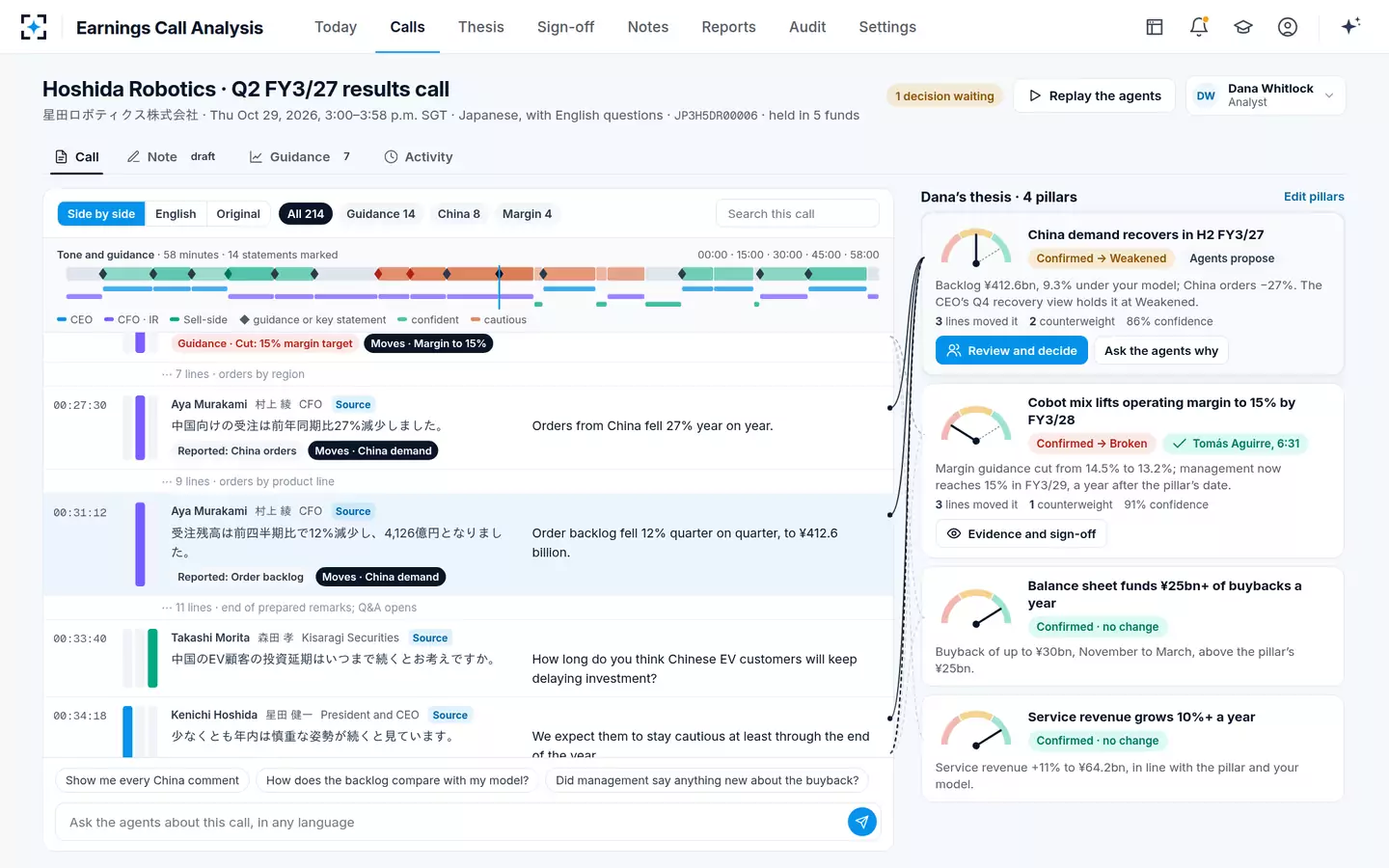
Earnings Call Analysis reads a Tokyo company's call in Japanese, with English beside every line
A jurisdiction map for the research team
A global team needs, for every covered name, four facts recorded once and checked each year: whether the company files with the SEC and in what status, domestic filer or foreign private issuer, or neither; which selective-disclosure rule governs its private conversations; which reporting calendar it follows, quarterly or half-yearly; and the language its authoritative disclosures and calls are in. The first decides whether Regulation FD is in play. The second decides what a compliance officer checks when a note cites a one-on-one. The third and fourth decide when the analyst's evening happens and whether it waits for a translation.
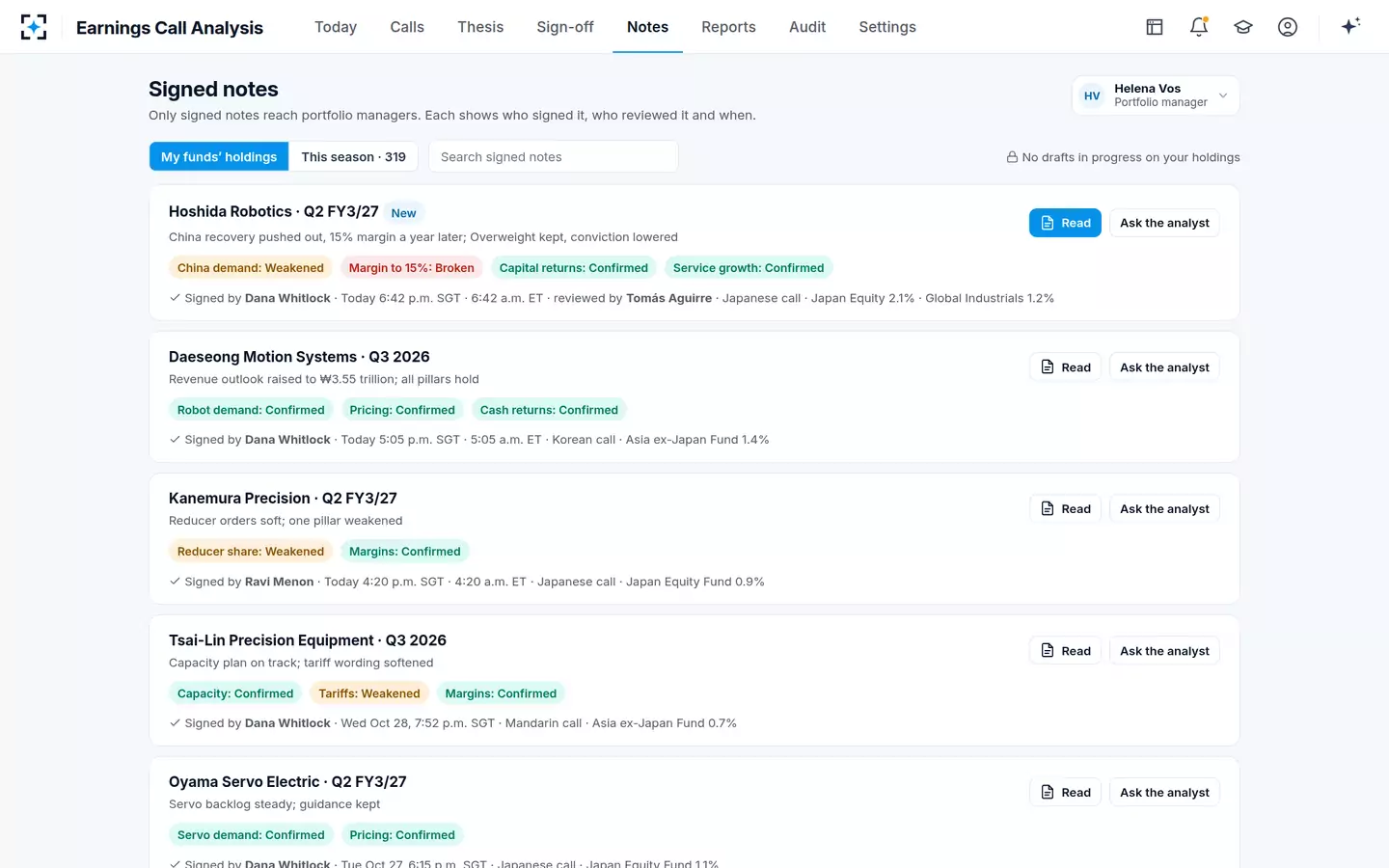
In Earnings Call Analysis those differences show up where they matter. The listener reads a call in the language spoken and the translator checks every figure in both languages, so a Japanese, Korean or German call is analysed while it runs rather than when the English arrives. The compliance agent holds any note citing a private meeting for research compliance whatever the issuer's home market, because the analyst's obligations do not stop where Regulation FD does. The transcripts page covers the data side, and Earnings Call Analysis shows a full evening across four languages.
Signed notes in Earnings Call Analysis from Japanese, Korean and Mandarin calls
Questions people ask
What is the foreign private issuer test?
A foreign company is a foreign private issuer unless more than 50% of its voting securities are held of record by US residents and, in addition, a majority of its executives or directors are US citizens or residents, more than half its assets are in the US, or it is administered principally in the US. The test is run on the last business day of the second fiscal quarter.
Do foreign private issuers have to file quarterly reports?
Not with the SEC. Foreign private issuers file no Form 10-Q; they furnish on Form 6-K whatever they publish at home, which for many markets includes quarterly or half-yearly results, and file an annual report on Form 20-F within four months of year-end.
Can a foreign private issuer choose to follow Regulation FD?
A foreign private issuer can file on domestic forms, and the SEC's 2025 concept release notes that some file their annual reports on Form 10-K, but Regulation FD's text excludes foreign private issuers as a class. A company's own disclosure policy may promise similar practice; a research team can read it, but should not mistake it for the rule.
Are ADRs covered by Regulation FD?
An ADR program does not by itself change the issuer's status. If the underlying company is a foreign private issuer, Regulation FD does not apply to it; if it has no SEC reporting obligation at all, as with over-the-counter trading that relies on the Rule 12g3-2(b) exemption, no SEC disclosure rule applies to its calls.
What is the language barrier in earnings calls?
It is the effect of managers speaking in a second language on how clearly a call is understood. Peer-reviewed research found calls from countries with greater language barriers contain more non-plain English and errors, and move prices and volume less, which suggests listeners discount what they cannot clearly hear.