To listen to an earnings call, open the company's results release or its investor relations page: it gives the date, the time, the dial-in number and the webcast link, and a US company that wants the call to count as public disclosure has to let the public listen in. The call usually lasts about an hour, a scripted presentation followed by questions from analysts. Listening well is harder than finding the link, because the prepared remarks mostly repeat the release and the new information tends to arrive in the Q&A, in answers that are short, hedged or missing. Botminds' Earnings Call Analysis is software for buy-side research teams that listens to every covered call as it runs, in the language spoken, and tests what is said against each analyst's own investment thesis; this guide explains the listening habit it is built on, so you can practise it with or without the software.
The research figures below come from regulators and peer-reviewed studies, linked where they appear. The worked example uses a fictional asset manager, Quillfield Capital, and a fictional Tokyo-listed company, Hoshida Robotics, as they run through the solution: every name and number about them is sample data.
An earnings call is an hour, and most of it is questions
64min
average length of the 20 calls studied, from 35 to 95 minutes
41min
of that average went to the Q&A, against 23 for the presentation
45%
of analysts’ questions were about topics the presentation never raised
19.3
questions per call on average, from 10 to 33
Can anyone listen to an earnings call?
In the United States, almost always yes, because the rules reward companies for opening the call. Regulation FD forbids a company from giving material nonpublic information to analysts and investors before the public, and when the SEC adopted it in 2000 it described a model for results day that keeps the call inside the rule. First a press release with the results. Second, notice of the call "giving investors both the time and date of the conference call, and instructions on how to access the call". Third, "hold the conference call in an open manner, permitting investors to listen in either by telephonic means or through Internet webcasting" (SEC Release 33-7881, August 2000).
Form 8-K repeats the logic. A company must furnish its results release on Form 8-K under Item 2.02, but it does not have to furnish the call separately if four conditions hold: the call starts within 48 hours of a release already furnished, it is "broadly accessible to the public by dial-in conference call, by webcast, by broadcast or by similar means", the financial figures it uses are posted on the company's website, and the call was announced in a widely disseminated release saying when and how to join (Form 8-K, Item 2.02(b)). A company that keeps its call private gives up that exemption and takes on Regulation FD risk for anything new said on it.
The SEC staff has also said what the notice should contain: "the date, time, subject matter and call-in information", and for a regular quarterly call, "notice of several days would be reasonable" (Regulation FD interpretations, Question 102.01). So the place to look is the release that schedules the call, or the events page of the investor relations site, several days before results. Companies outside the US follow their own market's rules, which the guide to foreign private issuers' calls sets out.
Where can I listen to earnings calls live, and are they recorded?
Live, on the webcast link or the dial-in number in the company's notice; afterwards, usually on a replay. Listening to the webcast and dialling in are the same event by two channels: the 8-K exemption names the dial-in call, the webcast and the broadcast side by side, and what matters is that the public can reach one of them. Questions normally come through the operator's queue on the dial-in line, a point who asks questions in an earnings call takes up.
On recordings, the SEC has encouraged rather than required. Its 2000 release asked companies that use a call or webcast for public disclosure to consider keeping it available for a reasonable time afterwards, and its staff encourages the notice to say how, and for how long, a transcript or replay will be offered. In practice the replay sits on the investor relations site and a written transcript comes from a vendor some hours later, a gap that matters for any analyst writing the same evening; the transcript sources and what each one lacks are compared separately.
What happens in the hour: the presentation, then the questions
Every call has the same two parts. The prepared remarks come first, typically the chief executive on strategy and the chief financial officer on the numbers and guidance, read from a script. Then the operator opens the line and analysts ask questions, with management deciding who answers each one. In the Dutch study the chief financial officer was on every call and the chief executive on 95% of them.
Two calls, one shape: the questions take most of the hour
- Presentation23 min
- Q&A41 min
- Prepared remarks≈33 min
- Q&A≈25 min
The split varies more than the total. One company in the study presented for 8 minutes, two for about 45, and the Q&A ran from 21 to 62 minutes. A long script is not a warning sign in itself, but a short Q&A after a long script leaves fewer chances for anyone to ask about what the script left out.
Is the Q&A more important than the prepared remarks?
For new information, usually yes. The prepared remarks largely restate the release, which the market has had for an hour or a day. The Q&A is where analysts push on what the release did not say, and the Dutch study found that 45% of the questions concerned topics the presentation never covered; 32% concerned topics neither the presentation nor the annual report covered. A study of more than 10,000 US call transcripts reached the same ordering, finding the discussion more informative than the presentation (Matsumoto, Pronk and Roelofsen, The Accounting Review, 2011), and the comparison of call summaries with thesis testing shows what that means for tools that read only the script.
Two findings explain why the Q&A rewards close listening. Managers sometimes decline to answer, and investors read the silence: Hollander, Pronk and Roelofsen found that managers "regularly leave participants on the conference call in the dark by not answering their questions", and that "investors seem to interpret no news as bad news" (Journal of Accounting Research, 2010). And managers sometimes answer from the script. Lee found that adherence to predetermined language in answers was negatively associated with the market's reaction to the call, that analysts downgraded their forecasts afterwards, and that firms were less likely to guide when they stuck to the script (The Accounting Review, 2016).
What the prepared remarks and the Q&A each carry
Prepared remarks: Chief executive and chief financial officer, sometimes investor relations, in a set order.
Q&A: Analysts, mostly sell-side, chosen by the operator from the queue; management decides who answers.
Prepared remarks: A script, reviewed in advance against the release.
Q&A: Talking points prepared for expected questions; the words are live.
Prepared remarks: Little beyond the release: emphasis, ordering, the story management wants told.
Q&A: Topics the script left out, the bridge between quarters, what management will not say.
Prepared remarks: Changed wording on guidance and targets; a metric that disappeared since last quarter.
Q&A: Non-answers, answers read from the script, a question the chief executive hands to the chief financial officer.
What should I listen for on an earnings call? Five signals
Listen for change, not for tone in general. A call is useful when it moves something you already believed, so the signals worth catching are the ones that differ from last quarter or from the release.
Guidance wording. "Maintained" and "reaffirmed" carry information, and so does a range that narrows toward one end. Compare each guidance line with the release and the last call while you listen. Targets that move in time. A margin or revenue target kept in size but pushed a year later is a cut, whatever the speaker calls it. Answers that do not answer. Note the question, who asked it and what was said instead. Answers read from the script. If the reply to a pointed question sounds like the prepared remarks, write down the time and listen to it again later. Non-GAAP figures. A measure that is not in the accounts must come with the comparable GAAP figure and a reconciliation; when it is first given orally, Regulation G is satisfied if the reconciliation is on the company's website and "the location of the web site is made public in the same presentation" (17 CFR 244.100, eCFR current to Oct. 23, 2026). Write down where the speaker says the reconciliation is.
Before the call: three things on one page
Preparation decides what you hear. An analyst who walks in with last quarter's guidance, the consensus and a rule for what would break each part of the thesis can mark a line as it is spoken; one who walks in cold spends the evening re-reading the transcript to find out what mattered. How to write an investment thesis you can test every quarter covers the break rules themselves.
A one-page listening sheet for an earnings call
- Last quarter’s guidance, line by line
Revenue, margin, capital returns, any target year. You are listening for the words that differ.
- Consensus and your own model for the quarter
So a figure in the release or on the call reads as a gap in percent, not as a number.
- Each thesis pillar with its break rule
What would move it, in figures: "China orders below −20% for two quarters", not "China weakens".
- Three questions you would ask
Whether or not you can ask them. If no analyst does, that is information too.
- Where the non-GAAP reconciliation sits
The release or the investor relations page; the speaker should say so on the call.
- The webcast link, the dial-in and the replay
And a way to timestamp your notes, so you can play a line again before you quote it.
A worked call: what one hour moved, line by line
Take the fictional Hoshida Robotics as it runs through Earnings Call Analysis. Its second-quarter call for the year to March 2027 is held in Japanese, with English questions, from 3:00 to 3:58 p.m. Singapore time on Thursday, October 29, 2026. Dana Whitlock, a fictional analyst covering 38 names at Quillfield Capital, holds a thesis on Hoshida in four pillars. Two of them move during the hour, and the timing of the lines shows why the Q&A matters.
In the prepared remarks the chief financial officer cuts full-year operating margin guidance from 14.5% to 13.2% at 22:40, moves the 15% margin target from the year to March 2028 to the year to March 2029 at 24:55, and reports China orders down 27% at 27:30 and the order backlog down 12% to ¥412.6 billion at 31:12. Everything that argues against the obvious reading comes later, in the questions: the chief executive's view that Chinese customers will stay cautious through the year (34:18), the chief financial officer's attribution of the margin cut to price competition in China and fixed-cost absorption (38:50), and the chief executive's expectation that China orders recover in the fourth quarter as large electric-vehicle projects restart, with two projects in final specification (44:05 and 46:20).
Earnings Call Analysis: the call in speaker lanes, the thesis beside it
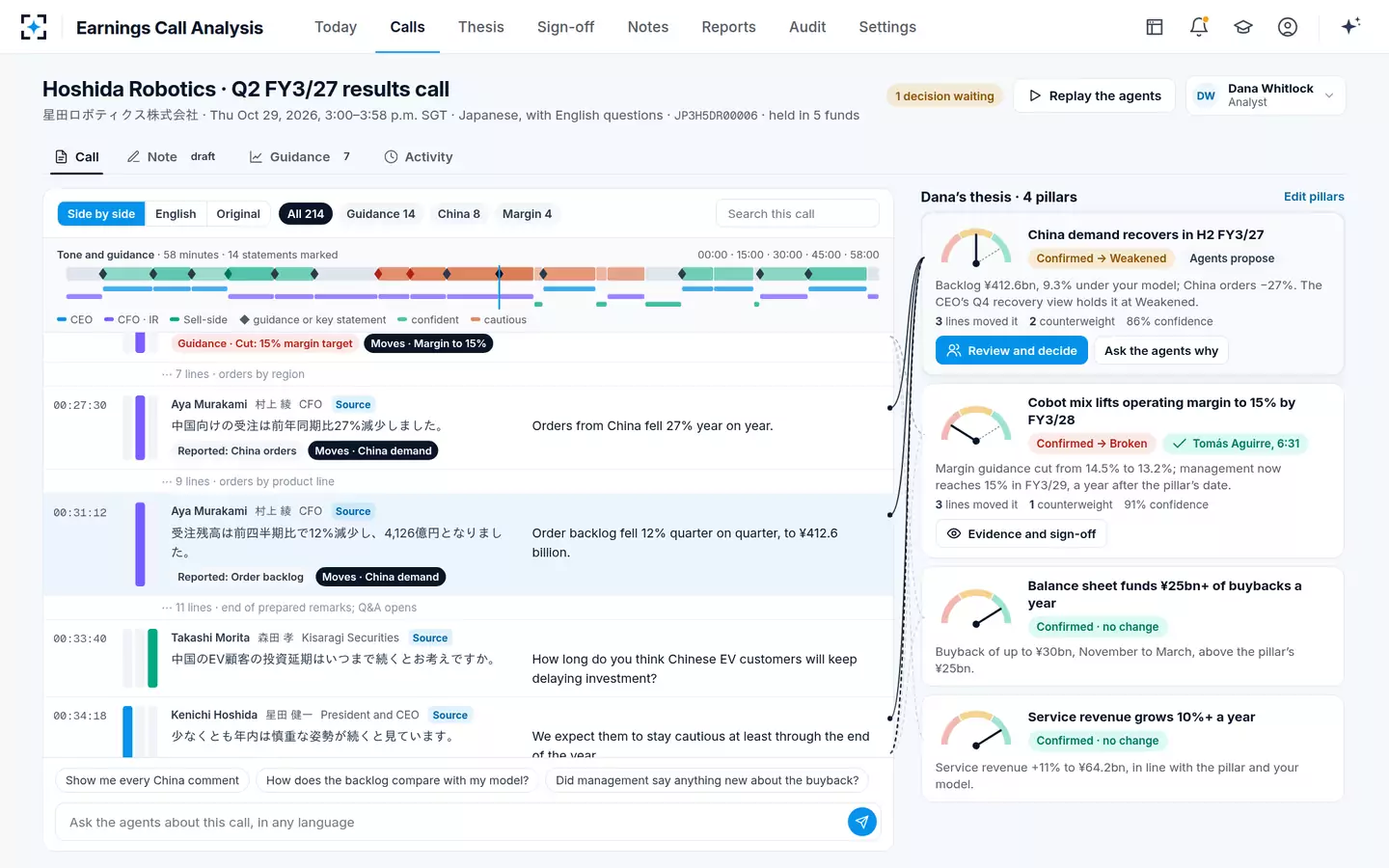
A listener who stopped after the script would mark the China pillar broken. A listener who stayed for the questions would mark it weakened, which is what the solution's agents proposed and what the analyst decided at 6:38 p.m.: the backlog fell, but the company gave a dated, specific reason to expect a recovery, and the thesis's own break rule, China orders below −20% for two quarters or backlog under ¥400 billion, had not yet been met. The margin pillar was different. A target moved by a year is a target missed, the counter-evidence (cobot sales up 18%) did not offset it, and the pillar went to Broken, confirmed by a second analyst.
Listening in a language you do not speak
A call held in another language adds a wait for the English. The sample call was in Japanese with English questions, and the vendor's English transcript arrived at 4:41 p.m., 43 minutes after the call ended. The solution's listener had already tagged 14 guidance and key statements in the language spoken, and its translator had put English beside every line and checked that the 23 figures in it matched in both languages.
One line, in the original and in English, with its figures checked
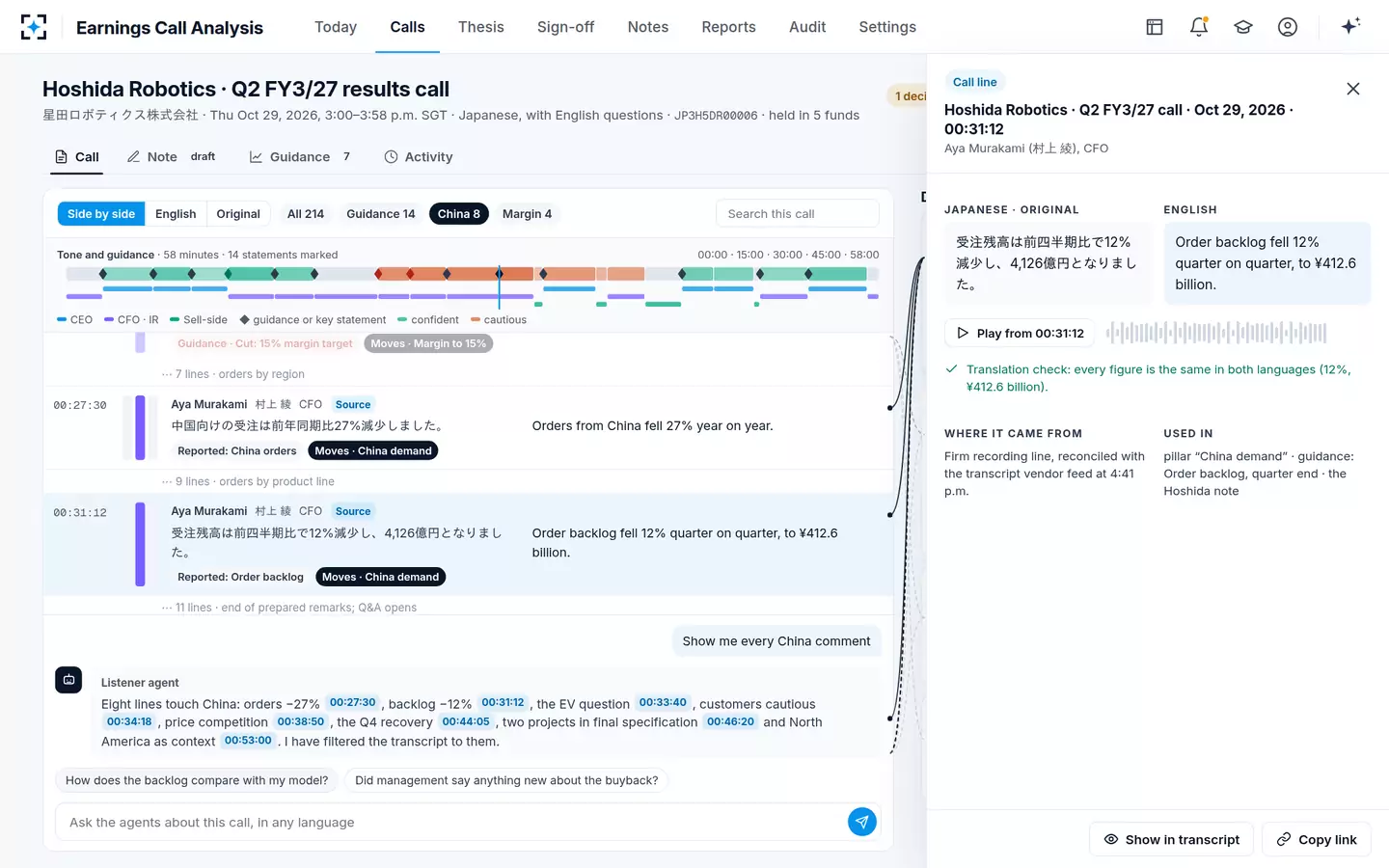
The habit to copy, with or without software, is the timestamp. Note the minute and second of every line you might quote, and play it back before it goes into a note. A transcript is an edited record, and in the sample the translator logged two lines where the vendor's transcript and the firm's own recording differed.
What Earnings Call Analysis does during the hour
The solution does the listening sheet's work while the call runs and leaves the judgement with the analyst. Its intake agent matches the call to the coverage list and joins the firm's recording line; the listener tags guidance and key statements with metric, value, direction, period, speaker and timestamp, and marks any line under 80% confidence as unclear until a person checks it; the comparer holds each statement against last quarter's guidance and the analyst's model. Before any pillar moves, a skeptic agent searches the same call for the strongest case against the move, which on the sample call meant the two Q&A lines about a fourth-quarter recovery.
What it does not do is decide. The analyst accepts, changes or rejects each proposed move with a reason code; a pillar marked Broken needs a second analyst who is not its author; and nothing reaches a portfolio manager until the covering analyst signs the note. The listening habit is the same one a good analyst keeps by hand. The difference is that it holds on the fourth call of a crowded evening, and every claim in the note keeps its line. Earnings Call Analysis shows the full evening, screen by screen.
Questions people ask
Are earnings calls public?
Most US companies make them public because the rules reward it: a results call that is broadly accessible by dial-in or webcast, starts within 48 hours of a furnished release and was announced in advance does not need its own Form 8-K. Regulation FD also bars companies from giving material nonpublic information to analysts before everyone else, so a closed call is a risk the company takes on itself.
Do I need to be an investor to listen to an earnings call?
No. The SEC's model is a call held "in an open manner", and Form 8-K's exemption asks that the call be broadly accessible to the public, not only to holders. Asking a question is different: the operator's queue is usually filled by analysts on the dial-in line.
What is the difference between an earnings call and a webcast?
None in substance: the webcast is the same call streamed online, often with slides. Form 8-K's exemption treats a dial-in call, a webcast and a broadcast as equal ways of making the presentation broadly accessible.
How long after the call is the replay or transcript available?
Replays usually sit on the investor relations site, and the SEC staff encourages companies to say in the call notice how, and for how long, a replay or transcript will be available. Written transcripts come from vendors, and for calls in other languages the English version can arrive well after the call ends; in the sample above it took 43 minutes.
Should I read the transcript instead of listening?
Read it for accuracy, but listen for the Q&A. A transcript cannot show an answer read from the script or a pause before a non-answer, both of which research links to how the market reacts. Many analysts listen live, timestamp what matters, and use the transcript to check quotes before they write.