Regulation FD (Fair Disclosure) is the SEC rule, in force since October 23, 2000, that forbids a US-registered company from giving material nonpublic information to analysts, investment advisers, brokers or shareholders likely to trade on it unless it also gives it to the public: at the same time if the disclosure is intentional, and promptly if it is not. It binds the company and the people who speak for it, not the analyst who hears it; it does not apply to foreign private issuers at all; and the analyst who does receive material nonpublic information faces insider-trading law and the firm's own policies instead. Botminds' Earnings Call Analysis is software that reads earnings calls and drafts research notes for buy-side analysts, and it checks every note's sources so that a line from a private meeting reaches research compliance before it reaches a reader. This guide explains the rule as an analyst meets it.
"In both cases, a privileged few gain an informational edge — and the ability to use that edge to profit — from their superior access to corporate insiders, rather than from their skill, acumen, or diligence."
SEC, Release 33-7881, adopting Regulation FD, August 2000
What is Regulation FD?
Regulation FD is a disclosure rule for issuers, 17 CFR part 243. Its core sentence: whenever an issuer, or anyone acting on its behalf, discloses material nonpublic information about the issuer or its securities to a covered person, "the issuer shall make public disclosure of that information … (1) Simultaneously, in the case of an intentional disclosure; and (2) Promptly, in the case of a non-intentional disclosure" (17 CFR 243.100(a), eCFR current to Oct. 23, 2026).
The covered persons are the market professionals and holders the SEC worried about: brokers and dealers and their associated persons; investment advisers and institutional investment managers that file Form 13F, and their associated persons; investment companies, including private funds that rely on the 3(c)(1) and 3(c)(7) exclusions; and any holder of the issuer's securities "under circumstances in which it is reasonably foreseeable that the person will purchase or sell" on the information. A buy-side analyst at an adviser or a hedge fund is squarely inside that list.
The people whose words count are the issuer's senior officials (directors, executive officers, investor relations and public relations officers) and anyone else who regularly talks to market professionals or holders. An official who leaks in breach of a duty to the company is not acting on its behalf, which takes the leak outside Regulation FD and into insider-trading law (243.101(c)).
What is the purpose of Regulation FD?
Its purpose is to stop companies from treating material information as a favour to be handed to selected analysts and investors. The SEC gave three reasons in 2000. Selective disclosure lets a few profit "at the expense of those kept in the dark", and erodes confidence in the market's fairness. It lets management trade information for favourable coverage: the Commission cited reports "that analysts who publish negative views of an issuer are sometimes excluded by that issuer from calls and meetings to which other analysts are invited". And technology had removed the excuse, because press releases, webcasts and teleconferences could reach everyone at once (Release 33-7881). The proposal drew nearly 6,000 comment letters, most from individual investors who supported it.
The rule changed how companies run calls. Bushee, Matsumoto and Miller found that "Reg FD had a significant negative impact on managers' decisions to continue hosting conference calls and on their decisions regarding the optimal time to hold the call" (The Accounting Review, 2004). The calls that continued became the open, announced, webcast events that how to listen to an earnings call describes, because an open call is how a company stays inside the rule.
Does Regulation FD apply to analysts?
Not directly: it puts the duty on the issuer, and an analyst cannot violate Regulation FD by listening. But an analyst who receives material nonpublic information is not free to use it. The SEC staff makes the point in its own interpretations: a recipient of confidential material information who trades or advises others to trade "could face insider trading liability" (Question 101.05). The rule itself says a failure to make a disclosure required solely by Regulation FD is not a violation of Rule 10b-5, which keeps private suits out but leaves insider-trading law where it was. An investment adviser must also have written policies and procedures, and enforce them, to prevent the misuse of material nonpublic information (Advisers Act Section 204A, 15 U.S.C. 80b-4a; one such procedure is a restricted-list check that runs before the note), and the SEC's examiners have called deficiencies under Section 204A and the code of ethics rule "among the most commonly observed" (risk alert, April 26, 2022; staff statement, not a rule).
So the analyst's question is not "did the company break Regulation FD?" but "can I use this?". The CFA Institute's Standard II(A) gives the profession's answer: an analyst may act on a mosaic of public and non-material nonpublic information, and "should save and document all their research" to show that the conclusion was reached that way (CFA Institute Standards of Practice, Standard II(A)).
What is selective disclosure? Guidance, reaffirmation and tone
Selective disclosure is a company telling some market participants material information it has not told the public. The obvious case is a number: next quarter's revenue whispered on a one-on-one call. The SEC's cases show the less obvious ones, and they are the ones an analyst is likely to hear.
Guidance by implication. The adopting release warned that an official who tells an analyst earnings will be higher, lower "or even the same" as forecasts likely violates the rule, "whether the information about earnings is communicated expressly or through indirect 'guidance,' the meaning of which is apparent though implied". Reaffirmation. The SEC staff treats "not changed" or "still comfortable with" a prior forecast as a confirmation, which can be material late in a quarter (Regulation FD interpretations, Question 101.01). Tone. In Schering-Plough, the SEC found that the chief executive conveyed negative earnings news "through a combination of spoken language, tone, emphasis, and demeanor" in private meetings with analysts and portfolio managers (SEC, Sept. 9, 2003).
Regulation FD: what a company may say to an analyst in private, and what it may not
No Regulation FD issue: Correcting historical facts already on the public record when reviewing an analyst’s model (staff interpretation 101.03).
A Regulation FD event: Using the model review to signal, "either expressly or in code", that estimates are too high or low.
No Regulation FD issue: "No comment", or a statement that the prior forecast was as of its date and is not being updated (101.01).
A Regulation FD event: "Still comfortable with" or "not changed" late in the quarter, when that conveys how the quarter went (101.01; Flowserve).
No Regulation FD issue: Immaterial pieces whose significance a skilled analyst discerns: the mosaic (adopting release; 101.03).
A Regulation FD event: Material news broken into "ostensibly non-material pieces" (adopting release).
No Regulation FD issue: Material information given to someone who "expressly agrees" to keep it confidential (243.100(b)(2)(ii); 101.04).
A Regulation FD event: An acknowledgement only that the recipient will obey the securities laws: not enough (101.06).
No Regulation FD issue: An announced, open call or webcast; a filing on EDGAR, not buried (102.02).
A Regulation FD event: A shareholder meeting open to the public but not webcast or broadcast (102.05); a closed meeting where the press happens to be present (102.06).
What does promptly mean under Regulation FD?
"Promptly" means as soon as reasonably practicable, but in no event after the later of 24 hours or the start of the next day's trading on the New York Stock Exchange, counted from when a senior official learns of the non-intentional disclosure and knows, or is reckless in not knowing, that it was material and nonpublic (243.101(d)). The SEC gave the weekend example itself: a disclosure discovered after Friday's close must be public by Monday's opening.
Simultaneously or promptly: the two clocks in Regulation FD
Intentional
The speaker knows, or is reckless in not knowing, that the information is material and nonpublic.
Public disclosure at the same time
A chief executive who decides mid-meeting to share it knowing it is material has made an intentional disclosure, even if it was unplanned (staff interpretation 102.04).
Not intentional
A slip: the speaker did not know, and was not reckless in not knowing, that it was material and nonpublic.
Public disclosure promptly: by the later of 24 hours or the next NYSE open
The clock starts when a senior official learns of the disclosure and knows, or is reckless in not knowing, it was material and nonpublic.
The intent test is forgiving of impromptu judgements. The SEC wrote that a materiality call "that might be reckless in the context of a prepared written statement would not necessarily be reckless in the context of an impromptu answer to an unanticipated question". For an analyst that cuts both ways: a surprising answer on a one-on-one may be a slip the company must now publish, and until it does, the analyst holds material nonpublic information.
What is a Regulation FD violation? Seven SEC cases
A violation is a company, or someone speaking for it, giving covered persons material nonpublic information without the required public disclosure. The SEC's settled cases show the pattern: private calls or meetings with analysts, usually near a quarter-end, usually about earnings, and usually followed by a price move when the news came out. The largest penalty to date is AT&T's: "The penalty that AT&T agreed to pay is the largest ever in a Regulation FD case" (SEC, Dec. 5, 2022).
Regulation FD penalties against companies in seven SEC actions
Four of the cases turn on conversations an analyst would recognise. At AT&T, investor relations executives "made private, one-on-one phone calls to analysts at approximately 20 separate firms" about smartphone sales, and the analysts cut their revenue forecasts. At Office Depot, the company did not say it would miss; it pointed analysts to peers' public statements about the slowing economy, and the analysts lowered their estimates. At Flowserve, an analyst at a private meeting asked about guidance and the chief executive reaffirmed it, 42 days before year-end; the next day the stock closed about 6% higher on 75% more volume. At TherapeuticsMD, the company messaged sell-side analysts that an FDA meeting was "very positive and productive", and the stock closed up 19.4% the next day.
Two more set the edges. At First Solar, the head of investor relations signalled to about 20 analysts and investors that a loan guarantee was unlikely; he paid $50,000, and the SEC did not charge the company, citing its extraordinary cooperation, its disclosure committee, its press release the next morning and its prompt self-report. At DraftKings, the company's public relations firm posted on the chief executive's personal social media accounts that the company continued to see "really strong growth" before the quarter's results were out. A channel investors have not been told to watch is not public disclosure.
Where Regulation FD stops
The rule has deliberate gaps, and a research team needs to know them because its exposure does not stop where the issuer's does. It does not cover a disclosure to someone who owes the issuer a duty of trust or confidence, such as its lawyers, bankers and accountants; to someone who "expressly agrees to maintain the disclosed information in confidence"; to the company's own employees; or most communications in a registered offering. It does not cover foreign private issuers, which the SEC exempted in 2000 while it reviewed their reporting; the guide to foreign private issuers' calls sets out what governs a Tokyo or Seoul call instead.
Each gap is a place where an analyst can end up holding information that no public disclosure will follow soon. A confidentiality agreement signed for a wall-crossing leaves the recipient holding information it cannot trade on, and no public disclosure is due. A conversation with a foreign issuer's chief financial officer at a broker conference may be fine under its home rules or may not, and Regulation FD will not settle it either way.
A research team's own rule
Because Regulation FD protects the market rather than the adviser, a buy-side team needs a rule of its own for one-on-ones, broker conferences, site visits and expert calls. The points below are a working draft; the firm's written policies under Section 204A and its compliance officer decide the final form.
A buy-side checklist for conversations with management
- Log every private conversation with an issuer
Who, when, which issuer, who else was there. The SEC’s 2022 risk alert faulted advisers that did not track and log expert calls; the same discipline applies to management meetings.
- Write down what was said about the quarter
Guidance, "comfortable with", tone about current trading. These are the forms selective disclosure took in the SEC’s cases.
- Ask: was it public before, and is it material?
If the answer to the first is no and the second might be yes, stop and call compliance before writing or trading.
- Never cite a private meeting in a note without review
A note is a record, and it travels. A paragraph resting on a one-on-one should reach compliance before any reader.
- Know the issuer’s home rule
Regulation FD does not cover foreign private issuers. Japan, Korea and the UK each have their own regime.
- Keep the mosaic documented
CFA Standard II(A): save and document the research that shows a conclusion came from public and non-material pieces.
How Earnings Call Analysis keeps private conversations out of notes
The solution treats the rule's gap as its job: every note's sources are checked before the note reaches anyone, and anything resting on a private conversation waits for a person in compliance. The note writer agent cites every factual claim to its source, a call line, the results release or the analyst's model, and labels the analyst's views as views. The compliance agent then checks the restricted and watch lists, research blackouts and whether every source is public; any paragraph that cites a private meeting or an expert call is held for research compliance, and the agent never releases it on its own.
From draft to reader: where a private-meeting paragraph stops in Earnings Call Analysis
Agent
Note writerDrafts the note with every claim cited to a call line, the release or the model; flags any sentence without a source.
Never: sends anything before the analyst signs
Agent
Compliance agentChecks restricted and watch lists, research blackouts, and whether each cited source is public.
Never: releases a held note on its own
A person decides
Research compliance officerSees the held paragraph and its source; releases the note, removes the paragraph, or blocks and escalates, with a reason code.
A person decides
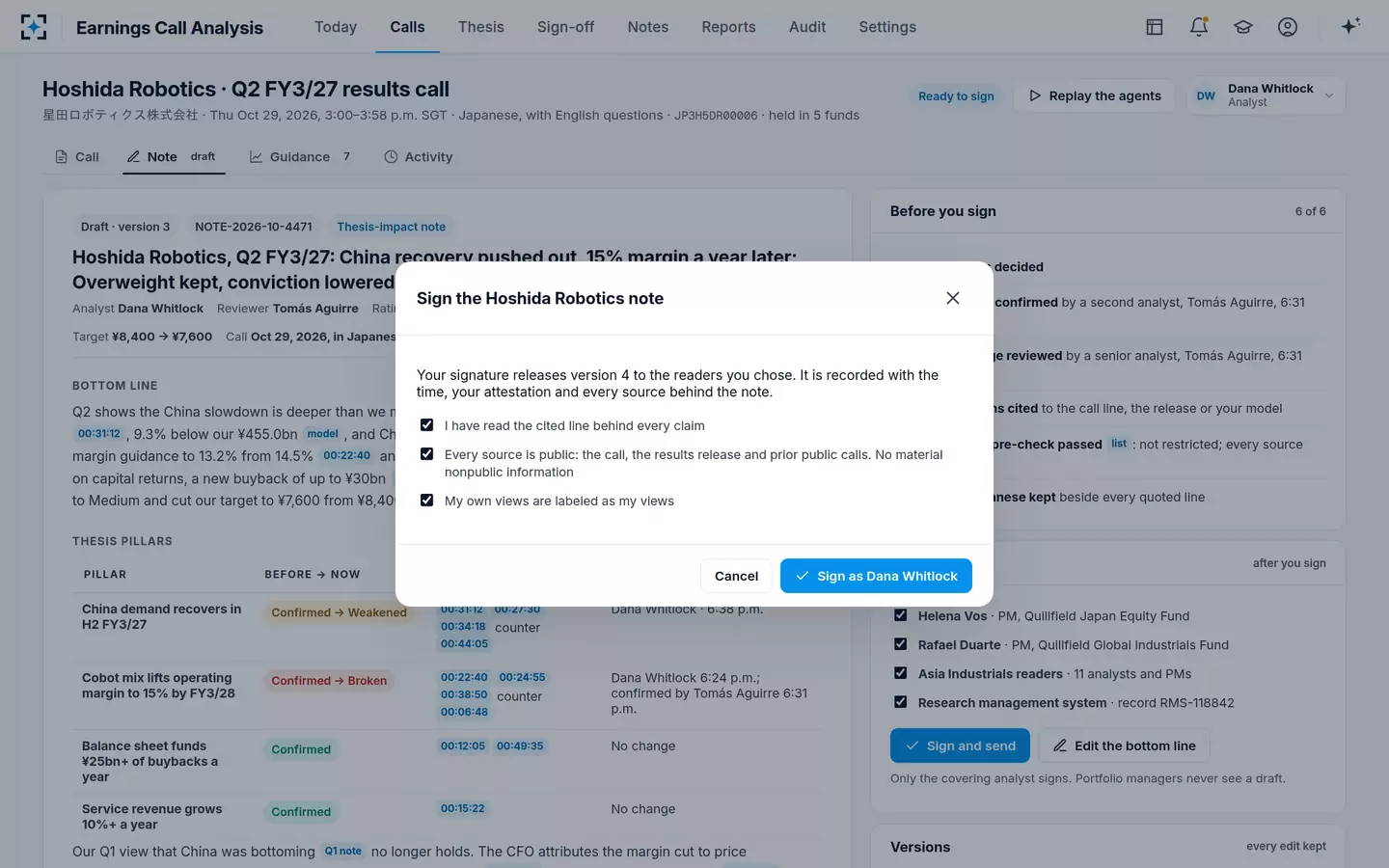
Covering analystSigns with three attestations, including that every source is public and no material nonpublic information was used.
A compliance hold: a one-on-one at a broker conference, held with the paragraph
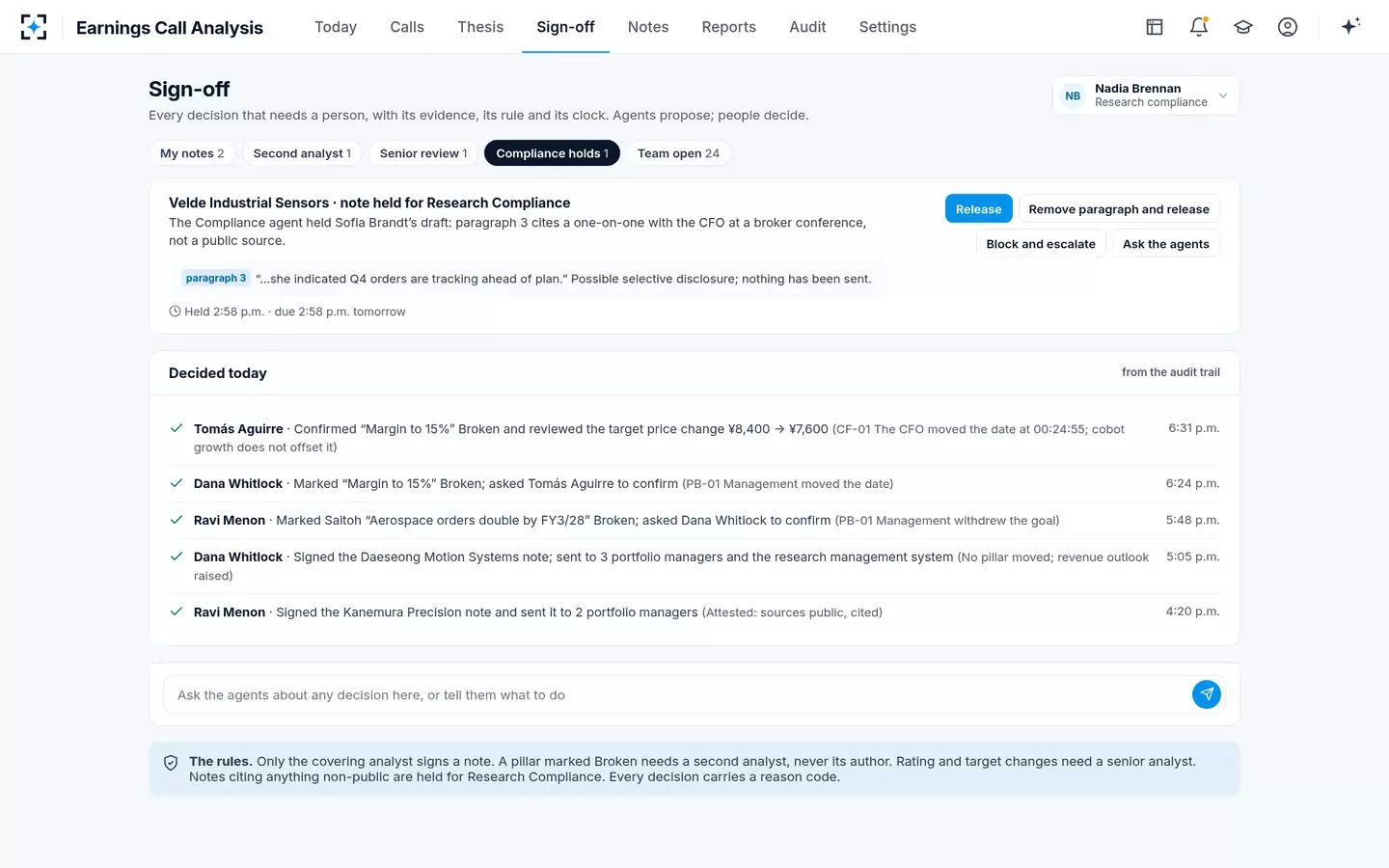
In the fictional sample, an analyst's draft on a European industrial company quoted the chief financial officer at a broker conference saying fourth-quarter orders were "tracking ahead of plan". That is exactly the kind of current-quarter signal the SEC's cases turn on. The note did not go out; the compliance officer could release it, remove the paragraph and release the rest, or block it, and each choice is recorded with who made it and why. Earnings Call Analysis shows the rest of the sign-off path, and who asks questions in an earnings call covers the public side of the same relationship.
The last check is the analyst's own. Before a note is released, the covering analyst attests that every cited line has been read, that every source is public with no material nonpublic information, and that the analyst's views are labelled as views. The attestation is recorded with the time and every source behind the note, which is the documentation CFA Standard II(A) asks an analyst to keep when relying on a mosaic.
The analyst signs: every source public, no material nonpublic information
Questions people ask
Does Regulation FD apply to private companies?
No. It applies to issuers with securities registered under Section 12 of the Exchange Act or reporting under Section 15(d), including closed-end funds, but not other investment companies, foreign governments or foreign private issuers. A private company's conversations with investors are governed by other law, including the antifraud rules.
Can shareholders sue for a Regulation FD violation?
No. The rule says a failure to make a disclosure required solely by Regulation FD is not a violation of Rule 10b-5, and the SEC said in 2000 that the rule creates no private liability. Enforcement is by the SEC, as in the AT&T case.
Can a company share material information under an NDA?
Yes, if the recipient "expressly agrees to maintain the disclosed information in confidence". The SEC staff says that agreement is enough without a separate promise not to trade, but a recipient who trades or tips can face insider-trading liability.
Do Regulation FD rules apply to social media?
A company can announce through social media only if investors have first been told which channels it will use. In 2024 the SEC fined DraftKings $200,000 after posts on its chief executive's personal accounts disclosed that the company continued to see "really strong growth" before results were public.
Was anyone ever fined personally under Regulation FD?
Yes. Schering-Plough's former chief executive paid $50,000 in 2003, which the SEC called its first penalty from an individual in a selective-disclosure case; executives at Flowserve, Office Depot, First Solar and AT&T later paid $25,000 to $50,000 each.