An earnings call transcripts API is a data feed, usually licensed from a commercial vendor, that delivers the text of company results calls, speaker by speaker, sometimes in more than one version: an early one and a corrected final. The SEC does not publish call transcripts: its own APIs carry filings and their financial data, and a results call held under the 8-K exemption is not filed at all. A feed is necessary for automated earnings call analysis but it is one input of five. The others are what the research team already holds: the coverage list matched to the earnings calendar, the analysts' thesis pillars, their models, and the note template with past notes. Botminds' Earnings Call Analysis, software that turns each covered call into a cited thesis-impact note for buy-side analysts, starts from all five, and adds the firm's own recording of the call so the analysis does not wait for the transcript. This guide covers where transcripts come from, how soon they arrive, and what a team needs to bring.
Five inputs to automated earnings call analysis, and what goes wrong without each
1 The call itself
Where it usually livesA transcript vendor's feed, and the firm's own recording line
Without itNothing to read; with the feed alone, analysis waits for the transcript.
2 Coverage list and calendar
Where it usually livesThe research management system; a market data vendor's earnings calendar and consensus
Without itCalls are missed, mismatched to the wrong issuer, or read with no consensus to compare.
3 Thesis pillars
Where it usually livesAnalysts' notes, often in documents rather than structured fields
Without itThe output is a summary: what was said, not what moved.
4 Analyst models
Where it usually livesWorkbooks in document management
Without itGuidance cannot be compared with the analyst's own numbers, only with consensus.
5 Note template and past notes
Where it usually livesThe research management system
Without itDrafts in a house style nobody uses; no prior view to compare against.
Is there an earnings call transcripts API?
Yes, from commercial data vendors, and not from the SEC. The SEC's application programming interfaces cover filings: "Currently included in the APIs are the submissions history by filer and the XBRL data from financial statements (forms 10-Q, 10-K,8-K, 20-F, 40-F, 6-K, and their variants)", updated "throughout the day, in real time, as submissions are disseminated" (SEC, EDGAR application programming interfaces). Anyone using them must "declare your user agent in request headers" and keep to a "current max request rate: 10 requests/second" (SEC, accessing EDGAR data).
The call itself is not in that data because the rules do not require it to be filed. A company furnishes its results release on Form 8-K under Item 2.02, but it need not furnish the call if the call follows within 48 hours, is open to the public, uses figures posted on its website, and was announced with instructions on how to join (Form 8-K, Item 2.02(b)). So the release is on EDGAR within the 8-K, and the call's words are on the company's replay and in vendors' transcripts.
Where can I get earnings call transcripts?
From three places, with different speed, cost and rights. The company's investor relations site can carry the webcast replay and sometimes its own transcript. Commercial transcript vendors license feeds and APIs. And a research firm can listen to and record the public call itself, which is the only source that exists the moment the call does.
The SEC has nudged companies toward keeping a public record. When it adopted Regulation FD in 2000 it said a company using a call or webcast for public disclosure "should consider providing a means of making the webcast or call available for some reasonable period of time" (Release 33-7881, note 73). Its staff later added: "If a transcript or re-play of the conference call will be available after it has occurred, for instance via the issuer's website, we encourage issuers to indicate in the notice how, and for how long, such a record will be available to the public" (Regulation FD interpretations, Question 102.01).
Are earnings call transcripts free?
The call and the company's replay are free to listen to; transcripts at scale, delivered by API, are generally licensed. What matters for a buyer is less the price than the licence terms: whether transcripts may be stored, how long, who inside the firm may see them, and whether they may be processed by AI tools. Those terms decide what an analysis system can keep as evidence behind a note, so read them before the price.
How soon are earnings call transcripts available?
After the call, by a margin that depends on the vendor, the market and the language; there is no rule that sets it. For calls in Japanese, Korean or German the English version is the slowest to arrive, and that wait falls exactly on the evenings when analysts are busiest, because results bunch together: Hirshleifer, Lim and Teoh found the market's own reaction to earnings is "much weaker" on days crowded with other announcements, with more of it delayed (Journal of Finance, 2009).
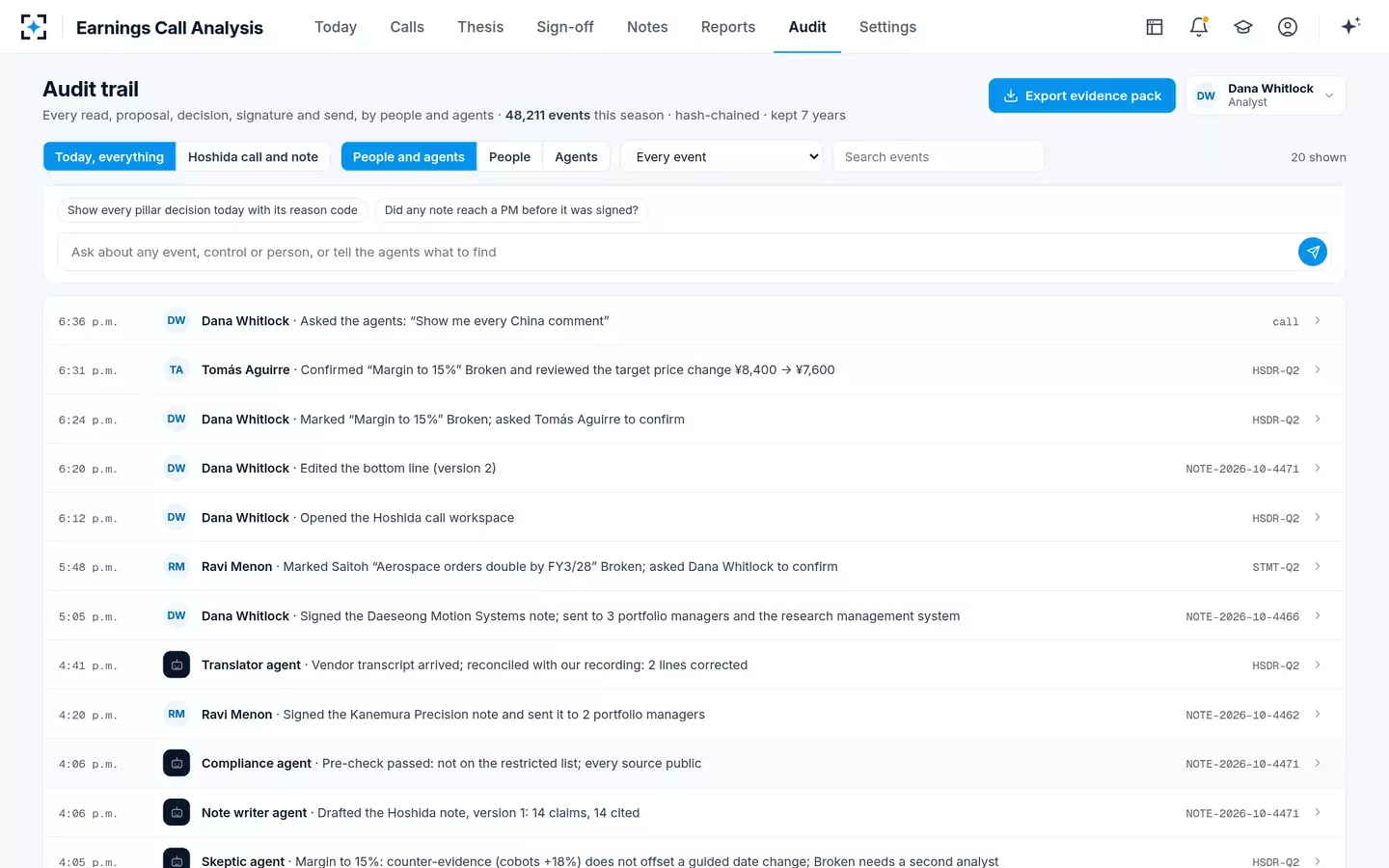
In the fictional sample at Quillfield Capital, Hoshida Robotics' call in Japanese ended at 3:58 p.m. Singapore time and the vendor's transcript arrived at 4:41 p.m., 43 minutes later. By then the solution had already read the call from the firm's recording line, put English beside every line and drafted the note. When the vendor transcript arrives, the translator agent reconciles it with the firm's recording and logs each correction; on the sample call there were two.
The audit trail: when the vendor transcript arrived, and what was corrected
Can you record an earnings call?
Often, but check two things before relying on it: the terms of the company's webcast or dial-in service, and the law where your firm and the call are. The call is public by design; recording and storing it is a separate question for your counsel. Where it is permitted, a firm's own recording has two uses. It removes the wait for a vendor transcript, and it is a primary source to check a transcript against.
Whatever the source, the firm should keep what its notes rely on. CFA Institute Standard V(C) lists "press releases or presentations issued by the covered company" and "personal notes from meetings with the covered company" among the records that support a recommendation, and recommends keeping records "for at least seven years" where no rule or firm policy sets a period (CFA Institute Standards of Practice, V(C), updated April 2024).
What data do you need to automate earnings call analysis?
The call, and four things only the firm has. The coverage list and the earnings calendar tell the system which calls to read and when, and must be matched issuer by issuer: in Earnings Call Analysis the intake agent sends any match under 90% to a person and never reads an unmatched call into a note. The thesis pillars, ideally with confirm and break rules, are what the call is tested against. The analysts' models let guidance be compared with each analyst's own numbers rather than only with consensus. And the note template with a sample of past notes gives the draft the house structure and the prior view to compare against.
How a call and the firm's own inputs come together in Earnings Call Analysis
Agent
IntakeMatches each call on the earnings calendar to the coverage list, joins the firm’s recording line, attaches the vendor transcript when it lands.
Never: read an unmatched call into a note; a match under 90% goes to a person
Agent
Listener and translatorTag guidance live in the language spoken; put English beside every line; check every figure in both languages; reconcile with the vendor transcript and log corrections.
Never: drop the original, or fix a figure mismatch silently
A person decides
Analyst checks unclear linesAny line under the confidence threshold, 80% by default, waits for a person before it can be used.
Agent
ComparerHolds each statement against last quarter’s guidance and the analyst’s model; proposes cell changes, each with its line.
Never: write to the model without approval
A person decides
Analyst approvesApproves model changes and decides pillar moves; the earlier model version is kept.
Getting the five inputs ready
Most teams have all five, in forms that need some work. Coverage lists drift from what analysts actually follow. Theses live in prose, and the break rules are in analysts' heads. Models are workbooks with house conventions. The work before going live is mostly turning those into something a system can read without guessing, and it is worth doing whether or not a team automates anything.
Before you connect a transcripts API: a data readiness checklist
- One coverage list, with issuer identifiers
Matched to the calendar by identifier, not by name; one owner for changes.
- Transcript licence terms read
Storage, internal sharing, retention and use with AI tools: they decide what can be kept as evidence.
- A recording option decided with counsel
Whether the firm records public calls, and where recordings are stored by office.
- Thesis pillars written down with break rules
Three to five per name, in figures, before the season starts.
- Model cells named for each pillar
So a proposed change lands in the right cell and a reviewer can see it.
- A note template and ten past notes
The structure readers expect and the prior views the next note compares with.
- Restricted and watch lists connected
So a note on a restricted name is held before anyone reads it.
A transcript feed alone, or the five inputs
A transcript feed on its own produces transcripts, faster or slower; with a summariser on top it produces summaries. The four other inputs are what turn a call into a decision, and they are the reason the go-live work is a research team's work rather than a data team's alone. In Earnings Call Analysis first-time setup is a guided conversation with the agents in six steps, each approved before the next, starting from the coverage list, thesis pillars, note template and a sample of past notes; nothing goes live until the last step is approved.
What a transcripts API gives you, and what the five inputs add
Transcript feed alone: When the transcript lands; later for calls in other languages.
Five inputs in Earnings Call Analysis: While the call runs, from the firm’s recording, in the language spoken.
Transcript feed alone: Nothing, unless someone builds it.
Five inputs in Earnings Call Analysis: Last quarter’s guidance, consensus and the analyst’s own model, cell by cell.
Transcript feed alone: Text, or a summary of it.
Five inputs in Earnings Call Analysis: Pillar moves with the lines behind them, a cited draft note, proposed model changes.
Transcript feed alone: Whatever the licence allows.
Five inputs in Earnings Call Analysis: Every read, proposal, decision and signature on a hash-chained trail, seven years by default.
Transcript feed alone: English transcript of a non-English call, when available.
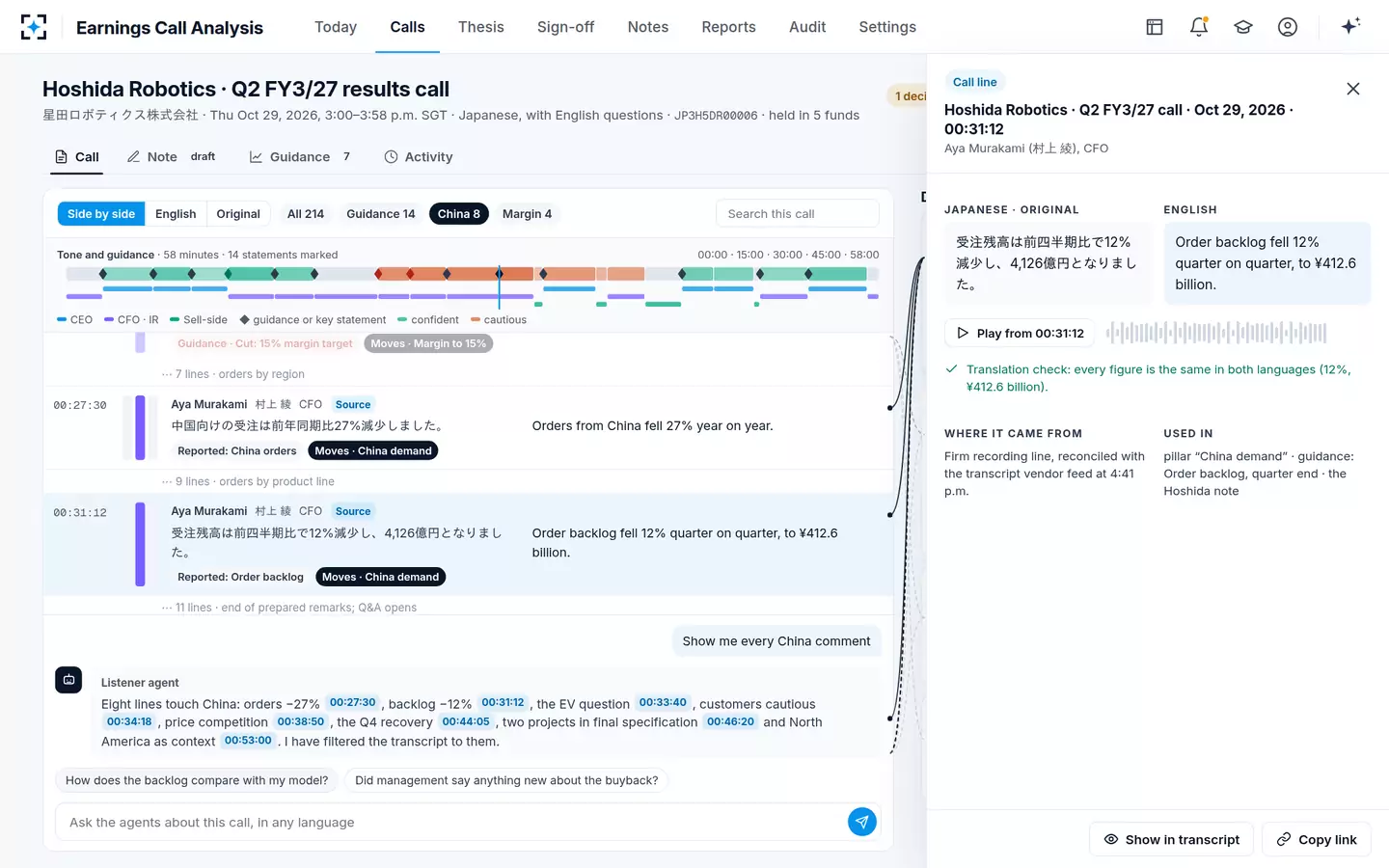
Five inputs in Earnings Call Analysis: Original beside English, every figure checked in both; vendor transcript reconciled, corrections logged.
Calls in other languages are where the difference is largest, and research gives a reason beyond speed. Brochet, Naranjo and Yu found that calls of firms in countries with greater language barriers more often contain non-plain English and erroneous expressions, and that those calls show lower intraday price movement and trading volume (The Accounting Review, 2016). Reading the original beside the English, with figures checked in both, is how a team avoids inheriting a translation's mistakes. The guide to foreign private issuers' calls covers the rules for those companies, how long earnings calls last covers the evening the wait falls into, and the Earnings Call Analysis page shows the full set of connections.
One line, the original and the English, and where it came from
Where Earnings Call Analysis fits, and where a feed is enough
A transcript feed is enough when nobody needs a decision from the call: a quantitative team building its own text models wants raw transcripts, not notes, and a monitoring list of names without a view can live on summaries. Earnings Call Analysis is not a transcript vendor and does not replace one; it reads the feed a firm already licenses, alongside the firm's own recording where that is permitted. Without a recording line it still works, starting when the vendor transcript lands, so the gain on speed is smaller and the gain on checking is the same.
It fits best where the four other inputs exist or can be written: a research team covering many names in the peak weeks, holding written theses, sending notes to portfolio managers who need to know which pillar moved. Its limits are deliberate. It never writes to a model, never sends a note before the analyst signs, and never releases a note that cites a private meeting without research compliance. A team that wants an automated publishing pipeline with no person in it is looking for a different product.
Questions people ask
Does the SEC publish earnings call transcripts?
No. The SEC's APIs carry filings and their XBRL financial data, including Forms 8-K, 10-Q, 10-K, 20-F, 40-F and 6-K. The results release is furnished on Form 8-K, but a call that meets Item 2.02's conditions need not be filed, so transcripts come from the company's replay or from vendors.
How long do companies keep earnings call replays online?
It varies by company. The SEC has encouraged companies to keep a replay available "for some reasonable period of time", and its staff encourages them to say in the call notice how, and for how long, a transcript or replay will be available.
What is the difference between a quick transcript and a final transcript?
A feed can carry more than one version of the same call, an early one and a corrected final. An analysis system should record which version each quote came from and reconcile the two; in the sample above, the reconciliation found two lines that differed from the firm's own recording.
Can I use a transcripts API with an AI model?
Technically yes; contractually, check the licence. Some data licences restrict storage, redistribution or processing by third-party AI services, and ESMA has said firms remain responsible for staff use of tools such as ChatGPT whether or not management approved it.
What is the minimum to start automating earnings call analysis?
A transcript source, the coverage list matched to an earnings calendar, and the analysts' thesis pillars. Models and a note template can follow, but without pillars the output is a summary rather than a test of anyone's view.