Asset managers are using AI mainly for support work: drafting and summarising documents, internal assistants, code, data cleaning and translation, with far fewer uses inside investment decisions themselves. That is what the regulators' own surveys show. ESMA's 2025 survey of 728 EU securities-market firms found most use cases in support functions and investment firms and managers behind other sectors; the Bank of England and FCA's 2026 survey of 196 UK firms found AI agents widely deployed but almost all of them recommending rather than acting. For investment research, the gap these numbers point to is narrow and specific: tools that read many sources quickly are common, and tools that read them under each reader's permissions and cite every sentence are not. That gap is what Botminds' Investment Research Assistant was built to fill.
AI in finance, in four regulators' numbers
86%
of UK financial firms surveyed use AI, up from 75% in 2024
56%
of UK firms' reported AI systems are generative AI
53%
of EU investment firms and managers surveyed had no AI use case
2%
of UK firms run AI agents with broad autonomy
How are asset managers using AI? The short answer from regulators' data
Asset managers are using AI to read, write and organise information faster, and only beginning to use it in decisions. The two largest regulatory datasets agree on that shape even though they count differently. ESMA counted 847 use cases reported by 395 EU firms, in a sample in which nearly three-quarters of respondents were investment managers or investment firms. The Bank of England and FCA counted AI systems and asked about agents, autonomy and controls across UK banks, insurers, investment firms and others.
ESMA's sample is the closest to asset management: 274 investment managers and 262 investment firms among 728 entities from 19 member states. Its authors are careful that participation was voluntary, so "the statistics presented in this article are not necessarily representative" of all EU firms (ESMA TRV Risk Analysis, February 20, 2026). The UK survey makes a similar caution about comparing years. Read both as the best public evidence, not as a count of every firm.
Three public datasets on AI in finance, and what each covers
| Source | Who and when | What it measures |
|---|---|---|
| Bank of England and FCA, AI in UK financial services 2026 | 196 UK firms (105 full responses), published October 26, 2026 | AI systems by business area, generative AI, agents and autonomy, third-party use, controls |
| ESMA, AI adoption and trends in securities markets | 728 EU entities incl. 274 investment managers, surveyed summer 2025, published February 20, 2026 | Use cases by category, autonomy, benefits, risks, investment plans |
| FINRA, 2026 Annual Regulatory Oversight Report | US broker-dealers, published December 9, 2025 | Observed generative AI uses, agent risks, practices firms consider |
| SEC Division of Examinations priorities | US registrants, FY2026 (November 17, 2025) and FY2027 (October 23, 2026) | What examiners will review; not a survey |
What is the top use of generative AI in finance? Drafting and summarising
The top use of generative AI in finance is drafting and summarising text, followed closely by internal assistants. In ESMA's survey the largest category was drafting and summarising with 239 use cases, 29% of the total, then internal assistants or copilots with 227, code generation with 109, data quality and processing with 105, and translation with 95. Client-facing uses were rarer: 86 for communication with clients and 34 for customer identification.
What EU securities firms use AI for: support work leads, investing trails
The UK picture matches. The Bank of England and FCA found "enterprise productivity", such as coding assistants or summarisation tools, the most widely reported current use, selected by 86% of full-survey respondents. FINRA reports the same pattern among US broker-dealers, with summarisation and information extraction as the leading generative AI use (FINRA, 2026 Annual Regulatory Oversight Report). How well summarisation tools actually do on one research input, the earnings call, is tested in earnings call summary AI, compared.
Where AI touches investment decisions, and where it does not yet
AI rarely touches the investment decision itself yet. ESMA counted only 20 use cases in portfolio risk management, 19 in portfolio optimisation, 10 in algorithmic trading, 3 in high-frequency trading and 2 in robo-advice, "with most still in development or experimental stages". Firms classed 87% of use cases as internal only, against 10% for client relationships and 3% for providing investment services. ESMA's reading is that AI is currently "a tool for enhancing back-office efficiency rather than transforming front-office or investment decision-making processes".
Investment research sits between those poles. It is not a back-office task, yet most of its hours go on reading and reconciling rather than deciding, which is exactly what drafting and summarising tools address. ESMA's chart includes investment research as a category in its own right, small beside drafting and internal assistants. The opportunity is real; the constraint, for research, is that the sources are licensed and sometimes confidential, which a general drafting tool does not handle.
What are AI agents in finance, and how much autonomy do they get?
AI agents in finance are AI systems that use tools and act toward a goal with some autonomy, and in practice almost all of them recommend while a person decides. The Bank of England and FCA define agents as systems that "perceive and act on their environment with a degree of autonomy, using tools as needed to achieve specific goals" (Bank of England and FCA, 2026). They then asked firms how much autonomy their deployed agents had.
The answer was graded. 80% of full-survey respondents had agents in decision support, where agents recommend and humans decide and execute; 46% had agents with constrained execution within predefined limits; 22% had conditional autonomy, acting independently but needing approval for certain actions; and 2% had broad autonomy. ESMA found the same caution in the EU: 77% of use cases ran with low or no autonomy, and even among the 141 agentic use cases, 68% were low or no autonomy.
Where UK firms deploy AI agents for decision support, by business area
Firms also drew a firm line around consequential actions. Even including plans for the next twelve months, no more than 9% of UK respondents expected agents to approve or decline customer outcomes, execute trades or place orders, move payments, or change limits and controls. That is the design rule in Investment Research Assistant too: the agents plan, read, compare and verify, but the agents may not trade, change a position, contact an issuer or broker, or approve anything.
Are investment firms behind on AI?
Yes, on adoption, though mostly because they are smaller. In ESMA's survey, investment firms and investment management firms "appear to trail the other sectors, with 53% of the respondents reporting no use cases", compared with 17% for credit institutions providing investment services. ESMA adds that the differences "largely reflect the different distribution of firms’ size across sectors": more than 90% of large enterprises in every sector were engaging with AI, and among medium-sized firms, investment firms and managers had among the lowest rates of non-adoption.
Expectations are modest too. On a scale of 0 to 5, EU firms' average expected cost saving from generative AI over the next two to three years was 2.1, with investment firms at 1.8, and expected revenue gains averaged 1.2. Investment managers rated 30% of their use cases as of medium or high materiality, against 43% at market infrastructures and 41% at credit institutions. Spending intentions point up all the same: 70% of firms expected to increase AI investment between 2025 and 2027.
What worries firms: hallucinations, data and third parties
Firms worry most about data, model errors and dependence on a few providers. In ESMA's survey 82% named at least one data-related challenge, led by data protection at 59% and data quality at 55%, and "model hallucinations remain a concern for the majority (51%) of respondents". UK firms rated data protection and security, third-party and supply-chain risk, and generative-AI-specific risks such as hallucinations and prompt injection highest.
The third-party point matters for any firm buying rather than building. Third-party systems made up 39% of UK firms' reported AI systems in 2026 and 53% of their high-materiality ones. For high-materiality third-party systems, 81% of firms relied on vendor assurance and contracts to understand them, and only 24% reported deep knowledge of how they worked, against 77% for systems built in-house. A buyer can narrow that gap by insisting that a tool show its working: the plan before it reads, the source behind every sentence, and a log of every check.
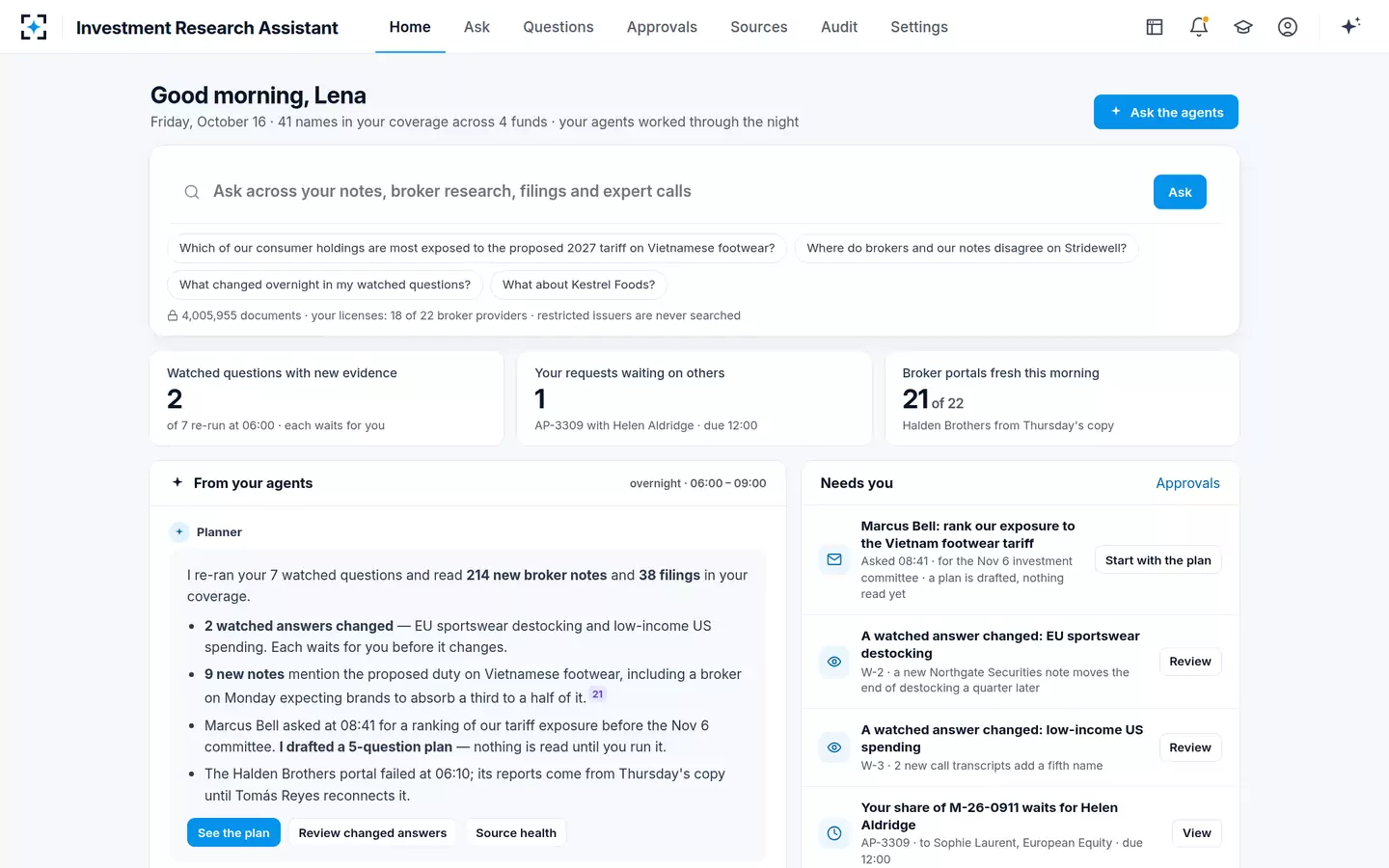
Investment Research Assistant: agents that read and recommend, people who decide
How firms govern their AI: policies are common, monitoring less so
Most firms have written AI policies; fewer have the inventories, reviews and incident plans that make them work. Among UK full-survey respondents, 94% reported firm-wide AI policies, principles or standards and 84% centralised AI or model-risk governance fora. But only 68% kept a central inventory of AI systems, 62% had a formal materiality classification and 61% reviewed AI systems at least annually, and fewer than half had incident-management playbooks (Bank of England and FCA, 2026).
The frameworks firms cite are a mix of law and voluntary standards: 71% of UK respondents mentioned the EU AI Act, 65% the FCA's AI Update and 60% the NIST AI Risk Management Framework. Skills are the quieter constraint. In ESMA's survey only 17% of firms said their board and senior management fully understood the AI technologies they used, and 8% said so of operational staff, though 65% had trained or planned to train employees.
AI governance in UK and EU firms: what is in place
94%
of UK firms have firm-wide AI policies, principles or standards
61%
of UK firms review their AI systems at least annually
17%
of EU firms say board and senior management fully understand their AI
65%
of EU firms have trained, or plan to train, staff on AI
For a research tool, the practical consequence is that controls should be built into the tool rather than left to a policy document: a plan shown before reading, permissions checked automatically, every sentence cited and every change to an agent versioned and approved. Those are controls an annual review can test, rather than intentions it has to take on trust.
What does the SEC say about AI? It examines it, in its own words
The SEC examines how firms use and describe AI, and its fiscal 2027 examination priorities use a new term for it. The Division of Examinations writes that "Registrants are increasingly incorporating super intelligence (SI) into their businesses" and that it will prioritise examinations of policies and procedures relating to monitoring SI; its fiscal 2026 priorities had already said examiners would check whether firms have policies and procedures to monitor or supervise their AI (SEC, FY2027 Examination Priorities, October 23, 2026; FY2026, November 17, 2025). What examiners have charged when AI claims ran ahead of the facts is in AI washing: what the SEC charged. Priorities are staff statements, not rules.
“There is also a sustained effort across the Division to integrate SI responsibly into examinations and risk assessment, augmenting staff capacity, enhancing oversight, and supporting mission-critical work without displacing examiner judgment.”
SEC Division of Examinations, Fiscal Year 2027 Examination Priorities, October 23, 2026
There is no pending SEC rule specific to advisers' use of AI. The 2023 proposal on conflicts of interest from predictive data analytics was withdrawn by a Commission notice dated June 12, 2025 (90 FR 25531, June 17, 2025). What the SEC does enforce is accuracy: claims about AI fall under the same anti-fraud and marketing rules as any other claim, as the SEC's AI-washing cases show.
What the numbers mean for a research team, and for Investment Research Assistant
For a research team, the numbers say three things. First, most AI in the industry is still general drafting and summarising, so a tool that merely summarises is not a differentiator. Second, the accepted operating model is decision support: agents read and recommend, a named person decides, and consequential actions stay with people. Third, the risks firms rate highest, hallucination, data protection and third-party opacity, are exactly the ones that matter most when the sources are licensed broker research and nonpublic notes.
Investment Research Assistant is built to that brief. Its agents plan and read under each reader's licences, set disagreeing sources side by side, and delete any sentence they cannot cite; the analyst chooses and approves, and a second person approves anything leaving the team. The way a research team's roles change around that model is in buy side research with AI agents: an operating model. To see it on your own research, start from Investment Research Assistant.
Questions people ask
How is AI used in investment management?
Mostly for drafting and summarising, internal assistants, code, data processing and translation, according to ESMA's survey of EU firms; uses inside portfolio decisions, such as risk management, optimisation and algorithmic trading, numbered only 20, 19 and 10 of 847 use cases. Agents are deployed mainly to recommend while people decide.
What percentage of asset managers use AI?
In ESMA's 2025 survey, 53% of EU investment firms and investment management firms reported no AI use case in production or development, so a little under half had at least one. The UK survey found 86% of all respondent firms using AI, but it covers banks and insurers as well as investment firms.
Do regulators allow AI agents in investment firms?
No regulator has banned them; supervisors expect the same rules to apply and a named person to remain accountable. ESMA says firms' management bodies remain responsible for decisions taken with AI, and FINRA lists agent risks such as acting beyond intended scope and weak auditability, with human oversight among the practices firms consider.
What is the biggest risk of AI in asset management?
Firms themselves rank data protection, third-party dependence and generative-AI-specific risks such as hallucination highest; in ESMA's survey 51% named hallucinations a concern. For research, the practical risks are an unsupported figure reaching a memo and licensed or nonpublic text reaching the wrong reader.
Is AI used for stock picking by asset managers?
Rarely as the decision-maker. ESMA found core investment uses such as portfolio optimisation and algorithmic trading among the least common, mostly still experimental, and UK firms almost never expected agents to place orders. AI's main role in research is reading and organising evidence for analysts who decide.