Payment optionality for investment research is the freedom, restored in the UK and the EU, for an asset manager to pay for third-party research jointly with execution, through commissions, instead of only from its own resources or a separately funded research payment account. The FCA introduced the option for MiFID investment firms from 1 August 2024 (PS24/9) and for UK fund managers from 9 May 2025 (PS25/4); EU member states apply their version from 6 June 2026. The option is hard to use well because it comes with conditions that need evidence every year: a research budget, an agreed method for identifying the research cost, fair allocation across clients, disclosure, and an assessment of what the research was worth. Botminds' Broker Vote produces that evidence as a by-product of running the broker vote, and drafts the annual assessment with each condition beside its evidence for Compliance to judge.
This guide is for the COO and the compliance officer of a manager with UK or EU business, and for US managers who buy research for or from those markets. The history of why research was unbundled in 2018 is covered in MiFID II research unbundling after 2024; here the question is what a firm using the new option must be able to prove. The sample figures come from a fictional manager, Quillfield Capital; every name in them is invented.
Paying for research with execution: the UK, EU and US conditions side by side
| Condition | UK: COBS 2.3B (PS24/9, PS25/4) | EU: MiFID II Art. 24(9a) as amended | US: Section 28(e) |
|---|---|---|---|
| In force | Investment firms from 1 Aug 2024; fund managers from 9 May 2025 | Member states apply from 6 Jun 2026 | Since 1975; client commission arrangements widely used |
| How the research cost is set | Arrangements stipulating the method for calculating and separately identifying research costs | An agreement with the provider establishing a methodology for remuneration | No method prescribed; good-faith judgement that commissions are reasonable for the value received |
| Budget | Required, at least annually, based on expected need, not trading volumes | Required for a research payment account; not set by the directive for joint payments | None |
| Assessment of research | At least annually: value, quality, use, contribution to decisions; charges reasonable against comparable services | Annually: quality, usability, value and contribution to better decisions, on objective quality criteria, whatever the payment method | The good-faith determination; SEC 2006 guidance on what counts as research |
| Allocation across clients | Fair between clients, at a level of aggregation suited to the business | Not specified for joint payments | Disclose whether soft dollar benefits serve all accounts or only those that paid |
| Disclosure to clients | Approach and policy before service; expected costs; total costs annually; types of providers paid | Choice of joint or separate payment and the policy; total research costs on request, annually, if known | Form ADV Part 2A, Item 12 |
| Best execution | Research must not be an execution factor; best execution rules unchanged | ESMA to report on the impact of joint payments on execution quality by 5 Dec 2028 | Section 28(e) does not change the duty to seek best execution |
What is payment optionality for investment research?
Payment optionality means a firm chooses how to pay for third-party research from three routes instead of two: from its own resources, from a research payment account funded by a specific charge to clients, or, now, through joint payments for research and execution. In the UK rule, research received in return for "joint payments for third-party research and execution services" is not an inducement, provided the firm meets the operating requirements that follow (FCA COBS 2.3B.3R).
Joint payment is not a return to the old bundle. The research cost must be identifiable within the total charge, the research portion may be used only to pay for research, and the payments must be spread through a structure that can reach independent research providers, not only the executing broker. The FCA said as much when it summarised the feedback: some respondents noted the option "does not represent “full bundling” due to the requirement to have separately identifiable research charges" (FCA PS24/9, paragraph 3.4). Rebundling research traces how the market got here.
What did FCA PS24/9 change?
FCA PS24/9 added joint payments as a third way for investment firms to pay for research from 1 August 2024, with guardrails, and made two smaller changes to the list of acceptable minor non-monetary benefits. It allowed short-term trading commentary and advice linked to trade execution as minor benefits, and it deleted the 2021 option to pay jointly for research on companies below £200 million of market capitalisation, which had seen "little take-up" and which the new option replaces for companies of any size (FCA PS24/9, paragraph 1.22).
The final rules were looser than the consultation in four places, and each matters for how a firm documents itself. Budgets may be set at a level of aggregation suited to the firm's investment process, products and clients. Firms disclose the types of providers they pay, such as independent research providers against others, not the names of the most significant ones, and need not disclose amounts paid to each. The price test became an outcome, research charges reasonable against comparable services, with benchmarking as one way to show it. And the method for separating research costs no longer needs a bilateral written contract: "We previously required that there be written agreements with research providers. We now more broadly require that arrangements be in place that stipulate how this is done" (FCA PS24/9, paragraph 1.23).
That last change is easy to misread. Many firms will still sign provider agreements, because a price cap is easiest to enforce from a contract, but the rule asks for arrangements that set the method, whether bilateral, multilateral through a service provider, or on standard terms of business.
The research payment calendar since 2023
3 Jul 2023
SEC staff relief for US brokers taking separate research payments expired
SEC Commissioner statement
1 Aug 2024
UK joint payment option open to MiFID investment firms
FCA PS24/9
9 May 2025
UK option extended to UCITS managers and alternative fund managers
FCA PS25/4 instrument
6 Jun 2026
EU member states apply joint or separate payment, with the annual assessment
Directive (EU) 2024/2811
Does payment optionality apply to fund managers?
Yes, in the UK since 9 May 2025. PS25/4 extended the joint payment option to UK UCITS management companies, full-scope UK alternative investment fund managers, and small authorised UK AIFMs and residual collective investment scheme operators, on the same model as PS24/9 with adjustments for funds (FCA PS25/4).
Three adjustments change how a fund manager's broker vote must be organised. Budgets can be set for one fund or across a fund range suited to the investment process, and one standard written policy can serve a fund range. Value must be assessed fund by fund for authorised funds, so the vote's evidence has to be attributable to funds, not only to teams. And for authorised funds, "the adoption of the joint payment option is a significant change, requiring fund managers to notify unitholders before the changes take effect" (FCA PS25/4, paragraph 1.17). The FCA also clarified that taking responsibility for the accounts used to buy research does not mean each fund needs its own commission sharing arrangement.
What changed in the EU in June 2026?
From 6 June 2026, EU investment firms may pay for research jointly with execution or separately, for research on companies of any size. Directive (EU) 2024/2811, part of the Listing Act, rewrote MiFID II Article 24(9a) and removed the 2021 limit that allowed joint payment only for research on issuers with a market capitalisation up to €1 billion. The Commission's own explanatory memorandum gives the reason plainly: "the decline in investment research did not slow down following this amendment" (Commission Delegated Directive C(2026) 994).
The directive sets three conditions. The firm and the provider of execution and research must agree in writing how the research will be paid for; the firm must tell clients whether it pays for research together with execution or apart from it, and make its policy available; and it must assess research quality, usability and value each year (Directive (EU) 2024/2811, Article 1). Research from a provider that offers no execution services, and belongs to no group that does, is treated as compliant subject to the same annual assessment.
The Commission's delegated directive, adopted on 20 February 2026 and aligned to the same application date, filled in the detail. It requires the annual assessment to rest on objective quality criteria and to lead to remedial action where research falls short, whatever the payment method. For firms that keep a research payment account, it sets that the account may not collect more than the research budget and may not be used "to fund internal research" (C(2026) 994, Article 13(4) and (6) as amended). The memorandum also records that a proposal to make firms compare each provider's research with other providers' had been "assessed and discarded by ESMA at an earlier stage, as deemed overly burdensome".
What guardrails come with joint payment for research?
In the UK the guardrails are a written policy, a method for identifying research costs, a structure for allocating payments between providers including independent ones, a budget, fair allocation across clients, an assessment at least once a year with a price test, client disclosure, operational responsibility for the accounts, and the rule that research is not an execution factor. Each one has a natural home in the broker vote's outputs, and a firm that runs the vote well already holds most of the evidence.
Nine UK guardrails, and the broker vote evidence that answers each
- Written policy on joint payments (2.3B.25R(1))
The research valuation policy itself, versioned, with governance for research kept apart from trade execution.
- Method for identifying research costs (2.3B.25R(2))
Provider arrangements and the agreed research charge per provider, held with each budget line.
- Payment allocation structure, including independent providers (2.3B.25R(3))
The allocation by provider and provider type that the vote produces.
- Budget, at least annually (2.3B.25R(5))
The budget approved before the vote, with any increase and its disclosure recorded.
- Fair allocation across clients (2.3B.25R(6))
The client-funded amount charged to funds and mandates in proportion to the research each used.
- Assessment and price test (2.3B.25R(7))
Two votes' scores, evidence and policy questions, plus caps and any benchmarks.
- Disclosure to clients (2.3B.30R and 31R)
Drafted per fund and mandate from the approved vote; types of providers, not individual amounts.
- Account administration and reconciliation (2.3B.28R)
Reconciled balances, timely payments, and a watch on surpluses and concentrations.
- Research not an execution factor (2.3B.29R)
A separate desk scorecard, and checks that research votes never cite execution.
Two guardrails are often under-built. The research accounts must be reconciled and reported on regularly and promptly, and the firm must keep monitoring "risks from unspent surplus amounts and research provider concentrations of these surplus amounts" (COBS 2.3B.28R), which needs balances by provider, not just a total. And the budget's breach rule must be written before it is needed: if research charges exceed the budget, or it is raised, the policy must already say what the firm will do and tell clients (COBS 2.3B.26R).
What happened to the SEC no-action relief for MiFID research payments?
It expired on July 3, 2023. In October 2017 the SEC's staff gave US broker-dealers temporary relief so they could accept research payments from clients bound by MiFID II, in hard dollars or from research payment accounts, without being treated as investment advisers. In November 2019 the staff extended it: "This no-action letter, which was set to expire July 3, 2020, has been extended until July 3, 2023" (SEC press release 2019-229). It was not extended again. Commissioner Uyeda's statement two days later recorded that "The MiFID II Relief expired on July 3, 2023" and that he was disappointed the staff had not extended it (Statement, July 5, 2023).
The FCA explained in PS24/9 why the expiry mattered. A US broker-dealer is excluded from the definition of investment adviser only if its advice is incidental to its brokerage and it receives no special compensation for it; a separate payment for research can be treated as special compensation, so US broker-dealers "must register as investment advisers if they wish to accept payment for research separate from execution commissions" (FCA PS24/9, paragraph 2.7). Joint payments, made through commissions, avoid that problem, which is one reason the UK and EU options matter to managers buying US research.
Does a US asset manager need to change anything?
A US manager with only US clients needs to change nothing because of PS24/9 or the EU rules: Section 28(e) and Form ADV Item 12 still govern how it uses client commissions for research. What changes the picture is any UK or EU connection. A US manager that runs a UK or EU fund, sub-advises one, or manages a mandate for a client subject to those rules will usually find the client or the fund's manager asking for the evidence those rules require: the budget, the method, the fair allocation, the annual assessment.
The good news for a US manager is that the evidence overlaps. The Section 28(e) safe harbor turns on a good-faith determination that commissions were reasonable for the value of the brokerage and research received (15 U.S.C. 78bb(e)), and Form ADV asks the adviser to explain the procedures it used to direct transactions in return for research. A broker vote with evidence of use, written criteria and an allocation anyone can rerun supports the US determination and the UK or EU assessment at once. Where the two regimes differ, most visibly on corporate access, the vote should score the service the same way and route the payment by regime.
Joint payment did not remove the work of unbundling. It moved the work from the payment route to the evidence.
Turning the guardrails into a broker vote file
The practical test of payment optionality is whether, a year from now, the firm can hand Compliance or a supervisor one file per condition. In Broker Vote, the Pack & Notice agent drafts the UK joint payment annual assessment from the approved vote, with each condition beside its evidence: the budget and who approved it, the policy version, the ballots and interactions behind the assessment, the allocation across funds and mandates, the provider arrangements and caps, and the client disclosures. It drafts the US Form ADV Item 12 input from the same vote. Nothing leaves before a checker releases it.
The annual assessment, condition by condition, from the approved vote
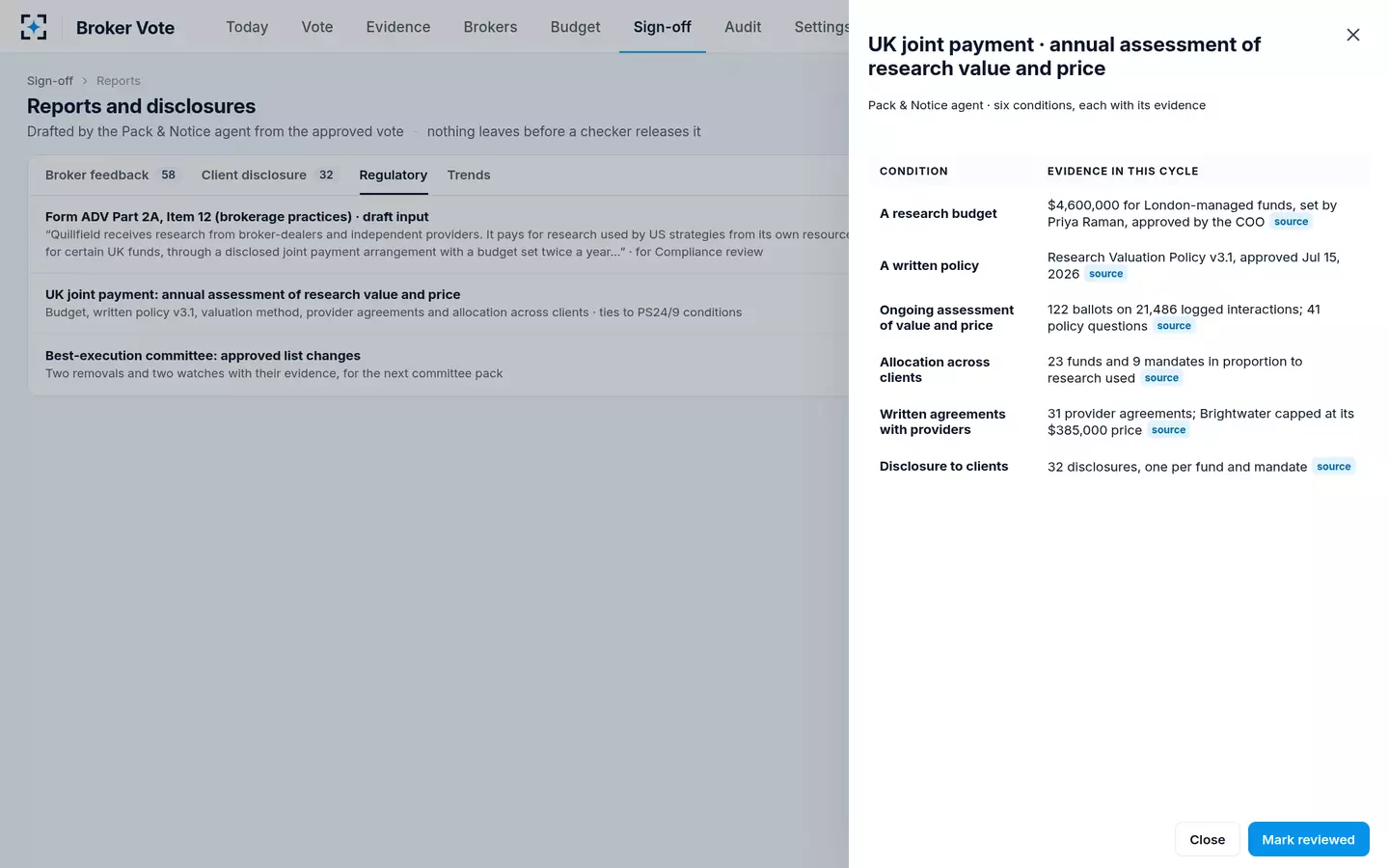
The same vote serves the EU firm. Its annual assessment needs objective quality criteria, which the research valuation policy supplies; evidence of quality, usability and value, which the scores and the usage behind them supply; and remedial action where research falls short, which the floor, the feedback letters and new-provider requests supply. How broker votes become a research budget shows the arithmetic that sits under each allocation, and corporate access under MiFID II deals with the one service each regime treats differently.
Questions people ask
Is joint payment the same as soft dollars?
They are relatives, not twins. US soft dollars, under Section 28(e), let a manager pay more than the lowest commission for research in good faith, with no required budget or separately identified research charge. UK and EU joint payments require the research cost to be identifiable within the total, an agreed method, an annual assessment and, in the UK, a budget and fair allocation across clients.
Do we have to disclose which research providers we pay?
Not by name in the UK. The final PS24/9 rules replaced disclosure of the most significant providers with the types of providers paid, for example independent research providers against others, and the FCA confirmed that disclosure of actual amounts paid to providers is not required. EU firms disclose their choice of payment method and policy, with total research costs on request.
Can the cost of running a commission sharing arrangement be charged to clients?
No, not in the UK. The FCA's guidance lists administration of an account for joint payments, and of a research provider payment allocation structure, among things it does not regard as research, so they cannot be paid from joint payments or a research payment account (COBS 2.3B.23G). The FCA said this was in line with the existing treatment of research payment account costs.
When must clients be told that the research budget was exceeded?
As soon as reasonably practicable, and in any case in the firm's next periodic disclosure on costs and charges (COBS 2.3B.31R(3)). The consultation had proposed disclosure within the budget period; the FCA relaxed it after feedback.
Can EU firms still use research payment accounts?
Yes. From 6 June 2026 an EU firm may pay separately, from its own resources or a research payment account, or jointly. A research payment account must be funded by a specific research charge, backed by a budget, and may not collect more than that budget in total.
Does a US broker-dealer need to register as an adviser to be paid for research?
Only if it accepts separate research payments that count as special compensation; since the SEC staff relief expired in July 2023, that question is live again for hard-dollar payments. Payments through commissions, including UK and EU joint payments and US client commission arrangements, do not raise it. Each broker's counsel makes that call, not the buyer.