Corporate access, in finance, is the service of arranging meetings between an investment manager and the management of a company it invests in or might invest in: one-to-one meetings, group lunches, conferences and site visits, usually organised by a broker. Under MiFID II as the EU's markets authority reads it, and under the FCA's rules in the UK, arranging such a meeting is not research, so a manager cannot pay for it from a research payment account or from the research part of a joint payment with execution. In the United States the answer differs: the SEC treats the content of a meeting with corporate executives as research a manager may pay for with client commissions under Section 28(e). That gap is why corporate access is the line item most likely to be paid from the wrong account. Botminds' Broker Vote lets voters score corporate access on the ballot like any other service, and pays every dollar of it from the firm's own P&L.
This guide is for research operations and compliance at managers with UK, EU or US business. The examples come from a fictional sample firm, Quillfield Capital, in its second-half 2026 broker vote; every name in them is invented.
Who may pay for which kind of corporate access, by regime
UK: Not research. Pay from the firm's own resources, unless the company is below £200m market value, where it can be an acceptable minor benefit.
EU: Not research. Likely a benefit that is not minor if exclusive; pay from own resources at a commercial price.
US: The meeting's content can be research under Section 28(e) if it imparts reasoning or knowledge about the issuer; disclose in Form ADV.
UK: Separate the research element from the access element; only research can be paid as research.
EU: Research may be paid as research; the price must not subsidise the access (concierge) element.
US: Seminars and conferences can be eligible where the content is genuinely research; the access element needs its own judgement.
UK: Treat as a non-monetary benefit and manage the risk that dealing commissions subsidise it.
EU: Could qualify as an acceptable minor benefit if freely and publicly open.
US: No payment involved; nothing to justify under Section 28(e).
UK: Not research: travel, accommodation and entertainment are listed as such.
EU: Not research.
US: Not eligible under Section 28(e); firm's own expense.
What is corporate access in finance?
Corporate access is the arranging, not the meeting. The FCA defined it in 2014 as a service that "denotes the service of arranging or bringing about contact between an investment manager and an issuer or potential issuer" (FCA PS14/7, May 2014), and that definition still frames the UK rules. The meeting itself may produce insight; what a broker sells as corporate access is the introduction, the scheduling and often the exclusivity.
The service is valuable, which is why the rules care about who pays. Surveying 365 sell-side analysts, Brown, Call, Clement and Sharp found that analysts rate private conversations with management above their own primary research as an input to earnings forecasts and stock recommendations (Journal of Accounting Research, 2015; who asks questions in an earnings call looks at the public side of the same access). Buy-side analysts and portfolio managers seek the same access for the same reason, and a broker that controls it controls something the manager wants badly. Paying for that access with clients' commissions is the conflict the European rules were written to stop.
Is corporate access research under MiFID II?
No. ESMA's answer, given in April 2017 in its MiFID II investor protection Q&A, is that arranging a meeting does not "explicitly or implicitly recommend or suggest an investment strategy and provide a substantiated opinion as to the present or future value or price of such instruments or assets", and so "does not appear to be ‘research’ and should be considered a discrete service" (ESMA35-43-349, Q&A 7 on inducements and research). A broker that also sells research may be paid for that research, but must make sure the research price is not "subsidising a charge for the corporate access (concierge) service".
The UK says the same in its own handbook. Among examples of goods and services the FCA does not regard as research, and which therefore cannot be paid for from research payment accounts or joint payments, the guidance lists "corporate access services", alongside seminar fees and travel, accommodation or entertainment costs (FCA COBS 2.3B.23G). The FCA had reached that view before MiFID II: in 2014 it reported that "None of the investment managers we visited could justify to us how Corporate Access met the evidential criteria for research" (PS14/7, paragraph 1.10).
Is corporate access a minor non-monetary benefit?
Usually not, with two exceptions. ESMA expects firms to assess carefully whether access is a material benefit, and gives the example that exclusive services, "such as individual meetings or field trips with a corporate, may involve the allocation of valuable resources by the provider", which makes them more than minor. By contrast, an investor roadshow organised by the issuer to support a capital raising, "freely and publicly open" to analysts and investors, "could be capable of qualifying as acceptable minor non-monetary benefits" (ESMA Q&A 7).
The UK adds a size exception. Its list of acceptable minor non-monetary benefits includes "corporate access services which relate to listed or unlisted companies with a market capitalisation below £200m" (FCA COBS 2.3A.19R(5)(k)). The FCA kept that provision in 2024 even as it deleted the companion option for research on the same small companies, because the new joint payment option covers research on companies of any size (FCA PS24/9, paragraph 1.22).
Can client money pay for corporate access?
Not in the UK or the EU, and not since 2014 in the UK. The FCA's review of research unbundling put it bluntly: paying dealing commissions for arranging contact between an investment manager and an issuer "has been banned in the UK since June 2014", and it found "one example of a firm using an RPA to pay for corporate access, which we consider is a breach of the rules" (FCA multi-firm review, 2019, now marked historical). The 2024 joint payment rules did not change that; corporate access inducement rules were among the subjects the FCA said were outside the scope of PS24/9 (PS24/9, paragraph 1.7).
Many firms asked for a change. A sizeable portion of respondents to the FCA's 2024 consultation argued that corporate access should be payable through the new option or a research payment account, to align with other markets and help smaller managers, and the FCA replied that the point was out of scope (PS24/9, paragraphs 3.53 and following). Until the rules change, the answer for UK and EU money is the firm's own resources. ESMA describes that route directly: a firm "can also treat corporate access as a commercial service and pay for it appropriately from its own resources", provided the access is not linked to research or execution payments.
Corporate access in the UK, in the regulator's own findings
June 2014
since when UK managers may not pay for corporate access with dealing commissions
FCA, 2019 review
£200m
market value below which UK corporate access can be an acceptable minor benefit
FCA COBS 2.3A.19R(5)(k)
1
firm the FCA found paying for corporate access from a research account: a breach
FCA, 2019 review
Does Section 28(e) cover corporate access?
Partly. The SEC's 2006 interpretive release says meetings with corporate executives "to obtain oral reports on the performance of a company are eligible because reasoning or knowledge will be imparted at the meeting", and that seminars and conferences can qualify when their content is genuinely research (SEC Release 34-54165, 2006). What is not eligible is the logistics: the same release puts the travel and other costs of trips to meet executives or analysts outside the safe harbor, as operational overhead the manager bears itself.
So a US manager can pay for the substance of management access with client commissions, in good faith and with disclosure, while a UK or EU manager cannot pay for the arranging service from client money at all. A firm with both kinds of client should not let the US treatment leak into UK or EU accounts. The simplest control is the sample firm's: score corporate access on the ballot everywhere, and pay all of it from the firm's own P&L, so no funding decision depends on which team cast the vote.
Corporate access is the one research-adjacent service where the same meeting is research in New York and not research in London.
How do you value a meeting with management?
Value a meeting with management by what it contributed to a decision and what the firm would pay for it as a commercial service, not by what a broker's commission share implies. The FCA's 2014 guidance offered two practical tests for a bundled event: perform "a fact-based analysis of the substantive research element", and consider "what the firm would be willing, in good faith, to pay for the non-eligible Corporate Access element" (PS14/7, paragraph 2.11). The second test is the price the firm should expect to pay from its own resources.
The market price has been hard to see. After 2018 the FCA found corporate access prices varied significantly and that "It is possible that some of these services are being under-charged in a way that poses a conflict of interest or inducement risk" (FCA, 2019): access sold cheaply alongside research or execution invites the manager to pay for it through the other services. ESMA's remedy points the same way: access priced at commercial levels and never dependent on research or execution payments.
A short method for valuing corporate access, and the evidence for each step
| Step | Question | Evidence |
|---|---|---|
| 1. Count | How many meetings did each voter attend through each broker? | Meetings logged in the CRM and accepted calendar invites from the broker |
| 2. Score | How much did those meetings contribute to decisions? | The voter's corporate access score, with a reason for outliers |
| 3. Separate | Did any event mix research with access? | Agenda: analyst sessions priced as research, company meetings as access |
| 4. Price | What would we pay for this access as a commercial service? | The provider's price list or agreement; the share of the corporate access budget the vote implies |
| 5. Fund | Which account pays? | Own resources for all corporate access; research accounts and joint payments for research only |
Corporate access at a manager with UK, EU and US clients
At a global manager the same meeting is often attended by a London analyst whose clients are under UK rules and a New York portfolio manager whose clients are under Section 28(e). The risk is not the meeting; it is the payment route. If the New York team pays the broker for access through commissions, and the London team attends the same meetings, UK clients' money may end up supporting access that UK rules say it cannot fund.
The FCA anticipated a version of this in 2014. A manager that pays a broker for execution and research, and also attends that broker's corporate access meetings "for ‘free’", "may want to consider ways to mitigate and manage any risk that they are subsidising Corporate Access that benefits the firm, with dealing commissions charged to the client" (PS14/7, paragraph 2.14). The cleanest mitigation is a single funding rule for the whole firm: corporate access is paid from the manager's own resources wherever the voter sits, and the research payment to each broker is set by research scores alone.
That rule costs a US manager something, because it gives up paying for the substance of management meetings with client commissions. Many firms will judge the simplicity worth it, since it removes the need to trace which team's commissions paid for which meeting. A firm that keeps the US route should at least record each meeting's funding source and the clients whose accounts paid, so that no UK or EU account bears any part of it.
How should broker votes treat corporate access?
A broker vote should score corporate access as a separate service, check it against logged meetings like any other service, and route its payment to the firm's own resources. Leaving it off the ballot does not remove its value; it hides it inside research scores, where it inflates a broker's research payment and puts client money behind the access after all.
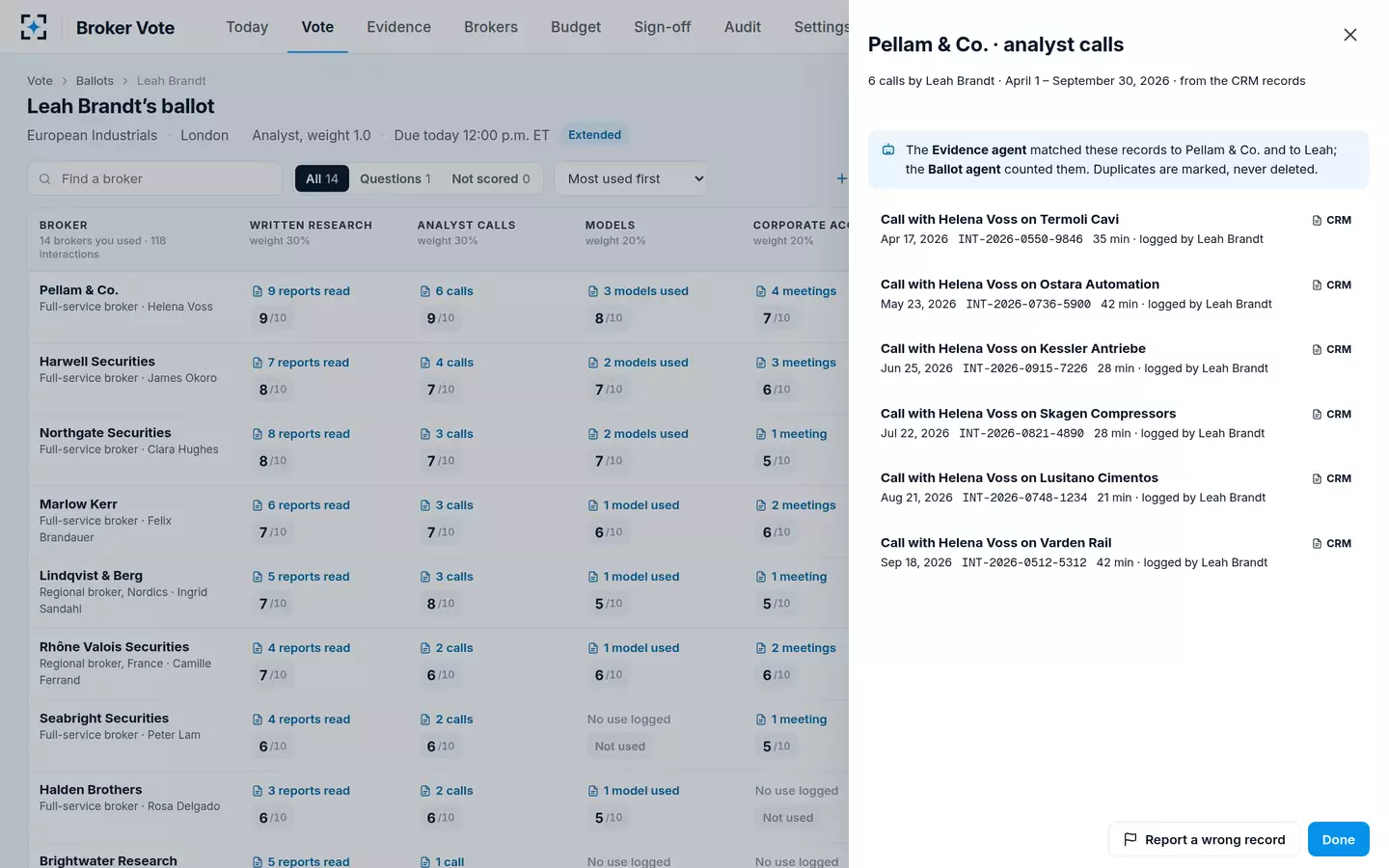
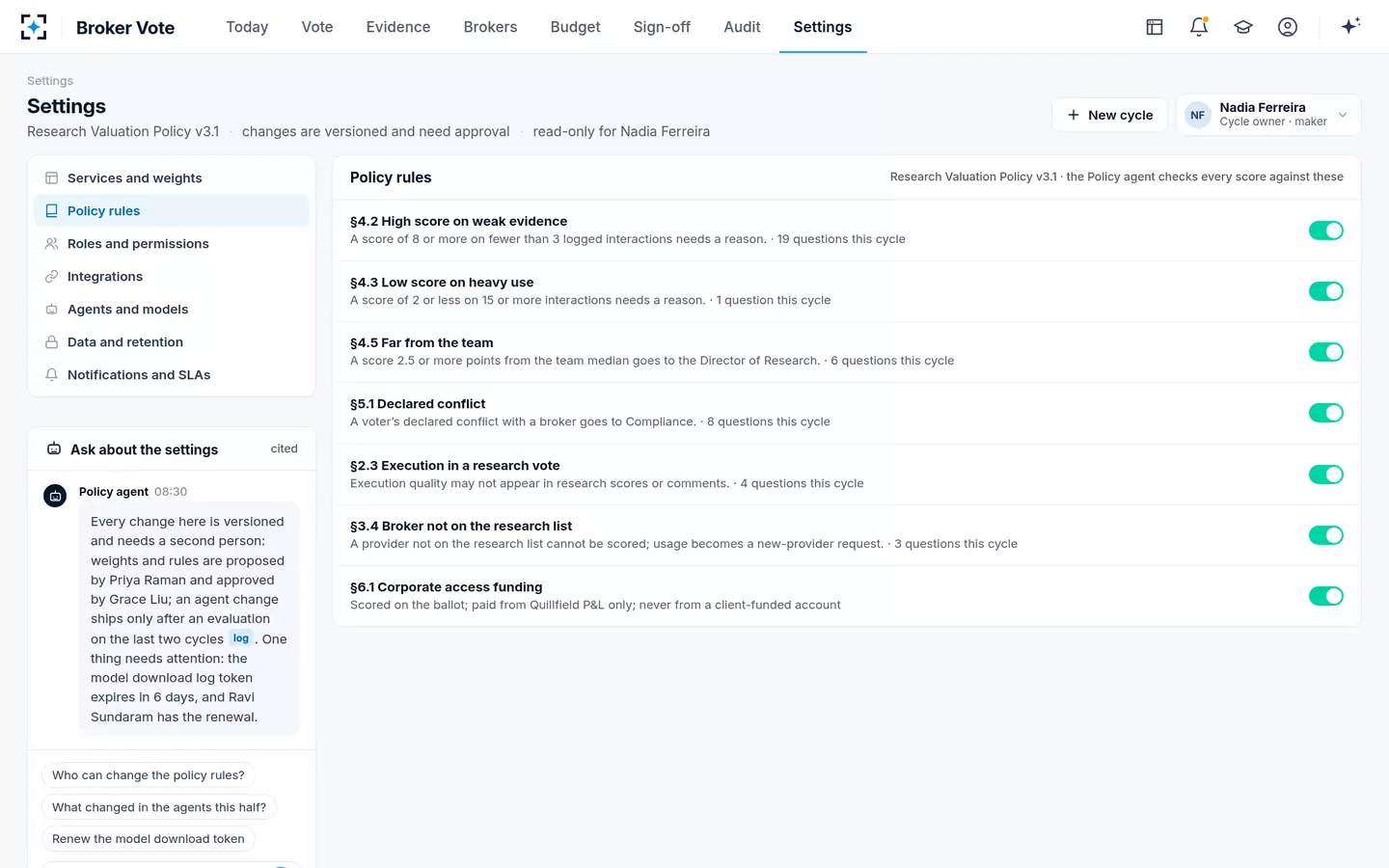
In the sample firm, corporate access carries a 20% weight on the ballot, beside written research, analyst calls and models. One analyst's ballot shows four meetings arranged by one broker in the half, which she scored 7. The policy rule that governs funding is short: corporate access is "Scored on the ballot; paid from Quillfield P&L only; never from a client-funded account", and the Budget agent will not charge it to the client-funded UK research account. In the sample budget, all $1.85 million of corporate access was paid from the P&L, and the approval checks confirmed it before the COO signed.
Corporate access needs the same evidence discipline as research. In the sample, one broker's service statement claimed 204 corporate access meetings for the half against 165 logged, a gap of 19%, and a query was drafted. And one voter's 9 for a broker's corporate access, resting on seven meetings, went to Compliance because the voter had declared a conflict with that broker. The broker scorecard template sets corporate access among the other services, and payment optionality for investment research covers what the new joint payment routes can and cannot fund.
Every count on the ballot, meetings included, opens to what was logged
The policy rule: scored on the ballot, paid from the firm's own P&L
Questions people ask
Can a broker provide corporate access for free?
It can offer it, but a UK or EU manager should not accept exclusive access as a free extra from a broker it pays for research or execution, because that is a benefit linked to those payments. ESMA expects access to be priced at commercial levels and not to depend on payments for other services; the FCA found under-charging that posed an inducement risk.
Who pays for travel to a company site visit?
The manager, from its own resources, in every regime covered here. The FCA lists travel, accommodation and entertainment costs among things that are not research, and the SEC's 2006 release says travel to meet corporate executives is not eligible under Section 28(e).
Can a manager arrange meetings with companies directly?
Yes, and many do. ESMA notes that meeting an issuer directly, or using an access provider that offers no other investment services, removes the main inducement risk. The FCA saw "a general increase in the proportion of corporate access meetings arranged directly between an issuer and asset manager without broker intermediation" after 2018.
Did the 2024 UK reforms change corporate access?
No. The FCA's 2024 policy statement on payment optionality treated corporate access rules as out of scope, even though many respondents asked for corporate access to be payable through the new option. The UK's specific carve-out for corporate access remains access relating to companies below £200 million of market capitalisation.
Should corporate access sit inside the research budget?
It can sit inside the same vote and the same approval, but with its own line and its own funding. The sample firm's budget of $14.2 million separates $12.35 million of research from $1.85 million of corporate access, so a reviewer sees immediately that client-funded money touched only research.
Is an issuer-sponsored conference corporate access?
If the issuer pays and the event is open to all investors, ESMA's view is that it could be an acceptable minor benefit, because no valuable resource is being allocated to one manager. An exclusive dinner with the chief executive arranged by a broker is a different thing, even at the same conference.