The broker vote process is the twice-yearly review in which a buy-side firm's analysts and portfolio managers score the brokers and research providers they used, the trading desk scores execution on its own scorecard, and the results set two things: how the research budget is split between providers and, together with a counterparty credit review, which brokers stay on the approved list. It is hard because it rests on memory and spreadsheets while the rules ask for evidence: a UK manager paying for research jointly with execution must assess its research at least once a year, an EU firm must do the same from 6 June 2026, and a US adviser relying on Section 28(e) must have judged in good faith that the commissions were reasonable for the research received. Botminds' Broker Vote runs the season with seven agents that pre-fill every ballot from logged use, question scores that rest on thin evidence and re-check every dollar, while voters keep their scores and the COO signs.
One word of disambiguation first. The phrase "broker vote" has a second, unrelated meaning in proxy voting, where the SEC's investor site explains that brokers may vote uninstructed shares on routine matters, and that "These votes may also be called uninstructed or discretionary broker votes" (Investor.gov glossary). This guide is about the research and execution review on the buy side. The examples come from a fictional sample firm, Quillfield Capital, as its second-half 2026 vote runs through the solution; every person, broker and fund in them is invented.
One half-year broker vote, in the sample firm's numbers
124
voters in six teams, each scoring only the brokers they used
Sample data
60
brokers and research providers on the ballot list
Sample data
21,486
logged research interactions behind the ballots for one half
Sample data
$14.2M
research and corporate access budget split across 31 providers
Sample data
What is a broker vote, and why does it carry money?
A broker vote is a structured rating of the research and service each broker or research provider delivered over a period, cast by the people who used it, and turned into payments. It carries money because commissions and research budgets follow it, and brokers know that. In a study of analyst pay at a major investment bank published in the Journal of Accounting Research, Groysberg, Healy and Maber found that analysts' “All-Star” recognition "proxies for buy-side client votes on analyst research quality used to allocate commissions across banks and analysts" (Journal of Accounting Research, 2011). The vote at a fund manager is, in other words, part of how the sell side pays its own analysts.
That gives the vote two audiences. Inside the firm, it is the evidence for a spending decision made with clients' or the firm's money. Outside, each broker reads its result as a revenue forecast and will ask why it fell. A vote that cannot show which calls, models, reports and meetings sat behind a score is weak on both fronts, and it is weakest exactly where a broker or an examiner pushes: the large allocation, the sudden drop, the new provider that jumped straight to the top.
The vote is also different from the desk's broker review, though the two are often run in the same weeks. Research is scored by the people who read and called; execution is scored by traders and cost analysis; counterparty credit is checked by the risk team. The process works when those three streams meet only at the approval table, and fails when an execution complaint quietly lowers a research score.
How does the broker vote process work? Six stages, one season
The broker vote process works in six stages: set up the cycle, gather the evidence of use, run the voting window, score the desk and credit side separately, turn votes into dollars, then review, approve and act. Each stage has an owner, a deliverable and a characteristic failure. The calendar below is the sample firm's; the shape is the same whether a firm votes twice a year or once.
The six stages of a broker vote, who owns each, and what breaks when it is skipped
| Stage | Owner | What it produces | What goes wrong if it is skipped |
|---|---|---|---|
| 1. Set up the cycle | Research Operations | Voter list and weights, the ballot list of approved research providers, service weights, the deadline | Leavers still vote, new providers are missing, last year's weights apply by accident |
| 2. Gather evidence of use | Research Operations | Calls, meetings, reports read and models downloaded, matched to broker and voter; broker service statements reconciled | Scores rest on memory; a broker's own count of calls goes unchallenged |
| 3. Voting window | Analysts and portfolio managers | A scored ballot per voter, with reasons where the policy asks for one | High scores on one interaction, declared conflicts unseen, late ballots chased by email |
| 4. Desk and credit review | Head of Trading; counterparty credit risk | Execution scorecard, watch list, proposed removals with evidence | Execution complaints leak into research scores; a weak counterparty stays on the list |
| 5. Votes into dollars | Research Operations, checked by a second calculation | Allocation per provider after weights, caps and a floor, with the funding source for each dollar | A spreadsheet error moves money; corporate access is charged to the wrong account |
| 6. Review, approve, act | Director of Research, Compliance, COO | A signed approval pack, feedback letters, payment instructions, the updated approved list | Nobody can say later why one provider received what it did |
The order matters more than the dates. Evidence has to exist before the window opens, or the ballot is a memory test. The desk review has to finish before the allocation, so that a broker proposed for removal does not receive a research payment the committee is about to make pointless. And the allocation has to be recomputed before review, because a reviewer who cannot rerun the arithmetic is approving a number, not a method.
Most of the six weeks is assembly, not judgement
- Set up the cycle7 d
- Logs and statements7 d
- Chasing voters5 d
- Desk, credit, removals3 d
- Votes into dollars4 d
- Pack, letters, list4 d
- Agents prepare, people review4 d
- Pack, letters, list2 d
Who votes in a broker vote, and with what weight?
The people who consumed the research vote on it: analysts and portfolio managers, scoring only the providers they actually used. Traders do not vote on research; they score execution on the desk's own scorecard. Most firms weight voters, and the choice is a policy decision rather than a rule: the sample firm counts a portfolio manager's ballot at 1.5 and an analyst's at 1.0, on the reasoning that the portfolio manager makes the decision the research is meant to inform.
The FCA's review of how firms value research described the stronger models it saw, and one feature was who runs them: "Investment teams, rather than the finance function, being closely involved with, or running, the evaluation process" (FCA multi-firm review, 2019, now marked historical). The same review warned against the opposite failure, a fixed rate card that prices interactions by volume and adds them up into payments. A voter's score is where quality enters; a count alone is not a vote.
Three rules about voters save most of the later arguments. A voter scores only the providers on the approved research list, so new providers come in through a request, not a ballot write-in. A voter declares conflicts, such as a relative at a broker or a past employer, and those ballots go to Compliance. And a voter who left the firm mid-period, or was on leave, is excused or weighted for the months worked, by a rule written before the window opens.
A ballot arrives pre-filled with what the voter used
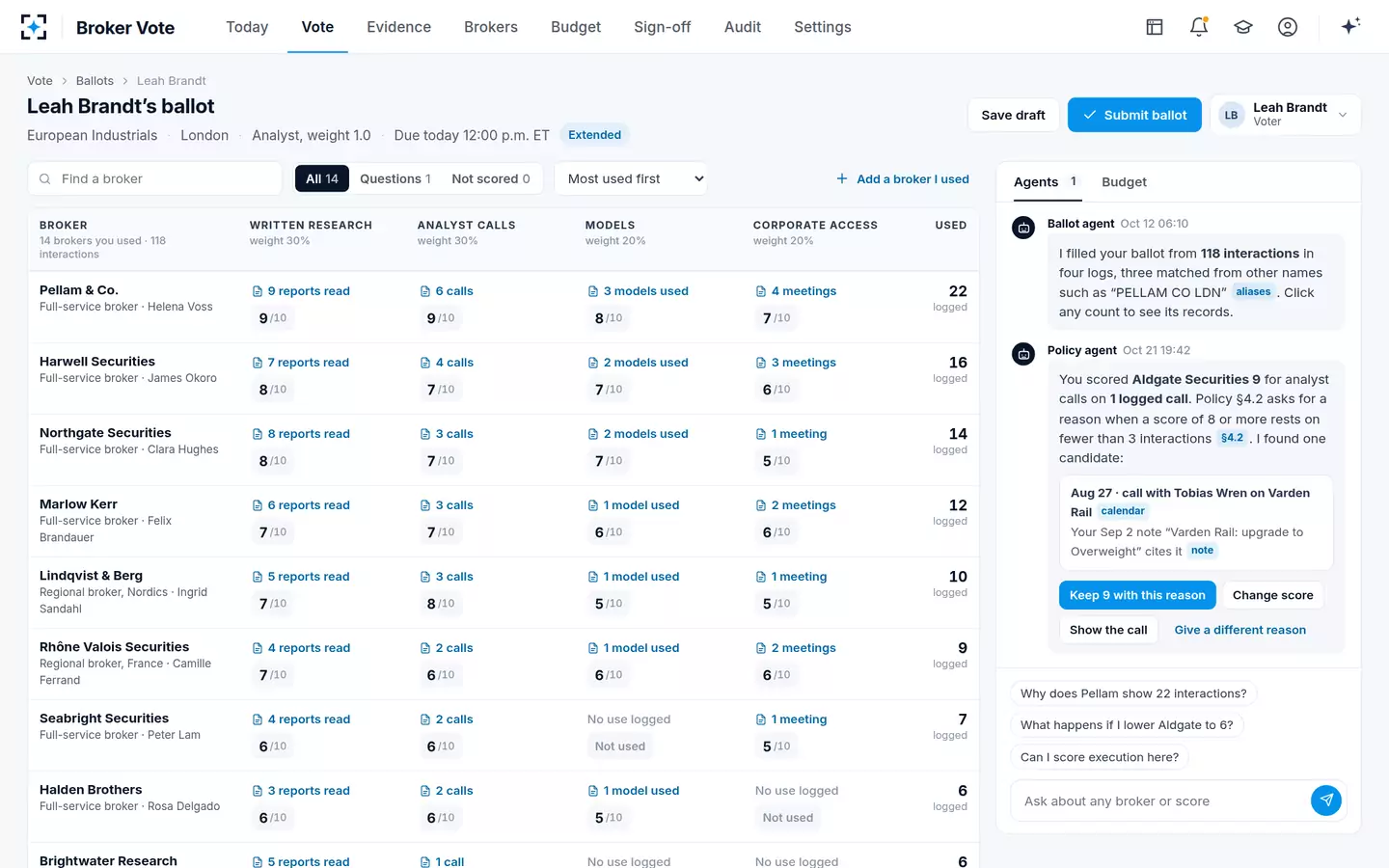
How often is the broker vote held?
No regulator sets the frequency of a broker vote; what the rules set is a floor on how often research must be assessed, and the payments the vote drives set its rhythm. In its review of research payments the FCA found that "Most firms make payments on a 3 or 6-monthly basis" (FCA, 2019), which is why a vote each quarter or each half is the familiar pattern. A UK manager using joint payments must set its research budget and assess the value and use of the research at least annually (FCA COBS 2.3B.25R), and the EU's amended MiFID II asks for an annual assessment of research quality, usability and value whichever way a firm pays (Directive (EU) 2024/2811).
In the United States, Section 28(e) sets no calendar either. It protects a manager who decided, in good faith, that the commissions paid were reasonable for the value of the brokerage and research received (15 U.S.C. 78bb(e)), and the SEC expects advisers to evaluate the execution they receive periodically and systematically (SEC interpretation, 2019). A vote held every six months is the usual way to show that the good-faith judgement was made with the evidence of the period in hand, not inherited from last year. What the safe harbor covers, item by item, is in soft dollars explained.
The trade-off is cost. A quarterly vote catches a provider that went quiet sooner, but by hand it means four rounds of chasing 100-plus voters. The sample firm votes twice a year and lets the agents keep the evidence current in between, so a mid-cycle question about one provider can be answered without a new vote.
Can execution quality affect research votes?
No. Execution quality decides who a firm trades with; it must not decide what a firm pays for research, and in the UK a one-line rule forbids counting research among the factors used to judge execution (FCA COBS 2.3B.29R). The mirror image matters just as much in practice. A research analyst annoyed by a broker's fill on an order is tempted to mark its research down, and that moves research money for an execution reason.
The FCA's review saw the benefit of the separation once firms made it: unbundling let asset managers select brokers "based purely on their ability to provide best execution", and the regulator found no evidence of hidden research payments through inflated execution commissions (FCA, 2019). Academic work supports keeping the two scores apart. Anand, Irvine, Puckett and Venkataraman found that trading desks' relative performance persists from one period to the next and reflects the desk's own skill, not only its choice of brokers (Review of Financial Studies, 2012), so an execution score mixes the desk's own skill with the broker's and is a poor proxy for anything about research. Once the vote sets the research payments, the money moves through commission sharing arrangements, which CSA reconciliation follows from broker statement to payment.
The sample firm writes the separation into its policy as a rule the agents check: a research score or comment that mentions execution is flagged as it is entered. Four research comments were flagged that way in the sample cycle, each returned to the voter or sent to Compliance with the voter's words attached. Execution goes on a separate scorecard, with cost against expected, settlement fails and trader surveys, which sets the approved broker list. Why the approved broker list is a different decision from research payment works through the two paths side by side.
What happens after the broker vote?
After the vote, four things leave the building: payment instructions to providers, feedback letters to brokers, the updated approved list to the order management system, and disclosures to clients. Each has its own checker, and each depends on the vote being finished and signed first.
Feedback letters tell each broker where it ranked by service and why its allocation moved, without revealing any individual voter's score. Payments go out through the firm's commission and payment system from the right funding source: the firm's own resources, a client-funded research account, or joint payments under the UK or EU rules. Disclosures follow the regime. A UK manager using joint payments must tell clients its approach and, after the year, the total research costs they bore (COBS 2.3B.30R); a US adviser explains in Form ADV how, over its last fiscal year, it steered client trades to particular brokers in exchange for research and other services (Form ADV Part 2A, Item 12.A.1.f).
The approval pack: what the COO signs, and what happens next
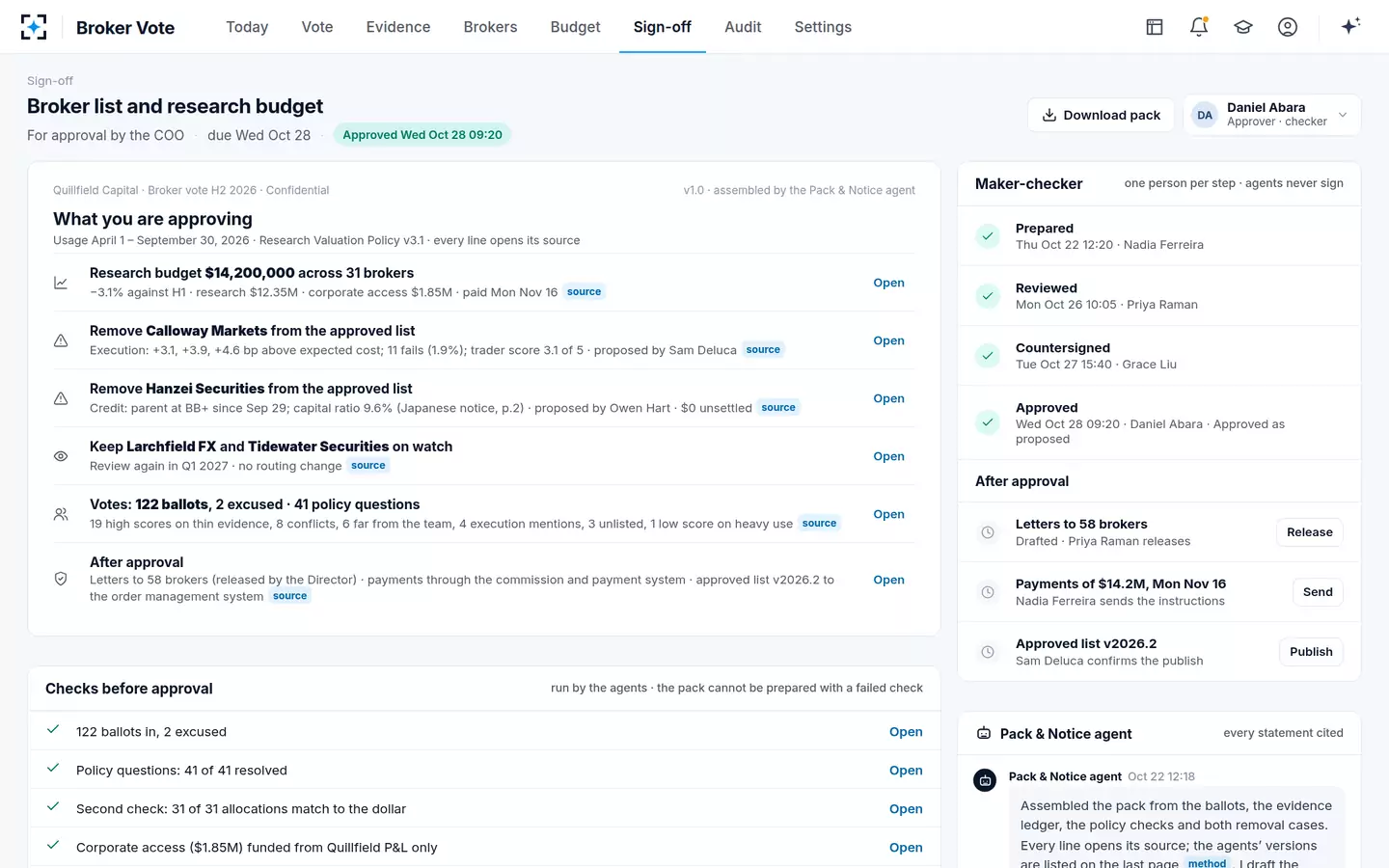
Who approves the broker vote, and why four signatures?
The COO, or a committee the COO chairs, approves the outcome; but the useful answer is a chain of four people, each checking something different. Research Operations prepares the pack, the Director of Research reviews the scores and the answers to policy questions, Compliance countersigns the conflicts and the funding, and the COO approves the broker list and the budget. The person who prepares the pack never approves it, and the approver cannot edit it.
The UK joint payment rules make this structure explicit. Among the requirements the FCA listed when it introduced the option is "A written policy describing the firm’s approach to joint payments, including with respect to governance, decision-making and controls" (FCA PS24/9, July 2024). The vote is where that policy is exercised twice a year, so the approval chain is the policy's evidence.
Broker Vote's approval chain: agents prepare, four people decide
Agent
Evidence and Ballot agentsMatch the usage logs to brokers and voters, reconcile broker statements, pre-fill each ballot with counts and the records behind them.
Never: enter or suggest a score
A person decides
VotersScore the providers they used and answer the Policy agent when a score needs a reason.
Agent
Policy and Budget agentsCheck each score against the research valuation policy, turn votes into dollars, then recompute every line independently.
Never: change a score or accept their own question
A person decides
Research Operations preparesResolves unmatched items, sends broker queries, signs the pack as preparer.
A person decides
Director of Research and ComplianceReview scores and answers; countersign conflicts, funding and the client disclosures.
A person decides
COO approvesApproves the approved broker list and the research budget as proposed, or returns them.
Where the six weeks go, and which part agents should take
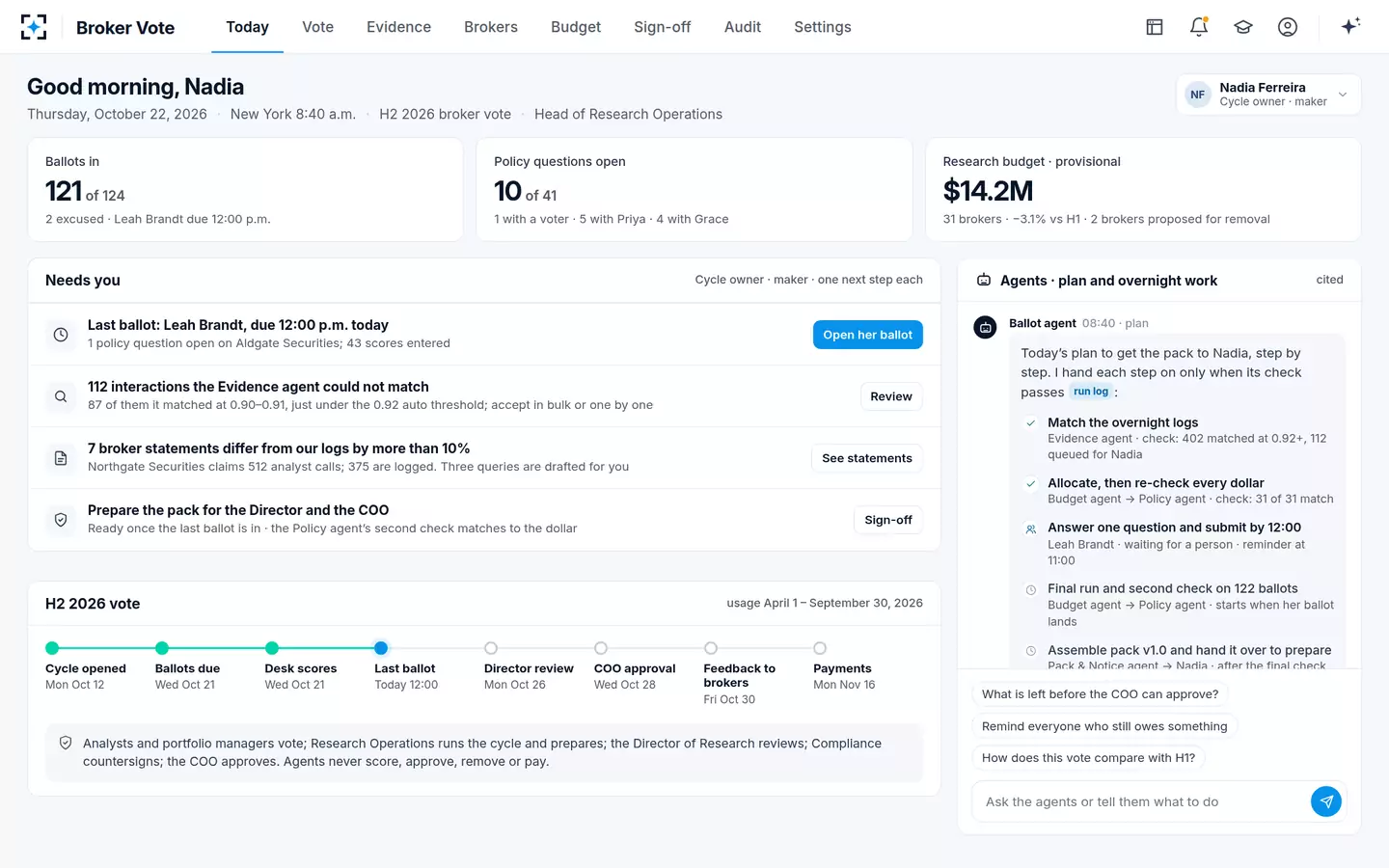
The weeks go on assembly: matching names across four usage logs, chasing ballots, reconciling what brokers claim against what was logged, and rebuilding the allocation spreadsheet each time a number changes. Those are the parts agents can take without touching a decision. In the sample cycle the agents matched 20,972 of 21,486 interactions on the first pass, resolved 402 more from aliases and left 112 below their confidence threshold for a person; they set one broker's claim of 512 analyst calls against the 375 that were logged and drafted the query.
What should never move to an agent is the judgement. A score is an opinion about value; a removal is a decision about counterparty risk; a budget is a spending decision. The design rule in Broker Vote is that agents match, count, ask, recompute and draft, and that they never score, accept, approve, remove, pay or send. What consumption tracking can and cannot do covers the matching in detail, and how votes become a research budget shows the arithmetic the second agent re-runs.
A broker vote is judged on the day someone asks why one provider received $1.46 million. The answer has to exist before the question does.
The cycle owner's morning: what needs a person, one next step each
Questions people ask
Is a broker vote required by regulation?
No rule names it. What the rules require is evidence: UK joint payments need an annual assessment of the value and use of research, the EU asks for an annual assessment of research quality, usability and value from 6 June 2026, and Section 28(e) protects only a good-faith determination that commissions were reasonable for what was received. A documented vote is the most common way to produce that evidence.
Do brokers see how each voter scored them?
They should not. Feedback letters give each broker its ranking by service and the reasons its allocation moved, without individual scores, so voters can score frankly. In the sample firm, letters went to 58 brokers only after the Director of Research released them.
Is the buy-side broker vote the same as a proxy broker vote?
No. In proxy voting, the SEC's investor site describes a broker vote as a broker voting a client's uninstructed shares on routine matters at a shareholder meeting, under stock exchange rules. The buy-side broker vote is an internal review of the research and service a manager used, and it never touches a shareholder meeting.
How long does a broker vote take from start to finish?
The sample firm gives voters ten days, from opening the cycle on October 12 to ballots due on October 21, with approval a week later and payments on November 16. Our estimate for a large manager is about 30 working days of Research Operations' time across the season by hand, against about six when agents prepare the evidence and the arithmetic.
What happens to a broker whose scores fall?
Its share of the research budget falls in proportion to its share of points, and if it drops below the firm's floor it is not paid that period and gets feedback. That is a research decision only: it does not remove the broker from the approved list for trading, which is decided separately on execution and credit evidence.
Should portfolio managers' votes count more than analysts'?
It is a policy choice, and both answers are defensible if written down before the window opens. The FCA said it would not expect payments assigned to every interaction, but would query "extremes in payments or other patterns that have little or no clear justification". A voter weight with a stated reason is not that.