CSA reconciliation is the monthly tie-out of each executing broker's commission sharing statement against the manager's own records: the trades in the order management system, the research credit each trade should have earned under the agreement, the payments the manager actually instructed, and the resulting balance. Its purpose is to find every break, a missing credit, a wrong rate, a credit on a client that forbids soft dollars, a payment nobody approved, before the pool is used to pay another invoice. Botminds' Commission Management ties every statement to the trades automatically, traces each break to the clause of the agreement it breaks and drafts the query; a commission analyst prepares, compliance approves, finance releases, and the agents never move money.
The figures come from a fictional sample manager, Quillfield Capital, with commission sharing agreements at twelve brokers and research payment accounts in the UK and EU, as it runs through the solution. The time estimates are the solution's own, labelled as estimates and targets.
Where the monthly CSA tie-out and payment cycle spends its days
- Tie CSA statements to the OMS1.5 d
- Collect and key invoices1 d
- Prices, eligibility, splits1 d
- Choose account, check balance0.5 d
- Approvals and portal requests1 d
- All five steps, people still deciding0.9 d
What is CSA reconciliation?
CSA reconciliation proves three things each month: that every credit the agreements promise was booked, that every payment out of the pool was one the manager approved, and that the closing balance is what the manager thinks it can spend. It is the operational half of the SEC's 2006 attributes for third-party research, under which the broker "pays the research preparer directly" and "develops and maintains procedures so that research payments are documented and paid for promptly" (SEC Release 34-54165, page 59). The broker documents; the manager checks.
The reconciliation matters because the pool is client money that the manager cannot see directly. A credit never booked is research budget silently lost; a credit booked on the wrong account can breach a client's agreement; a payment made without an instruction is a control failure at the broker. None of these shows up in the manager's general ledger, because the money never passes through it. In the UK the FCA puts the obligation in a rule for joint-payment accounts: the firm "must ensure that the reconciliation and reporting for such accounts and structures is undertaken with an appropriate frequency and timeliness", even where it delegates administration (COBS 2.3B.28R).
How do you tie a broker CSA statement to your trades?
You tie a CSA statement in three passes: rebuild the credits the manager expects from its own trades, match them to the credits on the statement trade by trade, and roll the balance forward with the payments. The order matters, because a statement that matches its own total proves nothing; the manager's expectation must come from its own records.
First, take every trade with that broker in the period from the order management system, apply the agreement's schedule of commission rates and research credits by instrument and order type, and exclude accounts whose clients forbid soft dollars. That is the expected accrual. Second, match it to the broker's statement at trade level: same trade, same shares, same credit. Third, roll the pool: opening balance plus accruals, minus payments, equals closing balance, with every payment matched to an approved instruction and a provider's invoice. In the sample firm the Reconciliation agent tied September statements from 12 brokers and 2 research payment accounts to 18,940 trades this way, and found two issues.
Commission Management: fourteen statements tied, two breaks traced
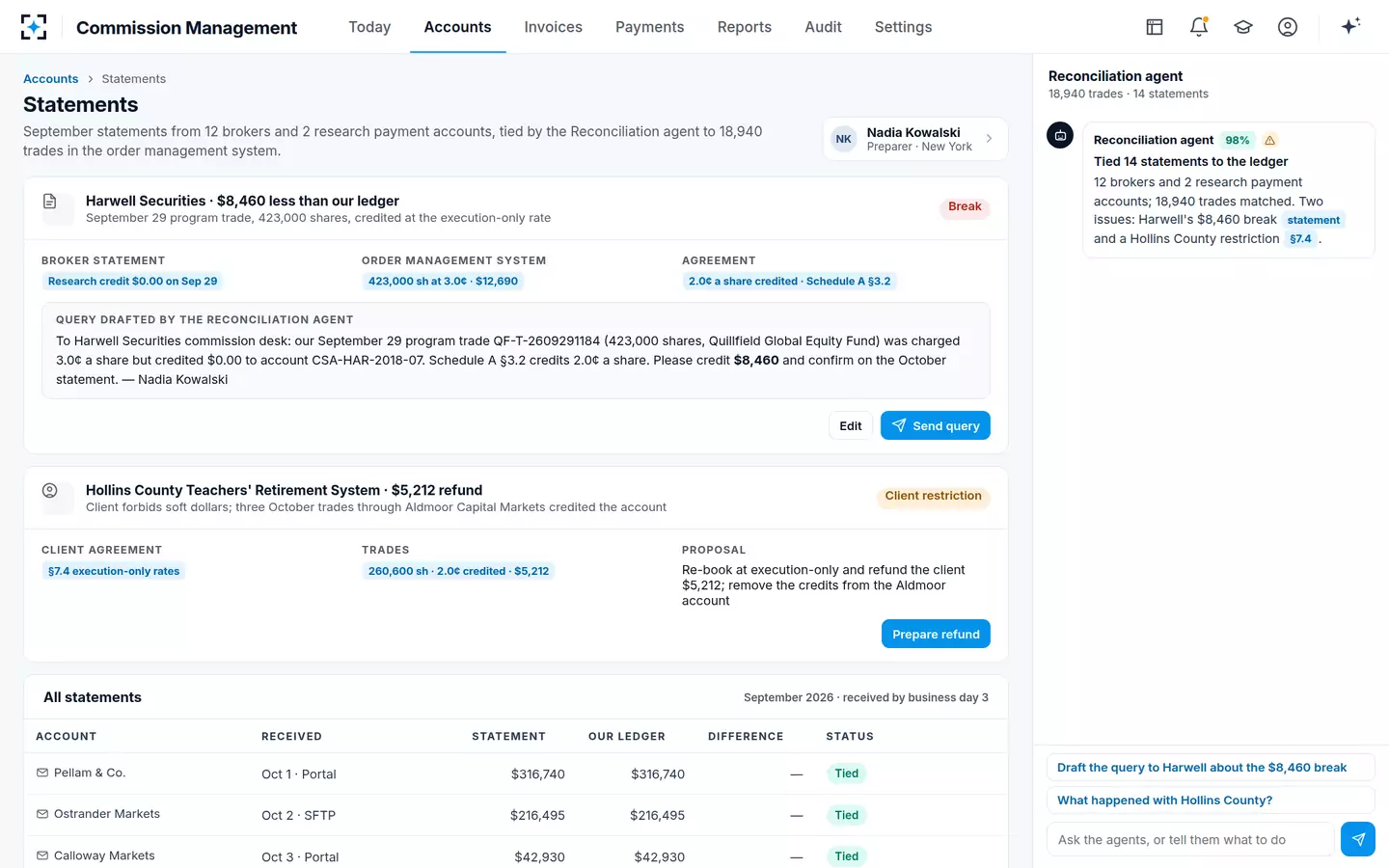
The first break is the classic one. A 423,000-share program trade was charged 3.0 cents a share, $12,690, but credited nothing; the agreement's Schedule A, section 3.2, credits 2.0 cents a share on program trades, so the pool is $8,460 short. The agent drafted the query, "Schedule A §3.2 credits 2.0¢ a share. Please credit $8,460 and confirm on the October statement", for the analyst to send. The second break is the reverse: credits that should not exist, on a client that forbids soft dollars.
Which breaks are common in CSA reconciliation?
Most breaks fall into a few families: credits missing or at the wrong rate, credits on the wrong accounts, timing differences at month-end, payments that do not match instructions, and balances that drift because a correction was never reversed. Each family has its own evidence and its own owner.
The breaks a CSA reconciliation should expect, and how each is settled
| Break | How it shows | What settles it | Who acts |
|---|---|---|---|
| Credit missing | Commission on the OMS, no credit on the statement | The agreement's rate schedule for that instrument and order type | Analyst queries the broker |
| Credit at the wrong rate | Credit per share differs from the schedule | Schedule version in force on the trade date | Analyst queries; compliance if the schedule is disputed |
| Credit on a restricted client | Accrual on an account whose agreement forbids soft dollars | The client agreement; re-book at execution-only rates | Analyst prepares refund; compliance approves |
| Trade in the wrong month | Trade-date and statement cut-off differ | The agreement's cut-off rule | Carry to next month; no payment held |
| Cancelled or corrected trade | Credit not reversed after a cancel or rebook | OMS audit history of the trade | Analyst queries |
| Payment without an instruction | Debit on the statement with no approved request | The manager's instruction log | Compliance and finance; possible broker control failure |
| Payment amount differs | Debit differs from the approved instruction | Instruction, invoice and any FX at the fixing rate | Finance |
Five checks every research invoice passes before the pool pays it
Reconciliation tells you the pool is right; it does not tell you the next invoice deserves to be paid from it. Every research invoice should pass five checks before anyone prepares a payment, and in the sample week those checks produced most of the exceptions the analyst saw.
Five checks on a research invoice, and what each caught in one sample week
- 1. Price against the contract
The invoice matches the order form or contract, with no tolerance over it. Caught: a $48,000 invoice against an order form of $42,000 a quarter; $6,000 queried.
- 2. Eligibility, line by line
Each line tested under Section 28(e)(3), the SEC's 2006 guidance and the firm's rulebook. Caught: $11,500 of travel, hotel and dinner on an $18,400 conference invoice, routed to the firm.
- 3. Mixed-use split from a signed, in-force study
The share applied comes from a current study whose population matches the invoice. Caught: a $240,000 order management license held because its study had expired.
- 4. Duplicates across every channel
Fingerprint every file and look back 24 months across mailboxes and portals. Caught: a $24,500 invoice already paid on October 14 through another broker's pool.
- 5. Bank details from the vendor master only
Any new account waits for a finance call-back on the number already on file. Caught: a $58,000 remittance to a new account from a look-alike domain.
Two more conditions sit beside the five. The provider must be on the approved list: in the sample week a $31,500 invoice from an unapproved expert network stopped for that reason alone. And the paying pool must be the right one: research for UK funds from the UK research payment account, for Luxembourg funds from the EU account, never from a US commission sharing account. In that sample week four of the catches, the duplicate, the over-contract price, the ineligible travel and the administrative share of a data terminal, kept $97,800 off client commissions; the look-alike bank account and the unapproved provider were stopped as well, but they are fraud and approval controls rather than charges a client would have paid.
Can CSA reconciliation be automated?
The tie-out can be automated almost entirely; the decisions should not be. Rebuilding expected credits from trades and agreements, matching statements at trade level and rolling balances are mechanical once the agreements are read correctly. What is not mechanical is whether to dispute a credit, whether a restricted client is owed a refund, and whether a payment should go ahead. The design question is not whether to automate but where the people sit.
Maker and checker in a CSA tie-out: one agent prepares, a second rechecks, people decide
Agent
Reconciliation agent preparesBuilds expected credits from 18,940 trades and the agreements, ties 14 statements, traces breaks to the clause, drafts queries.
Never: Adjusts the pool, or contacts a broker unseen.
Agent
Second-check agent rechecksRe-tests price, duplicates, arithmetic, FX and bank details on its own, on a separate model family, before seeing the first agent's confidence.
Never: Approves a payment.
A person decides
Analyst preparesSends the query, prepares the refund or payment, or returns it with a reason.
A person decides
Compliance approvesApproves with a reason code; cannot approve what it prepared. The head of trading adds a second approval at $250,000 or more.
A person decides
Finance releasesReleases one checked payment file in each broker's format; bank details only from the vendor master.
Regulators point the same way. FINRA's 2026 oversight report asks firms using AI agents to decide where a person must stay in the loop and how each agent's actions and decisions will be trailed (FINRA 2026 Annual Regulatory Oversight Report, December 2025). ESMA expects firms using AI in investment services to be able to show, from their records, the reasoning path, the data, the algorithms and every modification since (ESMA public statement on AI and investment services, May 30, 2024). A reconciliation where each agent step and each human decision is logged with its evidence answers both.
Who approves a research payment from a CSA?
A named compliance officer should approve every payment from client commissions, after an analyst prepares it and before finance releases it, with a higher approver above a threshold and no one approving what they prepared. No rule fixes the chain, but the SEC's requirement that the good-faith reasonableness determination be demonstrable, with the burden on the manager (Release 34-54165, page 48), is hard to meet if the person who keyed the payment also approved it.
Payments by stage: drafted by agents, released only by finance
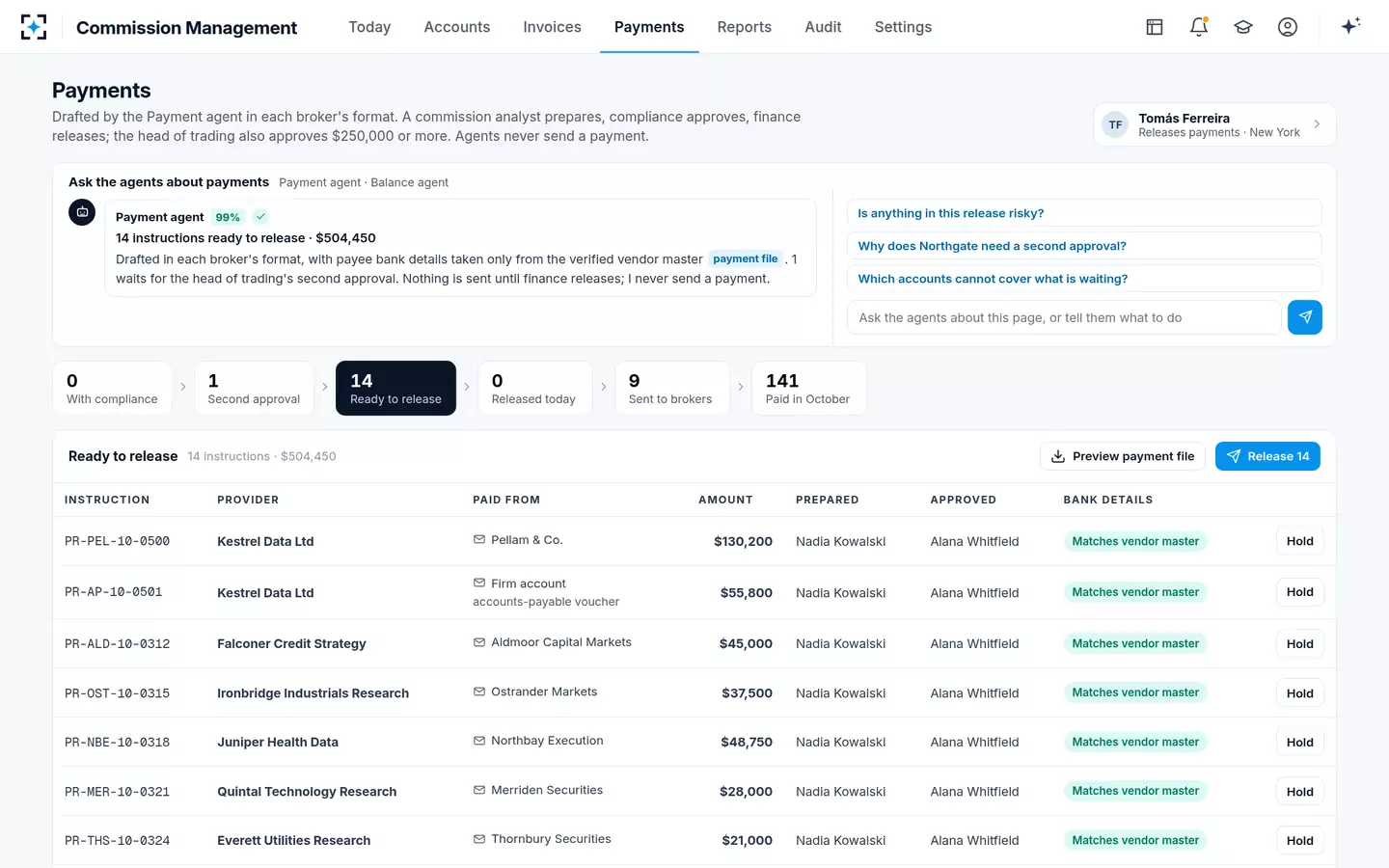
The sample firm's chain is analyst, compliance, finance, with the Global Head of Trading added at $250,000 or more. On the sample Monday, fourteen instructions totalling $504,450 were ready for finance to release, and one $262,500 payment waited for the head of trading. Mixed-use payments are approved one by one, never in bulk. The soft dollar policy is where these thresholds belong, so that a change to them is itself an approved decision.
What records satisfy an examiner?
An examiner should be able to follow any credit or payment from the trade to the statement to the invoice to the approval without asking anyone to remember. For a US adviser the books-and-records rule already reaches most of the documents: every bill and statement relating to the adviser's business, paid or not, the ledgers, and written communications about orders, each kept for five years from the close of the fiscal year in which it was last updated (17 CFR 275.204-2; the research-records guide on investment adviser recordkeeping requirements goes through the rule). For UK research payment accounts, the FCA's controls must let anyone trace each payment to a research provider and see how its amount was set (COBS 2.3B.11R).
What an examiner can follow, by hand and with a recorded tie-out
Spreadsheet and portals: A formula in a workbook that may have changed since.
Recorded tie-out: Rebuilt from OMS trades and the agreement version in force, kept with the result.
Spreadsheet and portals: An email thread with the broker.
Recorded tie-out: The break, the clause, the query sent and the broker's confirmation, linked.
Spreadsheet and portals: Email sign-offs, sometimes by the preparer.
Recorded tie-out: Preparer, approver, reason code and signature, with self-approval blocked.
Spreadsheet and portals: Assembled for the exam, over weeks.
Recorded tie-out: Exported as one pack: registers, statements, tie-outs, studies, approvals.
Where Commission Management fits, and where it does not
Commission Management fits where research money is paid and reconciled: commission sharing and research payment accounts, research invoices, mixed-use studies, approvals, payment drafting, statements and the examiner pack. It works with the systems already in place: the order management system for trades and commissions, broker statements and portals by portal, SFTP or email, the accounts-payable mailbox and vendor portals, the ERP for hard-dollar vouchers, and the vendor master for bank details.
It does not execute or route trades, measure execution quality or set the broker vote; it shows spend against the vote and flags where a payment would depart from it. It does not hold money, send payments or change bank details: finance releases every file. And it does not decide eligibility for the firm. The rulebook, the studies and the thresholds are the firm's, versioned and approved by compliance, and the agents apply them and cite them. If the problem is execution quality or broker selection, the reconciliation will show the money but not the answer; what to look for in commission management software sets out the boundaries in more detail.
Questions people ask
How often should CSA statements be reconciled?
Monthly, as statements arrive, and before any payment from that pool in the following month. In the sample firm, broker statements arrive within the first three business days and are tied the same day. In the UK the FCA requires reconciliation of joint-payment accounts "with an appropriate frequency and timeliness".
Should payments wait until a broker statement is tied?
Payments from a pool with an unresolved break should wait, or be limited to the balance the manager can confirm. A missing credit lowers the balance the manager can safely spend; an unexplained debit may mean the broker paid something the manager never approved.
What is a CSA reconciliation report?
A monthly report per broker showing expected and booked credits, payments matched to approved instructions, the balance roll-forward, and every open break with its owner and next step. It doubles as evidence for the annual compliance review under Rule 206(4)-7.
How do you catch duplicate research invoices?
Fingerprint every file and compare invoice numbers, amounts, periods and providers across every channel and every paying account over a long look-back; the sample firm uses 24 months. The duplicate that matters arrives by a second channel or is paid from a different broker's pool.
Does CSA reconciliation apply to research payment accounts?
Yes, with UK and EU additions: the account's charges must stay within the research budget, collections must reach the account promptly, and spend must be summarised against budget on request. Under COBS 2.3B.19G the FCA expects research charges to reach the account no later than 30 days after deduction from the client.
Who owns the CSA reconciliation?
Typically a commission analyst in trading operations prepares it, compliance reviews the breaks that involve clients or eligibility, and finance owns the payment file. Internal audit tests it. The owner should not be the person who approves payments from the same pools.