Mixed use soft dollars are client commissions spent on a product that serves both investment decisions and something else, such as administration, compliance or marketing; the SEC requires the manager to split the cost by a reasonable allocation of use, pay the non-research share with its own money, and keep books and records that support the split. A data license, an order management system or a proxy research service are typical. The split is where examiners look first, because the same release that permits it calls the allocation decision itself a conflict of interest. Botminds' Commission Management applies only a signed, in-force mixed-use study to each invoice, checks that the study still describes the population being billed, and drafts a re-study from usage logs when one lapses; it never sets a percentage itself.
The studies on this page belong to a fictional sample manager, Quillfield Capital, as they appear in the solution. The rules and exam findings are the SEC's, linked where they appear.
Four mixed-use studies at one sample manager, and where each cost goes
Market data and analytics license (62 seats)
- Research · 70%
- Firm · 30%
Pricing feed
- Research · 85%
- Firm · 15%
Proxy research service
- Research · 40%
- Firm · 60%
Order management license
- Brokerage · 21%
- Firm · 79%
What is a mixed-use item?
A mixed-use item is a product or service bought with client commissions that is used partly for eligible research or brokerage and partly for something that is not. The SEC introduced the concept in 1986, when it observed that a product "may serve functions that are not related to the investment decision-making process, such as accounting or marketing", and it named management information services that combine trading, accounting and performance measurement as the example (SEC Release 34-54165, 2006, page 16).
The 2006 guidance kept the rule and widened its reach. An item can be mixed use for two different reasons: because some of its functions are not eligible at all, or because the manager uses eligible functions for purposes that are not investment decisions. The SEC wrote both into a footnote: if products "also contain functionality that is not eligible brokerage or research under the safe harbor, or if the products and services are eligible brokerage or research but the money manager does not use them in a way that provides lawful and appropriate assistance in investment decision-making, they may be mixed-use items" (note 105). The second reason is why a study must measure use, not features.
How do you allocate a mixed-use product?
You allocate a mixed-use product by measuring how the firm and its people actually use it, setting the eligible share from that measurement, and paying the rest in hard dollars. The SEC's standard is "a reasonable allocation of the cost of the product according to its use" (Release 34-54165, page 47), and its footnote on method is the closest thing to a rulebook the industry has.
"In allocating costs for a particular product or service, a money manager should make a good faith, fact-based analysis of how it and its employees use the product or service," the SEC wrote. Relevant factors "might include, for example, the amount of time the product or service is used for eligible purposes versus non-eligible purposes, the relative utility (measured by objective metrics) to the firm of the eligible versus non-eligible uses, and the extent to which the product is redundant with other products employed by the firm for the same purpose" (note 148). It also allowed that "it may be reasonable for the money manager to infer relative costs from relative benefits".
The allocation, written out
Eligible-use share
eligible use ÷ total use
Measured in time, logged sessions, feed consumption by application, or user counts, over a stated window.
The study
Share applied
eligible share, rounded by policy
The sample firm rounds down to the whole percent: 70.4% measured, 70% applied.
Compliance signs
Client commissions
invoice × share applied
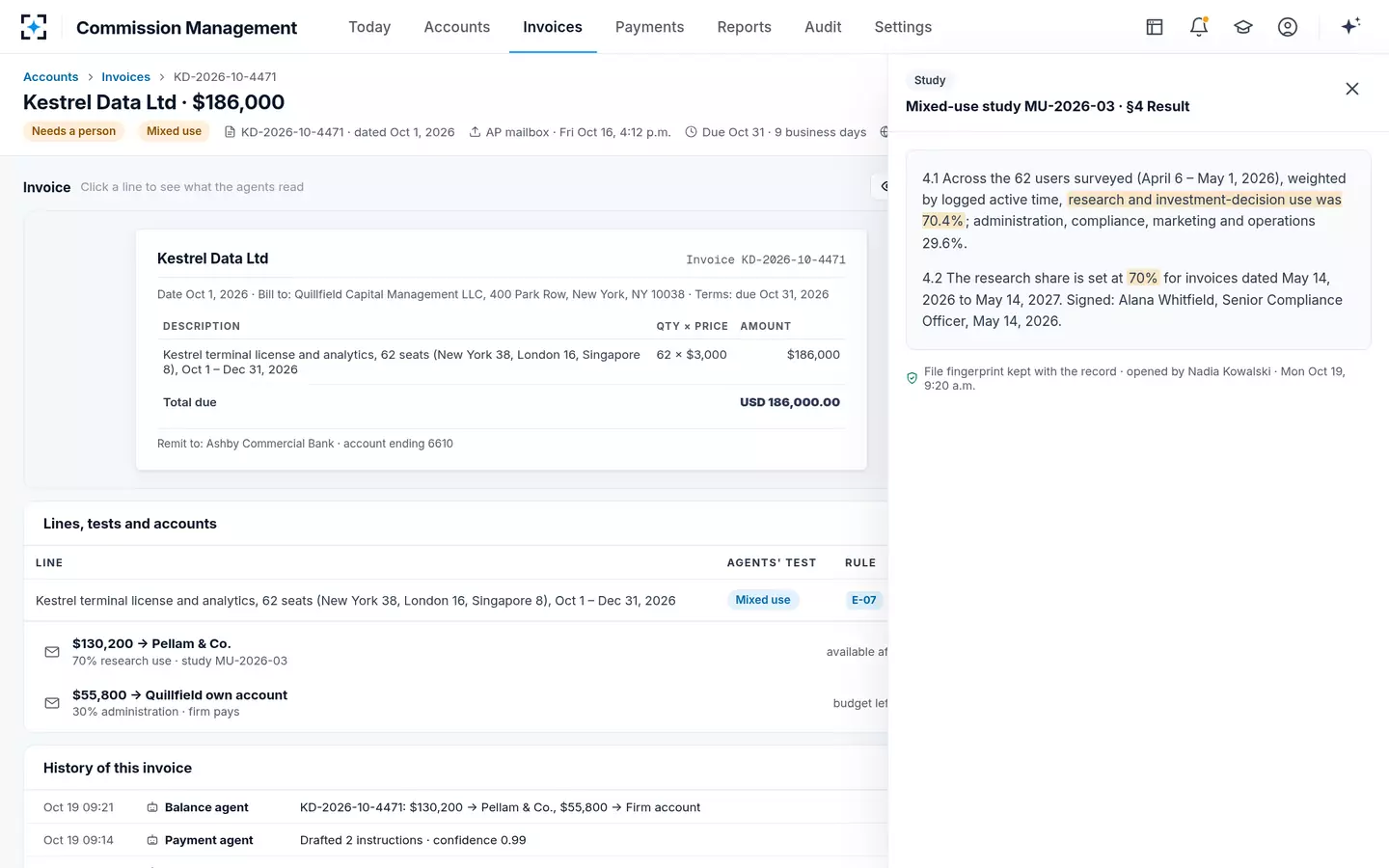
$186,000 × 70% = $130,200 from a commission sharing account.
Analyst prepares
Hard dollars
invoice − client share
$186,000 − $130,200 = $55,800 paid from the firm's own account.
Firm pays
What evidence supports a mixed-use percentage?
The evidence is the study: who used the product, for what, over what period, measured how, and signed by whom. A percentage with no measurement behind it is the deficiency examiners name. In 2018 the SEC's examination staff reported advisers that "did not appear to make a reasonable allocation of the cost of a mixed use product or service according to its use or did not produce support, through documentation or otherwise, of the rationale for mixed use allocations" (OCIE Risk Alert, July 11, 2018).
Three methods cover most studies, and each answers the note-148 factors differently. A time study or survey asks users how they spend their hours; it is cheap but self-reported. Login and session telemetry weights each user's activity by what they did in the product, and is the closest to "objective metrics". Consumption by application, for a data feed, counts how much of the feed lands in research and portfolio tools against valuation and accounting systems. The sample manager's four studies use all three, and one of them moved from a survey to telemetry when it lapsed.
What a defensible mixed-use study contains
- The product and contract it covers
Vendor, order form or license, number of seats or feeds, so the study can be matched to each invoice.
- The population
Every user or system measured, with the count, so a later invoice for a different number of seats is caught.
- Eligible and ineligible uses, defined
Which functions count as research or brokerage under Section 28(e)(3), and which are administration, compliance, marketing or accounting.
- The method and window
Survey, time study, telemetry or consumption, and the dates measured.
- The result and the share applied
The measured percentage, the rounding rule, and the share that will be charged to client commissions.
- Redundancy considered
Whether another product already serves the same research purpose, one of the SEC's three listed factors.
- Validity and triggers
The date it expires and the events that force an early re-study.
- Signature
A named compliance officer's approval and date; the person who measured is not the person who signs.
Which products are usually mixed use?
The products that most often need a study are the ones that sit across the front and back office: data and analytics licenses, order management systems, trade analytics, proxy services and performance tools. Commenters on the 2006 release named trade analytical software, proxy voting services and order management systems as candidates, and the SEC agreed the approach fits them (Release 34-54165, pages 46 to 47).
Common mixed-use items, and where the 2006 guidance draws the line inside each
| Product | Eligible share | Paid in hard dollars | Release page |
|---|---|---|---|
| Market data and analytics license | Data and analytics used in investment decisions | The terminal hardware itself; administrative, compliance and marketing use | pp. 33, 35–36 |
| Order management system | Order routing, algorithmic strategies, connectivity to brokers; market research delivered through it | Portfolio management, compliance testing and recordkeeping functions | pp. 41–42, note 125 |
| Trade analytics | Pre- and post-trade analytics used to decide how and where to trade | Use to evaluate the firm's own best execution or other compliance | pp. 34, 42, note 125 |
| Proxy service | Research on issuers used in investment decisions | Casting, counting, recording and reporting votes; research used only to decide votes | p. 37 |
| Performance and attribution reports | Analysis used in investment decisions | The same reports used for marketing | pp. 45, 47–48 |
Note what moves an item into the hard-dollar column: purpose, not product. The SEC said that where trade analytics or an order management system are used "both for research and to assist in fulfilling contractual obligations to the client or to assess whether they have complied with their own regulatory or fiduciary obligations such as the duty of best execution", the product "is a mixed-use product, and managers must use their own funds to pay for the allocable portion" (note 125). Proxy research makes the same point from the other side: reports on issuers can be research, but research "that assists a manager in deciding how to vote proxy ballots" does not help investment decisions (page 37).
Is an order management system a mixed-use item?
Usually, yes. An order management system's routing, algorithmic and broker-connectivity functions sit inside the brokerage "temporal standard", from order to settlement, and can be paid with client commissions; its portfolio management, compliance and recordkeeping functions cannot (Release 34-54165, pages 41 to 42). The hardware it runs on is never eligible.
The sample manager's order management license shows how much the study matters. Its old study, a survey of 132 users in August 2025, measured 25.4% of use as order routing and execution and set the brokerage share at 25%; it expired on September 30, 2026. The agents drafted a re-study from function telemetry for 148 users over August and September 2026, which measured 21.3% and proposes 21%. On a $240,000 license that moves $9,600 from client commissions to the firm: $50,400 instead of $60,000 from the commission account, $189,600 instead of $180,000 from the firm. Until compliance signs, the invoice cannot be prepared.
Commission Management: the signed studies behind every split, and one that lapsed
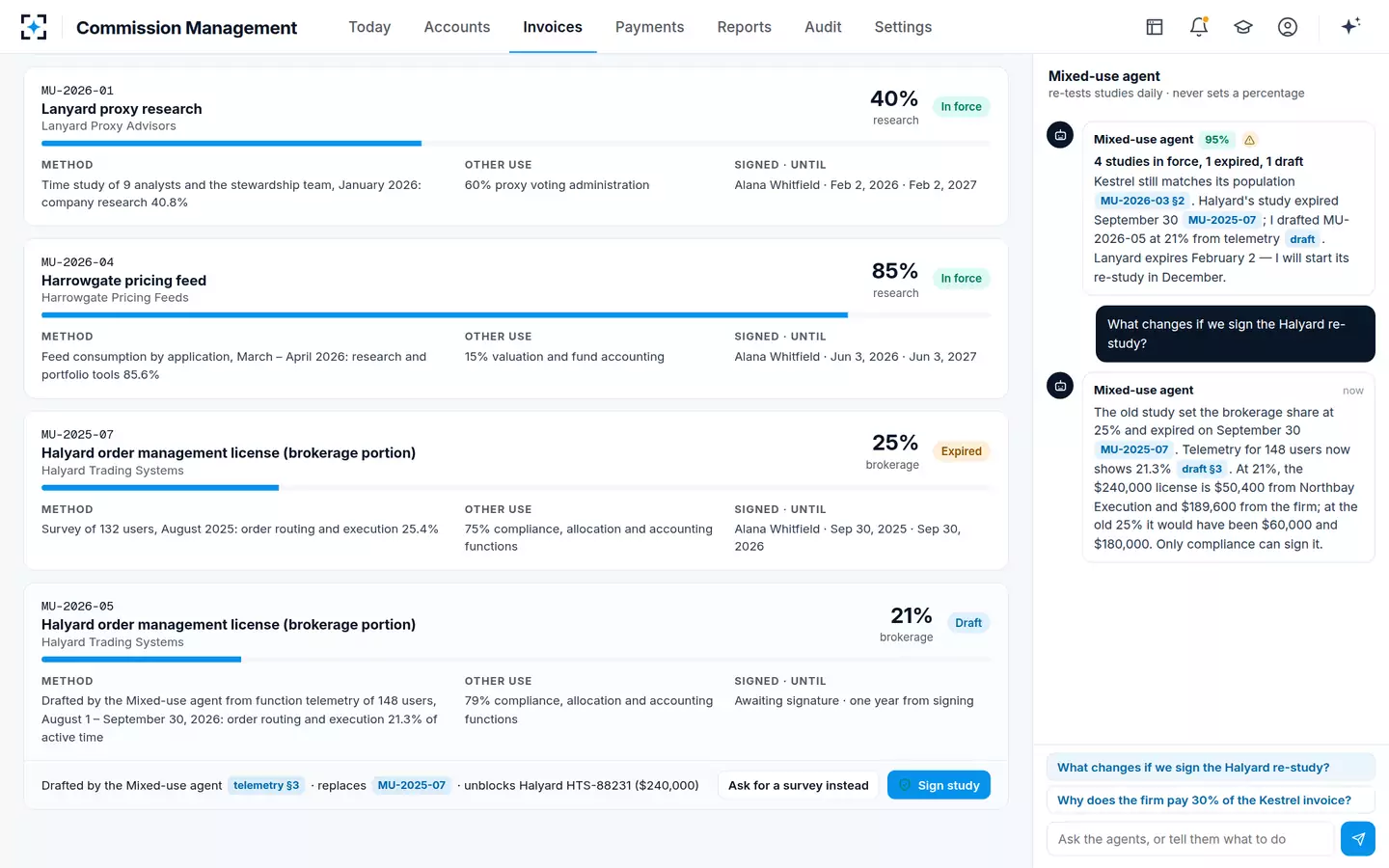
How often should a mixed-use study be refreshed?
No SEC rule sets a refresh period. The obligation is that the allocation stays reasonable for the product as it is used now, so a study needs a validity date and a list of events that end it early. The sample manager's studies run for one year from signing, which is a policy choice, not a requirement.
The early triggers are more important than the calendar. A new contract or order form changes what is being bought. A change in seat count or users changes the population the study measured; the sample firm's Mixed-use agent checks every invoice against it, which is why a 62-seat invoice against a 62-user study passes and a 70-seat invoice would not. A new module or a vendor's bundling change can add an ineligible function. And a reorganisation can move users from research to operations without a single license changing hands. The SEC's 2018 examiners found advisers "that did not allocate soft dollar expenses in accordance with their policies" (OCIE Risk Alert), which is what a stale study produces in practice.
What records must be kept for mixed-use allocations?
The manager must keep enough to show, item by item, how the split was made. The SEC's words, reaffirmed from 1986, are that "the money manager must keep adequate books and records concerning allocations so as to be able to make the required good faith showing" (Release 34-54165, page 47). Nothing in the 2006 release prescribes a form, but the Advisers Act books-and-records rule already reaches the documents involved.
Rule 204-2 requires an adviser to keep every bill and statement relating to its business, paid or unpaid, its ledgers, and its written communications about advice and orders. The retention clock is five years, running from the end of the fiscal year in which a record was last touched, with the first two years in the adviser's own office (17 CFR 275.204-2, paragraphs (a)(2), (a)(5), (a)(7) and (e)(1)). For a mixed-use payment that means the invoice, the study in force on its date, the split, the payment from each account and the approval, kept together so the chain can be read without reconstruction.
The SEC also treats the allocation decision itself as a conflict for the manager, one the client should be told about (Release 34-54165, pages 45 to 46). Form ADV's Item 12 asks for a description of what the adviser acquires with client commissions; soft dollar disclosure, clause by clause covers how mixed use belongs in it.
What examiners found wrong with mixed-use allocations
The SEC's record on mixed use is consistent across two decades: managers allocate, but do not document why. In its 1998 inspection sweep of 280 advisers and investment companies, the staff found that "68% of advisers that we examined had purchased at least one mixed-use item entirely or partially with soft dollars", and "few advisers have memorialized their mixed-use allocation decisions" (SEC Inspection Report on Soft Dollar Practices, September 22, 1998).
Mixed use in the SEC's 1998 sweep, and twenty years later
68%
of advisers examined had bought at least one mixed-use item with soft dollars
290products
allocated: $18.63 million in soft dollars, $5.05 million in hard dollars
79%
of those products' cost was put on client commissions (our arithmetic)
1,500+exams
behind the 2018 alert that again lists mixed-use allocation among common deficiencies
The 2006 release drew the same conclusion from the 1998 work: "some managers may have made questionable mixed-use allocations and failed to document the bases for their allocation decisions", and "lack of documentation makes it difficult for the manager to make the required good faith showing" and "difficult for compliance personnel to ascertain the basis for the allocation" (Release 34-54165, page 46). In 2018 the staff listed "not properly administering mixed use allocations" among the most frequent best-execution deficiencies in adviser exams. The finding has not changed because the work has not: a study in a shared drive, a percentage in a spreadsheet, and an invoice paid weeks later by someone who never opened either.
UK and EU: when the research share itself is narrower
A UK or EU manager splitting a product's cost faces a narrower definition of what the research side may contain. The FCA lists goods and services it "does not regard as research" and that therefore cannot be paid from a research payment account or joint payment, including "post-trade analytics", "services relating to the valuation or performance measurement of portfolios", "order and execution management systems" and price feeds "that have not been analysed or manipulated in order to present the firm with meaningful conclusions" (FCA COBS 2.3B.23G).
So the same order management license that carries a brokerage share in New York carries no research share in London, and post-trade analytics that can be eligible US research are not UK research at all. A manager with clients in both places needs the study to record which regime each share was computed for, and the payment to come from the account whose rules it was computed under. In the sample firm, research for UK funds is paid only from the UK account and for Luxembourg funds only from the EU account, never from a US commission sharing account.
How Commission Management applies only signed, in-force studies
Commission Management treats a mixed-use percentage as a signed record, not a setting. The Mixed-use agent applies the study in force on the invoice date, checks that its population still matches the invoice, cites the study's result section, and blocks preparation when a study has expired. It drafts re-studies from seat lists and usage logs; compliance signs them. Mixed-use payments are approved one by one, never in bulk.
The cited passage: the study's own result, one click from the split
Across 2026 the sample manager made 186 mixed-use payments totalling $4,812,600: $3,207,700 from client commission accounts and $1,604,900 paid by the firm. Asked for every one of them with its study, the Evidence agent assembles the register with the studies, both approvals and the broker confirmations. That is the answer to the question the 1998 examiners kept asking, produced from the evidence kept when each payment was approved, and a soft dollar compliance checklist shows how to test that the record is complete.
Questions people ask
Can a mixed-use percentage be estimated rather than measured?
The SEC asks for "a good faith, fact-based analysis" of use and allows inferring relative costs from relative benefits, so judgement is permitted. What examiners criticise is an allocation with no support: the 2018 risk alert names advisers that "did not produce support, through documentation or otherwise". An estimate should say what it rests on and be replaced by measurement when it can be.
Should the research share be rounded up or down?
No rule says. Rounding down to the whole percent, as the sample manager does, keeps every rounding difference on the firm's side, which is easier to defend than the reverse. Whatever the rule, it should be written in the policy and applied the same way to every study.
Who should sign a mixed-use study?
Someone independent of the people who use the product and of the person who measured it, usually a compliance officer with authority over soft dollars. The SEC says the allocation decision is itself a conflict of interest; a signature by the portfolio manager who benefits from the product does not answer it.
Is a market data license always 70% research?
No. There is no standard percentage. The sample manager's 70% comes from its own users' logged activity, and another firm with more operations or sales users on the same product would measure less. Applying a figure from another firm or a vendor is what the SEC's "fact-based analysis" language rules out.
Do mixed-use rules apply to research payment accounts?
Yes, in substance. The FCA requires research payment account money to be used only to pay for research, and lists post-trade analytics, portfolio valuation and performance services and order management systems among items it does not regard as research. A UK manager therefore splits a mixed product too, often with a smaller research share than in the US.
What happens to invoices when a study expires?
They should stop. Paying a mixed-use invoice on an expired study means the allocation has no current support. In the sample firm, an expired order management study held a $240,000 invoice until compliance signed the re-study the agents drafted.