A commission sharing agreement (CSA) is a contract with an executing broker that splits each commission into a part that pays for execution and a research credit the broker holds and, on the manager's instruction, pays out to research providers, including independent ones. Traditional soft dollars bundle the two: the broker that executes is the broker whose research the manager receives. The difference is plumbing, not principle. Under a commission sharing agreement or under soft dollars, the money is the client's commission, so in the United States both must fit inside Section 28(e), and in the UK and EU both sit inside the inducement rules. Botminds' Commission Management keeps every CSA, research payment account and the firm's own budget side by side, so the analyst sees where each credit sits and what it may pay for.
The examples come from a fictional sample manager, Quillfield Capital, with commission sharing accounts at twelve executing brokers. The rules are the SEC's, the FCA's and the EU's, linked where they appear.
Soft dollars and a commission sharing agreement, row by row
Bundled soft dollars: The research broker, or its clearing correspondent.
Commission sharing agreement: Any broker chosen for execution quality.
Bundled soft dollars: The same broker: its own analysts, or third-party research it arranges.
Commission sharing agreement: Any provider the manager names; the executing broker pays it from the pooled credits.
Bundled soft dollars: Hidden inside one all-in commission rate.
Commission sharing agreement: Visible: a stated research credit per share or per trade, accrued as a balance.
Bundled soft dollars: Tied to research: to pay for the research, you trade with that broker.
Commission sharing agreement: Separated: trading volume can follow execution quality while research is paid elsewhere.
Bundled soft dollars: Section 28(e): eligible, used, reasonable, disclosed.
Commission sharing agreement: The same tests, plus the broker must still "provide" the research under the SEC's 2006 attributes.
Bundled soft dollars: What each broker's research was worth against what it was paid.
Commission sharing agreement: Balances, accruals and every payment out of each broker's pool, reconciled monthly.
What is a commission sharing agreement?
A commission sharing agreement is an arrangement in which the manager directs an executing broker to set aside part of each commission as a research credit and, periodically, to pay named research providers from the accumulated pool. In the sample firm's agreement with one broker, a program trade is charged 3.0 cents a share and Schedule A credits 2.0 cents of it to the research pool, so a single 423,000-share trade should add $8,460 to the balance.
The SEC described exactly this in 2006, as commenters reported it from the UK: managers "direct broker-dealers to collect and pool client commissions that may have been generated from orders executed at that broker-dealer, and periodically direct the broker-dealer to pay for research that the money manager has determined is valuable" (Release 34-54165, page 55). The SEC welcomed the result: "efficient execution venues provide good, low-cost execution while research providers offer valuable research ideas", and arrangements "that promote functional allocation of these services are not the same as 'give-ups'" (page 56).
"Commission sharing agreement" and "commission sharing arrangement" are used interchangeably; the agreement is the contract, the arrangement the practice. Some firms call the resulting balance a "CSA account" or "CSA pot". In the US the regulator's own term is different, and the reason matters.
How is a CSA different from soft dollars?
A CSA changes who executes and who supplies research; it does not change whose money it is. With bundled soft dollars, the manager pays one all-in rate to a full-service broker and receives that broker's research. With a CSA, the manager can trade with the broker that executes best and spend the research credit on whichever providers its analysts value, at a price it can see.
That visibility is the main practical difference. Bundled research has no invoice; its cost is whatever the commission rate exceeds an execution-only rate by, which the manager must estimate to make the good-faith judgement Section 28(e) requires. A CSA turns the research share into a per-share credit, a running balance and a list of payments, each of which can be tied to a trade and a provider invoice. The SEC pointed managers to that kind of evidence when it said that where a broker "also offers its research for an unbundled price, that price should inform the money manager as to its market value" (page 49).
What does not change is the eligibility test. Credits in a CSA pool are client commissions. Paying a conference hotel or a terminal's administrative share out of the pool is the same mistake as paying it with bundled commissions, and the three Section 28(e) tests apply to every payment out of the pool.
Why the SEC calls them client commission arrangements
In US rules a CSA is a "client commission arrangement", because the SEC chose not to borrow the UK term. "To minimize confusion with the phrase 'commission-sharing arrangements' as used in the United Kingdom to refer to unique arrangements in that market place, we refer to arrangements under Section 28(e) as 'client commission arrangements' or 'Section 28(e) arrangements'," the 2006 release says (page 4). US firms often say CSA or CCA; examiners read both.
The distinction is legal, not cosmetic. The UK has no statute like Section 28(e), as the SEC noted (page 20), so a UK arrangement is judged under the FCA's inducement and research rules, while a US one must satisfy a statute with two linked words: the broker that is paid for "effecting" the trade must be the one that "provides" the research.
Who holds the money in a commission sharing agreement?
In a US client commission arrangement the executing broker holds the credits and pays the providers; in a UK or EU research payment account the manager controls the account. That is the structural difference between the two pipes, and it follows from the law each grew under.
Four ways to pay for research with client money, compared
| Bundled soft dollars (US) | Client commission arrangement (US) | Research payment account (UK, EU) | Joint payment (UK from 2024, EU from 2026) | |
|---|---|---|---|---|
| Who holds the money | No balance: research is embedded in the rate | The executing broker, as accrued credits | The manager: "a separate research payment account controlled by the firm" | Joint commission; the firm administers the research accounts |
| How it is funded | All-in commission | Research credit per share or trade | A specific research charge to clients, not linked to trading volume | A research charge identified separately within the commission |
| Budget required | No rule | No rule; good-faith reasonableness | Yes, set and regularly assessed | Yes, at least annually, not linked to volumes |
| Main test | Section 28(e) | Section 28(e) plus "provided by" | COBS 2.3B.4R (UK); MiFID II Art 24(9a) (EU) | COBS 2.3B.25R (UK); MiFID II Art 24(9a) (EU) |
For a US arrangement, the SEC's 2006 interpretation lets a broker that is not obliged to pay for third-party research still "provide" it, if three attributes are present: "(i) the broker-dealer pays the research preparer directly; (ii) the broker-dealer reviews the description of the services to be paid for with client commissions under the safe harbor for red flags that indicate the services are not within Section 28(e) and agrees with the money manager to use client commissions only to pay for those items that reasonably fall within the safe harbor; and (iii) the broker-dealer develops and maintains procedures so that research payments are documented and paid for promptly" (page 59). The broker's review does not replace the manager's: the release also warns that a broker paying for ineligible items may face aiding-and-abetting liability (pages 60 to 61).
What the executing broker must do to keep the safe harbor
The broker paid for "effecting" the trade must actually take part in it. The SEC's test is that it executes, clears or settles the trade, or performs at least one of four functions and makes sure the others are allocated among the brokers in the arrangement: "(1) taking financial responsibility for all customer trades until the clearing broker-dealer has received payment (or securities) ...; (2) making and/or maintaining records relating to customer trades ...; (3) monitoring and responding to customer comments concerning the trading process; and (4) generally monitoring trades and settlements" (Release 34-54165, page 57).
One program trade's commission through a commission sharing agreement
Agent
Trade executed423,000 shares at 3.0¢: $12,690 commission, recorded in the order management system.
Agent
Split by the agreementSchedule A credits 2.0¢ a share, $8,460, to the research pool; 1.0¢ pays execution.
Agent
Statement tiedThe broker's monthly statement should show the credit; if it does not, the break is traced and a query drafted.
Never: Adjusts the pool without the analyst.
A person decides
Payment directedThe manager instructs the broker to pay a named provider for an eligible, approved invoice.
Agent
Broker pays the providerDirectly and promptly, as the 2006 attributes require; the confirmation is matched back.
Those functions are why introducing brokers that only route research money and never touch a trade fall outside the safe harbor. The SEC's history here is the 1980 Investment Information, Inc. report, in which brokers "in no significant sense provided the money managers with research services": they executed, kept half, and sent the rest to an intermediary that paid the managers' bills (pages 13 to 14). A CSA's paper trail exists largely to show that a modern arrangement is not that one.
Is a CSA the same as a research payment account?
No. A research payment account (RPA) is the UK and EU structure created for MiFID II in January 2018: an account the manager controls, funded by a research charge agreed with clients and set against a research budget. A CSA can be the collection mechanism that feeds an RPA, but the rules attach to the RPA, not to the CSA.
The FCA's rule makes the link explicit. Where the research charge "is not collected separately but alongside a transaction commission, the firm must still indicate a separately identifiable research charge" and meet the RPA conditions in full (COBS 2.3B.16R). The charge must be based on a research budget and "not be linked to the volume or value of transactions executed on behalf of clients" (COBS 2.3B.4R). A UK manager can still use brokers' commission-sharing machinery to collect the money; it cannot let the amount float with trading as a US credit does.
Control is the other test. A third party may administer an RPA, but the FCA expects the firm to keep "sole, full and absolute discretion over the use of the account", with monies "ring-fenced and separately identifiable from the assets of the third party" and research charges collected "no later than 30 days after deduction from the client's account" (COBS 2.3B.19G). Those three conditions are what an RPA's monthly statement has to prove, and how a CSA reconciliation ties each statement to trades shows the same discipline on the US side.
Commission Management: one sample manager's research money, by pipe
12CSAs
commission sharing accounts at executing brokers, $2,182,385 in all
£1.84M
in the UK research payment account for UK funds
€1.13M
in the EU research payment account for Luxembourg funds
$34,760
short in one broker's pool against the invoice its broker vote assigns it
Joint payment returns: the UK in 2024, the EU in June 2026
Since August 1, 2024 in the UK, and since June 6, 2026 in the EU, managers may again pay for research jointly with execution, under conditions. The FCA added joint payments as a third route alongside paying from the firm's own resources or an RPA (COBS 2.3B.3R), in rules that came into force on August 1, 2024 (FCA PS24/9), and extended the option to fund managers from May 9, 2025 (FCA PS25/4). The EU's Listing Act directive rewrote MiFID II Article 24(9a) so that firms may choose between joint and separate payment and must tell clients which they use; member states had to transpose it by June 5, 2026 and apply it from June 6, 2026 (Directive (EU) 2024/2811).
Joint payment is not a return to 2017. The UK version requires a written policy, a research budget set at least annually that does not move with expected trading volumes or values, a "research provider payment allocation structure", fair allocation of costs between clients and a yearly assessment of the research's value (COBS 2.3B.25R). It also forbids the conflation that bundling invited: research may not count as an execution factor when choosing where to trade (COBS 2.3B.29R; the UK and EU rule changes covers both regimes in full). In the EU, the directive adds a record-keeping duty a CSA analyst will recognise: "Where known to them, investment firms shall keep a record of the total costs attributable to third-party research provided to them."
The EU change also redraws what counts as research. The directive says that "trading commentary and other bespoke trade advisory services intrinsically linked to the execution of a transaction in financial instruments shall not be considered to be research", and ESMA must report on the market's development "by 5 December 2028" (Directive (EU) 2024/2811, Article 1). A manager with US, UK and EU clients now runs three regimes over the same broker relationships, which is the practical case for keeping every pipe in one place.
What goes in a commission sharing agreement template?
A workable CSA template does three jobs: it fixes the split, it binds the broker to the 2006 "provided by" attributes, and it makes the pool reconcilable. The clauses below are a checklist, not a form; the legal drafting is counsel's.
Ten clauses a commission sharing agreement should carry
- Accounts covered, and accounts excluded
Name the client accounts whose trades accrue credits, and exclude any client that forbids soft dollars, so its trades are booked at execution-only rates.
- The split, by instrument and order type
A schedule of commission rates and research credits (for example 3.0¢ with 2.0¢ credited for program trades), with an effective date.
- Eligible use and red-flag review
The broker agrees to pay only for items that reasonably fall within Section 28(e) and to review service descriptions for red flags: attribute (ii) of the SEC's 2006 release.
- Direct, prompt payment
The broker pays the research preparer directly and promptly against the manager's written instruction: attributes (i) and (iii).
- Statements
A monthly statement of accruals by trade, payments, and balance, delivered by a stated business day in a format that can be tied to the order management system.
- Effecting the trade
Which broker performs which of the four functions the SEC lists, where introducing and clearing brokers share the work.
- Instructions and authority
Who at the manager may direct payments, by what channel, and how bank details for providers are verified.
- Unspent balances and termination
What happens to credits on termination, on a broker's default, or when a provider relationship ends.
- UK and EU accounts
Where the pool feeds a research payment account or joint payment, a separately identifiable research charge, budget link and transfer timing.
- Records and audit access
Retention of statements, instructions and confirmations, and the manager's and examiners' right to see them.
The first clause is the one most often missing. A client that forbids soft dollars in its investment management agreement needs its trades excluded at the broker, not only in the manager's records. In the sample firm, three trades for a fictional teachers' retirement system credited $5,212 to one broker's pool despite the client's restriction; the agents proposed re-booking at execution-only rates and a refund, which the analyst prepares and compliance approves.
Balances, accruals and the account that runs short
A CSA turns research spending into treasury management: every pool has a balance, an accrual rate and a queue of invoices, and the broker vote decides which pool should pay which provider. When a pool cannot cover what it owes, the manager either waits for accruals, pays from another broker's pool, or pays in hard dollars, and each choice changes what the broker vote said would happen.
Commission Management: every commission sharing account as an envelope
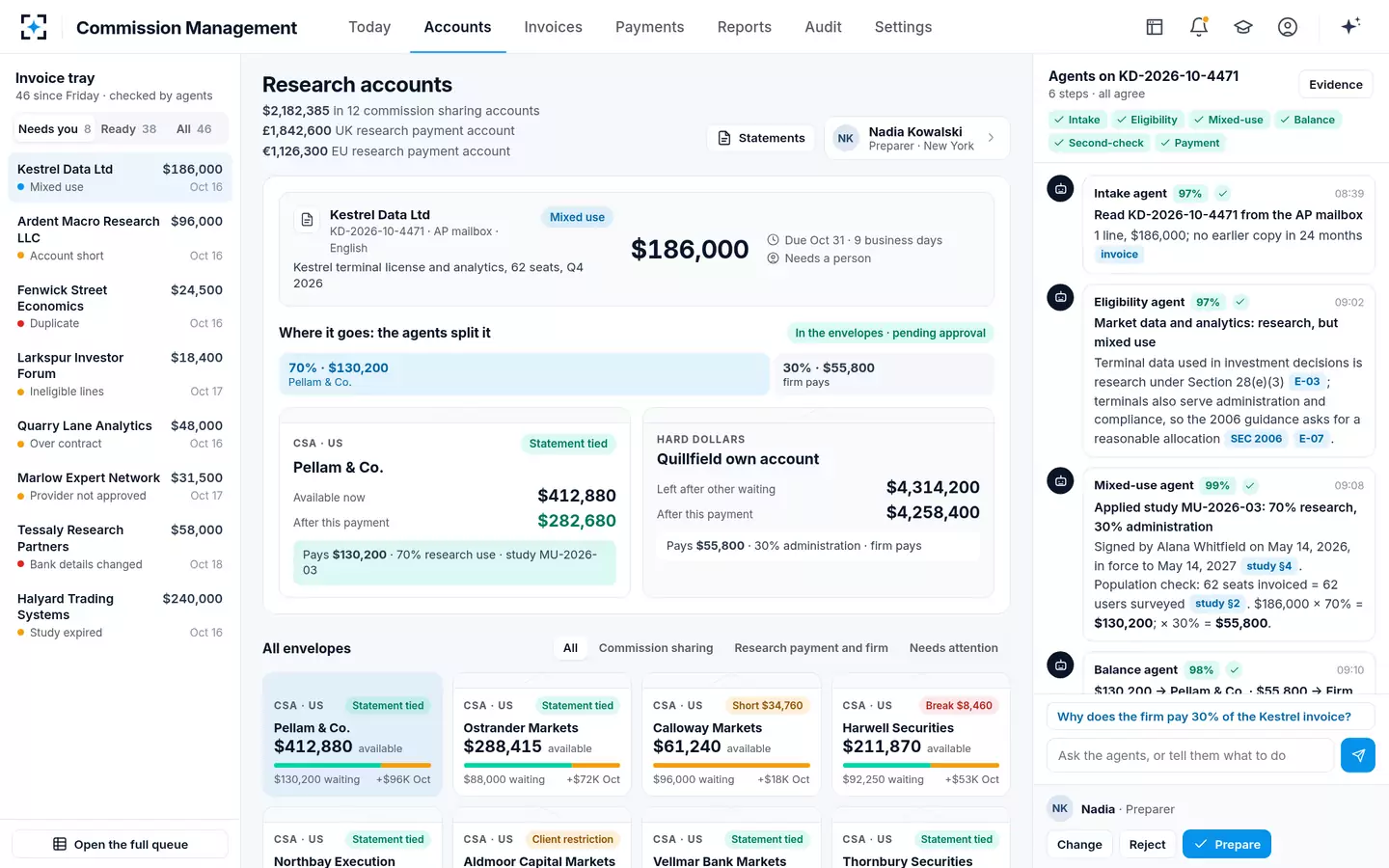
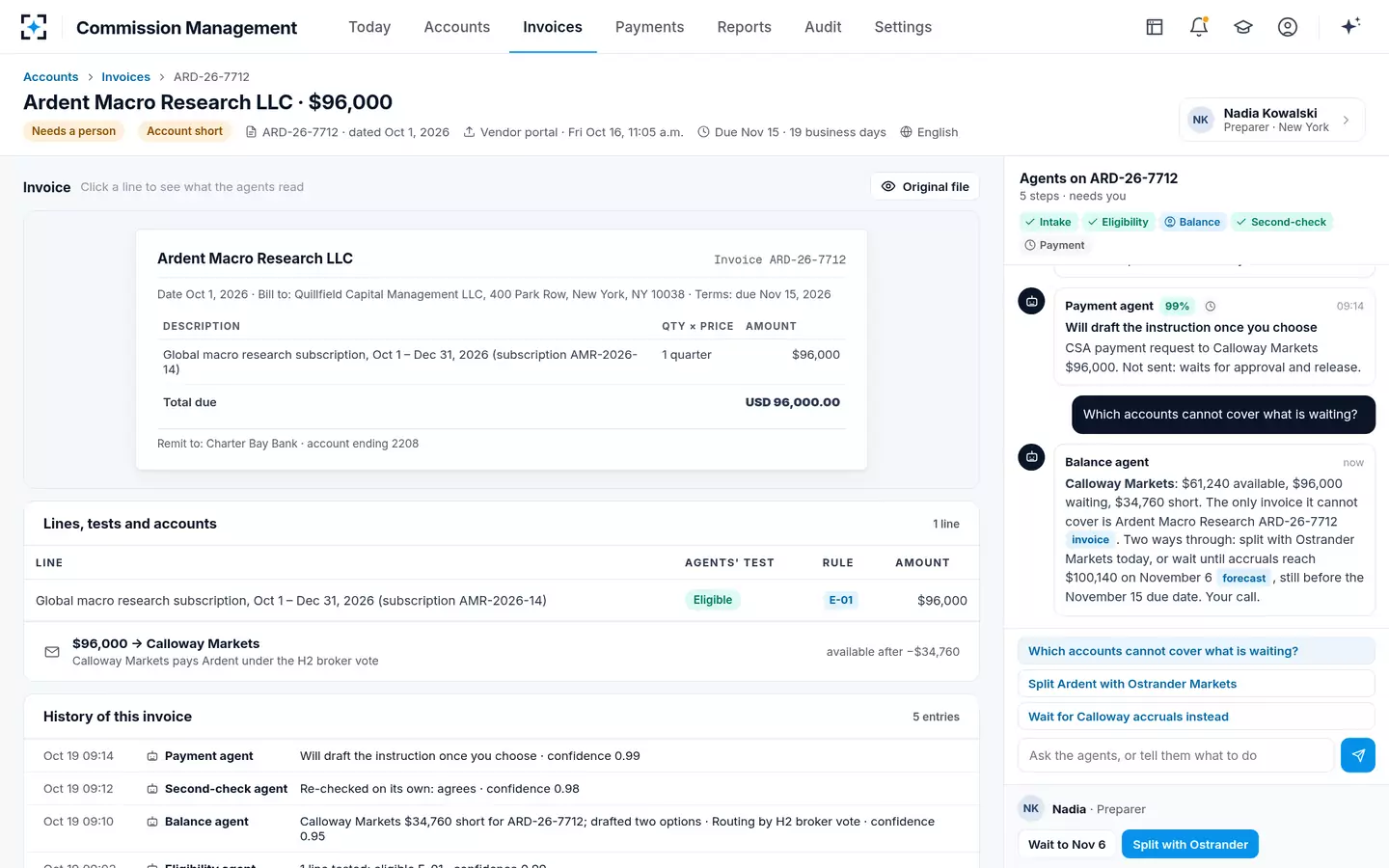
In the sample week, one broker's pool holds $61,240 against a $96,000 subscription its second-half broker vote assigns it. Asked which accounts cannot cover what is waiting, the Balance agent offers two ways through: split the payment with a second broker's pool today, or wait until accruals reach $100,140 on November 6, still before the invoice's November 15 due date. It never moves money between accounts itself, and it never routes UK or EU fund research to a US pool.
A short commission sharing account, and two ways through
Questions people ask
Can a CSA pay for independent third-party research?
Yes. That is its main purpose. The SEC said in 2006 that the safe harbor "encompasses third-party research and proprietary research on equal terms", provided the executing broker pays the research preparer directly and meets the other "provided by" attributes.
Is a commission sharing agreement legal in the US?
Yes, as a client commission arrangement within Section 28(e). The SEC's 2006 release revised its reading of "effecting" and "provided by" specifically to accommodate these arrangements, while requiring that a broker in the arrangement perform at least one of four trade functions and pay providers directly and promptly.
What happens to unspent CSA credits?
No US rule says; the agreement should. In the UK, an RPA surplus at the end of a period must be rebated to clients or offset against the next period's budget and charge under COBS 2.3B.8R, and the firm must "take reasonable steps to maintain a fair allocation of costs between clients".
What does joint payment change for an existing CSA?
The plumbing can stay; the paperwork around it grows. Since August 1, 2024 in the UK and June 6, 2026 in the EU, a CSA can carry joint payments, but only with a research budget that does not follow trading volumes, a payment method agreed with each provider, client information on the choice and a yearly assessment of the research. Whether rebundling suits the firm at all is a separate decision, weighed in rebundling research.
Do the same eligibility rules apply to CSA payments and bundled soft dollars?
Yes, in the US. Payments out of a CSA pool are client commissions, so each must be eligible research or brokerage, actually used in investment decisions, allocated if mixed use, and reasonable for its value. Examples of soft dollars, sorted shows where common invoices fall.
Should every broker get a CSA?
Not necessarily. Each agreement adds a pool to reconcile every month, and credits spread thinly across many brokers make a short account more likely. A manager can hold CSAs only with the brokers that carry most of its volume and trade execution-only elsewhere; that is a broker-review decision, not an operations one.