Soft dollar disclosure is the adviser's statement to clients of how it uses their commissions to obtain research and other services, and of the conflicts that creates. For an SEC-registered adviser the requirement sits in Form ADV: Part 2A Item 12.A.1 asks for six specific disclosures, from the benefit the adviser receives to the procedures it used last year to direct trades for soft-dollar benefits, and Part 1A Item 8.G asks whether the adviser receives soft-dollar benefits and whether all of them are eligible under Section 28(e). The statute behind both requires disclosure "of his policies and practices with respect to commissions" (15 U.S.C. 78bb(e)(2)). Botminds' Commission Management drafts the Item 12 support, and the UK and EU client disclosures, from the payments that were actually decided, so the brochure describes what happened rather than what the policy hoped for.
The examples come from a fictional sample manager, Quillfield Capital, as it runs through the solution. Form text and exam findings are quoted from the SEC, the FCA and the EU, linked where they appear.
Form ADV Part 2A Item 12.A.1, clause by clause, and the record each needs behind it
| Clause | What it requires | Records that support it |
|---|---|---|
| 12.A.1 (lead) | If you receive research or other products or services other than execution in connection with client trades, "disclose your practices and discuss the conflicts of interest they create"; include proprietary and third-party research. | A list of every soft-dollar arrangement and every provider paid in the year. |
| a | Explain that you receive a benefit "because you do not have to produce or pay for the research, products or services". | The policy; the hard-dollar budget that would otherwise carry the cost. |
| b | Disclose that you may have an incentive to choose a broker for research "rather than on your clients' interest in receiving most favorable execution". | Broker review minutes showing how research and execution were weighed. |
| c | If clients may pay commissions higher than other brokers charge in return for soft-dollar benefits ("paying-up"), disclose it. | Commission rates by broker against execution-only rates. |
| d | Disclose whether soft-dollar benefits serve all clients or only those that paid, and whether you allocate them in proportion to the credits each account generates. | Accounts accruing credits; accounts excluded by client restriction. |
| e | Describe the types of products and services acquired with client commissions "within your last fiscal year", in more detail for items outside Section 28(e). | The year's payment register by provider and type, mixed-use shares included. |
| f | Explain the procedures you used during your last fiscal year to direct client transactions to a broker in return for soft-dollar benefits. | The broker vote, commission sharing agreements, routing rules. |
What are the soft dollar disclosure requirements?
For a US registered investment adviser, the soft dollar disclosure requirements are Form ADV Part 2A Item 12.A.1 in the client brochure and Part 1A Item 8.G in the registration form. Both rest on Section 28(e)(2) of the Exchange Act, which lets the regulator prescribe what a person exercising investment discretion must disclose about its commission practices. Advisers to registered funds also answer to the fund's board, which the SEC says has an obligation "to review the adviser's compensation, including any 'soft dollar' benefits the adviser may receive from fund brokerage" (SEC Release 34-54165, 2006, note 6).
Item 12 opens more broadly than soft dollars. Item 12.A asks every adviser that selects brokers to "describe the factors that you consider in selecting or recommending broker-dealers for client transactions and determining the reasonableness of their compensation". Soft dollars are the first of three named practices inside it; brokerage for client referrals (12.A.2) and directed brokerage (12.A.3) follow, and each can interact with a commission sharing arrangement (Form ADV Part 2).
Item 12.A.1, clause by clause
Item 12.A.1 is short, but each lettered clause answers a different question a client would ask. The lead sentence says what triggers it: receiving "research or other products or services other than execution from a broker-dealer or a third party in connection with client securities transactions". A note then closes the obvious gap: the disclosure "must include all soft dollar benefits you receive, including, in the case of research, both proprietary research (created or developed by the broker-dealer) and research created or developed by a third party". Bundled research from a full-service broker counts, even with no invoice.
Clauses a to c describe the conflict: the adviser saves money (a), may be tempted to choose brokers for research (b), and may pay more than other brokers charge (c). Clause d asks who benefits, which matters wherever research paid by one group of accounts serves another. Clause e asks for the year's actual purchases, and clause f for the procedures used to direct trades. The last two are the ones that cannot be drafted from a template, because they describe the past fiscal year.
Part 1A Item 8.G: the yes-or-no examiners read first
Part 1A Item 8.G asks two questions. "(1) Do you or any related person receive research or other products or services other than execution from a broker-dealer or a third party ('soft dollar benefits') in connection with client securities transactions?" And, if yes, "(2) ... are all the 'soft dollar benefits' you or any related persons receive eligible 'research or brokerage services' under section 28(e) of the Securities Exchange Act of 1934?" (Form ADV Part 1A).
The answers are public and they set expectations. A "yes, all eligible" answer is a representation that every mixed-use split was made and every ineligible item was paid in hard dollars. The SEC has warned that an adviser that tells clients it operates within Section 28(e) and does not makes a false representation, which "may be a violation of Section 206 of the Advisers Act and Section 10(b) of the Exchange Act and Rule 10b-5" (Release 34-54165, note 188). A "no" is lawful for most clients, but it obliges the brochure to describe the non-eligible items in more detail.
How specific must soft dollar disclosure be?
Specific enough for a client to evaluate the conflict, and more specific for anything outside the safe harbor. The note to clause e is blunt: the description "must be specific enough for your clients to understand the types of products or services that you are acquiring and to permit them to evaluate possible conflicts of interest", must be "more detailed for products or services that do not qualify for the safe harbor in section 28(e)", and "merely disclosing that you obtain various research reports and products is not specific enough" (Form ADV Part 2, Item 12.A.1.e).
A useful test is whether a client could match the brochure to the year's payment register. "Third-party research, market data and analytics, and the research share of mixed-use data and order management licenses" can be checked against a register; "research and other services" cannot. The register is what makes the sentence true, which is why disclosure work starts in the payment records, not in the brochure template.
Most advisers disclosed something; half disclosed enough
Is disclosure enough when an item falls outside Section 28(e)?
For some clients, no amount of disclosure is enough. Advisers to registered funds and ERISA plans must stay within the safe harbor for those clients, and for a fund the SEC has said that if an arrangement "is not consistent with Section 28(e), disclosure of the arrangement would not cure any Section 17(e)(1) violation" of the Investment Company Act (Release 34-54165, note 31). For ERISA plans, using plan commissions to buy services for the manager's own benefit is a prohibited transaction regardless of what the brochure says (DOL Technical Release 86-1, 1986).
For separate accounts and private funds, full and fair disclosure can make a non-28(e) practice lawful, but the bar is high and the disclosure must be specific to the items. The SEC also reminds managers that a disclosure can be wrong because the eligibility call behind it was wrong: "If a money manager incorrectly concludes that a product or service is within the safe harbor, the money manager may provide disclosure that is inadequate" (Release 34-54165, page 25). Disclosure inherits every mistake in the eligibility file, which is why how common items are classified belongs in the same review.
What disclosure mistakes do SEC examiners find?
Examiners have found the same three gaps for almost thirty years: vague descriptions, silent cross-subsidies between clients, and non-eligible items described as if they were research. In the 2018 risk alert drawn from over 1,500 adviser examinations, the staff listed advisers that "did not appear to adequately disclose the use of soft dollar arrangements", that "did not disclose that certain clients may bear more of the cost of soft dollar arrangements than other clients", and that "did not appear to provide adequate or accurate disclosure regarding products and services acquired with soft dollars that did not qualify as eligible brokerage and research services" (OCIE Risk Alert, July 11, 2018).
The theme continues in the SEC's 2026 work on conflicts. In a June 9, 2026 risk alert on advisers' economic conflicts of interest, the Division of Examinations reported advisers "that made disclosures under Item 12 that were inconsistent with other disclosures or were incomplete" (SEC Risk Alert, June 9, 2026). Its example concerned clearing-firm revenue sharing rather than research, but the lesson for soft dollars is the same: Item 12 is read against everything else the adviser says, including Part 1A, the policies and the advisory agreements.
What UK and EU managers must disclose about research payments
UK and EU managers disclose research budgets and costs rather than soft-dollar practices, because their rules forbid research as an inducement unless it is paid in an approved way. The disclosure depends on the route chosen.
Research disclosure: the UK and EU routes side by side
Research payment account: The budgeted amount for research and each client's estimated research charge (COBS 2.3B.5R; Delegated Directive 2017/593 Art 13(1)).
Joint payment with execution: UK: the firm's use of joint payments, its policy's key features and the expected annual cost (COBS 2.3B.30R). EU: the choice of joint or separate payment and the policy on it (MiFID II Art 24(9a)(b)).
Research payment account: The total cost each client incurred for third-party research.
Joint payment with execution: UK: total research costs within the annual costs and charges report, with the most significant providers and services. EU: total research costs on request, where known.
Research payment account: Providers paid, amounts, benefits received, and spend against budget, including any rebate or carry-over (COBS 2.3B.20R).
Joint payment with execution: UK: the disclosures again, at least annually. EU: "a record of the total costs attributable to third-party research".
Research payment account: Only after "clear information to clients about such intended increases" (Art 13(5)); in advance (COBS 2.3B.8R).
Joint payment with execution: UK: the policy must say what is disclosed if research charges exceed the budget or the budget rises (COBS 2.3B.26R).
The budget-increase rule is where disclosure becomes an operational deadline. Under the EU delegated directive, "increases in the research budget shall only take place after the provision of clear information to clients about such intended increases" (Delegated Directive (EU) 2017/593, Article 13(5)). A research payment account forecast to overspend is therefore not only a budget problem: the manager must either trim spending or tell clients before it spends more.
Commission Management: research budgets against what clients were told
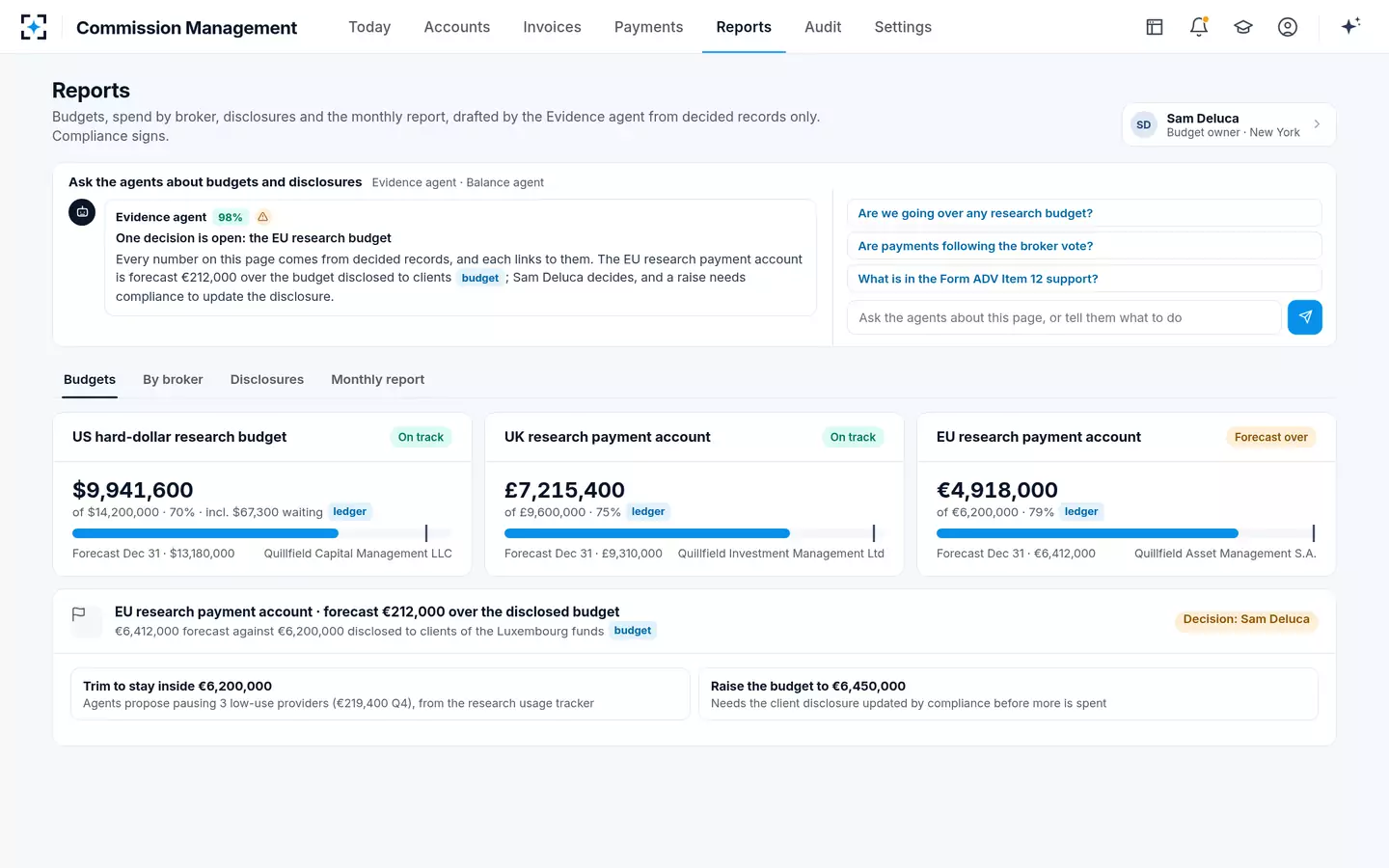
In the sample firm, the EU research payment account for its Luxembourg funds is forecast to reach €6,412,000 against €6,200,000 disclosed to clients, €212,000 over. The agents lay out two options, pausing three low-use providers or raising the budget to €6,450,000, and the second carries its own condition: the client disclosure is updated by compliance before more is spent. The decision belongs to the Global Head of Trading.
Do ERISA plan fiduciaries need soft dollar information?
Yes. The plan fiduciary that appoints an investment manager keeps a duty to monitor how the plan's commissions are spent, and it cannot do that without information. The Department of Labor said in 1986 that Section 28(e) "does not relieve anyone other than the person who exercises investment discretion" from ERISA's fiduciary provisions, so the appointing fiduciary "is not relieved of his ongoing duty to monitor the investment manager to assure that the manager has secured best execution of the plan's brokerage transactions and to assure that the commissions paid on such transactions are reasonable in relation to the value of the brokerage and research services provided to the plan" (ERISA Technical Release 86-1).
The release's own example shows why the request is reasonable. A manager directs a plan's trades to a broker that supplies research on tax-exempt securities, which the plan cannot hold but the manager's other accounts can. The arrangement is within Section 28(e), the Department said, but the plan's named fiduciaries must still "periodically review the execution" and "ensure that the brokerage commissions paid by Plan P ... are reasonable". A manager that can produce, for one plan, its commissions by broker, the credits they generated and what those credits bought makes that review possible.
Building the disclosure from records, with Commission Management
Disclosure is only as accurate as the records it is drafted from, so the safest order of work is records first, sentences second. The checklist below follows that order.
Drafting Item 12 from the year's records
- Close the payment register for the fiscal year
Every payment from client commissions, by provider, type and account, with mixed-use shares and the hard-dollar remainder.
- Classify the types in the client's language
Group the register into the categories the brochure will name, so clause e can be checked line by line against it.
- Separate non-28(e) items
If any exist, describe each specifically, and make sure Part 1A Item 8.G(2) says "no".
- Measure who benefited
Which accounts generated credits, which were excluded, and whether research served accounts that did not pay, for clause d.
- Describe the procedures actually used
The broker vote, the commission sharing agreements and the routing rules in force during the year, for clause f.
- Reconcile with every other disclosure
Part 1A, the policies, fund and plan agreements, and UK and EU client disclosures, the inconsistency the SEC flagged in 2026.
- Have a person sign
An analyst prepares; compliance approves the text and the figures behind it.
Commission Management's Evidence agent keeps the record of every invoice, split, approval and payment, and drafts the monthly commission report, the Form ADV Item 12 support and the UK and EU client disclosures from decided records only, each number linked to the payments behind it. An analyst prepares and compliance signs; the agent drafts nothing that a person does not approve. For an examiner, the same records export as one pack: the payment and mixed-use registers, signed studies, approvals with reason codes, statements and the audit trail.
Every decision on a write-once trail the disclosure can be drawn from
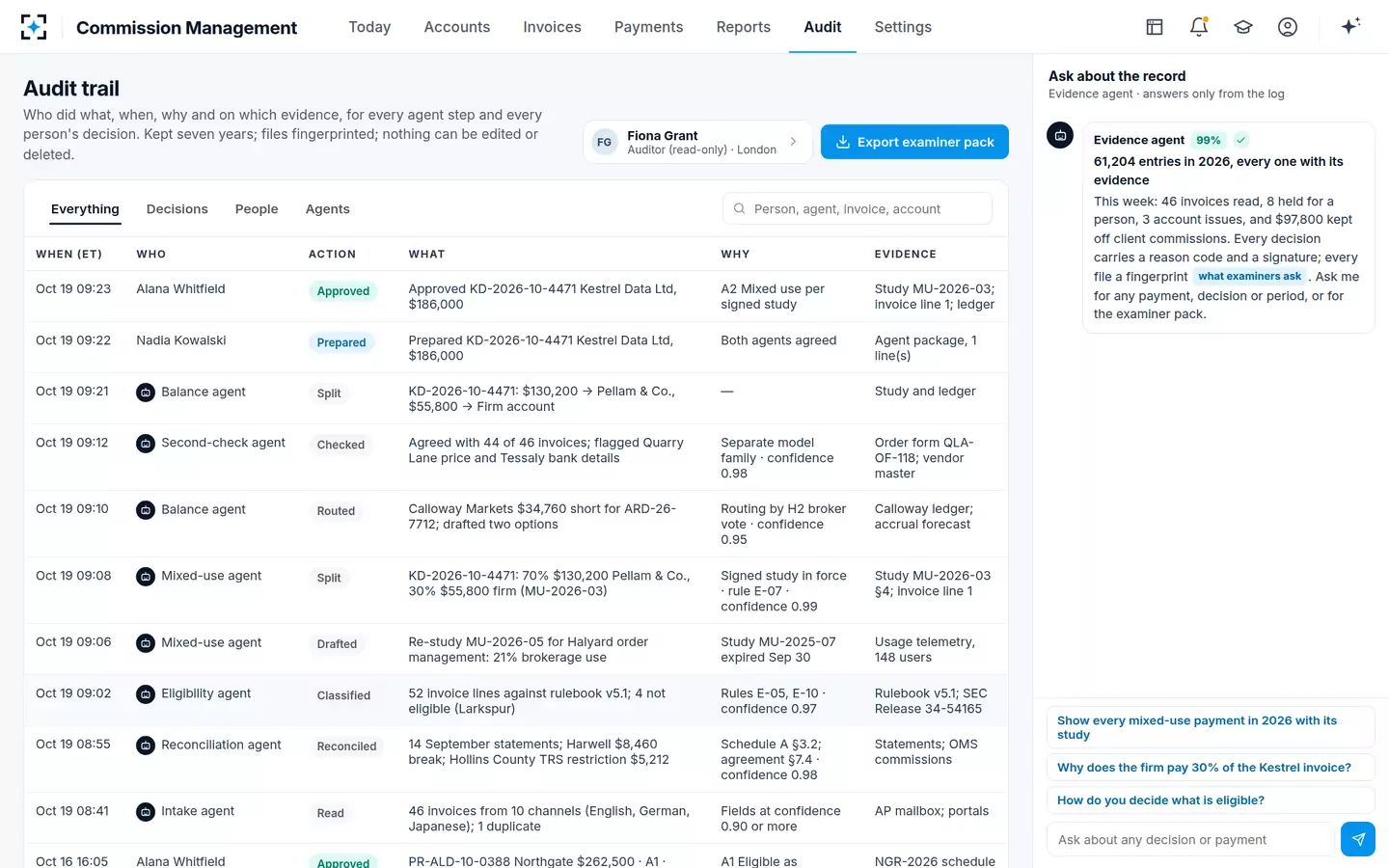
A brochure drafted this way changes the annual update from an editing exercise into a reconciliation. If the register shows a new type of service, clause e changes; if a client restriction excluded accounts, clause d says so; if a mixed-use study changed a share, the description of mixed use stays true. The soft dollar policy that governs who signs sets out the approvals the brochure then describes.
Questions people ask
Where do soft dollars go in Form ADV?
In Part 2A, the client brochure, under Item 12.A.1 "Research and Other Soft Dollar Benefits", and in Part 1A, Item 8.G, which asks whether the adviser receives soft-dollar benefits and whether all are eligible under Section 28(e). Item 12 also covers brokerage for client referrals and directed brokerage.
Does bundled research from a full-service broker need to be disclosed?
Yes. The instructions say the disclosure "must include all soft dollar benefits you receive", naming both proprietary research created by the broker and third-party research. Research received with no separate invoice is still a soft-dollar benefit.
Must advisers disclose the dollar amount of soft dollars?
Item 12 asks for types of products and services and the procedures used, not a dollar total. UK and EU rules go further: research payment account clients receive an annual figure for the research costs they incurred, and in the EU a record of total research costs is available on request where known.
What is "paying up" in Form ADV?
Paying up is causing clients to pay a commission higher than other brokers would charge in return for soft-dollar benefits. Item 12.A.1.c requires an adviser that may do so to disclose it, and Section 28(e) protects the practice only for eligible research and brokerage judged reasonable in good faith.
How often must soft dollar disclosure be updated?
At least with each annual update of Form ADV, because clauses e and f describe the last fiscal year. A material change in practice, such as a new type of non-eligible service, should not wait for the annual cycle if it makes the brochure inaccurate.
Do mixed-use allocations need to be disclosed?
Yes. The SEC says the mixed-use allocation decision "poses a conflict of interest for the money manager that should be disclosed to the client". In practice the brochure names the types of mixed-use products and says the manager pays the non-research share with its own funds.