Soft dollar compliance is the set of written policies, controls and records that let an adviser show every dollar of client commissions bought eligible research or brokerage, used in investment decisions, split if mixed use, judged reasonable, and disclosed. The legal frame is short: Section 28(e) puts the burden of proof on the manager, Rule 206(4)-7 requires written policies reviewed at least annually and a chief compliance officer to run them, and Form ADV Item 12 requires the practice to be described accurately. What fails in exams is rarely the policy text; it is the control that was never tested. Botminds' Commission Management runs the checks on every invoice and records who decided what, and this guide shows how to test those checks, or any others, by planting errors whose answers you already know.
The sample figures come from a fictional manager, Quillfield Capital, as it runs through the solution. The rules and exam findings are the SEC's, FINRA's and the Department of Labor's, linked where they appear.
Twelve controls a soft dollar compliance program needs
- Written policy, owned by compliance
Rule 206(4)-7(a): policies reasonably designed to prevent violations; names who prepares, approves and signs.
- Eligibility test on every line
Each invoice line classified as research, brokerage, mixed or ineligible under Section 28(e)(3), with the rule cited.
- Use test
Eligible items confirmed as used in investment decisions, not marketing, compliance or administration.
- Signed, in-force mixed-use studies
No mixed-use payment without a current study whose population matches the invoice.
- Price against contract
Every invoice priced against the provider's order form or contract; any increase held.
- Duplicate detection
Across every channel and provider, over a stated look-back.
- Bank-detail verification
Payee details only from a verified vendor master; changes confirmed by call-back to a known number.
- Maker-checker approvals
Preparer and approver are different people; a higher approver above a threshold; reason code on each decision.
- Client restrictions enforced at the broker
Accounts that forbid soft dollars excluded from credit accrual, and refunded if credited.
- Monthly statement reconciliation
Each commission sharing and research payment account statement tied to trades and payments; breaks traced.
- No commissions for distribution or referrals
Broker selection never rewards fund sales, shelf space or client referrals.
- Disclosure reconciled to records
Form ADV Item 12 and Part 1A Item 8.G checked against the year's payment register.
What should a soft dollar compliance program include?
A soft dollar compliance program should include a written policy, the twelve controls above, the records each control produces, an annual review of whether they work, and a named person accountable for all of it. Rule 206(4)-7 sets the frame for every SEC-registered adviser: put in place written policies and procedures designed to stop Advisers Act violations, check at least once a year both whether they are adequate and whether they work in practice, and name a chief compliance officer to run them (17 CFR 275.206(4)-7).
Section 28(e) supplies the content. The SEC's 2006 guidance requires a manager to show that each item is eligible, that it was used for investment decisions, that mixed-use items were reasonably allocated with adequate books and records, and that the commission was reasonable for the value received, and it leaves the manager to prove each of those points (Release 34-54165, page 48; soft dollars explained walks through the safe harbor itself). A program is the machinery that produces that proof as a by-product of paying invoices, not as a project before an exam.
Two controls on the list come from outside Section 28(e). Funds may not use brokerage to pay for distribution, the SEC noted in 2006, citing Rule 12b-1(h), and it warned managers against using eligible products "to camouflage the payment of higher commissions to broker-dealers for ineligible services, such as shelf space or client referrals" (page 49). FINRA forbids its members to "favor or disfavor the sale or distribution of shares of any particular investment company or group of investment companies on the basis of brokerage commissions received or expected" (FINRA Rule 2341(k)(1)). The control is that the broker review records why each broker was chosen.
What are the most common soft dollar deficiencies?
The most common soft dollar deficiencies are the same in every SEC review since 1998: non-research items paid with client commissions, mixed-use splits without support, disclosure that is vague or silent about cross-subsidies, and practice that does not follow the firm's own policy. OCIE's 2018 risk alert, which summarised what examiners had written to advisers after more than 1,500 examinations, put soft-dollar disclosure and mixed-use allocation among the most frequent best-execution deficiencies, and added advisers "that did not allocate soft dollar expenses in accordance with their policies" (OCIE Risk Alert, July 11, 2018).
The deficiencies examiners keep finding, and the control that catches each
| Finding | Where the SEC reported it | Control that catches it | Evidence it leaves |
|---|---|---|---|
| Non-research items paid with client commissions | 1998 sweep: 35% of broker-dealers and 28% of advisers | Eligibility test on every line | Rule cited per line; ineligible share routed to hard dollars |
| Mixed-use splits without documented rationale | 2018 alert; 1998: "few advisers have memorialized" decisions | Signed, in-force studies; population check | Study, signature, expiry, invoice match |
| Soft-dollar arrangements not adequately disclosed | 2018 alert | Disclosure reconciled to records | Register-to-brochure tie-out |
| Some clients bear more of the cost, undisclosed | 2018 alert; 1998: only 38% disclosed it | Client restrictions; benefit-by-account analysis | Accounts accruing credits vs. accounts served |
| Expenses not allocated per the firm's own policy | 2018 alert | Maker-checker approvals with reason codes | Preparer, approver, reason, time |
| Credits churned to pay the manager's own costs | Sage Advisory Services, 2001, cited in the 2006 release | Broker review; commission rate vs. execution-only rate | Rates by broker; trading volume vs. credits |
The last row is the serious one. The Sage case shows what the controls are ultimately for: the Commission charged that the adviser "churned advised account to generate client commission credits to pay personal operating expenses" (Release 34-54165, note 4). A program that only checks invoices will not see it; the broker review, which compares commission rates and volumes with execution quality, will. That is why the policy, the broker vote and the invoice checks have to be read together, and who approves what in a soft dollar policy sets out how they connect.
How do you test soft dollar controls? Plant errors you already know
You test soft dollar controls by putting known errors through the real process and counting how many come out caught, where, and by whom. A walkthrough of a policy proves the policy exists; a sample of paid invoices proves only that the sampled ones were fine. A planted error has a known right answer, so a miss is unambiguous.
The method borrows from audit practice. Build a set of invoices, statements and requests that each contain one error, label them privately, and run them through a normal month alongside real work, with the people and systems that usually handle them. Afterwards, score each one: caught before payment, caught after payment, or missed. A control that catches errors only after money has moved is a detection control, not a prevention control, and the policy should say which it is meant to be.
A twenty-error test plan, by the control each error targets
A twenty-error test, built and scored
A good planted set hides each error the way it would arrive in real life. The duplicates should come by two different channels, one with a new invoice number, because a duplicate that arrives twice by email is caught by anyone. The ineligible lines should sit inside an otherwise eligible conference or research invoice. The bank-detail change should come from a domain one character away from the provider's real one. The restricted-client credit should be on a statement from a broker that holds credits for other clients, so the total looks normal.
Then measure three things for each error. Was it caught before the payment was prepared? Which control caught it, and is that the control the policy says should? And what evidence was kept: the rule cited, the person who decided, the time. An error caught by a sharp-eyed analyst whose name appears nowhere is a near miss, not a passing control, because the next analyst may not see it.
One planted-error test, start to signed report
- Build errors1 wk
- Run inside a normal month4 wks
- Score each error1 wk
- Fix and re-test misses2 wks
- Unaware of which items are planted5 wks
- Remediate3 wks
How do you prove a soft dollar control works?
You prove a control works by showing it caught the errors it was designed to catch, before money moved, and left evidence a stranger can read. In the sample firm, each control leaves evidence: the Intake agent's duplicate check over a 24-month look-back, the Second-check agent's re-test of price, arithmetic, FX and bank details on a separate model family, the reason code on each approval. On one Monday the solution's tray held eight items for people, among them a $24,500 duplicate already paid through another broker, a $6,000 price above the order form, $11,500 of travel and dinner on a conference invoice, a provider not on the approved list and a vendor's changed bank details.
Commission Management: a changed bank account held for a call-back
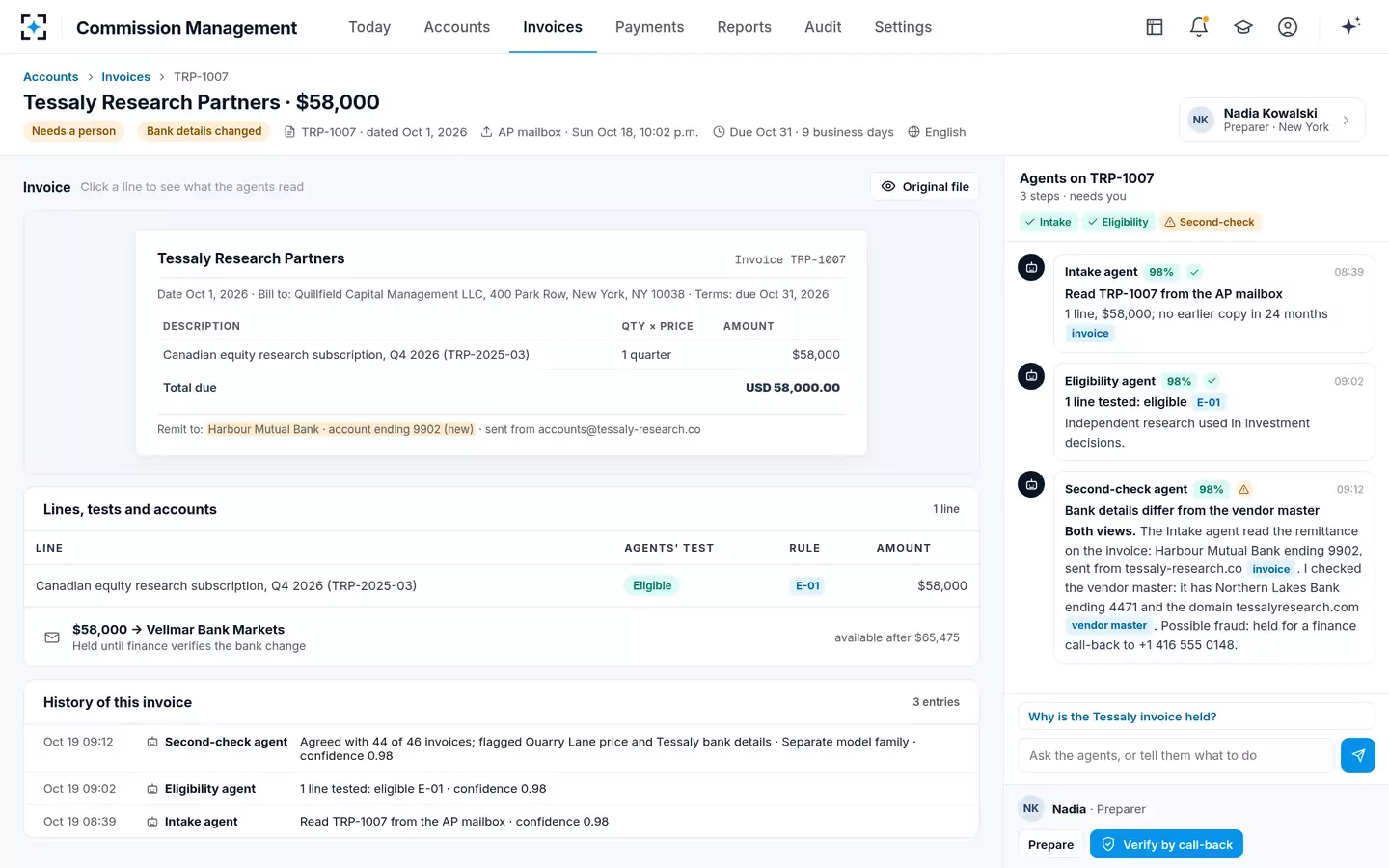
Controls that depend on thresholds need a second kind of test: what would have happened at a different setting. The sample firm's compliance officer asked what lowering the auto-prepare threshold from 0.90 to 0.85 would do. The agents replayed September's 212 invoices: nine more packages would have been prepared without a person checking a field, and on two of them the analyst had in fact corrected a field, a service period and a seat count. The recommendation was to keep 0.90, and any change would be a new, approved version of the thresholds. That is a control test with a measured answer, run before the change rather than after an exam.
How often should soft dollar controls be tested?
At least once a year as part of the annual review, and again whenever something material changes. Rule 206(4)-7(b) requires the review at least annually and asks about effectiveness, not only adequacy, which a planted-error test answers directly. The SEC's examination staff say they look at this: the Division of Examinations' fiscal year 2027 priorities list trading and portfolio management among the parts of a compliance program it will test, and say examiners will typically analyze the adviser's annual compliance review (SEC FY2027 Examination Priorities; what those examinations have turned up on the trading side is in the SEC best execution risk alert, read as evidence gaps).
Event-driven tests matter as much as the calendar. A new commission sharing agreement, a new research payment account, a new system, a change of approvers or a change in UK or EU rules, such as joint payment from June 6, 2026 in the EU, each changes what the controls must catch. A firm that tests in January and changes its payment process in March has an untested process for nine months.
What do SEC examiners request on soft dollars?
The SEC does not publish a fixed soft-dollar request list, but its findings show what an examiner will test, and each finding implies a document. A manager should be able to produce, quickly and for any period: every arrangement and agreement; every payment from client commissions with its invoice, eligibility call and approval; every mixed-use study in force and its population; the broker review and how research was weighed; commission rates by broker; client restrictions and how they were enforced; and the Form ADV Item 12 text reconciled to the payment register.
"In the Commission's view, the prudent way for a money manager to meet its burden of showing eligibility for the safe harbor is to document fully its client commission arrangements."
SEC Release 34-54165, 2006, note 83
ERISA plan clients may ask for much of the same. The Department of Labor says the fiduciary who appoints a plan's manager keeps an "ongoing duty to monitor" that the manager secured best execution and that commissions were reasonable for the services provided to the plan (ERISA Technical Release 86-1, 1986). A pack that answers an examiner also answers a plan's investment committee.
Who is responsible for soft dollar compliance?
The adviser is, through its chief compliance officer, but the work is shared and so is the liability. Rule 206(4)-7(c) makes the chief compliance officer responsible for administering the policies. The portfolio managers who use research own the use test; trading owns the broker review; finance owns payment controls. Brokers carry their own duty: under the SEC's 2006 interpretation a broker providing third-party research reviews service descriptions "for red flags", and one that knowingly pays for ineligible items for a manager that claims to operate within Section 28(e) "may risk aiding and abetting liability" (Release 34-54165, pages 59 to 61).
Testing the agents too: the same discipline for automated checks
Where software or AI agents perform checks, they are controls and are tested the same way, with one addition: what the agent may not do. FINRA's 2026 oversight report lists the risks firms should weigh with AI agents, among them that a general-purpose agent may not know enough about a specialised field to do complex, industry-specific work reliably, and it suggests firms work out how they will trail each agent's actions and decisions and what guardrails will limit what an agent may do (FINRA 2026 Annual Regulatory Oversight Report, December 2025). The SEC's examiners frame it as continuity of obligation: as registrants adopt what the Division calls "super intelligence" (SI), it is checking that the obligations firms already had, which do not depend on the technology, are still met (FY2027 Examination Priorities). Soft dollar eligibility is one of those obligations; an agent that applies it is a control to be tested like any other.
Commission Management: approvals and thresholds as versioned settings
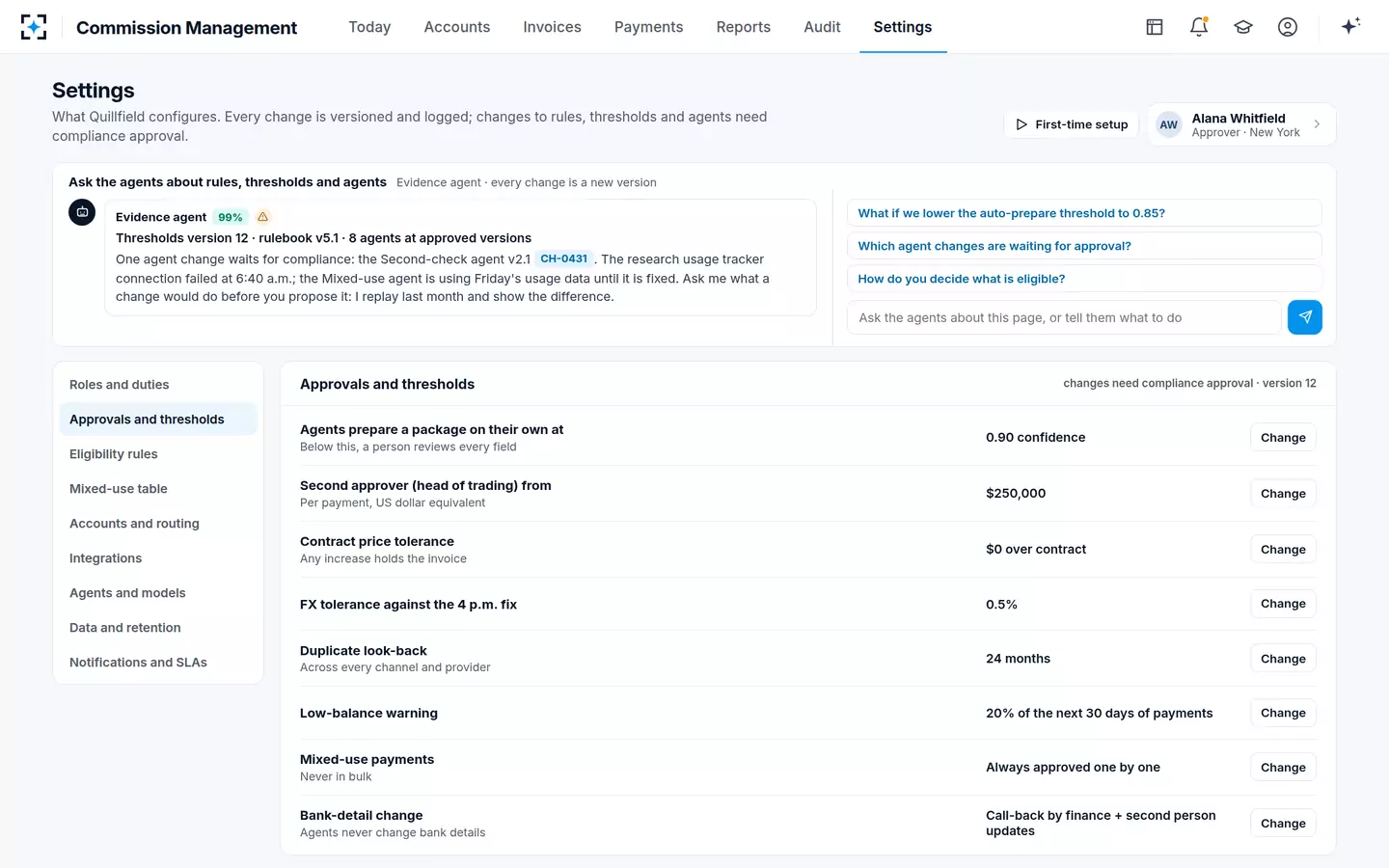
In Commission Management the agents' limits are part of the control design, which makes them testable: they never approve or send a payment, set a mixed-use percentage, move money between accounts, change bank details or contact a broker unseen. A planted self-approval or a planted request to route UK fund research through a US account should be refused every time, and the audit trail should show the refusal. How CSA reconciliation separates the agent that prepares from the people who approve follows the same design into the monthly tie-out.
Questions people ask
Is there a regulatory soft dollar compliance checklist?
No regulator publishes one. The obligations come from Section 28(e), the SEC's 2006 interpretive release, Rule 206(4)-7 and Form ADV Item 12, and the SEC's 2018 risk alert lists the deficiencies examiners found. A checklist is the firm's translation of those into controls.
Should soft dollar testing be done by compliance or internal audit?
Either, as long as the tester is not the person who runs the control. Compliance testing typically owns the annual review under Rule 206(4)-7; internal audit adds independence. In a planted-error test, the people processing invoices should not know which items are planted.
How large should a soft dollar test sample be?
For planted errors, enough to hit every control at least once and the riskiest ones more than once; twenty is a workable month. For sampling paid invoices, size depends on volume and risk, and a sample can only show that no error was found, not that none exists.
Do broker-dealers have soft dollar compliance duties?
Yes. A broker that provides third-party research under a client commission arrangement should review service descriptions for red flags and pay providers directly and promptly, and may face aiding-and-abetting liability for paying ineligible items. FINRA Rule 2341(k) separately bars members from favoring fund sales on the basis of brokerage commissions.
What evidence shows a mixed-use control is working?
A signed, in-force study for every mixed-use payment, a recorded population check against the invoice, and no payment made on an expired study. The SEC's 1998 sweep found 68% of advisers had bought mixed-use items with soft dollars and few had memorialized the allocations.
Can soft dollar controls be fully automated?
The checks can; the judgements cannot. Eligibility tests, duplicates, prices, balances and statement tie-outs can run automatically, but the good-faith reasonableness determination, the mixed-use signature and the approval are a named person's under Section 28(e). Automation that records those decisions makes them easier to prove.