A soft dollar policy is an adviser's written statement of how it uses client commissions to obtain research and brokerage: which products and services are eligible under Section 28(e), how mixed-use items are allocated, which clients are excluded, who prepares, approves and releases each payment, who signs each mixed-use study, and how the practice is disclosed and reviewed. For an SEC-registered adviser it is part of the written compliance policies Rule 206(4)-7 requires. Its real job is evidential: Section 28(e) protects a good-faith judgement, and only a policy that names who makes each judgement can show the right person made it. Botminds' Commission Management turns the policy's approvals, thresholds and limits into versioned settings, so the person named in the policy is the only one the system lets decide.
The sample roles and thresholds come from a fictional manager, Quillfield Capital, as it runs through the solution. The rules are the SEC's, the FCA's, the EU's and the Department of Labor's, linked where they appear.
An approval matrix for client-commission payments, as set in Commission Management
| Decision | Prepares | Approves | Releases or signs | Never |
|---|---|---|---|---|
| Eligible research or brokerage payment | Commission analyst | Compliance officer, with a reason code | Finance controller releases | Approved by the preparer |
| Payment of $250,000 or more | Commission analyst | Compliance, then the Global Head of Trading | Finance releases | Released before the second approval |
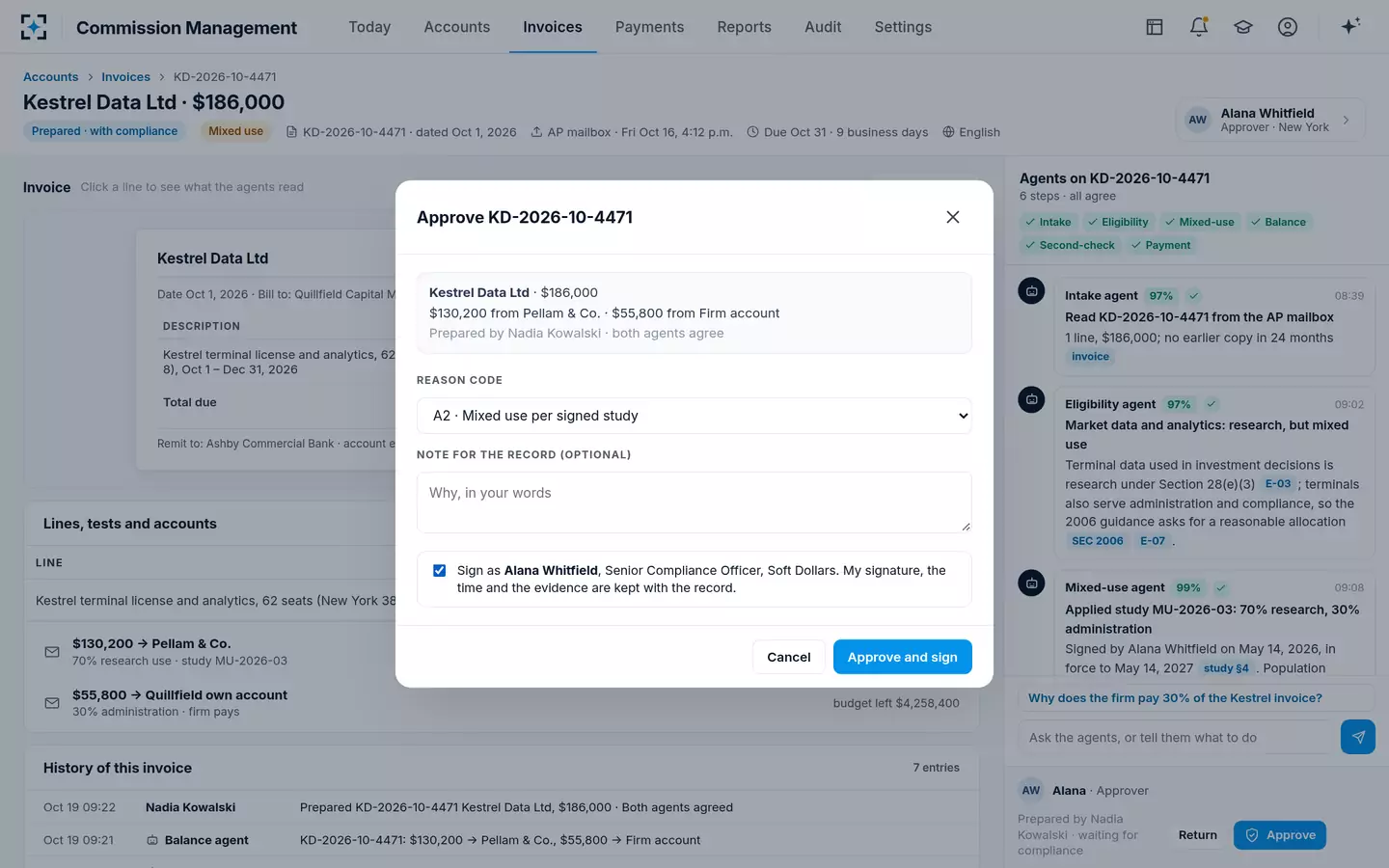
| Mixed-use payment | Commission analyst, from a signed study | Compliance, one payment at a time | Finance releases | Approved in bulk; paid on an expired study |
| Mixed-use study or re-study | Measured from usage data | Senior compliance officer for soft dollars signs | Compliance records the expiry | Signed by a user of the product |
| Refund to a restricted client | Commission analyst | Compliance | Finance | Netted against other clients' credits |
| Change of vendor bank details | Finance, after a call-back on the number on file | A second person updates | Recorded with who called and when | Taken from an invoice or email |
| Change to thresholds or the rulebook | Compliance drafts; effect replayed on last month | Chief Compliance Officer | New version, logged | Changed without a version |
What is a soft dollar policy?
A soft dollar policy is the part of an adviser's compliance manual that governs client commission arrangements. Rule 206(4)-7 requires every SEC-registered adviser to put in place written policies and procedures designed to prevent violations of the Advisers Act and its rules, and to name a chief compliance officer to run them (17 CFR 275.206(4)-7). Soft dollars touch several obligations at once, the fiduciary duty, best execution, disclosure and books and records, so most firms write a dedicated policy rather than scatter the rules.
The policy's content comes from Section 28(e) and the SEC's 2006 guidance: the three tests of eligibility, use and good-faith reasonableness, the treatment of mixed-use items, and the conditions for third-party research through client commission arrangements. Its structure comes from the people involved. The SEC put the burden of proving each determination on the money manager (Release 34-54165, page 48; the tests themselves are in soft dollars explained), and a firm discharges a burden through people, so the policy has to say which people.
What should a soft dollar policy contain?
A soft dollar policy should contain at least ten sections: scope, eligibility, mixed use, approvals, broker selection, client restrictions, payment controls, records, disclosure and review. The checklist below lists what each should say; the order is a suggestion.
Ten sections of a soft dollar policy, and what each must say
- Scope and clients
Which accounts generate credits; that registered funds and ERISA plans stay within Section 28(e); which clients forbid soft dollars.
- Eligibility
The firm's rulebook: research and brokerage under Section 28(e)(3) and the 2006 guidance, with the overhead list; separate UK and EU research rules.
- Use
That eligible items must be used in investment decisions, and how use is confirmed.
- Mixed use
Study method, population check, rounding rule, validity period, early triggers, and who signs.
- Approvals
The approval matrix: preparer, approver, second approver, releaser, reason codes, no self-approval.
- Broker selection
How research value is weighed against execution in the broker review, and that brokerage never rewards fund sales or client referrals.
- Payment controls
Price against contract, duplicates, approved providers, bank details only from the vendor master.
- Records
What is kept for each payment and study, where, and for how long.
- Disclosure
Who drafts Form ADV Item 12 and Part 1A Item 8.G, from which records, and UK and EU client disclosures.
- Review and testing
The annual review, event-driven reviews, and how controls are tested.
Two sections are where policies most often fail in practice. The broker selection section must tie the soft dollar policy to the best-execution policy, because the SEC has said in terms that Section 28(e) left the manager's duty to seek best execution untouched (Release 34-54165, note 6), and that duty has its own review and committee, set out in what best execution means in practice. And the scope section must handle the clients that cannot be outside the safe harbor: the SEC says advisers to mutual funds and ERISA plans "must operate within the safe harbor with respect to those clients" (note 188).
Who approves soft dollar payments?
A compliance officer with authority over soft dollars should approve every payment from client commissions, after a commission analyst prepares it and before finance releases it, with a senior approver added above a threshold. No rule prescribes the chain. The reason for it is the conflict the SEC describes: client commissions spare the manager costs it would otherwise bear, so the person who benefits from the research should not be the person who decides it may be paid for with client money.
The seats in a soft dollar policy, and what each keeps
Today
Keys invoices into spreadsheets and broker portals and ties statements by hand.
With agents
Prepares packages the agents have read, tested and split, and works the exceptions.
Still theirs: Prepares; never approves what they prepared.
Today
Approves payments from email and needs the study, not a memory, when an examiner asks.
With agents
Approves with a reason code from cited evidence; signs every mixed-use study.
Still theirs: Approves; signs studies.
Today
Releases payments keyed into a dozen portals and must catch changed bank details.
With agents
Releases one checked file; any bank change waits for a call-back.
Still theirs: Releases; verifies bank changes.
Today
Owns the broker vote and budget, with little view of where research money went.
With agents
Sees spend against the vote and gives the second approval on large payments.
Still theirs: Second approval at $250,000; budget decisions.
Today
Owns a policy that lives in a document.
With agents
Approves every change to thresholds, rulebook and agents as a new version.
Still theirs: Owns the policy under Rule 206(4)-7.
Today
Assembles evidence for examiners over weeks.
With agents
Reads the write-once trail and exports the examiner pack.
Still theirs: Read-only; tests the controls.
Who signs mixed-use studies?
A compliance officer independent of the product's users should sign each mixed-use study, and the policy should say so by name or title. The SEC calls the allocation decision itself "a conflict of interest for the money manager that should be disclosed to the client" (Release 34-54165, pages 45 to 46), and in 1998 its staff found that "few advisers have memorialized their mixed-use allocation decisions" (SEC inspection report, September 22, 1998). A signature by an independent person answers both: it records that the split was decided, and by someone without a stake in it.
The policy should also separate measuring from signing. In the sample firm the Mixed-use agent drafts a re-study from seat lists and usage logs when one lapses, but it "never sets or changes a percentage"; the senior compliance officer for soft dollars signs. How to split a license and prove the split covers the study's content.
Commission Management: compliance approves with a reason code and a signature
How often should a soft dollar policy be reviewed, and what triggers an early review?
At least once a year, and whenever the business or the rules change. Rule 206(4)-7(b) requires a review at least annually of whether the policies are adequate and whether they work in practice. Effectiveness means testing, not rereading: the SEC's 2018 risk alert reported advisers whose soft dollar allocations departed from their own policies, and others whose own broker-monitoring policies, covering execution price, research and responsiveness, were written down but not followed (OCIE Risk Alert, July 11, 2018).
UK and EU rules add their own annual cycle. A UK firm paying jointly must assess, at least once a year, what the research bought through joint payments was worth, how good it was and how much it was used, and must check that research charges stand comparison with similar services (COBS 2.3B.25R(7); the UK and EU rule changes, 2024–2026 sets out the full conditions). The policy review is the natural place to record that the assessment was done. Event triggers matter too: a new commission sharing agreement, a new regime such as EU joint payment from June 6, 2026, or a change of approvers each warrants a review before the next payment, and a soft dollar compliance checklist sets out how to test the result.
How a soft dollar policy ties to Form ADV
The policy and the brochure must say the same thing, because the brochure describes the policy in practice. Form ADV Part 2A Item 12.A.1.f asks the adviser to "explain the procedures you used during your last fiscal year to direct client transactions to a particular broker-dealer in return for soft dollar benefits you received" (Form ADV Part 2), and Part 1A Item 8.G asks whether all soft-dollar benefits are eligible under Section 28(e). Both answers come from the policy and the year's records.
"If an adviser that represents to its clients that he will operate within Section 28(e) and fails to do so, the representation is false and the conduct may be a violation of Section 206 of the Advisers Act and Section 10(b) of the Exchange Act and Rule 10b-5."
SEC Release 34-54165, 2006, note 188
That is the practical reason to write the policy narrowly enough to follow. A policy that promises every invoice is checked against the contract, or every study re-signed annually, becomes a representation the firm must keep. A policy that says less but is followed every time is easier to defend than an ambitious one with gaps.
UK and EU: the written policies the rules require
UK and EU rules require written research policies of their own, and they are provided to clients. A UK firm using a research payment account must "establish a written policy" on how it assesses research quality and allocates research costs fairly across clients' portfolios, and "provide the policy ... to their clients" (COBS 2.3B.12R). A firm paying jointly needs a written policy that specifies "how the firm's governance, decision-making and controls in respect of third-party research purchased using joint payments operate, including how these are maintained separately from those for trade execution" (COBS 2.3B.25R(1)).
The US policy and the UK and EU policies, side by side
United States: Rule 206(4)-7 (policies generally); Section 28(e) sets the content.
United Kingdom and EU: COBS 2.3B.12R and 2.3B.25R (UK); MiFID II Article 24(9a)(b) as amended, from June 6, 2026 (EU).
United States: No; Form ADV Item 12 describes the practice.
United Kingdom and EU: Yes: the policy, or in the UK its key features, is provided or made available to clients.
United States: No rule; good-faith reasonableness.
United Kingdom and EU: A research budget not linked to trading volume, set at least annually.
United States: Best execution unchanged by Section 28(e).
United Kingdom and EU: Research decisions governed separately from trade execution; COBS 2.3B.29R bars treating research as an execution factor.
United States: Annual review of policies under Rule 206(4)-7(b).
United Kingdom and EU: Annual assessment of research value, quality and use (UK joint payment; EU Article 24(9a)(c)).
In the EU, the policy also has to address conflicts: since June 6, 2026, a firm informs clients of its choice to pay jointly or separately and makes available its policy on payments, "including ... how the investment firm prevents or manages conflicts of interest" when paying jointly (Directive (EU) 2024/2811, amending MiFID II Article 24(9a)). A manager with clients in all three places can keep one policy with regional annexes, provided each annex can stand on its own for its regulator.
Is there a soft dollar policy template?
No regulator publishes one, and a borrowed template is a risk, because the policy becomes a representation. A better starting point is the table below: each section, the question it answers, and the rule behind it. Write each section to describe what the firm actually does, then check that the system enforces it.
A soft dollar policy template, section by section
| Section | Answers | Rule behind it |
|---|---|---|
| 1. Purpose and scope | Which accounts, which regimes, which clients are excluded | Section 28(e); 2006 release note 188; client agreements |
| 2. Eligibility rulebook | What client commissions may buy, line by line | Section 28(e)(3); 2006 release pp. 27–44; COBS 2.3B.23G |
| 3. Mixed use | How splits are measured, signed and refreshed | 2006 release p. 47 and note 148 |
| 4. Approvals | Who prepares, approves, releases; thresholds; reason codes | Section 28(e) good faith; 2006 release p. 48 |
| 5. Broker selection and research | How research and execution are weighed; no distribution or referral rewards | 2006 release note 6 and p. 49; FINRA Rule 2341(k) |
| 6. Commission sharing agreements | What each agreement must contain; reconciliation | 2006 release pp. 57–59 |
| 7. Payment controls | Contract price, duplicates, providers, bank details | Firm's own controls; Rule 204-2 records |
| 8. ERISA and fund clients | Monitoring information for plan fiduciaries; fund board reporting | DOL Technical Release 86-1; 2006 release note 6 |
| 9. Disclosure | Form ADV Item 12 and Item 8.G; UK and EU client disclosures | Form ADV; COBS 2.3B.5R, 2.3B.30R |
| 10. Records, review and testing | Retention; annual and event-driven review; control tests | Rule 204-2; Rule 206(4)-7(b) |
Commission Management holds sections 2, 3, 4 and 7 as data: the eligibility rulebook, the signed studies, the approval matrix and thresholds, and the payment controls are settings, each change a new version approved by the Chief Compliance Officer, with the agents replaying last month to show its effect first. The rest of the policy stays a document; the system makes sure the parts that decide money are applied as written, every time.
Questions people ask
Is a soft dollar policy required?
For an SEC-registered adviser that uses client commissions for research, effectively yes: Rule 206(4)-7 requires written policies reasonably designed to prevent violations, and soft dollars carry fiduciary, disclosure and records obligations. UK and EU firms paying for research from client money must have written research policies under COBS 2.3B and MiFID II.
Can the chief investment officer approve soft dollar payments?
The policy can allow it, but it weakens the evidence. The CIO and portfolio managers are the main users of research, and the conflict the SEC describes is the manager's benefit from client-paid research. A compliance approver independent of the users is easier to defend.
What is a soft dollar committee?
Some firms set up a committee, often combined with the best execution or broker review committee, to approve the eligibility rulebook, review mixed-use studies and commission spending, and sign off the annual review. No rule requires one; what matters is that the policy names who decides each item.
Should a soft dollar policy cover ERISA clients separately?
Yes. ERISA plans must stay within Section 28(e), and the Department of Labor says the fiduciary that appoints a manager keeps an ongoing duty to monitor best execution and the reasonableness of commissions, so the policy should say what information plans receive and how restrictions in plan agreements are enforced.
How detailed should the eligibility section be?
Detailed enough that two analysts would classify the same invoice line the same way. The SEC's 2006 release gives the categories and an overhead list; the firm's rulebook should map its actual providers and products onto them, and record the reason for each mapping.