Commission management software, in the asset-management sense, is software that tracks the brokerage commissions a manager pays, the research credits those commissions build up in commission sharing accounts (CSAs) and research payment accounts, and the research invoices paid from them, so every payment is eligible, correctly split, approved and disclosed. It is not sales-commission or incentive-compensation software, which calculates what salespeople earn; the phrase is shared, the problem is not. The buying question is less which screen looks best than which systems the software must join, because the work is tying an order management system, a dozen broker statements, provider contracts and accounts payable together under Section 28(e) and the UK and EU research rules. Botminds' Commission Management does that join with eight agents and leaves every approval to named people.
The sample figures come from a fictional manager, Quillfield Capital, as it runs through the solution. Rules are cited from the SEC, the FCA and the EU where they appear.
Commission management software is a join: nine systems, and the checks each one feeds
Order management system
What it givesTrades and commissions by broker, account and order type
Checks that need itExpected research credits; client restrictions; broker-vote spend
Broker CSA statements and portals
What it givesAccruals, payments and balances per broker, by portal, SFTP or email
Checks that need itStatement tie-out; balance before each payment; confirmations
Commission sharing agreements
What it givesRate schedules, research credits, restricted accounts, cut-offs
Checks that need itExpected credit per trade; break tracing to the clause
AP mailbox and vendor portals
What it givesResearch invoices in any format and language
Checks that need itIntake, fingerprinting, duplicates across channels
Provider contracts and order forms
What it givesPrices, seats, periods
Checks that need itPrice against contract; seat counts against studies
Eligibility rulebook and mixed-use studies
What it givesThe firm's Section 28(e) and UK/EU research rules; signed splits
Checks that need itLine-by-line eligibility; mixed-use share
Vendor master
What it givesApproved providers and verified bank details
Checks that need itApproved-provider check; payee details; call-back on change
Accounts payable, ERP, general ledger
What it givesHard-dollar vouchers, accruals, research expense
Checks that need itThe firm's share of mixed-use and ineligible items
Fund administrator (UK and EU)
What it givesResearch payment account statements and budgets
Checks that need itSpend against disclosed budgets; regime routing
What is commission management software for asset managers?
For asset managers, commission management software is the system of record for research money paid through trading commissions: how much each broker owes in research credits, what each research provider was paid, from which account, on what evidence and with whose approval. It replaces the spreadsheet that usually tracks credits and payments and the email chains that hold approvals, and it sits between trading, compliance and finance.
Its scope follows the regulation. In the US it must apply the three Section 28(e) tests to each payment, eligibility, use in investment decisions and good-faith reasonableness, and keep "adequate books and records concerning allocations" of mixed-use items (SEC Release 34-54165, 2006, page 47). In the UK it must keep research payment accounts inside budgets "not linked to the volume or value of transactions" (COBS 2.3B.4R). In the EU, since June 6, 2026, it must handle both separate and joint payment and the record of research costs the Listing Act directive requires (Directive (EU) 2024/2811). A product that handles one regime well and the others by spreadsheet leaves the hardest part outside the system.
Two kinds of software share one name
Sales commission software: What the firm pays its own salespeople or agents.
Brokerage commission management: What the firm's clients pay brokers on their trades.
Sales commission software: The firm's payroll.
Brokerage commission management: Client assets: commissions and research credits held at brokers or in research accounts.
Sales commission software: Compensation plans, payroll and revenue accounting.
Brokerage commission management: Section 28(e), the SEC's 2006 guidance, Form ADV Item 12, FCA COBS 2.3B, MiFID II Article 24(9a), ERISA.
Sales commission software: Plans, quotas, payouts.
Brokerage commission management: Trades, CSA statements, invoices, studies, approvals, disclosures.
Which systems does commission management software connect to?
It must connect to at least the order management system, every broker's CSA statement, the provider contracts, the accounts-payable intake and the vendor master, and, for UK and EU funds, the fund administrator's research account statements. Each check in the map above needs two or more of them: an expected research credit needs the order management system and the agreement; a duplicate check needs every intake channel; a bank-detail check needs the vendor master and the invoice.
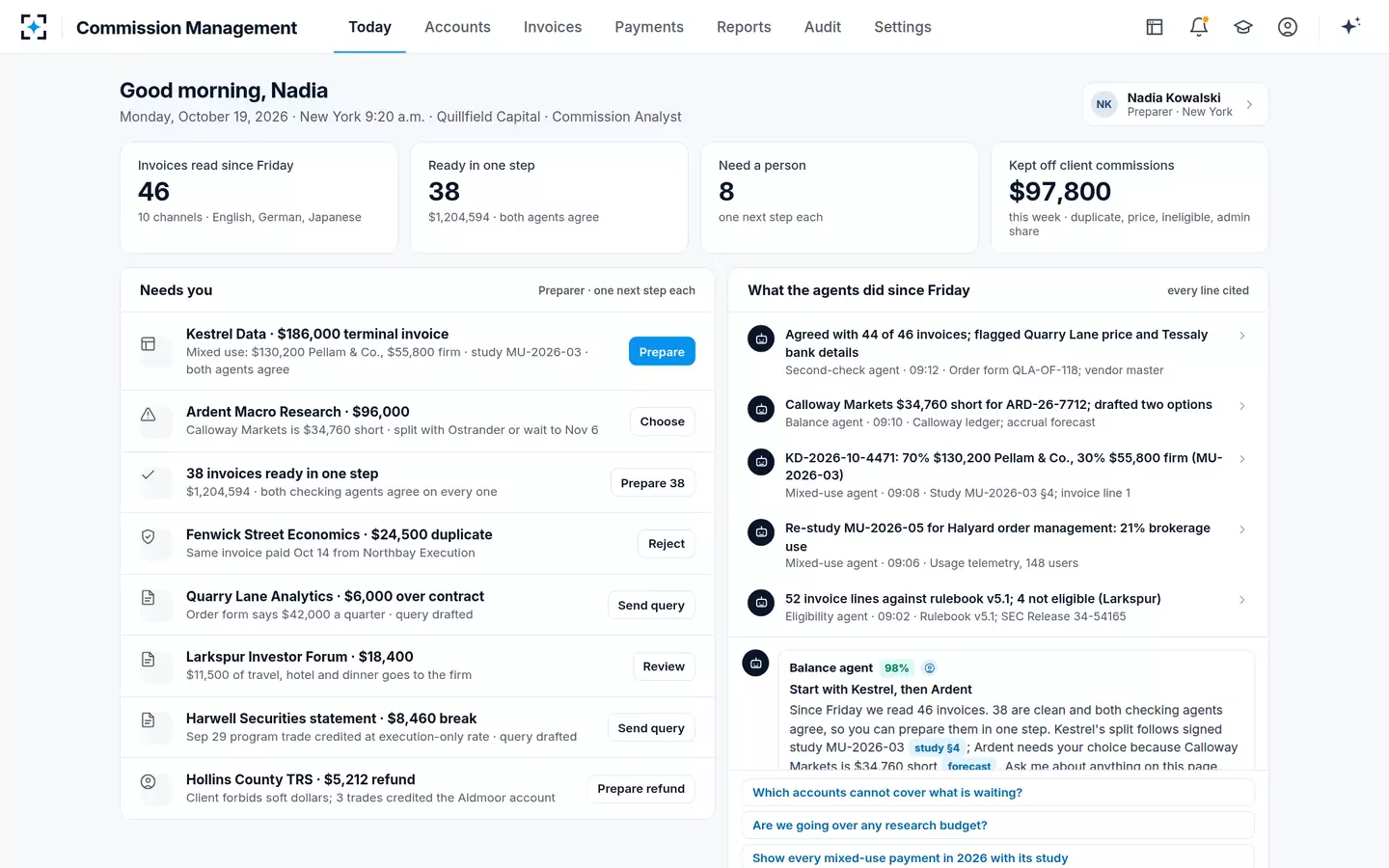
Ask how each connection works on day one. Broker statements arrive by portal, SFTP or email in each broker's own layout; invoices arrive as PDFs in several languages; agreements are contracts, not data. In the sample firm, the agents read 46 invoices from 10 channels in English, German and Japanese over one weekend, and read every agreement and contract during setup so that rates, seats and prices became checkable. Software that expects clean, structured feeds will push that reading back onto the analyst.
One sample manager's commission estate
12brokers
with commission sharing agreements and monthly statements
214
provider contracts and order forms every invoice is priced against
18,940
trades in September to tie to statements
3regimes
US Section 28(e), UK research payment account, EU research payment account
Does commission management software replace broker portals?
No. Brokers still hold the commission sharing pools, issue the statements and receive the payment requests, and their portals remain the channel for many of them. What the software replaces is the manager's re-keying: reading each statement into a spreadsheet, typing each payment request into each portal, and chasing confirmations by email.
The useful pattern is that the software drafts each payment request in the broker's own format, with payee details taken only from the verified vendor master, and a person releases the file. In the sample firm the Payment agent drafts CSA and research payment account requests and accounts-payable vouchers for the firm's share, matches the brokers' confirmations, and "never sends a payment": finance releases every file. That keeps the portal where it is and moves the judgement where it belongs.
Can one system handle CSAs and research payment accounts?
Yes, provided it keeps the regimes apart. A US commission sharing pool is funded by credits per trade and governed by Section 28(e); a UK research payment account is funded by a research charge set against a budget; an EU account may run on separate or joint payment. One screen for all of them is useful; one set of rules for all of them is a compliance error.
The FCA's research list shows why. It does not regard "post-trade analytics", "order and execution management systems" or "services relating to the valuation or performance measurement of portfolios" as research (COBS 2.3B.23G), although some of these can be eligible in the US. The system must know which account pays before it decides whether a line is eligible. In the sample firm the Balance agent routes research for UK funds only to the UK account and for Luxembourg funds only to the EU account, never to a US commission sharing account, and watches each budget against what was disclosed to clients.
Commission Management: the week's research money in one view
How does commission management software support Form ADV Item 12?
By keeping the records the brochure describes. Form ADV Part 2A Item 12.A.1 asks an adviser to describe "the types of products and services you or any of your related persons acquired with client brokerage commissions ... within your last fiscal year", in enough detail "to permit them to evaluate possible conflicts of interest", and to explain "the procedures you used during your last fiscal year to direct client transactions to a particular broker-dealer in return for soft dollar benefits" (Form ADV Part 2). Both are statements about last year's payments, which only a complete payment register can support.
Good software produces that register as a by-product and drafts the support from it. In the sample firm the Evidence agent drafts the Item 12 support, the UK and EU client disclosures and the monthly commission report "from decided records only", each number linked to its records; an analyst prepares and compliance signs. Soft dollar disclosure, clause by clause shows what each clause needs.
Questions to ask a commission management software vendor
Most vendor demonstrations show a clean invoice going through a clean process. The questions below test the cases that cause findings: the duplicate from a second channel, the expired study, the restricted client, the changed bank account, and the decision nobody can explain later.
Ten questions for a vendor, and what a good answer shows
| Question | Why it matters | A good answer shows |
|---|---|---|
| How do you build expected credits from our trades? | A statement that ties to itself proves nothing. | Trade-level credits from the OMS and the agreement version in force. |
| How do you read agreements, contracts and studies? | Rates, prices and splits live in documents, not feeds. | Each figure traced to the passage it came from. |
| How are duplicates found across channels? | The duplicate that costs money arrives by a second route. | File fingerprints and look-back across every channel and account. |
| What happens when a mixed-use study expires? | Paying on an expired study is the deficiency examiners cite. | Preparation blocked; a re-study drafted for compliance to sign. |
| How are client soft-dollar restrictions enforced? | Credits on a restricted account breach the client agreement. | Restricted accounts excluded from expected credits; refunds proposed. |
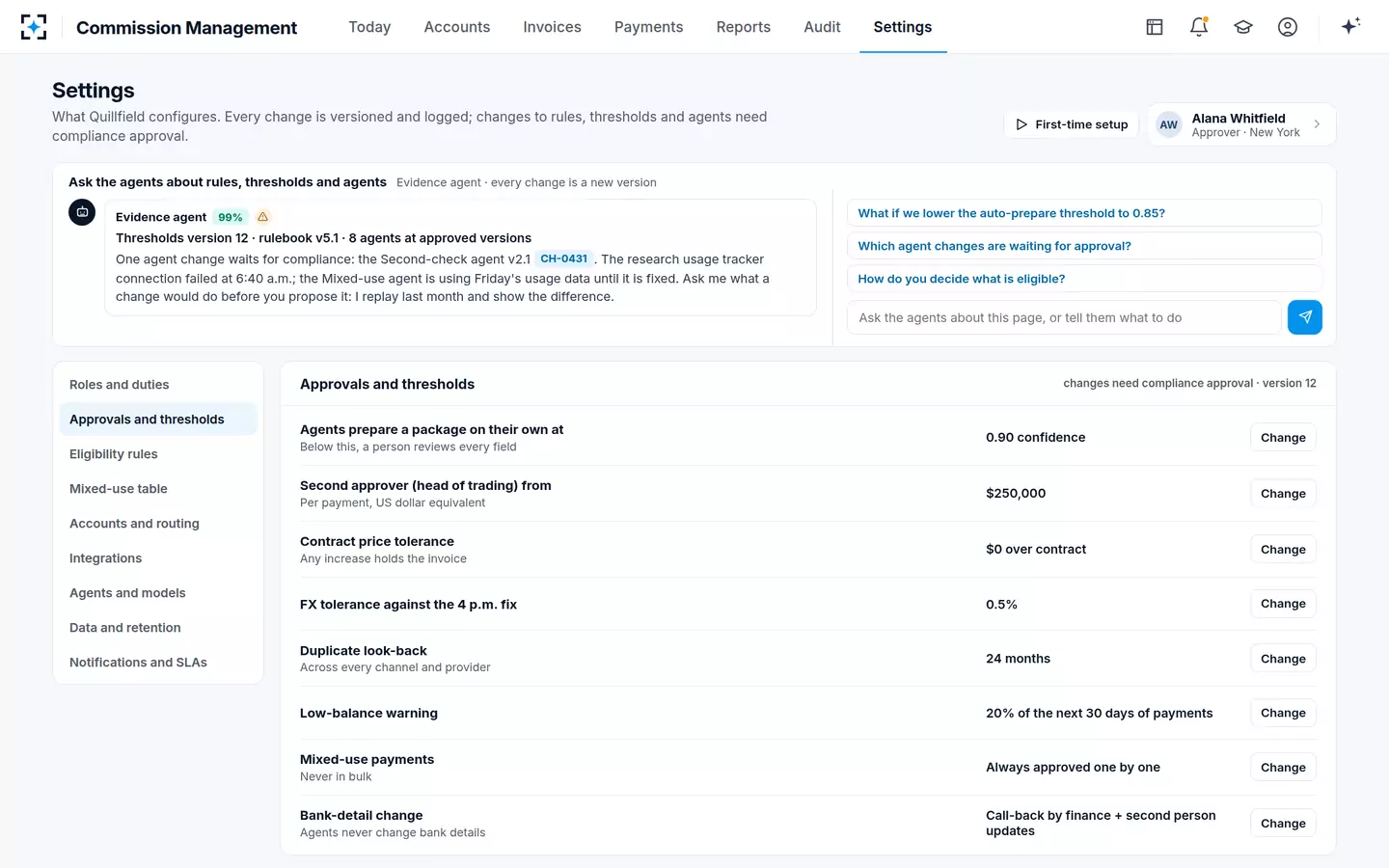
| Who can approve, and can anyone approve their own work? | The good-faith judgement must be shown to be someone's. | Self-approval blocked; thresholds and reason codes as versioned settings. |
| Where do payee bank details come from? | A changed account can send client money to the wrong party. | Only the verified vendor master; changes by call-back. |
| How are US, UK and EU accounts kept apart? | The same line can be eligible in one and not the other. | Account-level rules and routing that cannot cross regimes. |
| If AI is involved, what can the agents not do? | Autonomy without limits is the risk regulators name. | Written limits: no approvals, no payments, no percentages. |
| What does the examiner pack contain? | Evidence assembled by hand is slow and easy to leave incomplete. | One export: registers, studies, approvals, statements, trail. |
The AI question deserves a precise answer. FINRA's 2026 oversight report lists, among the risks of AI agents, that an agent working on sensitive data may keep, probe, disclose or misuse it without anyone intending it to, and that a badly designed reward function can push an agent to optimise for outcomes that hurt investors, firms or markets (FINRA 2026 Annual Regulatory Oversight Report). A vendor should be able to say what data each agent reads, what each may and may not do, and how a change to an agent is approved. In Commission Management the agents' instructions, models and confidence thresholds are versioned, and a change needs compliance approval.
How is commission management software priced?
Vendors in this market rarely publish prices, and no regulator or independent study publishes a benchmark for what managers pay. The useful approach is to size the work yourself and price against it. Count the brokers with commission sharing agreements, the research accounts by regime, the research invoices per year, the provider contracts, and the systems that must be connected; those drive both setup effort and running cost.
Then measure the current cost in time. The solution's own estimate for a large manager is about five business days a month for the statement tie-out and payment cycle by hand, with a design target of about one day: a day and a half tying statements to the order management system, a day each on invoices, eligibility and splits, and approvals, and half a day choosing accounts. Your own figures will differ; time a month before you buy. Add the time an exam response takes when the evidence is assembled by hand from inboxes and spreadsheets, and the cost of a single payment error, which in the sample week ranged from a $6,000 price overcharge to a $58,000 remittance to a changed bank account that was held.
Approvals and thresholds as settings the firm owns
What Commission Management does, and what it leaves to you
Commission Management fits a manager that pays for research through commission sharing agreements or research payment accounts, carries the Section 28(e) and Form ADV obligations, and wants the evidence made at the time of each payment rather than assembled for an exam. Its eight agents read every invoice in its own language, test each line under Section 28(e) and the firm's rulebook, apply only signed mixed-use studies, route each share to the right account, tie broker statements to the order management system, re-test price, duplicates and bank details on a separate model, draft payments in each broker's format, and keep the evidence. The analyst prepares, compliance approves with a reason code, finance releases, and the head of trading adds an approval at $250,000 or more.
It is not an order management or execution system, it does not measure transaction costs or run the broker vote, and it does not calculate sales commissions. It does not decide what is eligible: the firm's rulebook and studies do, and compliance owns them. And it does not move money: no agent sends a payment, moves funds between accounts or changes bank details. For records, everything is kept on a write-once trail; the sample firm keeps it seven years, beyond the five-year minimum in the Advisers Act books-and-records rule (17 CFR 275.204-2(e)(1)). An eight-week go-live plan shows what implementation involves, and CSA reconciliation shows the monthly tie-out in detail.
Questions people ask
What is the difference between commission management and research management software?
Commission management software follows the money: credits, invoices, accounts, approvals and disclosure. Research management software follows the content: notes, models, meetings and readership. They meet at the broker vote and the research budget, where usage evidence informs how much each provider should be paid; broker vote software covers the data that vote needs.
Do small advisers need commission management software?
Not always. An adviser with one or two brokers, no commission sharing agreements and few research invoices can meet its obligations with a disciplined spreadsheet and a written policy. The case for software grows with brokers, regimes, mixed-use products and clients that forbid soft dollars.
Can commission management software handle bundled soft dollars with no invoice?
It can record them, but there is less to check. Bundled research has no separate price, so the good-faith reasonableness judgement rests on the broker review. Form ADV still requires the adviser to disclose proprietary research received through bundled commissions.
How long does implementation take?
It depends on integrations more than on the software. Reading every agreement, contract and study, connecting the order management system and broker statements, and running one month in parallel is a realistic minimum; the eight-week plan sets it out week by week.
Is AI safe to use on client commission payments?
It can be, with limits a regulator would recognise: agents that prepare and recheck but never approve or pay, a second independent check, named people on every payment, and every step recorded. FINRA's 2026 report suggests firms consider human-in-the-loop oversight and how to track agent actions and decisions.
Can commission management software support EU joint payment from 2026?
It should. Since June 6, 2026 EU firms may pay for research jointly with execution under Article 24(9a) of MiFID II as amended, with a remuneration methodology agreed with each provider, client information on the choice and an annual assessment of the research, and they keep a record of total research costs where known. The software must hold those records alongside the US and UK ones.