A soft dollar management system is the system of record and control for paying research with client commissions: it holds the commission sharing agreements and research accounts, tests every research invoice for eligibility under Section 28(e), applies signed mixed-use studies, routes payments for approval, ties broker statements and keeps the evidence for Form ADV and examiners. Going live is mostly not a software task. It is reading every agreement and contract into checkable form, agreeing opening balances with every broker, putting a signed study behind every mixed-use product, and running one full month alongside the old spreadsheet. Done in that order, about eight weeks is realistic for a manager with a dozen brokers. Botminds' Commission Management is set up exactly that way: its agents read every agreement and contract during setup, the systems of record are connected, and go-live follows a dry run on last month's invoices compared with what was actually decided.
The plan below is our recommendation, illustrated with a fictional sample manager, Quillfield Capital, as it runs through the solution. Durations are planning estimates, not measured results.
Eight weeks from kickoff to the first examiner-ready month
- OMS, statements, AP intakewk 1–2
- Vendor master, historywk 3–4
- Support the parallel monthwk 5–8
- Read agreements, contractswk 1–2
- Rulebookwk 3
- Fix mappings the parallel run findswk 4–8
- Measure missing or expired studieswk 1–4
- Signwk 5
- Expiry and triggers watchedwk 6–8
- Build the comparison setwk 1–3
- Dry run on last month, then a live month side by sidewk 4–7
- Sign-offs collected as items finishwk 1–7
- Cutoverwk 8
What is a soft dollar management system?
A soft dollar management system replaces the commission spreadsheet, the broker portals used as records, and the email approvals with one system in which each research payment carries its rule, its split, its approvals and its evidence. It answers to three sets of rules: Section 28(e) and the SEC's 2006 guidance in the US, the FCA's COBS 2.3B in the UK, and MiFID II Article 24(9a) in the EU as amended for joint payment from June 6, 2026 (Directive (EU) 2024/2811).
The difference from a spreadsheet is not arithmetic; it is evidence made at the time. The SEC's 2006 guidance says the prudent way for a manager to meet its burden "is to document fully its client commission arrangements" (Release 34-54165, note 83). A spreadsheet documents outcomes; a system can document who decided, on which version of which rule, from which passage, and when. That is what a go-live has to prove before the spreadsheet goes.
How long does it take to implement a soft dollar management system?
About eight weeks for a manager with a dozen brokers and three regimes, if mixed-use studies start on day one and one full month runs in parallel. The software is rarely the constraint. The constraints are reading agreements accurately, agreeing balances with brokers, and measuring how products are actually used, which takes calendar time no tool can compress.
The sample manager's own studies show why. Its market data license study measured 62 users over almost four weeks, April 6 to May 1, 2026; its order management re-study used two months of function telemetry, August 1 to September 30. A firm that discovers in week six that three mixed-use products have no current study cannot go live on schedule without either paying on unsupported splits or holding those invoices, and the SEC's examiners have been reporting advisers that could not show why a mixed-use split was what it was for two decades (the study that answers them is set out in the mixed-use allocation guide). Faster plans exist; they usually leave this item for later.
What does week one look like?
Week one does four things in parallel: connect the order management system and the broker statements, collect every agreement and contract, start the missing mixed-use studies, and fix the approval matrix on paper. Each starts a longer thread, and none waits for the others.
In Commission Management, the first connections are the order management system for trades and commissions, the broker statements by portal, SFTP or email, and the accounts-payable mailbox and vendor portals for invoices. The agents then read every commission sharing agreement, provider contract and order form, so that a rate, a price or a seat count becomes a checkable figure with its source passage. The compliance officer for soft dollars lists every product that needs a study and starts measurement for any that lack one. And the policy owner writes down who prepares, approves and releases, at what thresholds, before anyone configures it; the approval matrix in a soft dollar policy is the input.
What data must be migrated to a soft dollar system?
Migrate whatever a check depends on: agreements and rates, opening balances, contracts, studies, client restrictions, the vendor master, and enough payment history to catch duplicates. History matters more than most plans allow, because a duplicate check is only as long as its memory; the sample firm looks back 24 months across every channel and provider.
The data a soft dollar system needs on day one, and why
- Every commission sharing agreement and its rate schedule
Expected credits per trade, restricted accounts and cut-offs come from here.
- Opening balance per broker, agreed with the broker's statement
The first reconciliation is only as good as the balance it starts from.
- Provider contracts and order forms
Every invoice is priced against them; the sample firm holds 214.
- The eligibility rulebook
The firm's mapping of providers and products to Section 28(e) and to UK and EU research rules.
- Signed mixed-use studies, with populations and expiry dates
No mixed-use payment without one in force on the invoice date.
- Client soft-dollar restrictions
Accounts excluded from credit accrual, from the investment management agreements.
- Vendor master with verified bank details
The only source of payee details; verified before the first payment, not after.
- Payment and invoice history, 24 months
So the duplicate check can see an invoice already paid through another channel or broker.
- The broker vote and routing rules
Which pool pays which provider; the basis for short-account options.
- UK and EU research budgets and client disclosures
Spend is watched against what clients were told; a raise needs disclosure first.
Two items deserve their own owner. Opening balances should be agreed in writing with each broker, because a disputed balance in month one becomes a permanent reconciling item. And the vendor master should be verified before migration, not imported as is: a bank account changed by email last year and never called back becomes a trusted record the day it is loaded.
What should run in parallel during go-live?
Run a dry run on last month's invoices first, then one full live month in which the old process still pays and the new one prepares everything, and compare every decision. The dry run replays a month already decided: each invoice, eligibility call, split, account and approval that the old process produced is compared with what the system proposes, and every difference is explained before the live month starts.
Differences are the point. Some will be the system's errors, a misread rate or a mapping the rulebook missed, and are fixed. Others will be the old process's errors: a credit that was never booked, a study that had lapsed, an item that was paid in full but should have been split. Those are findings for compliance, not for the project, and they may need client refunds or a correction to Form ADV. The sample firm's own tie-out of one month found a broker that had credited nothing on a 423,000-share program trade, $8,460, and credits of $5,212 on a client that forbids soft dollars; a parallel run should expect breaks of that kind.
Commission Management: one research invoice with its tests, split and history
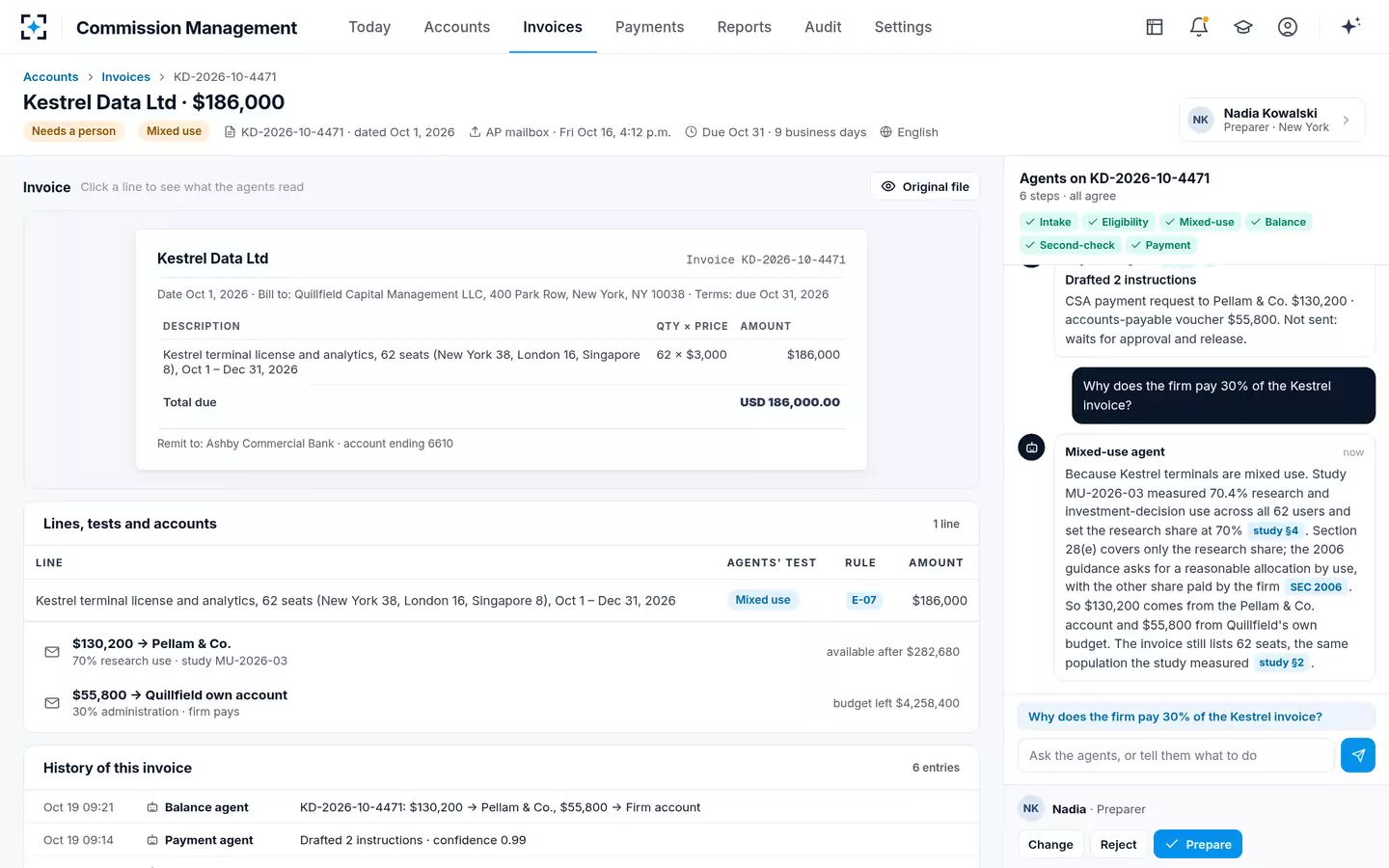
The parallel month is also when thresholds are tuned with evidence. In the sample firm, the compliance officer asked what lowering the auto-prepare threshold from 0.90 to 0.85 would do; the agents replayed September's 212 invoices and found nine more would have been prepared without a person checking a field, two of them with fields the analyst had corrected. The threshold stayed at 0.90. Questions like that are best answered before go-live, on real invoices, rather than argued from a vendor's demonstration.
What sign-offs are needed before go-live?
Every rule the system applies on the firm's behalf needs an owner's signature before it applies them to real money. The table lists the sign-offs and who should give them.
Sign-offs before cutover, and who gives each
| Sign-off | Who signs | Evidence |
|---|---|---|
| Eligibility rulebook, version 1 | Chief Compliance Officer | Rulebook mapped to Section 28(e)(3), the 2006 guidance and COBS 2.3B |
| Approval matrix and thresholds | Chief Compliance Officer | Versioned settings; replay of last month at the chosen thresholds |
| Every mixed-use study in force | Senior compliance officer, soft dollars | Signed studies with populations and expiry dates |
| Opening balances | Commission analyst and each broker | Broker statements agreed to the opening position |
| Vendor master and payment file formats | Finance controller | Verified bank details; test files accepted by each broker |
| Broker vote and routing rules | Global Head of Trading | Routing by pool and regime |
| Parallel month results | Compliance and internal audit | Every difference explained; findings logged |
| Audit trail and examiner pack | Internal audit | A full export reviewed for completeness |
| AI agents: limits, models, thresholds | Chief Compliance Officer | Written limits; versioned instructions; records of each agent step |
The last row is new for most firms and regulators already expect it. ESMA expects firms using AI in investment services to keep full records of that use: how decisions were reached, which data and algorithms were used, and what changed along the way (ESMA public statement on AI and investment services, May 30, 2024). In Commission Management the agents' instructions, models and confidence thresholds are versioned, a change needs compliance approval, and each agent step is logged with its evidence.
When can the soft dollar spreadsheet be retired?
Retire the spreadsheet when one full live month has tied to every broker statement with no unexplained difference, opening balances are agreed, duplicate history is loaded, and internal audit has exported and reviewed a complete examiner pack. Until then it is the fallback. After that it becomes an archive, kept read-only for at least as long as the books-and-records rule requires, which for most records is five years after the fiscal year of the last entry, with the first two years' records kept in an appropriate office (17 CFR 275.204-2(e)(1)).
Commission Management's write-once trail, replacing the spreadsheet's history
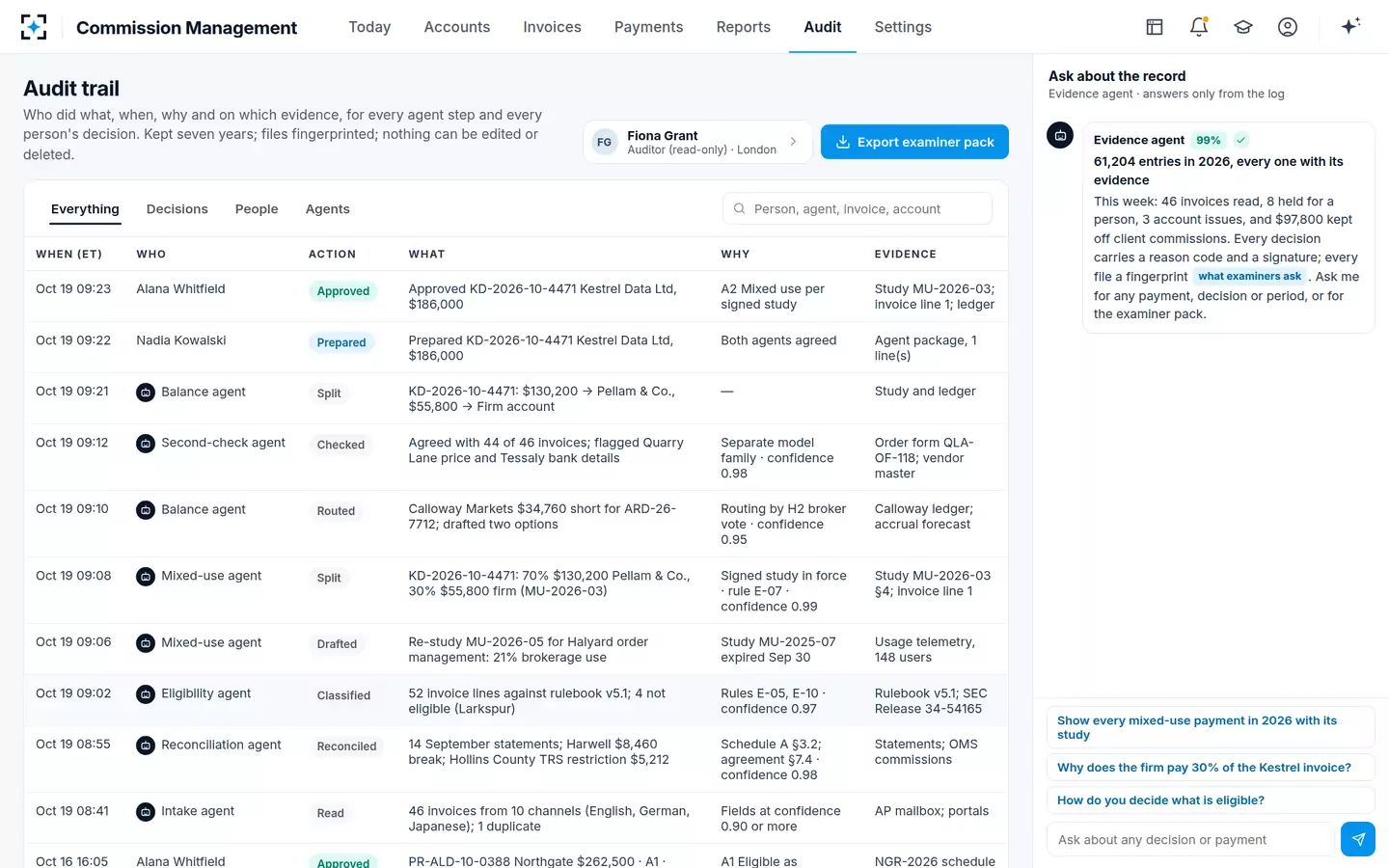
The examiner pack is the right finish line because it is the question the old process answered worst. Asked for every mixed-use payment in 2026, the sample firm's Evidence agent assembles 186 payments, $4,812,600, with their studies, both approvals and the broker confirmations. A go-live that can produce that answer for its first live month has proven the evidence trail works; a planted-error test then proves the controls do.
What does a soft dollar management system cost to run?
Vendors rarely publish prices and no regulator or independent study publishes a benchmark, so measure your own baseline first. Time one month of the current process from statement arrival to the last payment released, by task. The solution's estimate for a large manager is about five business days by hand, with a design target of about one day.
Where the monthly cycle's five days go by hand
By hand, about 5 business days
- Tie statements · 30%
- Invoices · 20%
- Checks · 20%
- Account · 10%
- Approvals · 20%
Running costs after go-live come from change, not volume. New commission sharing agreements, new providers, studies that expire, the annual policy review and rule changes such as the EU's move to joint payment each need someone to update the rulebook or the studies and compliance to approve a new version. Budget for that work by name; a system nobody maintains drifts back into a spreadsheet beside it.
One sample week in Commission Management
46invoices
read since Friday from 10 channels, in English, German and Japanese
38
ready to prepare in one step, $1,204,594, both checking agents agreeing
8
needing a person, each with one next step
$97,800
kept off client commissions in the week
Questions people ask
Can a soft dollar system go live in less than eight weeks?
Yes, for a manager with few brokers, no research payment accounts and current mixed-use studies. The parts that cannot shrink are measuring product use where a study is missing and running one month in parallel; cutting either moves the risk into the first live month.
Should historical payments be re-checked during migration?
Load at least 24 months of history so duplicates can be caught, and re-check a sample. Re-checking everything is rarely necessary, but anything the parallel month finds, such as a lapsed study or a missed credit, should be traced back as far as it goes.
Who should own a soft dollar system implementation?
A sponsor in trading or operations, with compliance owning the rulebook, studies and thresholds, finance owning payments and the vendor master, and internal audit signing off the audit trail. The chief compliance officer should approve the configuration because it enforces the firm's policy.
Do brokers need to change anything when a manager goes live?
Usually little. Brokers keep their statements and portals; the manager may ask for statements in a consistent format by a set business day and for payment requests in the broker's own format. Opening balances must be agreed with each broker before cutover.
What changes for UK and EU accounts at go-live?
Their budgets and client disclosures are loaded so spend can be watched against them. Under the EU delegated directive a research budget may only be increased after clear information to clients, so a forecast overspend becomes a decision for the head of trading and compliance, not a surprise at year-end.