Soft dollars are the research and brokerage services a money manager receives in return for directing clients' trades, and the commissions that pay for them: the client's money buys something the manager would otherwise buy with its own "hard" dollars. In the United States this is lawful because of Section 28(e) of the Securities Exchange Act of 1934, a safe harbor that protects a manager who pays more than the lowest available commission, but only for eligible research and brokerage, only when the service actually helps investment decisions, and only when the manager judged in good faith that the commission was reasonable for what it bought. Botminds' Commission Management applies those tests to every research invoice before client money moves, with the rule and the invoice line cited, because the burden of proving them rests on the manager, not on the examiner.
The examples come from a fictional sample manager, Quillfield Capital, as it runs through the solution. Everything else on this page is the statute, the Securities and Exchange Commission's own guidance and the Department of Labor's, linked where they appear.
The safe harbor in four numbers
1975
the year fixed commissions ended and Congress wrote Section 28(e)
3tests
every soft-dollar purchase must pass, in the SEC's 2006 framework
28%
of managers examined in 1998 had at least one arrangement outside the safe harbor
35%
of broker-dealers examined in 1998 did the same
What are soft dollars?
Soft dollars are the part of a commission that pays for something other than executing the trade. When a manager pays a broker 3 cents a share and execution alone would cost 1 cent, the other 2 cents buy research, data or brokerage services. The manager receives them without writing a cheque, which is why the practice is called "soft": the payment is embedded in the client's commission rather than in the manager's own budget.
The SEC states the problem plainly. "Use of client commissions to pay for research and brokerage services presents money managers with significant conflicts of interest," the Commission wrote in its 2006 guidance, because it "may give incentives for managers to disregard their best execution obligations" and to trade "inappropriately in order to earn credits" (Release 34-54165, page 3). In that release the SEC switched to the term "client commission arrangements", "to avoid confusion that may arise over the usage of the phrase 'soft dollars'" (page 4). Practitioners and Form ADV still use both.
Hard dollars are the opposite: the manager's own money, paid through its own accounts payable. Every soft-dollar question ends in the same choice. If an item is eligible and used for investment decisions, client commissions may pay for it. If it is not, the manager pays in hard dollars, and if it is partly both, the manager pays its share.
What is the Section 28(e) safe harbor?
The Section 28(e) safe harbor says a manager has not breached its fiduciary duty "solely by reason of" causing an account to pay a commission above what another broker would have charged, if the manager "determined in good faith that such amount of commission was reasonable in relation to the value of the brokerage and research services provided" (15 U.S.C. 78bb(e)(1)). The reasonableness can be judged on that transaction or on the manager's "overall responsibilities" to the accounts it manages, which is what allows research bought with one client's commissions to serve others.
It is a safe harbor, not a permission. It removes one specific liability, paying up, for one specific purchase, brokerage and research services. It covers anyone exercising investment discretion: the SEC lists "investment advisers, mutual fund portfolio managers, fiduciaries of bank trust funds, and money managers of pension plans and hedge funds" (Release 34-54165, note 25). It does not cover every commission: the SEC has said managers may not use it for "fixed income trades that are not executed on an agency basis, principal trades (except for certain riskless principal trades), or other instruments traded net with no explicit commissions" (note 27).
One commission dollar through the Section 28(e) tests
Agent
1. Is it eligible?Research under 28(e)(3)(A) or (B) — advice, analyses or reports on securities, issuers, industries, economics or portfolio strategy — or brokerage under (C), from order to settlement.
Never: Hardware, rent, salaries, travel, meals, marketing.
A person decides
2. Does it actually help decisions?The "lawful and appropriate assistance" test looks at how the manager uses the item, not what it is.
Never: Performance reports used for marketing.
A person decides
3. Mixed use? AllocateA reasonable allocation by use, kept in books and records; only the decision-making share may be paid with client commissions.
A person decides
4. Good-faith reasonablenessThe manager decides the commission is reasonable for the value received, and must be able to show it: the burden of proof is the manager's.
Agent
5. DisclosedForm ADV Part 2A Item 12 describes the practice and its conflicts; Part 1A Item 8.G answers whether everything received is eligible.
Why it exists: the end of fixed commissions on May 1, 1975
Section 28(e) exists because commissions stopped being fixed. The SEC's Rule 19b-3 ended fixed commission rates on national securities exchanges "effective May 1, 1975", and a month later Congress unfixed them by statute in the Securities Acts Amendments of 1975 (Release 34-54165, pages 8 to 9). Under fixed rates, brokers could not compete on price, so they competed on research and services. Managers feared that once rates were negotiable, paying anything above the cheapest execution would be called a breach of duty.
Congress answered with a narrow shield. It also drew a line that still shapes every arrangement: the broker that is paid must be the broker that provides the service. Congress called the pre-1975 practice of "give-ups", in which part of a commission was redirected to a broker that did nothing on the trade, "a regrettable chapter in the history of the securities industry" (quoted at page 53, note 164). The SEC's modern view that commission sharing arrangements are "not the same as give-ups" rests on that history, and how a commission sharing agreement differs from soft dollars follows it into today's plumbing.
Fifty years of guidance on one sentence of statute
| Year | What the SEC said | What it means today |
|---|---|---|
| 1975 | Rule 19b-3 ends fixed exchange commissions on May 1; Congress adds Section 28(e). | Paying up for research is protected only within the statute's terms. |
| 1976 | Items "readily and customarily available ... to the general public" are excluded. | Withdrawn in 1986; the mass-marketed test survives in narrower form. |
| 1986 | Introduces the "lawful and appropriate assistance" standard and "mixed use". | Both still apply; the 2006 release reaffirms them. |
| 2001 | Extends "commission" to certain riskless principal trades with disclosed fees. | Principal and net-priced trades otherwise stay outside. |
| 2006 | Release 34-54165: research must reflect "reasoning or knowledge"; brokerage runs from order to settlement; hardware is out. | The working rulebook for eligibility, mixed use and commission sharing. |
What counts as research under Section 28(e)?
Research counts when it is advice, analysis or a report that reflects "the expression of reasoning or knowledge" about the subjects the statute names: the value of securities, issuers, industries, economic factors and trends, portfolio strategy and the performance of accounts (Release 34-54165, pages 27 to 28). The form does not matter. A written report, a call with an analyst and a meeting with a company's executives all qualify, because each delivers reasoning or knowledge about an issuer.
The 2006 release then drew four lines that settle most real cases. Market data such as "stock quotes, last sale prices, and trading volumes" qualifies as a report concerning securities, and so do company financial data and economic data (pages 35 to 36). Mass-marketed publications do not, while specialised newsletters and trade journals aimed at a narrow audience can (pages 30 to 31). Anything physical does not: the SEC said it does "not believe that any computer terminals are eligible 'research'" (note 101), even though the data delivered through a terminal can be. And consultants count only when they advise on portfolio strategy, "not eligible if the advice relates to the managers' internal management or operations" (page 29).
Third-party research is treated exactly like a broker's own. The safe harbor "encompasses third-party research and proprietary research on equal terms" (page 50), provided the broker that is paid is the one that provides it. That condition is the reason commission sharing arrangements exist; examples of soft dollars, sorted item by item applies the lines to two dozen common invoices.
Research and brokerage: the two halves of Section 28(e)
Research — 28(e)(3)(A) and (B): Advice, analyses or reports reflecting "reasoning or knowledge" on the statute's subjects.
Brokerage — 28(e)(3)(C): Effecting the trade and functions incidental to it, such as clearance, settlement and short-term custody.
Research — 28(e)(3)(A) and (B): Any time, including before an order exists.
Brokerage — 28(e)(3)(C): From the moment the manager transmits an order until funds or securities are delivered or credited.
Research — 28(e)(3)(A) and (B): Analyst reports and calls, market and economic data, pre- and post-trade analytics.
Brokerage — 28(e)(3)(C): Order routing and algorithmic trading software, connectivity to the broker, post-trade matching and allocation messages.
Research — 28(e)(3)(A) and (B): Mass-marketed publications, hardware, consultants on the manager's own operations.
Brokerage — 28(e)(3)(C): Terminals and hardware, long-term custody, stock lending, margin, error-correction trades.
What is "lawful and appropriate assistance"?
Lawful and appropriate assistance is the test of use: an eligible item is protected only if it actually helps the manager make investment decisions. The phrase comes from the 1975 Senate report, which called it "the touchstone" for eligibility, and the SEC adopted it in 1986 and reaffirmed it in 2006 for both research and brokerage (Release 34-54165, pages 24 to 26 and note 82). It "focuses on how the manager uses the eligible research" (page 44).
The SEC's own example makes the point. Analyses of account performance are research on their face, since the statute names "the performance of accounts". Used to market the manager's funds, the same analyses are "not within the safe harbor because they are not providing lawful and appropriate assistance" (page 45). The item did not change; the use did.
This is why eligibility cannot be judged from a vendor's product sheet alone. The SEC put it directly: one manager may buy an eligible research item with client commissions "if he or she properly uses the information in formulating an investment decision, but another money manager cannot rely on Section 28(e) to acquire the very same item if the manager does not use the item for investment decisions" (page 48). A list of approved products is a starting point; the evidence of use is the proof.
Brokerage: what the safe harbor covers from order to settlement
Brokerage under Section 28(e) is everything from the moment the manager sends an order to a broker until the trade settles. The SEC called this a "temporal standard": brokerage "begins when the money manager communicates with the broker-dealer for the purpose of transmitting an order for execution and ends when funds or securities are delivered or credited to the advised account" (Release 34-54165, pages 40 to 41).
Inside that window are order-routing and algorithmic trading software, direct market access, dedicated lines to the broker's desk, post-trade matching, allocation messages and short-term custody tied to settlement. Outside it are the hardware those tools run on, long-term custody, stock lending, margin and capital introduction. So are compliance uses, including "an analysis of the quality of brokerage executions (for the purpose of evaluating the manager's fulfillment of its duty of best execution)" (page 42). A manager's own best-execution monitoring is the manager's cost.
Two items surprise people. Error-correction trades are not eligible brokerage, because they are "separate transactions to correct the manager's error, not to benefit the advised account" (page 43). And an order management system is usually mixed use: routing and algorithmic functions may be eligible brokerage, while its portfolio, compliance and accounting functions are not, which is why the mixed-use study behind every split matters as much as the eligibility call.
Does the safe harbor change the duty of best execution?
No. "Congressional enactment of Section 28(e) did not alter the money manager's duty to seek best execution," the SEC wrote, citing its 1986 release (Release 34-54165, note 6). A manager may pay more than the lowest commission for research it values, but it still has to choose brokers for the quality of execution as a whole, and the 1986 standard repeated in the same release puts the best qualitative result for the account, not the cheapest commission, at the centre (note 149; the difference is worked through on a single trade in best execution vs best price).
"The burden of proof in demonstrating this determination rests on the money manager."
SEC Release 34-54165, 2006, page 48
In practice the two duties meet in the broker review. Research value is one factor in choosing where to trade; execution capability, commission rate, financial responsibility and responsiveness are others. A manager that routes orders to earn research credits it could not otherwise justify has a best-execution problem that Section 28(e) does not touch. The SEC's own enforcement history shows the shape of it: in Sage Advisory Services (2001), the Commission charged that an adviser "churned advised account to generate client commission credits to pay personal operating expenses" and paid "commissions twice the rate the same broker charged other customers" (note 4).
Do soft dollars need to be disclosed?
Yes. The statute itself requires a person exercising investment discretion to "make such disclosure of his policies and practices with respect to commissions" as the regulator prescribes (15 U.S.C. 78bb(e)(2)). For SEC-registered advisers that means Form ADV. Part 2A, Item 12.A.1 requires an adviser that receives research or other services in connection with client trades to "disclose your practices and discuss the conflicts of interest they create", including that it receives a benefit "because you do not have to produce or pay for the research" (Form ADV Part 2).
Part 1A of the same form asks two yes-or-no questions in Item 8.G: whether the adviser or a related person receives "soft dollar benefits", and if so, whether all of them are eligible "research or brokerage services" under Section 28(e) (Form ADV Part 1A). A "no" to the second question is allowed, but it is a public statement that some client commissions buy things outside the safe harbor, and Item 12 then demands a more detailed description of those items.
Disclosure does not make an ineligible purchase safe. For a registered fund, the SEC has said that if an arrangement "is not consistent with Section 28(e), disclosure of the arrangement would not cure any Section 17(e)(1) violation" under the Investment Company Act (Release 34-54165, note 31). Soft dollar disclosure, clause by clause works through what each line of Item 12 must say.
Who cannot step outside the safe harbor: funds and ERISA plans
Most advisers may choose to operate outside Section 28(e) if they disclose it fully; advisers to registered funds and ERISA plans may not. "Advisers to mutual funds and ERISA plans must operate within the safe harbor with respect to those clients because of Section 17(e) of the Investment Company Act or ERISA," the SEC wrote (Release 34-54165, note 188). An adviser that tells clients it operates within the safe harbor and then does not makes a false statement, which the same note says may violate Section 206 of the Advisers Act and Rule 10b-5.
Who may use client commissions outside Section 28(e)
| Client | Outside the safe harbor? | Why |
|---|---|---|
| Registered fund (mutual fund, ETF) | No | Investment Company Act §17(e)(1); disclosure does not cure a violation (2006 release, notes 31 and 188). |
| ERISA plan | No | Using plan commissions for the manager's own benefit is a prohibited transaction under ERISA §406 (DOL Technical Release 86-1, 1986). |
| Separate account, private fund | Only with full disclosure | Fiduciary duty under the Advisers Act; Form ADV must describe non-28(e) items in more detail. |
| Any client told "we stay within 28(e)" | No | The representation itself binds the adviser (2006 release, note 188). |
The Department of Labor adds a duty for the plan's own fiduciaries. Section 28(e), it said in 1986, "does not relieve anyone other than the person who exercises investment discretion" from ERISA's fiduciary provisions, so the fiduciary that appoints a manager keeps an "ongoing duty to monitor" whether the manager secured best execution and paid commissions reasonable for the services received (ERISA Technical Release 86-1). A pension plan's investment committee is entitled to ask a manager how its commissions were spent.
How Commission Management applies the Section 28(e) tests to each invoice
Commission Management turns the three tests into checks that run on every invoice line, and keeps the judgement with people. The Eligibility agent tests each line against Section 28(e)(3), the 2006 guidance and the firm's own eligibility rulebook, cites the rule and the line, and sends anything under 0.90 confidence to a person. The Mixed-use agent applies only a signed, in-force study. A commission analyst prepares the payment, a compliance officer approves it with a reason code, and finance releases it.
Commission Management: one research invoice tested line by line
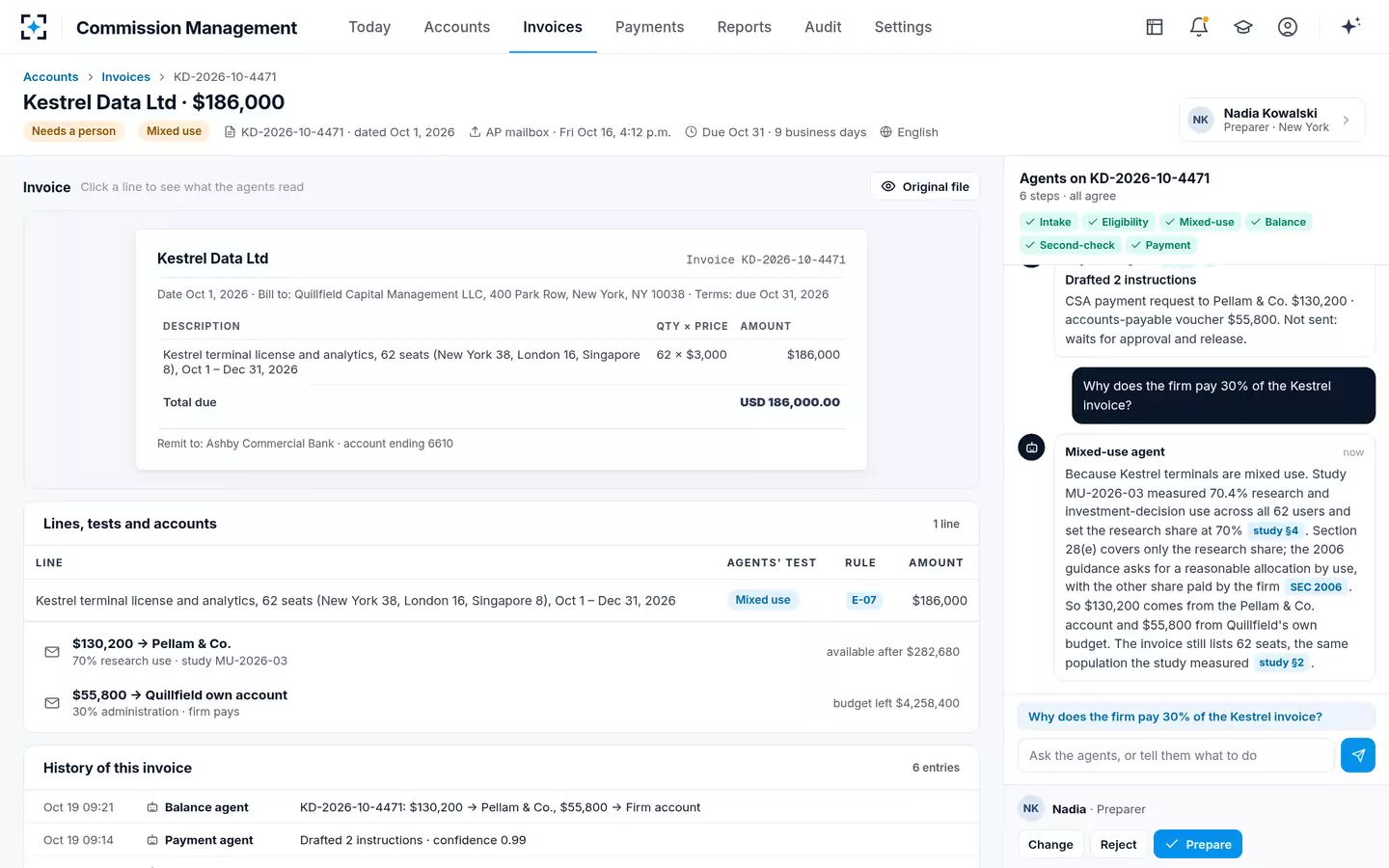
Take the sample manager's Monday. Over the weekend the Eligibility agent tested 52 invoice lines against version 5.1 of Quillfield's rulebook and found four not eligible, all on one conference invoice: the registration for research sessions stays on client commissions, while $11,500 of travel, hotel and dinner goes to the firm, exactly the line the 2006 release draws for seminars and the travel around them. The terminal data and analytics license from Kestrel Data is eligible research but mixed use, so the signed study decides the split, and a compliance officer approves it with reason code A2, "Mixed use per signed study".
Approval with a reason code: the good-faith judgement on the record
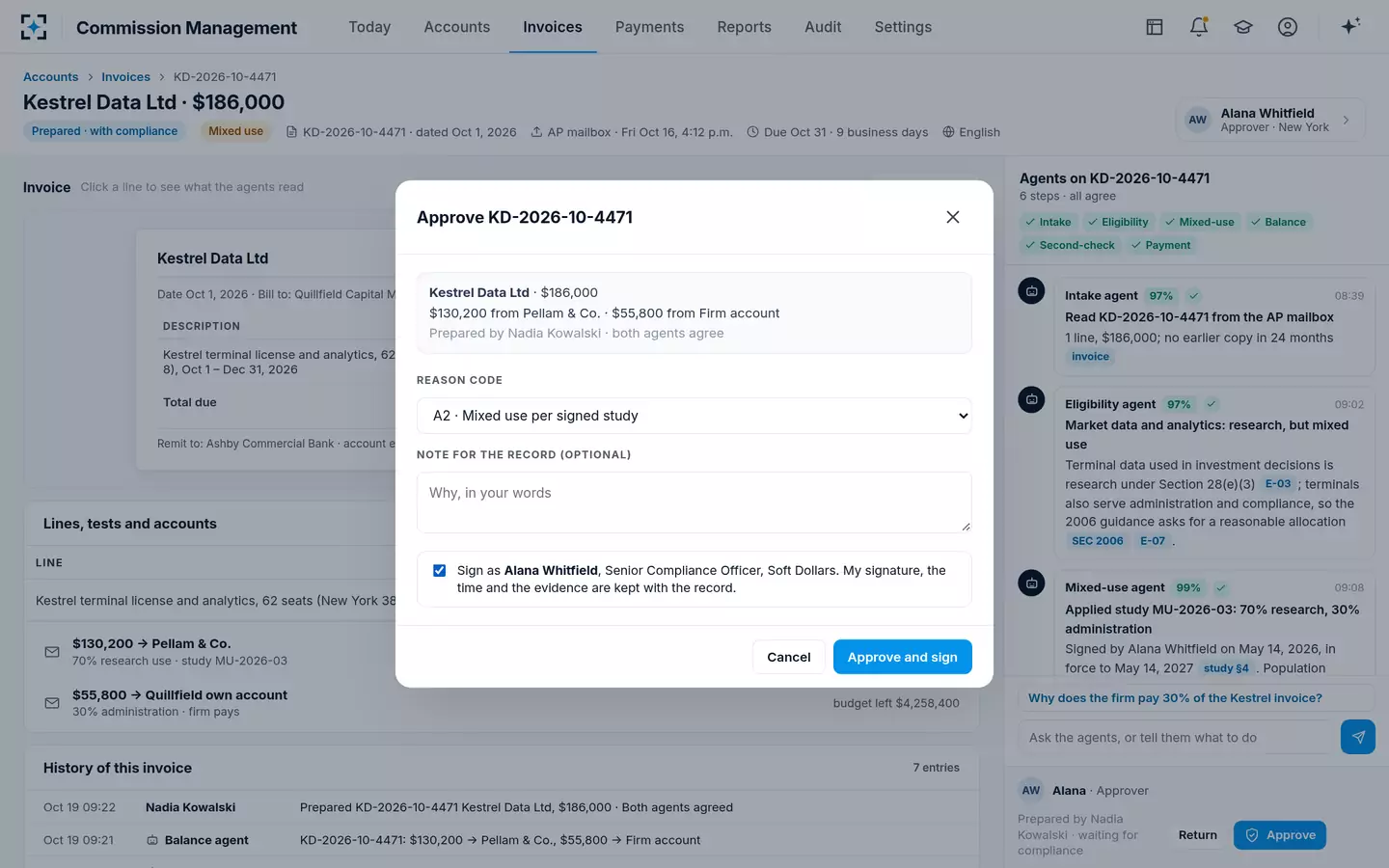
None of that replaces the manager's judgement; it records it. The statute protects a determination made "in good faith", and the SEC says "the prudent way for a money manager to meet its burden of showing eligibility for the safe harbor is to document fully its client commission arrangements" (Release 34-54165, note 83). An invoice that arrives with its rule, its study, its preparer and its approver already attached is documentation made at the time, not reconstructed for an examiner.
Questions people ask
Are soft dollars legal in the US?
Yes, within limits. Section 28(e) of the Securities Exchange Act protects a manager who pays more than the lowest commission for eligible brokerage and research, if it judged in good faith that the commission was reasonable for the value received. Paying for anything outside those limits with client commissions is not protected, and for registered funds and ERISA plans it may also violate the Investment Company Act or ERISA.
What is the difference between soft dollars and hard dollars?
Soft dollars are paid out of clients' trading commissions; hard dollars are the manager's own money, paid through its own accounts. Under the SEC's 2006 guidance, an item that is ineligible or used for non-investment purposes must be paid in hard dollars, and a mixed-use item is split between the two by a reasonable allocation.
Do soft dollars apply to bond trades?
Only when there is an explicit commission. The SEC has said the safe harbor does not cover fixed income trades that are not executed on an agency basis, principal trades other than certain riskless principal trades, or instruments traded net with no explicit commission. A bond bought from a dealer at a net price cannot pay for research under Section 28(e).
Can soft dollars pay for research that only benefits other clients?
Yes, within reason. The statute lets the manager judge reasonableness on "his overall responsibilities with respect to the accounts as to which he exercises investment discretion", not only on the trade that paid. Form ADV Item 12.A.1.d then requires the adviser to disclose whether it uses soft-dollar benefits to service all clients or only those whose commissions paid.
Is a market data terminal a soft-dollar item?
The data and analytics can be; the terminal hardware never is. The SEC's 2006 release says no computer terminal is eligible research, while market data and analytics delivered through it can be. Because such services are also used for administration, compliance and marketing, they are usually allocated as mixed use.
Who decides whether a commission is reasonable?
The manager does, in good faith, and it carries the burden of proving it. The SEC adds that where a broker also sells its research for an unbundled price, "that price should inform the money manager as to its market value". A written soft dollar policy should name who makes the call.