Best execution and best price are not the same thing. Best price is one number on one fill; best execution is the most favourable overall result for the client, weighing price with commissions and fees, market impact, speed, the likelihood the order is completed, its size and its nature. The SEC put it plainly in 2019: "Maximizing value encompasses more than just minimizing cost" (SEC Release IA-5248). For a fund, the difference matters because the visible cost of trading, the commission, varies little from trade to trade, while the cost that moves with each decision is the implicit cost of how the order was worked. Botminds' Best Execution Review measures each broker on total cost against what was expected, so a committee sees which choices cost the fund money, not just which brokers charged the least.
The comparison below takes one order and two ways of executing it. The arithmetic is illustrative, but the pattern is the one a cost analysis shows every quarter.
One $50 million order, two brokers: the cheaper commission is the more expensive trade
Broker A: lowest commission: 2 bp: $10,000
Broker B: lower total cost: 4 bp: $20,000
Broker A: lowest commission: 18 bp: $90,000, worked fast into a thin book
Broker B: lower total cost: 9 bp: $45,000, paced to the volume, with a block found
Broker A: lowest commission: 20 bp: $100,000
Broker B: lower total cost: 13 bp: $65,000
Broker A: lowest commission: Best broker on the list
Broker B: lower total cost: Twice as expensive
Broker A: lowest commission: $35,000 more expensive for the client
Broker B: lower total cost: Best qualitative execution
Is best execution the same as best price?
No. Every rulebook that defines best execution names price as one factor among several. MiFID II requires firms to take "all sufficient steps to obtain ... the best possible result for their clients taking into account price, costs, speed, likelihood of execution and settlement, size, nature or any other consideration relevant to the execution of the order" (MiFID II, Article 27(1)). The SEC's version for advisers is the client's "total cost or proceeds", which by definition includes more than the price on the ticket.
For a small retail order in a liquid stock, price and its direct costs may be almost everything, and MiFID II says so for retail clients, where the best result "shall be determined in terms of the total consideration, representing the price of the financial instrument and the costs relating to execution". For an institutional order large enough to move the market, the quoted price at arrival is a starting point, and the question is how much worse the average fill was, and why.
Maximizing value encompasses more than just minimizing cost.
SEC, Commission Interpretation Regarding Standard of Conduct for Investment Advisers, 2019
What else counts besides price in best execution?
For a US adviser, the SEC's list is "the full range and quality of a broker's services in placing brokerage including, among other things, the value of research provided as well as execution capability, commission rate, financial responsibility, and responsiveness". For a European firm, the list is costs, speed, likelihood of execution and settlement, size and nature. Both lists include things that are hard to price: a broker's ability to find natural liquidity in a small-cap, its balance sheet when a trade needs capital, its responsiveness when something breaks.
The practical way to weigh them is to measure what can be measured, cost against a benchmark and against the cost a model expected for that order, and score the rest explicitly. A trader survey of each broker's execution capability and responsiveness, kept quarter by quarter, is evidence of the qualitative factors the SEC staff found advisers skipping. Price alone is neither.
Likelihood of execution is the factor a price-only view forgets. An order that waits for a better price and never completes has a cost too: the move the portfolio manager wanted to capture and missed. Measuring the real portfolio against the paper portfolio the manager intended is the idea Perold named the implementation shortfall in 1988 (Journal of Portfolio Management), and it is why a review that rewards the cheapest fills can quietly reward the orders that did not finish. A committee should see unexecuted quantity beside cost.
Can paying a higher commission be best execution?
Yes, and the law says so twice. The SEC's long-standing view, which its 2019 interpretation repeats from 1986, is that the "determinative factor" is not the lowest possible commission cost "but whether the transaction represents the best qualitative execution". A broker that charges more and delivers a lower total cost, as in the comparison above, is the better choice.
Section 28(e) of the Exchange Act adds a second route for research. A manager that pays a broker more commission than another would have charged does not breach its fiduciary duty for that reason alone, provided it decided in good faith that the commission was reasonable for the brokerage and research it bought (15 U.S.C. 78bb(e)). The safe harbor protects the higher commission; it does not protect worse execution. The SEC's 2006 guidance says so plainly: Section 28(e) left the duty to seek best execution where it was (SEC Release 34-54165; what Section 28(e) actually protects takes the statute apart).
MiFID II makes the same point from the other direction. Where more than one venue could execute an order, the firm must compare the results for the client including "the investment firm's own commissions and the costs for executing the order on each of the eligible execution venues" (Article 27(1)). Commissions are in the comparison; they are not the comparison.
Where the money is: implicit costs and desk skill
The research on institutional trading is consistent on one point: the costs that matter are the ones that do not appear on a confirmation. Keim and Madhavan's study of order-level data covering $83 billion of institutional equity trades found trading costs economically significant and rising with the difficulty of the trade (Journal of Financial Economics, 1997). Commissions, as a later study found, vary little with the characteristics of the trade; impact and delay are the part that moves with how the order is worked.
The variable part is also where skill shows. Anand, Irvine, Puckett and Venkataraman found that institutional trading desks sustain their relative performance from one period to the next, and that the persistence does not come only from picking better brokers (Review of Financial Studies, 2012). Puckett and Yan measured what trading within the quarter adds: "After transactions costs, our estimates suggest that interim trading skills contribute between 20 and 26 basis points per year to the average fund's abnormal performance" (Journal of Finance, 2011). A committee that reviews only commissions is looking away from the part of trading that research says is worth tens of basis points a year.
What the research says the difference between best execution and best price is worth
20–26bp a year
added to the average fund's abnormal performance by interim trading skill, after costs
29bp
incremental implicit cost of soft-dollar execution on buyer-initiated orders (24 bp on sells)
41bp
the same premium on large buy orders (30 bp on large sells)
$83B
of institutional equity trades behind the finding that costs rise with trade difficulty
How much is one basis point worth on a fund's turnover?
A basis point of trading cost is worth one ten-thousandth of everything the fund trades, every year it trades it. A fund with $10 billion of assets and 100% turnover buys and sells roughly $20 billion of securities a year, so each basis point of execution cost on that flow is about $2 million, or two basis points of the fund's assets. The bars below run the same arithmetic for three funds.
What one basis point of execution cost is worth a year, by fund size and turnover
Scale it to a manager rather than a fund and the numbers grow quickly. Take a sample asset manager, fictional Quillfield Capital, which traded $412.2 billion across 41,280 orders in one quarter: one basis point on that flow is $41.2 million in a quarter. That is the arithmetic behind a committee's interest in a single broker. In the sample, one equity broker ran 4.6 basis points above its expected cost on $9.6 billion of the quarter's flow, an estimated $4.4 million of excess cost on our arithmetic, for the third quarter running.
Does research count in best execution?
Yes. The SEC's list of factors begins with "the value of research provided". In the US, a manager may pay for research with commissions within Section 28(e), and must disclose it: Form ADV Item 12 requires an adviser that receives research or other services through client trades to describe the practice and the conflicts it creates (Form ADV Part 2; Form ADV Item 12, clause by clause). In the EU, research may again be paid for jointly with execution from 6 June 2026, provided, among other things, the firm judges the research's quality, usability and value once a year (Directive (EU) 2024/2811), which is the job of turning broker votes into a research budget.
Research counts, but it has to be counted separately. A broker whose research the portfolio managers value and whose execution costs the fund ten extra basis points is two separate questions, answered by two separate reviews. Mixing them is how a research budget becomes an execution cost without anyone deciding it should. How the research vote is run, separately, is set out in the broker vote process; the best execution review only needs to keep execution quality out of it.
How do soft dollars affect the analysis?
They make the commission a bundle, which makes total cost harder to see. Conrad, Johnson and Wahal used proprietary order data to separate orders sent to soft-dollar brokers from others, and estimated that soft-dollar execution cost an extra 29 basis points on buys and 24 on sells in implicit cost, and 41 and 30 on large orders, while allowing that the research the manager received could make up for some of that (Journal of Finance, 2001; examples of soft dollars sets the study beside the items commissions buy). The premium they found was in implicit cost, not in the commission rate.
Goldstein, Irvine, Kandel and Wiener offer an explanation of why commissions behave this way. They argue that a commission works as a fixed fee, agreed in advance, for long-term access to a broker's best services, and they find that institutions seldom renegotiate rates and send most of their flow to a short list of brokers (Review of Financial Studies, 2009). If the commission is really a subscription, then the only way to judge whether a trade was well executed is to look past it, at the cost of the trade itself. How those commissions are split between execution and research is the subject of commission sharing agreements vs soft dollars.
What the committee should see instead of a commission table
A committee deciding best execution should see each broker's total cost against a benchmark, against the cost a pre-trade model expected for that flow, and against peers; its trend over several quarters; a quality score from the traders; and the outliers that went through it, with their reasons. The commission rate belongs on the page, but at the bottom of it.
A broker scorecard that ranks total cost against expected, not commission
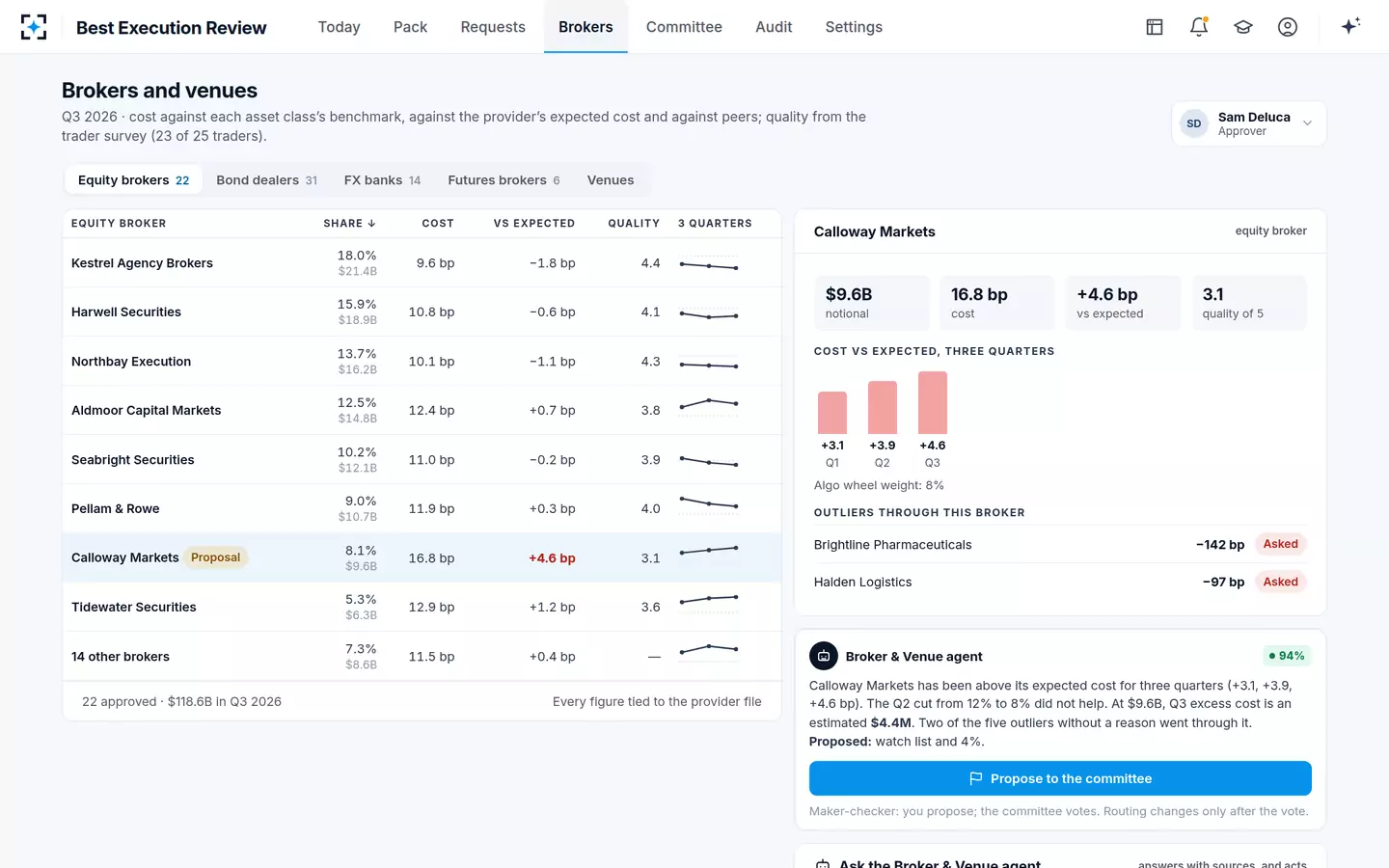
Read the sample scorecard and the point of this page is on it. The largest broker by share, Kestrel Agency Brokers, ran 1.8 basis points better than expected; the broker at the bottom ran above expected for three quarters, through a cut in its share of the algorithm wheel that did not help. The agents flagged the trend and drafted the proposal; the head of trading put it to the committee; the vote is the committee's.
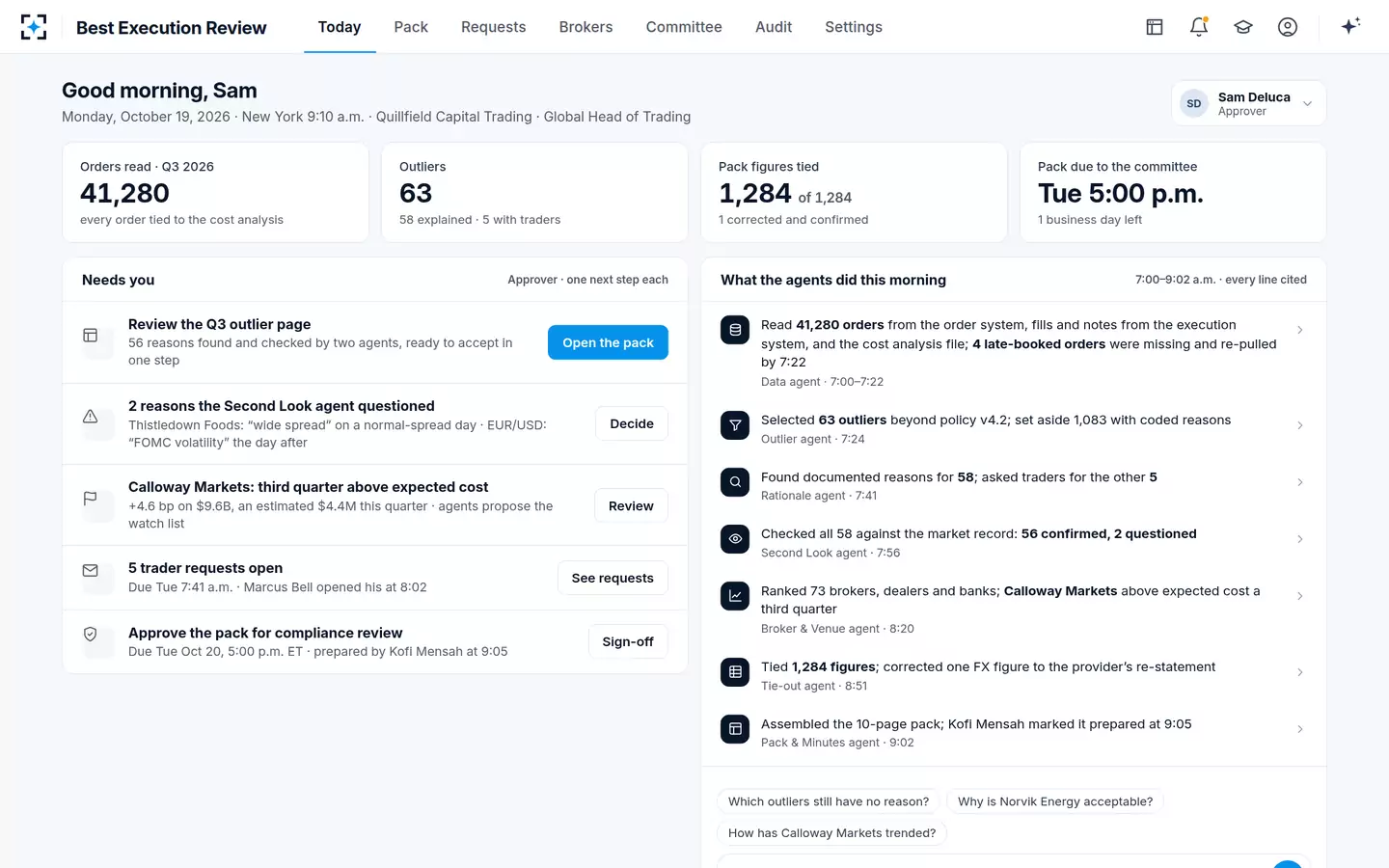
The head of trading's morning: the excess cost of one broker, next to everything else the review needs
For the regulatory side of the same question, what best execution means for advisers, brokers and EU firms sets out each regime's test, and the SEC best execution risk alert shows what happens to reviews that weigh commission alone. Measuring total cost from the investment decision to the last fill is worked through in the implementation shortfall formula. To see total cost in a quarter's best execution review, start from Best Execution Review.
Questions people ask
What is the best qualitative execution?
It is the SEC's phrase for the standard an adviser must meet: the execution that is best overall for the client once all the broker's services are weighed, not the one with the lowest commission. The SEC has used it since its 1986 release on Section 28(e), and repeated it in its 2019 interpretation of the adviser's fiduciary duty.
Is the best bid or offer the same as best execution?
No. The national best bid or offer is the best displayed quote at a moment; best execution is a judgement about the whole order. A large order filled entirely at the displayed quote is rare, and one filled in a way that pushes the price may still be best execution if the alternative was not finishing at all.
Should a best execution review compare commissions?
Yes, but as one input. Commission is a factor the SEC names; it is not the determinative one. A review that ranks brokers by commission alone misses market impact and delay, the costs that change with how each order is worked.
How do you measure total cost for a best execution review?
Measure each order against a benchmark chosen for its instruction, usually the arrival price for orders worked through the day, the close for market-on-close orders, or composite mid for bonds; then compare the cost with what a pre-trade model expected and with peers. Sum by broker and asset class, and trend it quarter by quarter.
Does paying for research make execution worse?
Not necessarily, but it can hide it. Conrad, Johnson and Wahal found higher implicit costs on orders sent to soft-dollar brokers, with large variability and a possible offset from the research received. The safeguard is to judge execution and research separately, and to disclose soft dollar practices as Form ADV Item 12 requires.