A best execution committee is the group that reviews a firm's execution quality, usually every quarter, and decides what to change: which brokers stay on the list, which thresholds move, which outlier trades are accepted and which need more. Its members typically include the head of trading, a trading analyst who prepares the material, compliance and an independent chair, often from risk. The committee is how an investment adviser shows the SEC that it evaluates execution "periodically and systematically", and how a broker-dealer runs FINRA's "regular and rigorous" review. The weak point is rarely the meeting itself; it is the weeks before it, when an analyst assembles cost analysis and chases traders for reasons. Botminds' Best Execution Review builds that material with agents, so the committee spends its hour on decisions.
Every seat on the committee exists to stop a different failure, and the regulators' findings show which failures recur. The figure below sets out each seat as it works today and as it works once agents take the assembly, with what stays with the person.
Five seats on a best execution committee, and what each signature is for
Today
Reads papers assembled the night before, and defends trades by memory.
With agents
Reads it a day or more early, accepts reasons two agents agree on, questions the rest with the evidence in view.
Still theirs: proposing broker and threshold changes; approving the papers with an attestation
Today
Spends the quarter-end pulling cost files, reconciling counts and emailing traders.
With agents
Confirms the corrections the agents log and marks the papers prepared.
Still theirs: preparing, never approving, the papers they prepared
Today
Asked in October about an order placed in July.
With agents
Gets one request per unexplained order, with the chart and what was already checked.
Still theirs: explaining their own orders; never accepting them
Today
Reviews whether the process ran, with little data of its own.
With agents
Sees every reason with its source and countersigns or returns the papers.
Still theirs: approving any threshold change; the countersignature
Today
Runs a meeting on slides and hopes last quarter's actions worked.
With agents
Runs it from the papers, records each vote with quorum and recusal.
Still theirs: the vote, and approving the minutes
What is a best execution committee?
A best execution committee is a standing governance body that receives the periodic review of execution quality and makes the decisions the review calls for. No US rule requires an investment adviser to have one; the requirement is to evaluate execution periodically and systematically and to be able to show it. The committee is a common form for that obligation, because it creates a dated decision with named people behind it.
FINRA describes the same structure among broker-dealers' effective practices: "Best Execution Committees: Establishing committees that meet quarterly or more frequently to conduct 'regular and rigorous' reviews and determine, if necessary, to modify the firm's order routing and execution arrangements" (FINRA 2026 Annual Regulatory Oversight Report). The second half of that sentence is the test. A committee that reviews but never modifies anything is a reading group.
The committee also carries a duty FINRA's guidance makes explicit: where a review finds "material differences in execution quality" among markets, the firm should change its routing or "justify why it is not modifying its routing arrangements" (Regulatory Notice 15-46). Justify is the committee's verb. Its minutes are where the justification lives.
Who should sit on a best execution committee?
A typical membership is the head of trading, a trading or best execution analyst as preparer and secretary, a senior portfolio manager, compliance, and a chair independent of the trading desk, commonly the head of investment risk; operations or a chief investment officer may attend. Five voting members with a quorum of three, the shape of the sample committee later on this page, is workable. What matters more than the headcount is that the people who propose changes are not the only people who decide them.
Portfolio managers belong in the room for a reason the SEC staff spelled out. Among the most common adviser deficiencies in the 2018 risk alert were reviews carried out without hearing from the firm's own traders and portfolio managers (OCIE Risk Alert, July 11, 2018; the full list is in the SEC best execution risk alert). A portfolio manager knows which orders carried an urgency that no benchmark records, such as a guidance cut or a redemption, and that knowledge is often the reason an outlier is acceptable.
Compliance needs a seat with data, not only a vote. The FCA's 2017 review of investment managers found "compliance staff were not empowered by senior management in order to provide effective challenge to the front office on execution quality", sometimes because "they lacked access to the data used by the dealing team", which "led to a 'tick box' monitoring process where failings were unlikely to be discovered" (FCA multi-firm review, 2017; the FCA now marks it historical). Its December 2025 review of eight wholesale banks found that the key weaknesses of its 2014 review remained at many of them: compliance "typically focused on challenging processes rather than actual outcomes" (FCA, December 2025).
Who would the FCA hold responsible if the firm fails in its obligation to ensure it consistently achieves best execution?
FCA, Investment managers still failing to ensure effective oversight of best execution, 2017
What each signature on the committee papers means
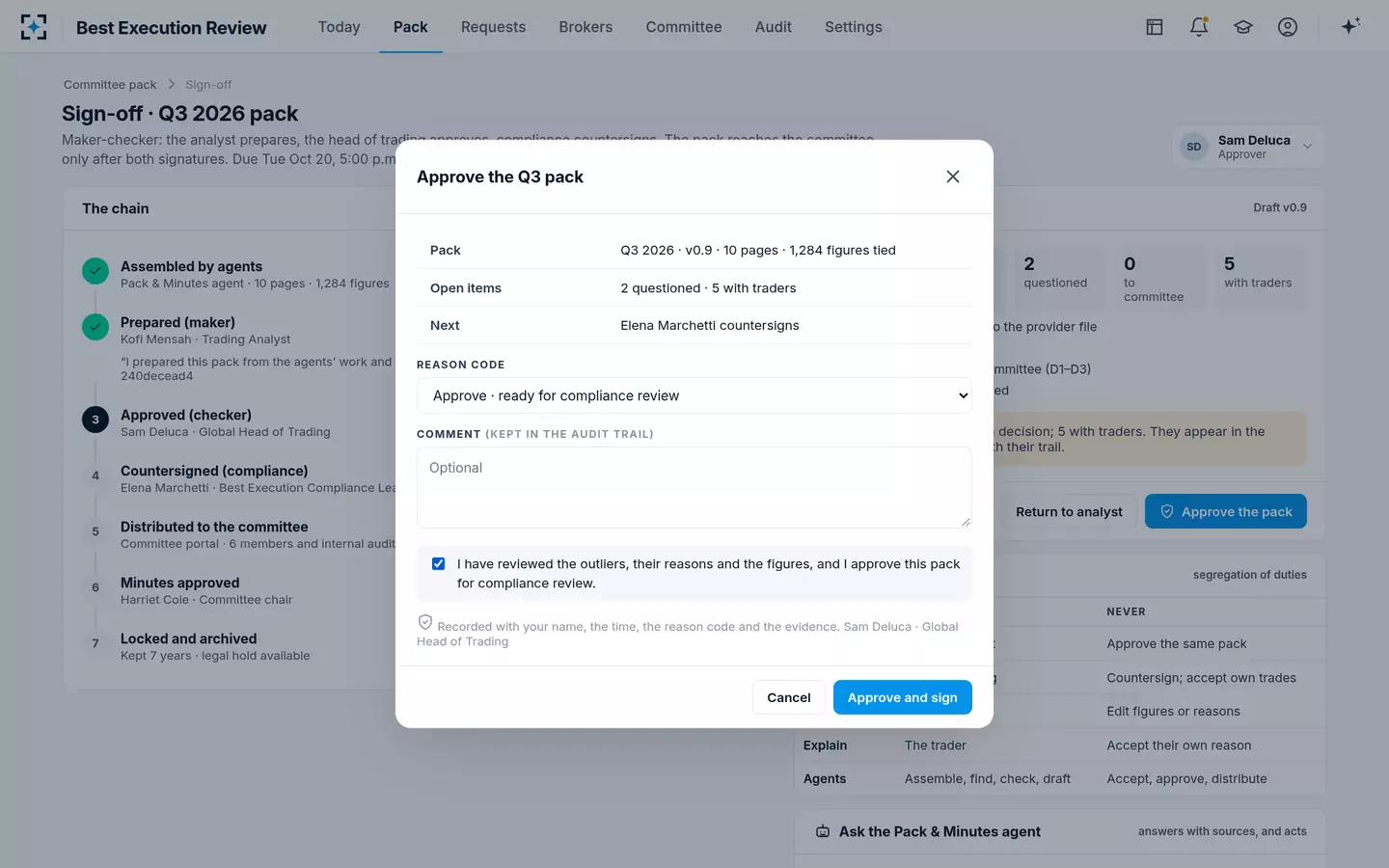
Each signature should attest to something the signer could have checked. The analyst's says the figures tie to their sources and the population is complete. The head of trading's says every outlier has been read and its reason accepted, questioned or referred. Compliance's countersignature says the review followed the written policy and the open items are visible. The chair's approval of the minutes says the decisions recorded are the decisions taken.
The rule that makes the chain mean anything is that nobody signs twice. The preparer never approves the papers they prepared; a trader never accepts the reason for their own order; a member who proposed a change does not vote on it. Rule 206(4)-7 puts a named chief compliance officer in charge of administering the policies (17 CFR 275.206(4)-7), and a committee whose papers can be prepared, approved and countersigned by people who report to one desk gives that officer little to stand on.
Approving the committee papers: maker, checker, countersignature, distribution
How often should a best execution committee meet?
Quarterly, the rhythm FINRA's effective practices describe, timed a few weeks after quarter end so cost analysis files have settled, with an ad hoc meeting for a material event such as a broker failure or a market dislocation. FINRA's floor for a broker-dealer's regular and rigorous review is quarterly, and FINRA notes that some firms, reviewing their business, have found it necessary to review more often, "with most of those firms conducting monthly reviews" (Regulatory Notice 15-46). The FCA's 2025 review found several banks running sub-committees or working groups that did the detailed analysis beneath the committee, a structure that suits a monthly look and a quarterly decision.
For UK and EU managers the timetable has an annual anchor as well: a portfolio manager must "review its order execution policy and order execution arrangements at least annually and whenever a material change occurs" (FCA COBS 11.2A.34R). Folding that annual review into one of the four quarterly meetings, and minuting it as such, lets the policy review and the execution review cite the same evidence.
What goes in a best execution committee charter?
A charter should state the committee's purpose, membership and quorum, how often it meets, what papers it receives and when, what it may decide and what it must escalate, and how it records decisions. The table below is a working outline; the clauses on conflicts and on what the committee does with the previous quarter's actions are the ones most charters leave out.
A best execution committee charter, clause by clause
| Clause | What it should say | Why it is there |
|---|---|---|
| Purpose and scope | The asset classes, accounts and entities covered; the link to the written best execution policy. | An examiner tests the review against the policy; a charter that covers equities only leaves bonds and FX unreviewed. |
| Membership and quorum | Named roles, voting and non-voting; quorum (for example 3 of 5) with the chair or a deputy present. | A decision taken without quorum is not a committee decision. |
| Independence | A chair from outside the trading desk; compliance as a voting or veto member. | Separates the people who propose from the people who decide. |
| Conflicts and recusal | A member never votes on their own proposal or on a broker they have a relationship with. | Recusals recorded in the minutes show the rule was applied. |
| Papers and timetable | What the papers contain; due a set number of business days before the meeting; who prepares, approves and countersigns. | Late papers turn a review into a reading. |
| Decisions and escalation | What the committee may decide (broker list, routing weights, thresholds proposed for compliance approval) and what goes to senior management. | Defines who may change routing, and that no one changes it before the vote. |
| Follow-up | Every action has an owner and a date; the next meeting opens with whether last quarter's actions worked. | An action that is never checked is not an action. |
| Records | Minutes, papers and votes kept for the firm's retention period, at least the books-and-records minimum. | Rule 204-2 sets five years for most adviser records. |
What should best execution committee minutes record?
Minutes should record what the committee looked at, what it decided, who voted, who abstained or recused, and why; for each decision, the evidence it relied on. A minute that says "the committee reviewed execution quality and was satisfied" records attendance, not a review. The test is whether someone who was not in the room could reconstruct the decision from the minute and the papers it cites.
The FCA's 2025 review is useful here because it describes committee papers at their best and at their worst. The strongest management information covered, among other things, "outlier trend analysis, including themes and rationales", use of third-party brokers, and "open and closed actions with action owners and time to complete". At one bank whose information "only covered outlier analysis", the committees "had not generated any substantial discussion or actions to improve the framework" (FCA, December 2025). The lesson carries to an asset manager's committee: minutes are only as good as the papers they rest on.
A best execution meeting minutes template, item by item
- Date, attendees, quorum and any recusals
Who voted on what, and who stood aside on their own proposals.
- The papers received, by version
The version of the papers and the policy version in force, so the minute points at what was actually read.
- Last quarter's actions and whether they worked
For example, a cut in a broker's algorithm-wheel share, and its cost against expected since.
- Costs by asset class against benchmark and peers
With the comparisons against brokers and venues not used, which FINRA guidance and the SEC staff both expect.
- Outliers: accepted, questioned, still open
The count in each, and the reason for any accepted without a documented source.
- Each decision with its proposer, vote and evidence
Broker list changes, routing weights, threshold proposals for compliance approval.
- Actions, owners and dates
Carried into the next meeting's agenda as its first item.
- The chair's approval
Minutes drafted from the meeting are a draft until the chair approves them.
When the committee disagrees with the head of trading
Disagreement is the committee working. The head of trading proposes because the desk knows the brokers and the flow; the chair and compliance challenge because the desk also has relationships to protect. When they disagree, the charter should say what happens: the committee votes, the dissent is minuted, and anything above the committee's authority goes up with both views attached.
The FCA's 2025 good-practice examples show what effective challenge looks like in data. At one bank, compliance "challenged the front office on an increase of its best execution alerts", which "resulted in a change in the bank's SOR logic"; it then "identified alert trends and collated and shared these with the best execution committee" (FCA, December 2025). Challenge that changes routing is the kind a regulator recognises. Challenge that ends in "noted" is the kind it does not.
Why traders give input, and never sign their own trades
Traders are the best source of the reason behind an outlier and the worst judges of whether it is acceptable. Both halves come from the same place: they placed the order. The SEC staff cited advisers that did not ask their traders for input; a well-run committee asks every trader for the reasons behind their own outliers, and then has someone else decide.
How the question is asked decides the quality of the answer. An email in October about a July order produces "market conditions". A request the morning after the review, with the price chart, what has already been checked and one specific question, produces a reason that can be tested. The outlier reasons a committee can defend sets out what a good reason contains and how to test one against market data.
A committee meeting prepared by agents
With the assembly done by agents, the committee's papers arrive complete and the meeting starts at the decisions. Take a sample manager, fictional Quillfield Capital, as its third-quarter committee runs in Best Execution Review: five voting members, a quorum of three, four present, the chair from investment risk in London, the secretary the trading analyst who prepared the papers. The agenda is built from the papers, and three decisions wait for a vote.
The best execution committee agenda, built from the papers, with three decisions to vote
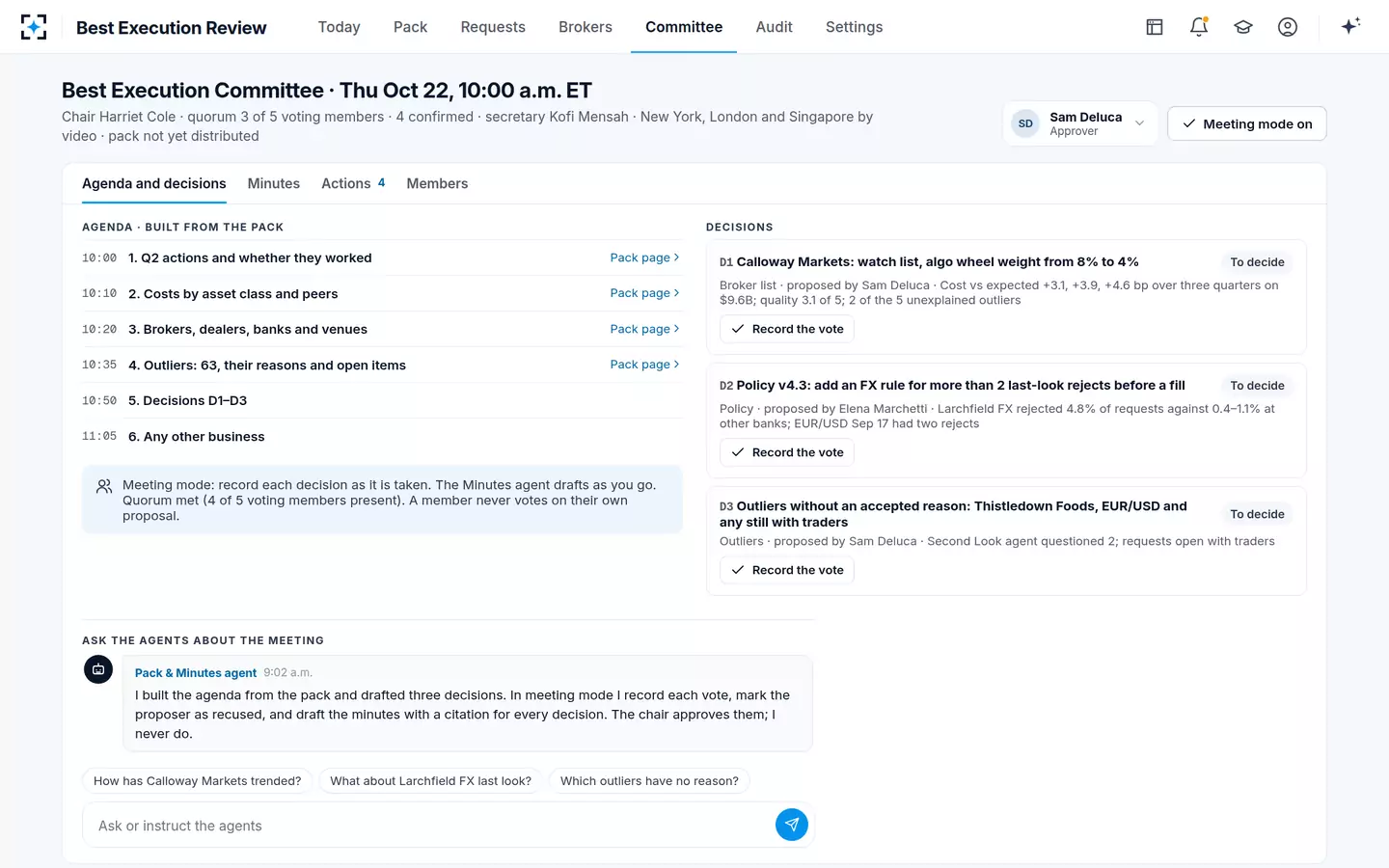
The first decision shows why the follow-up clause matters. A broker, fictional Calloway Markets, ran above its expected cost for three quarters running: 3.1, 3.9 and 4.6 basis points. In the second quarter the committee cut its share of the algorithm wheel from 12% to 8%, and the third quarter was worse. On $9.6 billion of the quarter's flow, 4.6 basis points is an estimated $4.4 million, our arithmetic on the sample data. The agent proposes a watch list and a 4% weight; the head of trading puts it to the committee; the routing changes only after the vote, and the proposer is recused from it.
The agents never vote and never approve. They assemble the agenda, draft each minute with a citation to the evidence behind it, and record the votes as they are taken; the chair approves the minutes. Best execution AI tools sets out where agents help a review and what they must never decide. To see a full committee cycle on a quarter's orders, start from Best Execution Review.
Questions people ask
Is a best execution committee required by the SEC?
No rule requires one for advisers. The SEC expects an adviser to evaluate execution periodically and systematically and to be able to demonstrate it; a committee with minutes is the most common way to do both. FINRA lists quarterly best execution committees among broker-dealers' effective practices in its 2026 report.
Should the head of trading chair the best execution committee?
It is better if they do not. The head of trading proposes broker and routing changes, so a chair from outside the desk, often the head of investment risk or a senior compliance officer, separates proposing from deciding. The FCA has repeatedly found second-line challenge to be the weakest part of best execution governance.
What is a best execution committee charter template?
It is a standard set of clauses: purpose and scope, membership and quorum, independence, conflicts and recusal, papers and timetable, decisions and escalation, follow-up of actions, and records. The clauses on recusal and on checking last quarter's actions are the ones most often missing.
How long should best execution committee records be kept?
At least as long as the books-and-records rule requires: for most records an adviser must keep, Rule 204-2 sets a five-year floor, counted from the end of the fiscal year in which the record was last written to, with two of those years on the adviser's premises (the rule is read in full in investment adviser recordkeeping requirements). The sample firm on this page keeps committee papers, minutes and decisions for seven years, with legal hold.
Can a trader sit on the best execution committee?
A senior trader can attend and should give input, but should not vote on reasons for their own orders or on brokers they route to most. The committee needs traders' knowledge; the SEC staff have cited advisers whose reviews did not ask for it.