The order protection rule repeal is a proposal, not yet a rule. On June 17, 2026 the SEC published a proposal to "rescind the trade-through rule for NMS stocks", Rule 611 of Regulation NMS, together with Rule 610(e) on locked and crossed quotations (91 FR 36656). Comments closed on August 17, 2026, and as of October 28, 2026 no final rule has appeared in the Federal Register. The proposal's central argument concerns best execution: the Commission says that "given this highly automated and interconnected nature of our equity markets today, Rule 611 is not needed to backstop a broker's duty of best execution". With the SEC's proposed Regulation Best Execution withdrawn in June 2025, nothing new would replace the backstop. The weight would fall on reviews firms already run, which is the work Botminds' Best Execution Review does: every outlier selected, explained and checked, and every broker compared with the alternatives.
The figure below follows one marketable order through the market as it works today and as it would work without Rule 611. The trade is the same; what changes is who has to catch a worse price.
One order, two rulebooks: where the trade-through check would move
Today, with Rule 611
- The orderA marketable buy for 5,000 shares reaches the broker's router. Another exchange displays a protected offer one cent better.
- The venue's checkThe trading center must have "policies and procedures that are reasonably designed to prevent trade-throughs" of protected quotations. It routes away, sweeps with an intermarket sweep order, or relies on one of nine exceptions.
- What the review seesFills that, exceptions aside, did not trade through a protected quote. The broker's best execution review starts from that floor.
If the SEC rescinds Rule 611
- The orderThe same order, the same better quote displayed elsewhere.
- The venue's checkNo rule requires the venue to prevent the trade-through. The broker's routing logic decides whether to take the better price, on its duty to seek "the most favorable terms reasonably available".
- What the review seesTrade-throughs become something the broker's regular and rigorous review, and the adviser's review of the broker, must look for and explain.
Is the SEC repealing the order protection rule?
The SEC has proposed to repeal it and has not yet decided. The proposal, published on June 17, 2026, would rescind Rule 611 "in its entirety", rescind Rule 610(e), and delete the defined terms that exist only to serve them, such as protected quotation and intermarket sweep order, with conforming changes to Rules 600, 15c3-5 and 15b9-1. It followed two SEC roundtables, on September 18, 2025 in Washington and December 16, 2025 in Austin.
A proposal can be adopted as written, changed or dropped. Regulation Best Execution, published as a proposal in January 2023, never became a rule: on June 17, 2025 the Commission withdrew it and said it would not adopt final rules on it (90 FR 25531). No firm should treat the Rule 611 rescission as done. But it should treat the argument behind it as the Commission's current view of where best execution responsibility lies, because that view does not depend on the vote.
What is Rule 611 of Regulation NMS?
Rule 611, the order protection or trade-through rule, requires every trading center to "establish, maintain, and enforce written policies and procedures that are reasonably designed to prevent trade-throughs on that trading center of protected quotations in NMS stocks", and to "regularly surveil" whether those procedures work (17 CFR 242.611). A trade-through is an execution at a price worse than a protected quotation displayed on another market. Nine exceptions apply, among them intermarket sweep orders, single-priced opening, reopening and closing transactions, a market experiencing a system failure, and a quote that had been at or worse than the trade price within the prior second.
The Commission adopted it in 2005, when it said the rule "will backstop a broker's duty of best execution on an order-by-order basis by prohibiting the practice of executing orders at inferior prices, absent an applicable exception". The 2026 proposal quotes that sentence and answers it. Markets in 2005 had eight exchanges trading NMS stocks, plus Nasdaq, which became an exchange in 2006; the proposal counts 17 operating today and three more approved, with off-exchange trading "since the end of 2024, now regularly exceeding 50% of overall volume".
A broker's duty to seek to obtain for its customer orders the most favorable terms reasonably available under the circumstances will continue to apply regardless of whether Rule 611 is rescinded.
SEC, The Trade-Through Rule and Locked and Crossed Markets Provisions of Regulation NMS, proposed rule, June 17, 2026
Why the SEC says best execution no longer needs a backstop
The proposal makes three arguments. Markets are now "highly automated and interconnected, and routing technologies have become increasingly sophisticated". Investors have far better access to market data and execution quality information than in 2005, so the concern that they could not monitor whether their orders got the best available prices "is no longer applicable". And competition should do what the rule did: "a firm's commercial and competitive incentives should result in the firm routing orders to execute against the best price at an away market when consistent with the duty of best execution (rather than being required to do so by Rule 611)".
The proposal also makes a point institutional desks have pressed for years. Some commenters, it records, argue that the rule "has harmed institutional investors that seek to trade in large size by forcing them to access small-sized quotations that may signal their trading intentions to short-term proprietary traders", and it says rescission "would allow institutional investors more flexibility to route child orders, thereby allowing them to avoid trading at exchanges that may increase their information leakage and reducing slippage". Flexibility is the benefit. Evidence is the price: each routing choice that skips a displayed better price now needs a reason a review can find.
The order protection rule repeal in the SEC's own numbers
17exchanges
operating for NMS stocks today, against eight in 2005 plus Nasdaq
50%+
of US equity volume traded off exchange, regularly, since the end of 2024
2.4%
or less: trade-through rates in Q2 2025 where Rule 611 did not apply, such as odd lots and extended hours
11–19%
trade-through rates of off-exchange trades of 5 to 40 shares in high-priced stocks, against odd-lot quotes inside the NBBO
What happens to locked and crossed markets?
The SEC proposes to rescind those rules too. Rule 610(e) requires exchanges and FINRA to have rules requiring members "reasonably to avoid displaying quotations that lock or cross protected quotations". The proposal argues that automation, market data access and investor sophistication "obviate the need for Rule 610(e)", and that where crossed markets "do occur and resolve quickly due to market forces, the potential for investor confusion is minimal".
It also asks whether something should survive: "should prohibitions on the display of crossed markets be maintained?" For a best execution review, a crossed market is a benchmark problem before it is a compliance one. If the best bid can sit above the best offer, an arrival mid computed from the consolidated quote can be nonsense, and a cost analysis that does not flag those moments will misprice the trades made in them. Ask the cost analysis provider how it will handle them.
Was Regulation Best Execution adopted?
No. The SEC published a proposed Regulation Best Execution in January 2023 that "would have changed the existing regulatory framework concerning the duty of best execution by requiring detailed policies and procedures for all broker-dealers and additional policies and procedures for broker-dealers engaging in certain transactions with retail customers, as well as related review and documentation requirements". It withdrew the proposal on June 17, 2025, with the Order Competition Rule proposal in the same notice (90 FR 25531).
Put the two decisions together and the direction is clear. In 2023 the Commission's answer to best execution was more prescription; in 2026 it is less structure and more reliance on the duty itself. For broker-dealers that duty is FINRA Rule 5310 and its regular and rigorous review; for advisers it is the fiduciary duty the SEC interpreted in 2019, under which an adviser "should 'periodically and systematically' evaluate the execution it is receiving for clients" (84 FR 33669). Neither duty changes if Rule 611 goes. What changes is how much each review has to catch.
What the SEC expects rescission to cost, and what that misses
The SEC estimates that each broker-dealer choosing to update its best execution policies would need 54 hours, "48 hours of legal time and 6 hours of review by a Chief Compliance Officer", about $40,100; across the 173 broker-dealers it counts as sending customer orders directly to an exchange in January 2026, about $6.94 million in all. The Commission itself says it "acknowledges uncertainty regarding this estimate".
The estimate prices the rewrite of a policy. It does not price the evidence that a changed policy needs every quarter after. The proposal itself expects that some brokers "may determine they need to update their best execution policies and procedures relating to order routing choices", and adds that they "might update their best execution review process as part of updating their policies and procedures". For an adviser the cost sits in the same place: the review of each broker now has to include whether the broker's routing still took better displayed prices when no rule made it.
Where trade-through risk would sit after rescission, firm by firm
| Who | Today | If Rule 611 is rescinded |
|---|---|---|
| Trading center (exchange, ATS, wholesaler) | Written policies to prevent trade-throughs of protected quotes, and regular surveillance | No trade-through obligation; its own rules, if it keeps any |
| Broker-dealer handling the order | Best execution under Rule 5310, with Rule 611 as a floor beneath the routing | Best execution under Rule 5310 alone; routing logic and its review must show better prices were sought |
| Investment adviser choosing the broker | Periodic and systematic evaluation of each broker | The same duty, now including whether brokers' routing still captured better displayed prices |
| Best execution committee | Reviews costs and outliers against benchmarks | Adds trade-through measures to broker scorecards and asks brokers for their review results |
Does a buy-side firm need to change its best execution policy?
Not yet, and perhaps not much. Until a final rule is adopted and its compliance date passes, Rule 611 applies. But a policy that reads well in a world with a trade-through floor may be thin in a world without one, and the work to close that gap is evidence, not drafting. Five additions cover most of it.
Five changes to a buy-side best execution review if Rule 611 is rescinded
- Ask each broker how its routing will change, in writing
Including whether its router will continue to take better displayed prices at away markets, and how its own regular and rigorous review will test that.
- Request Rule 606(b)(3) reports for not-held equity orders
Six months of routing by calendar month, due within seven business days of a request; compare before and after any change.
- Add a trade-through measure to the broker scorecard
Child fills priced worse than a displayed quote elsewhere at the time, with size and venue, so a pattern shows by broker.
- Judge large orders as parent orders
The SEC describes institutional customers expecting the analysis to evaluate whether the parent order got the most favourable price; a child fill through a small quote may be the right call for the whole order, if the reason is written down.
- Revisit thresholds and exclusions
Benchmarks built on the consolidated quote need a rule for locked and crossed moments; an exclusion code for them keeps the review honest.
Public data will help. Amended Rule 605 reports, with broader coverage and finer time stamps, apply to execution data from August 1, 2026: "Beginning on August 1, 2026, market centers, brokers, and dealers subject to Rule 605 must begin to collect the information needed to prepare the execution quality reports" (90 FR 47552). How to read those reports beside a broker's own routing report is set out in the routing data your broker owes you; deciding what they mean for a broker belongs with the committee.
When will the SEC decide on Rule 611?
There is no date. The comment period closed on August 17, 2026; the Commission can adopt the rule, re-propose it or let it lie, and a final rule would set its own compliance dates. A firm tracking it should watch the Federal Register docket for the proposal rather than any forecast, and plan the review changes so they can be switched on when a compliance date is known.
Keeping best execution evidence without the backstop
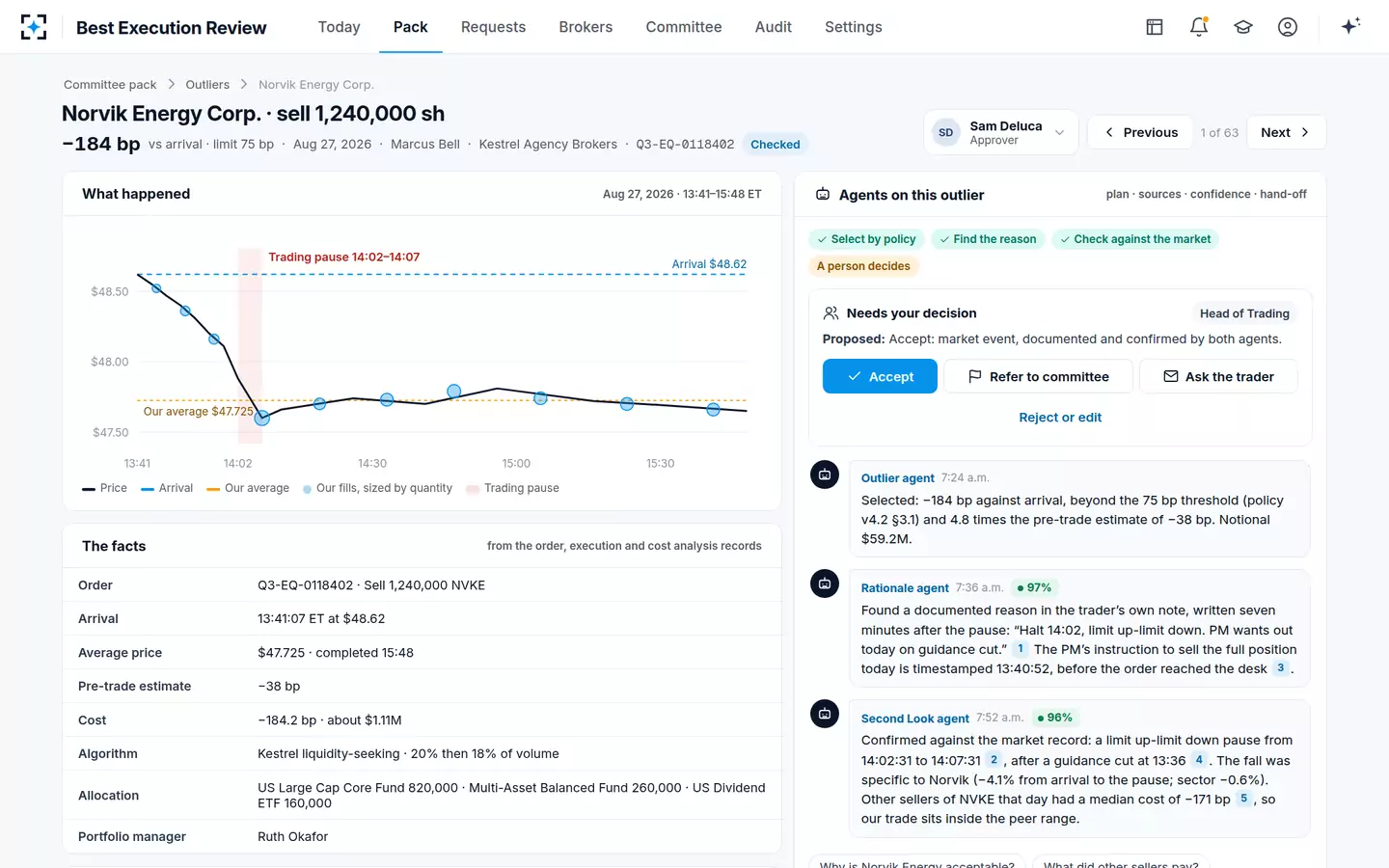
Without Rule 611, more of the burden of proof sits in the review: each outlier needs a reason that survives a check against the market data of the moment, and each broker needs a comparison with the alternatives. Botminds' Best Execution Review is built around both. Take a sample manager, fictional Quillfield Capital, as its third quarter runs through the solution. One equity sale, Norvik Energy, cost 184 basis points against arrival, beyond the 75 basis point limit. The agent found the trader's note written minutes after a limit up-limit down trading pause; a second agent confirmed the pause from 14:02:31 to 14:07:31 in the market data, and that other sellers that day paid a median of 171 basis points.
An outlier explained by a trading pause, checked against market data before anyone accepts it
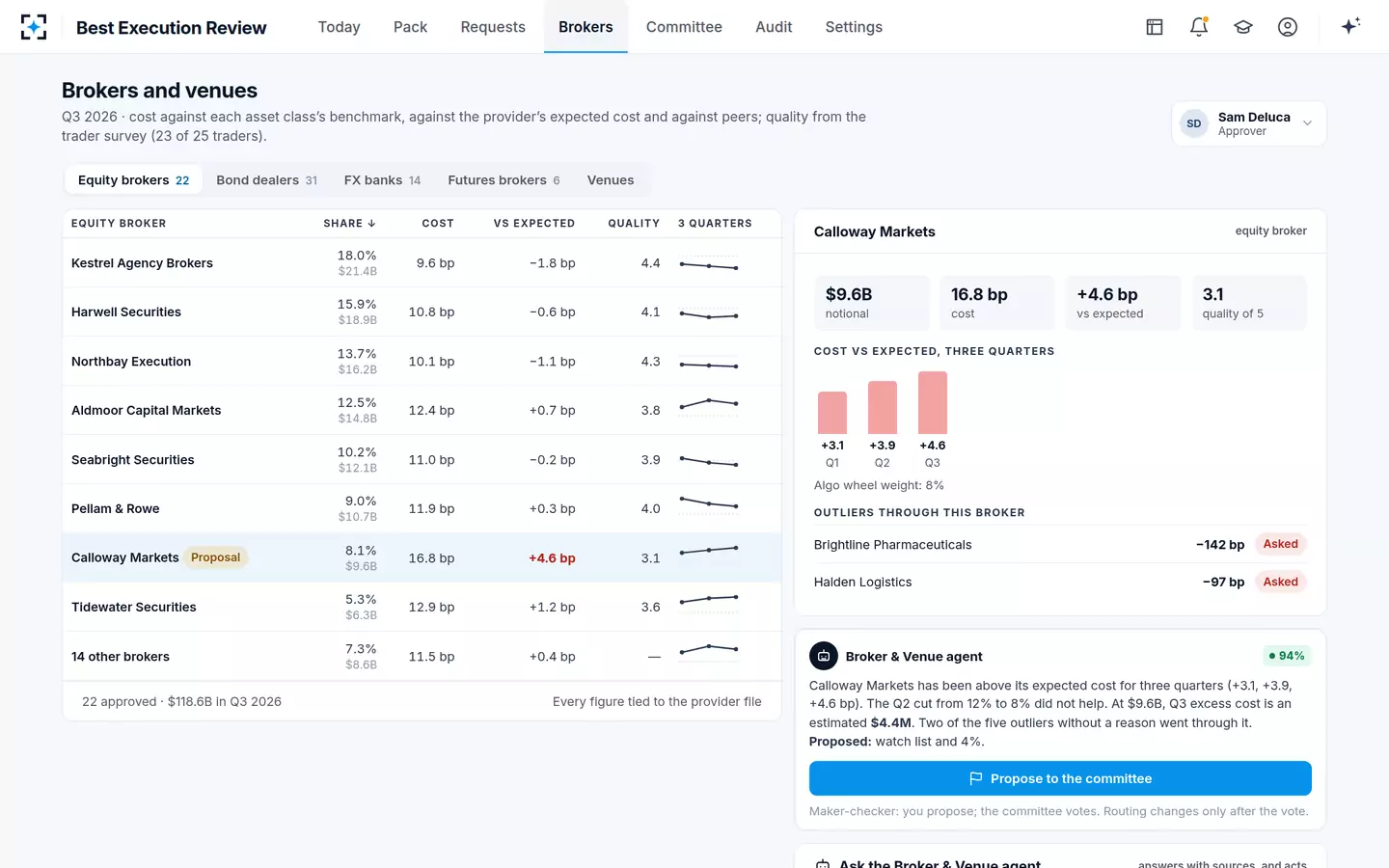
The broker side of the same review shows cost against expected, trend and a trader-survey quality score for every broker, dealer and bank, and checks whether last quarter's committee actions worked. A trade-through measure per broker would sit on the same scorecard.
The broker scorecard where a trade-through measure would sit
The outlier reasons a committee can defend sets out how a reason is tested, and the best execution committee covers who decides what a broker's numbers mean. To see a quarter's review end to end, start from Best Execution Review.
Questions people ask
Has Rule 611 been repealed?
No. As of October 28, 2026 it is a proposal: the SEC published it on June 17, 2026 and comments closed on August 17, 2026. No final rule has been published in the Federal Register, so Rule 611 still applies.
What is an intermarket sweep order?
An intermarket sweep order is an order flagged as one of a set sent at the same time to execute against the full displayed size of every better-priced protected quotation. Rule 611(b)(5) and (b)(6) exempt executions of such orders from the trade-through prohibition. If Rule 611 is rescinded, the SEC proposes to delete the definition as well.
Would repealing Rule 611 allow brokers to ignore better prices?
No. The SEC says a broker's duty to seek the most favourable terms reasonably available "will continue to apply regardless of whether Rule 611 is rescinded". What goes is the venue-level prohibition; the broker's routing and its review would have to show that better prices were sought.
Does the order protection rule apply to bonds or options?
No. Rule 611 covers protected quotations in NMS stocks only. Bond best execution rests on the broker's diligence under FINRA Rule 5310 and on the adviser's own review, which is why the review standard for bonds is the closest guide to what equity reviews may become.
What did commenters say about repealing Rule 611?
The proposal summarises its roundtables and letters: critics said the rule added cost and complexity, led to complex order types and pushed large institutional orders into small quotes, and some recommended rescinding it entirely; others offered alternatives, such as modifying Rule 611 or other parts of Regulation NMS. Several described how closely the rule is tied to best execution and asked the Commission to consider ways to support best execution compliance.