A Rule 606(b)(3) report is the routing and execution report a US broker-dealer must give a customer, on request, about that customer's not-held orders in NMS stocks: within seven business days, covering the prior six months by calendar month. For each venue the broker used, it shows the shares routed, how many were immediate-or-cancel or further routable, the fill rate, the fees and rebates, and how much executed at the midpoint or on either side of the spread. It is free, standardised and largely unused, and it answers the question a TCA report cannot: why one broker's orders cost more than another's. Since August 1, 2026 the amended Rule 605 has added monthly execution-quality data with millisecond timestamps from a wider set of brokers. Botminds' Transaction Cost Analysis is built to sit next to that public evidence: its agents cost every order against a fair benchmark and rank brokers, algorithms and venues, so a 606(b)(3) report has the desk's own implementation shortfall to be read against.
The rule text and the SEC's releases are linked where they appear; the rule was read in the eCFR as of October 23, 2026. Product examples use the solution's sample data on a fictional asset manager, Quillfield Capital, and its fictional brokers.
A Rule 606(b)(3) report, section by section, and the TCA question each section answers
Header
What the rule requiresCustomer, broker, the six calendar months covered, by month; split into directed and non-directed not-held orders
The TCA question it answersWhich orders, which broker, which months: match them to your own parent orders before reading anything else.
Order flow totals
What the rule requiresShares sent; shares executed by the broker as principal; orders exposed through an actionable indication of interest, and to which venues
The TCA question it answersHow much of your flow did the broker trade against itself, and how widely did it advertise your orders?
Routing, per venue
What the rule requiresShares routed; shares routed immediate-or-cancel; shares routed that were further routable; average order size routed
The TCA question it answersWhere did your child orders go, and how often were they sent somewhere that passed them on again?
Execution, per venue
What the rule requiresShares executed; fill rate; average fill size; net fee or rebate; shares and percentage at the midpoint, on the favourable side and on the unfavourable side of the spread
The TCA question it answersWhich venues filled you, at what price within the spread, and who earned the rebate?
Providing liquidity, per venue
What the rule requiresShares and percentage executed providing liquidity; average time from order entry to execution or cancellation, in milliseconds; net rebate or fee
The TCA question it answersHow long did your passive orders rest, and did resting pay?
Removing liquidity, per venue
What the rule requiresShares and percentage executed taking liquidity; average net fee or rebate
The TCA question it answersHow aggressive was the algorithm, and what did crossing cost in fees?
What is Rule 606?
Rule 606 of the SEC's Regulation NMS requires broker-dealers to disclose how they route customer orders in NMS stocks and listed options. Rule 605, its companion, requires disclosure of execution quality; the SEC's 2024 release notes that "Rule 605, along with Rule 606 of Regulation NMS, was adopted in 2000" to give investors public information on routing and execution (SEC, 89 FR 26428, April 15, 2024). Rule 606 has two audiences. Paragraph (a) requires a public quarterly report on held orders, broken down by month, naming the top venues. Paragraph (b) gives individual customers reports about their own orders.
Paragraph (b)(3) is the part written for institutions. The SEC added it in 2018 (SEC, Disclosure of Order Handling Information, 83 FR 58338, November 19, 2018), effective January 18, 2019 with compliance from May 20, 2019. Rule 606 was not changed by the 2024 amendments, which applied to Rule 605.
What is a Rule 606(b)(3) report?
It is a broker's account of how it handled one customer's not-held orders, venue by venue, in a format the SEC prescribes. Paragraph (b)(3) obliges every broker-dealer to produce it for any customer that asks and that sends it not-held orders in NMS stocks, directly or indirectly, covering the previous six months month by month (17 CFR 242.606(b)(3)). The rule adds that the handling of a not-held order "includes the handling of all child orders derived from that order", which is what makes the report useful for algorithmic execution.
The report is delivered in the SEC's XML schema with a PDF rendering, so reports from different brokers can be loaded side by side. It is split into directed orders, where the customer chose the venue, and non-directed orders, where the broker did.
Rule 606(b)(3) in five numbers
7business days
for the broker to deliver the report after a request
6months
covered, by calendar month
$1M
average monthly notional of not-held orders below which a customer can be refused
5%
share of not-held shares below which a broker is exempt
28of 342
brokers receiving not-held orders that the 2018 staff analysis expected to be exempt
Who can request a Rule 606(b)(3) report, and how fast must the broker answer?
Any customer that sends not-held orders in NMS stocks to the broker, directly or indirectly, can request one, and the broker has seven business days to deliver it. "Indirectly" matters for asset managers: an order sent through an execution management system or another broker can still count. The rule attaches no condition to a request beyond its two exceptions and does not limit how often a customer asks, so a desk can ask every six months and build a continuous record.
The SEC chose not-held orders as the trigger rather than a size threshold. It had proposed an "institutional order" definition with a $200,000 threshold and dropped it, so the obligation follows how the order is handled, not how large it is.
The Rule 606 b3 de minimis and the five percent threshold
Two exceptions limit the obligation. A broker need not report to a customer that "traded on average each month for the prior six months less than $1,000,000 of notional value of not held orders in NMS stocks through the broker or dealer" (17 CFR 242.606(b)(5)). And a broker is exempt altogether if not-held orders were less than five percent of the NMS-stock shares it received from customers over the prior six months, with a six-month compliance period once it crosses the line (17 CFR 242.606(b)(4)).
For most institutional desks neither exception bites: a manager sending a million dollars a month of not-held flow to a broker is small. The SEC's own analysis at adoption found that about 8% of the 342 broker-dealers receiving not-held orders, 28 firms, would qualify for the five percent exception. A broker that declines a request should be asked which exception it relies on.
What changed in the Rule 605 amendments, and when did they start?
The 2024 amendments widened Rule 605 to larger brokers, added a summary report, and moved its clock to milliseconds; firms began collecting the data on August 1, 2026. The SEC adopted the amendments on March 6, 2024 (89 FR 26428) and extended the compliance date "from December 14, 2025, to August 1, 2026" (SEC, 90 FR 47552, October 2, 2025). Reports are due within one month after the month they cover, so the first amended monthly reports, for August 2026, were due by the end of September 2026.
Rule 605 after the 2024 amendments and Rule 606(b)(3), side by side
| Amended Rule 605 | Rule 606(b)(3) | |
|---|---|---|
| Who reports | Market centers, plus brokers that introduce or carry 100,000 or more customer accounts | Any broker-dealer with not-held NMS-stock orders from customers, subject to the 5% exception |
| Which orders | Covered orders, which exclude not-held orders and orders for the open or the close | The customer's not-held orders and all their child orders |
| Whose orders | All covered orders the firm received, in aggregate | One customer's orders only |
| Public? | Yes: monthly, kept online for three years; a summary report too | No: delivered to the customer on request |
| Timing | Monthly, within one month after the month ends | Within seven business days of a request; prior six months |
| Price measures | Effective and realized spreads, price improvement, execution speed in milliseconds | Shares at the midpoint and on each side of the spread, per venue |
| What it says about your TCA | How the broker's held child orders fared, in aggregate | Where your orders went and how they filled |
Three changes matter to an institutional desk. Rule 605 now reaches larger brokers: in the SEC's words, "approximately 85 broker-dealers introduce or carry more than 100,000 customer accounts and these broker-dealers together handle over 98% of customer accounts." Time of receipt and execution are measured in milliseconds or finer. And realized spread, the spread a liquidity provider kept once the price settled, is now reported at several intervals, from 50 milliseconds and one second after execution in the full reports to 15 seconds and one minute in the summary. The gap between the effective spread and the realized spread at each interval is how far the price moved in the direction of the trade within that time, which is how the reports show short-term price impact.
Public execution data for US stocks, date by date
| Date | Rule | What happened |
|---|---|---|
| 2000 | Rules 605 and 606 | Adopted, as Rules 11Ac1-5 and 11Ac1-6: monthly execution-quality reports from market centers, and routing reports |
| November 19, 2018 | Rule 606 | Amendments published, adding paragraph (b)(3) for not-held orders; effective January 18, 2019 |
| May 20, 2019 | Rule 606(b)(3) | Compliance date: customers can request their routing reports |
| April 15, 2024 | Rule 605 | Amendments published: larger brokers, summary reports, millisecond timestamps, realized spreads at several intervals |
| October 2, 2025 | Rule 605 | Compliance date extended from December 14, 2025 to August 1, 2026 |
| August 1, 2026 | Rule 605 | Firms begin collecting data under the amended rule |
| End of September 2026 | Rule 605 | First amended monthly reports, for August, due |
How to use Rule 605 and 606 data in TCA
Use your own TCA to find which brokers' orders cost more, and the 606(b)(3) reports to see what those brokers did differently. The SEC described exactly this use when it adopted the rule. TCA, it noted, "generally analyzes data on the parent orders, but typically cannot analyze data on the child orders because of the lack of standardization of the current ad hoc order handling information." With the reports, "With TCA alone, a customer may observe different implementation shortfalls across broker-dealers. The adopted amendments could allow the customers or their third-party vendors to correlate implementation shortfall with the routing decisions of the broker-dealers" (83 FR 58338).
"the Commission believes that adopted Rule 606(b)(3) will not replace TCA."
SEC, Disclosure of Order Handling Information, 83 FR 58338 (November 19, 2018)
In practice the comparison works like this. Take two brokers with similar orders whose costs differ by a few basis points against arrival. Load their reports. If the costlier broker routed a higher share of child orders immediate-or-cancel to venues that were themselves further routable, filled a lower share at the midpoint and a higher share on the unfavourable side of the spread, the cost difference has a mechanism, and the question to the broker writes itself. If the reports look alike, the difference is more likely in the orders, and the TCA peer groups need a second look. The implementation shortfall formula explains the cost side of that comparison.
Rule 605 adds the aggregate view. The SEC's 2024 release notes that large parent orders are often split into child orders handled as held orders and reflected in Rule 605 reports, and that "Institutional investors may incorporate information from Rule 605 reports into their TCA when evaluating the performance of their broker-dealers' Smart Order Router (``SOR'') algorithms." A broker whose own Rule 605 numbers show wide effective spreads on mid-size marketable orders is unlikely to route your child orders better.
Requesting and using 606(b)(3) reports: a six-step routine
- List every broker that receives your not-held equity orders
Include brokers reached indirectly through an execution platform; the rule covers both.
- Request the report in writing, dated, every six months
Seven business days is the deadline; record when each request went and each report arrived.
- Ask for the XML, not only the PDF
The SEC schema makes reports from different brokers comparable by machine.
- Tie the report's monthly totals to your own records
Shares sent and executed should match your order and fill data before any analysis.
- Set routing against cost, broker by broker
Compare midpoint and unfavourable-side shares, IOC and further-routable shares with each broker's implementation shortfall.
- Write down the question for each outlier
A broker inquiry backed by its own report gets a better answer than one backed by an average.
What the reports leave out
The reports describe routing; they do not give the cost. The SEC said so in a footnote to the 2018 release: "the amendments, as adopted, are not intended to replace TCA and, therefore, do not include many metrics common to TCA." There is no arrival price, no benchmark, no market impact and no opportunity cost in a 606(b)(3) report.
They also say nothing about why. A high unfavourable-side share could be an algorithm crossing the spread because the portfolio manager asked for urgency. Reading a report without the instruction on each order risks blaming a broker for doing what it was told, which is why the cost, the instruction and the routing need to sit in one place.
Does Rule 606 cover bonds or FX?
No. Rule 606(b)(3) covers not-held orders in NMS stocks, and Rule 605 covers NMS stocks; neither applies to corporate or municipal bonds, Treasuries or foreign exchange. For bonds, the public record is post-trade: FINRA's TRACE and the MSRB's reporting system, which fixed income TCA uses to build a fair price. For FX there is no regulatory routing report; the closest equivalent is the disclosure the FX Global Code expects of banks that use last look, and the GFXC's voluntary TCA data template for algorithms.
Reading routing reports next to Transaction Cost Analysis
In the solution, the Ranking agent ranks brokers, algorithms and venues per asset class with the number of orders, cost against expected and against peers, and a confidence label; ranks on too few orders are marked "too few to tell" rather than placed. In the sample third quarter, the equity rankings covered 22 brokers, 38 algorithms and 46 venues. The Data agent reads the inputs read-only; a 606(b)(3) report the desk has requested is one more document the agents can cite when they explain why a broker's orders cost what they did.
Broker, algorithm and venue rankings in Transaction Cost Analysis, with confidence labels
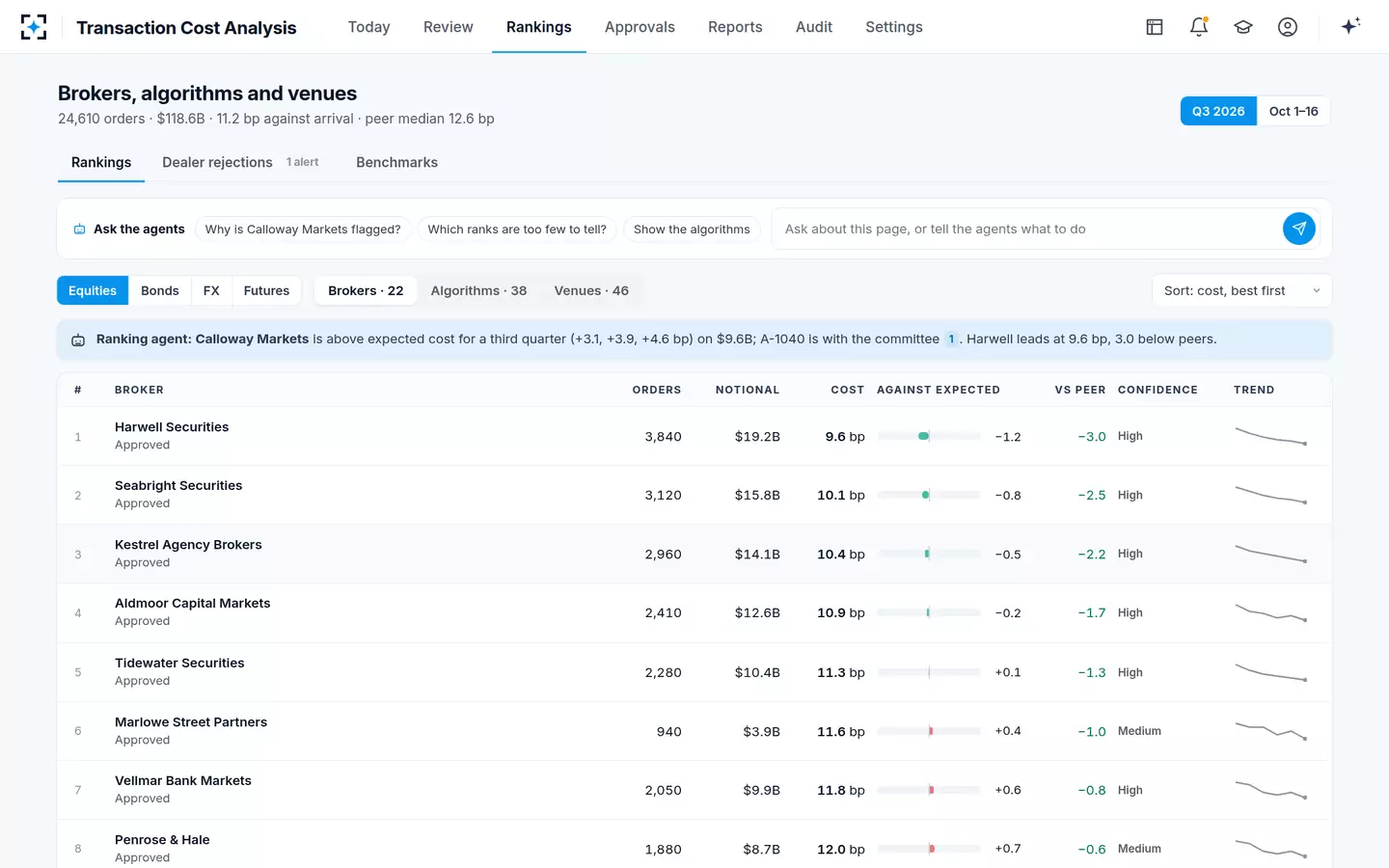
Agents in the solution never change routing or algo-wheel weights; the decision on the sample broker, moving it to a watch list and cutting its wheel weight from 8% to 4%, is a proposal for the committee to vote on. Which benchmark each order should be judged against before any of this comparison begins is the subject of VWAP vs arrival price. The full workflow is on the Transaction Cost Analysis page.
Questions people ask
What is a not-held order?
A not-held order gives the broker discretion over the time and price of execution, so the broker is not held to the market at the moment it receives the order. Algorithmic and worked institutional orders are typically not held. Rule 605 excludes them from its covered orders; Rule 606(b)(3) exists to cover them.
Is a Rule 606(b)(3) report public?
No. It is delivered only to the customer that requested it, about that customer's orders. The public routing report is the quarterly Rule 606(a) report on held orders, and the public execution-quality report is the monthly Rule 605 report.
What is the difference between Rule 605 and Rule 606?
Rule 605 measures execution quality: spreads, price improvement and speed, monthly, for covered orders a firm received. Rule 606 discloses routing: where orders were sent and on what terms. Rule 606(b)(3) adds a customer-specific report for not-held orders, including fill rates and where within the spread orders executed.
When were the first amended Rule 605 reports due?
Firms began collecting the data on August 1, 2026, and reports are due within one month after the end of the month they cover, so reports for August 2026 were due by the end of September 2026. The compliance date had been extended from December 14, 2025.
Can a broker charge for a Rule 606(b)(3) report?
The rule requires the broker to disclose the report on request within seven business days and says nothing about a fee. It is a regulatory disclosure owed to the customer, subject only to the exceptions in paragraphs (b)(4) and (b)(5).