AI transaction cost analysis applies agents to the work around the TCA number: gathering orders, fills and quotes from the desk's systems, choosing each order's benchmark from the execution policy, computing and splitting the cost, writing in plain words why an expensive order cost what it did, and having a second, independent agent recompute it. Done well, it gives a desk something a TCA report never has, the reason behind each cost with every figure linked to its source, the morning after the trade. Done badly, it produces fluent explanations no one can check and lets software move broker flow. The difference is in the controls: what each agent may not do, how its numbers are verified, and where a person signs. Botminds' Transaction Cost Analysis is built around those controls: eight agents work overnight, and every acceptance, broker action and method change is a person's decision on the record.
The trace below is the solution running on sample data for a fictional asset manager, Quillfield Capital, and fictional banks; the regulatory sources are linked where they appear.
One order through AI transaction cost analysis, and what each step may never do
Agent
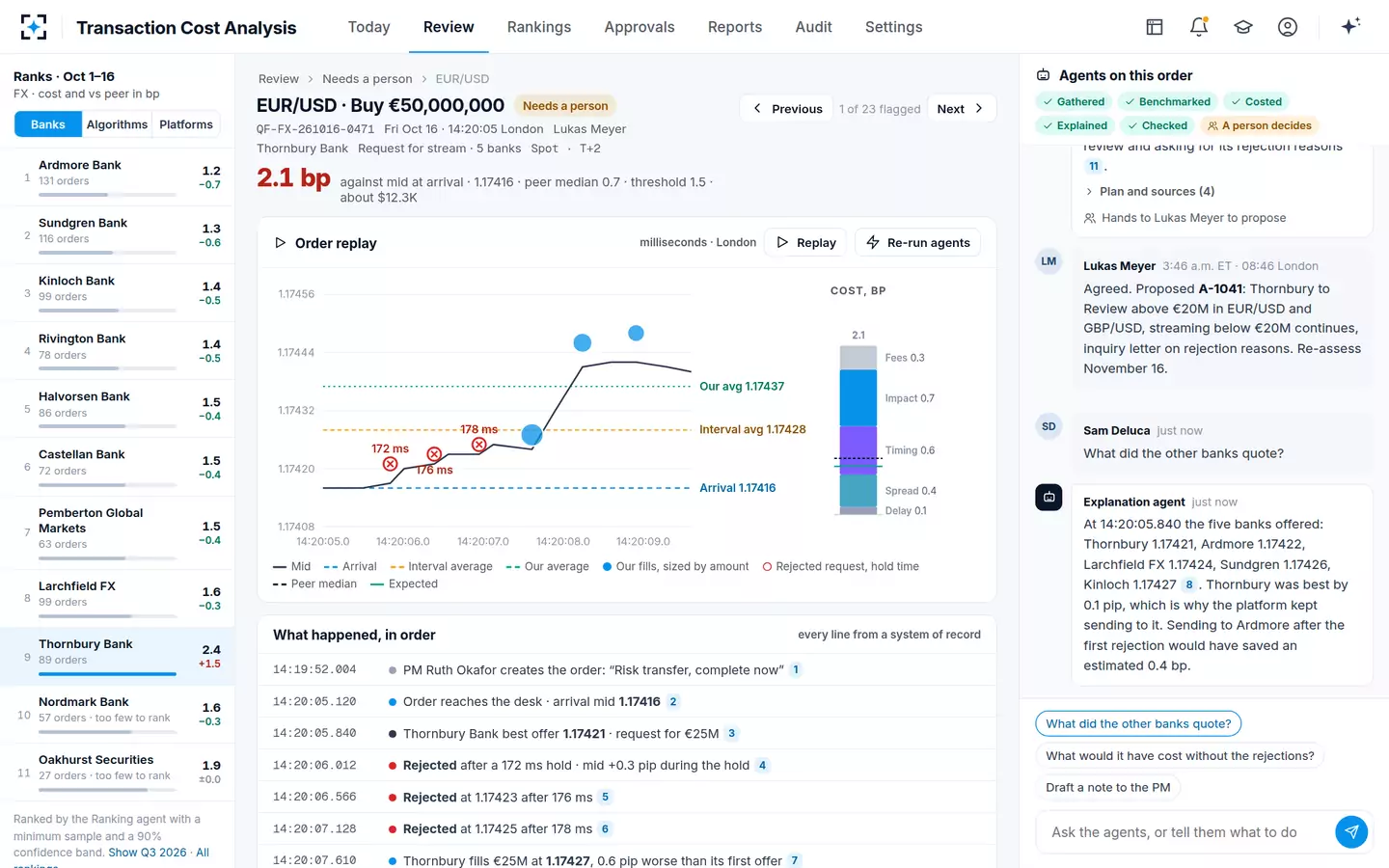
Data agent gathers and ties the recordPulls 3 fills from the FIX drop copy and 6 trade requests from the FX platform's log, 3 of them rejected; ties 9 events to the execution management system.
Never: fills in a missing number or writes to a system of record
Agent
Benchmark agent picks the fair benchmarkMid at arrival, 1.17416: the portfolio manager asked for a risk transfer, "complete now", so this is not a fix order and the policy's arrival benchmark applies.
Never: changes the methodology
Agent
Cost agent computes and splits the cost2.1 bp: delay 0.1, spread 0.4, timing 0.6, impact 0.7, fees 0.3, against a peer median of 0.7 and a threshold of 1.5.
Never: compares outside a like-for-like peer bucket
Agent
Explanation agent writes whyOne bank showed the best offer, rejected three requests while the price rose, then filled 0.6 pip worse; without the rejections the order would have cost about 0.8 bp.
Never: invents a reason, or accepts its own explanation
Agent
Checker agent recomputes independentlyRecomputes from the raw fills on a different model family: 2.09 bp. Confirms the 172, 176 and 178 ms holds and agrees with the explanation.
Never: sees the other agents' confidence first
Agent
Anomaly agent looks beyond the orderFinds the bank rejecting 16.8% of requests since 1 October after raising its last-look window to 200 ms, and drafts an inquiry letter.
Never: changes routing or panels, or contacts a bank
A person decides
Head of trading decides on the explanationReads the replay and the thread, asks what the other banks quoted, opens the rejection log, then accepts, edits or rejects the explanation.
A person decides
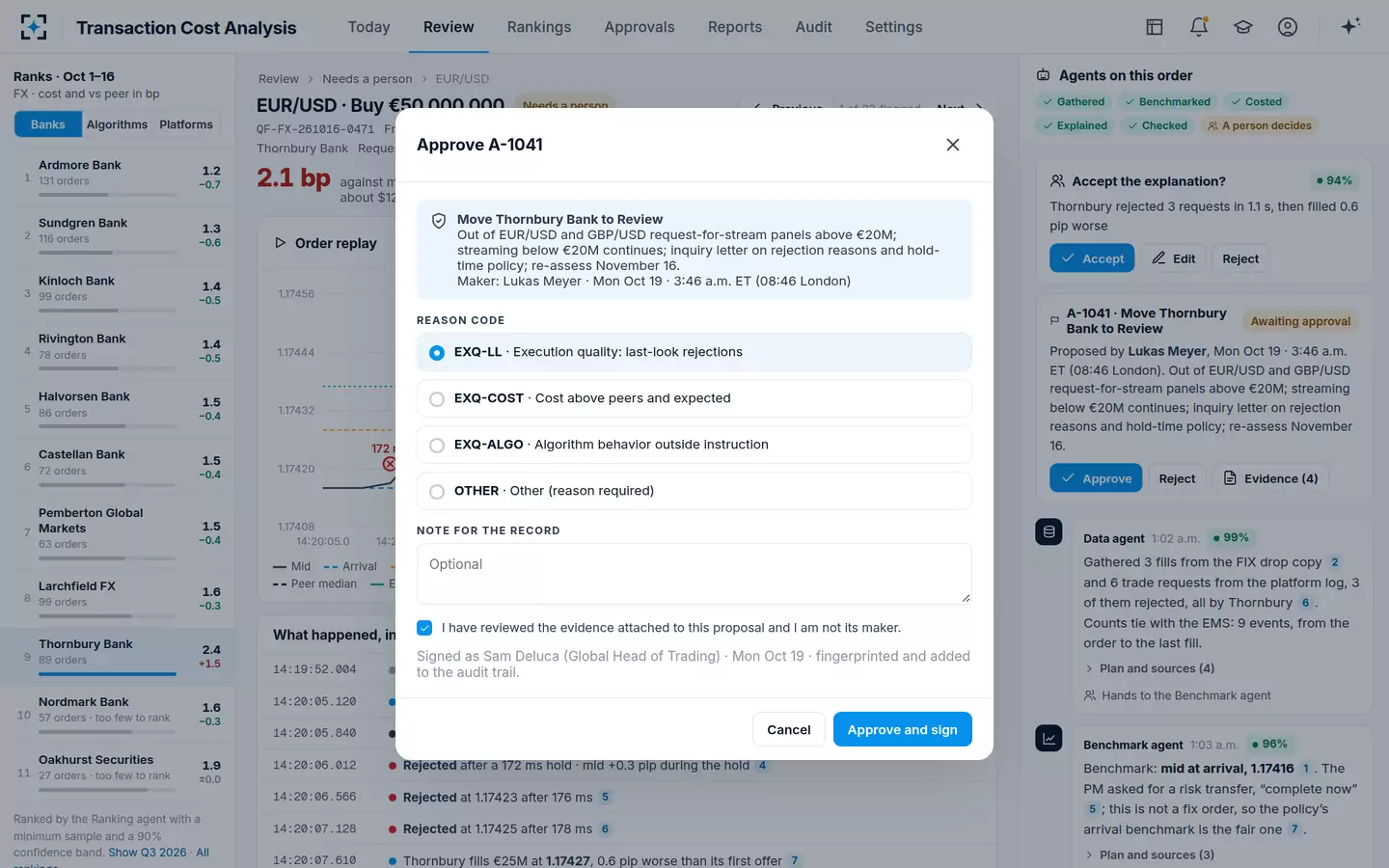
Trader proposes, head of trading approvesThe FX trader proposes moving the bank to Review above €20 million; the head of trading approves with a reason code and attests he is not the maker; the committee ratifies.
How does AI do transaction cost analysis?
It divides the work into steps a person can audit and gives each step to an agent with a narrow job and written limits. The calculation itself is old and simple; what AI changes is the work around it. Gathering and tying data across an order management system, an execution system, FX platforms, bond request-for-quote logs and market data is slow by hand. Choosing the right benchmark for a fix order, a market-on-close order or a stale-priced bond needs the instruction and the policy side by side. Writing why a cost was high means reading trader notes, news, halts and exchange notices, some of them in Japanese or Italian.
Each of those is a task a language model can do quickly and a person can check if the output points to its source. That condition is the whole design. An agent's sentence about a cost is worth something only if the figure in it can be clicked through to the line of the FIX drop copy, the platform log or the market data it came from.
The overnight trace for the sample order, as the audit trail records it
| Time, New York | Who | What was recorded |
|---|---|---|
| 1:02 a.m. | Data agent | Gathered 652 orders and 8,114 fills for Friday; counts tie with the execution system and FIX drop copy |
| 1:04 a.m. | Benchmark agent | Set benchmarks for 652 orders; replaced a stale evaluated price on one bond order |
| 1:11 a.m. | Explanation agent | Explained 22 of 23 flagged orders; asked an equity trader about the last |
| 1:13 a.m. | Checker agent | Recomputed all 23 flagged orders: 22 tie, 1 differs by 1.9 bp and goes to a person |
| 1:15 a.m. | Anomaly agent | Bank rejecting 16.8% of requests since 1 October after lengthening its hold window to 200 ms |
| 1:18 a.m. | Anomaly agent | Drafted an inquiry letter citing the FX Global Code; needs the head of trading's approval |
| 1:30 a.m. | Report agent | Drafted the committee brief |
| 3:46 a.m. (08:46 London) | FX trader | Proposed A-1041: move the bank to Review above €20 million; streaming below continues; re-assess 16 November |
| Morning | Global head of trading | Approved A-1041 with reason code EXQ-LL and the not-the-maker attestation; the committee ratifies on Thursday |
What can an AI agent explain that a TCA report cannot?
The reason, with its evidence, on the day. A TCA report says the EUR/USD order cost 2.1 basis points against a peer median of 0.7. The agents say why: the bank with the best offer rejected three requests after holds of 172 to 178 milliseconds while the price rose, then filled 0.6 pip worse, and its own disclosure dated September 28 had raised its maximum window from 50 to 200 milliseconds. Each of those figures links to the platform's log or the bank's document.
They can also answer the next question. Asked what the other banks quoted, the Explanation agent read the quote log: at 14:20:05.840 the five offers ranged from 1.17421 to 1.17427, the rejecting bank was best by 0.1 pip, and sending to the runner-up after the first rejection would have saved an estimated 0.4 basis points. A report cannot be asked a follow-up question; an agent with access to the record can, and the question and answer go on the audit trail.
Asking the agents about one order in Transaction Cost Analysis
How are an AI agent's TCA numbers checked?
By an independent recomputation, a tolerance and a person. In the solution, the Checker agent recomputes every cost and its split from the raw fills, on a different model family from the agents it checks and without seeing their confidence first, and it tests each explanation against the market record. If its figure differs by more than 1.0 basis point, the order goes to a person. On the sample Friday, 22 of 23 flagged orders tied; the 23rd, a bond where the two agents built fair prices 1.9 basis points apart, went to the head of trading with both figures and their inputs.
Three design choices make the check worth having. Independence: a second agent that reads the first agent's answer before computing its own tends to agree with it. Diversity: a different model family is less likely to share the same blind spot. And a threshold written into policy, so that a disagreement is never resolved by whichever agent sounds more confident.
A TCA report and an agentic TCA run, on the same expensive order
A monthly TCA report: Weeks after the trade
An agentic TCA run: Overnight; ready before the desk opens
A monthly TCA report: One per asset class, applied to every order
An agentic TCA run: Chosen per order from the policy and the instruction, with a sentence on why
A monthly TCA report: None; rebuilt later if someone asks
An agentic TCA run: Written in plain words, every figure linked to its source
A monthly TCA report: None until the quarterly review
An agentic TCA run: Recomputed by a second agent; disagreement above 1.0 bp goes to a person
A monthly TCA report: An email to the analyst
An agentic TCA run: A question typed under the order, answered from the record and logged
A monthly TCA report: A meeting, then an email
An agentic TCA run: A trader's proposal, approved by someone else with a reason code
Can AI change brokers or algo-wheel weights?
It should not, and in the solution it cannot. The agents never change routing, panels or algo-wheel weights, never contact a dealer or a client, and never accept their own work; connections to systems of record are read-only. The Anomaly agent drafts an inquiry letter; it cannot send it. The Ranking agent labels a rank "too few to tell" rather than ranking on noise. A change to a broker's status or wheel weight is a person's proposal, approved by a different person, and broker actions go to the best execution committee to ratify. The same boundary, applied to the committee's own review, is described in best execution AI tools: agents that ask the trader.
The reason is accountability, not caution for its own sake. A broker change has commercial and fiduciary consequences, and the firm must be able to say who decided and why. FINRA's 2026 report suggests that firms deploying AI agents decide how they will monitor what the agents can reach, where a person stays in the loop, how agent actions are tracked, and what guardrails limit them (FINRA, 2026 Annual Regulatory Oversight Report, December 2025). Read-only connections and a maker-checker rule are the simplest guardrails there are.
A broker action in Transaction Cost Analysis: proposed by one person, approved by another
How to audit an AI explanation of trading cost
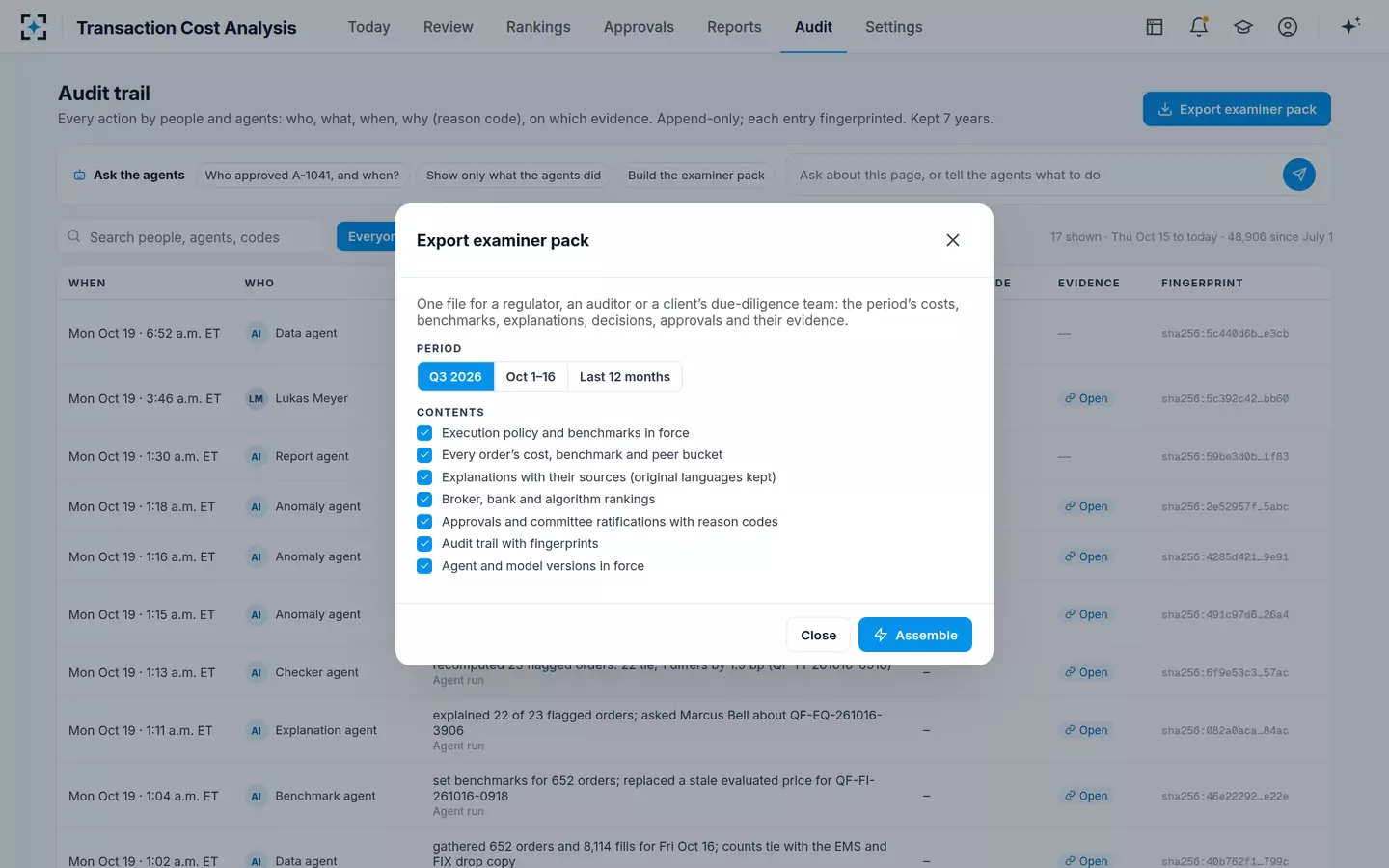
Audit it the way you would audit an analyst's: check the figures against the source, check the reasoning against the market record, and check who accepted it. That requires a record of what the agent saw and did. FINRA's oversight report counts keeping logs of prompts and outputs, and recording which model version produced each output, among the practices it has seen work for generative AI. An explanation without its inputs and the model version behind it cannot be reproduced, and one that cannot be reproduced cannot be audited.
The solution's examiner pack is built for that request. For a chosen period it assembles the execution policy and benchmarks in force, every order's cost, benchmark and peer bucket, the explanations with their sources in the original languages, the rankings, every approval and committee ratification with its reason code, the audit trail with fingerprints, and the agent and model versions in force.
The audit trail and examiner pack in Transaction Cost Analysis
What do regulators expect of AI agents in trading?
That existing rules still apply, that the firm understands how the tools affect outcomes, and that it can supervise what the agents do. FINRA has said its rules are technologically neutral and apply when members use generative AI (FINRA, Regulatory Notice 24-09, June 2024). Its 2026 report adds a domain warning that fits TCA closely: a general-purpose agent may not know a specialised field well enough to do complex, industry-specific work reliably. Choosing a benchmark from an execution policy, or telling a halt from an algorithm breach, is exactly that kind of work.
The SEC's examination staff, setting their priorities for fiscal year 2027 on October 23, 2026, described what they call "super intelligence" (SI) as already at work in firms, from drafting and coding to advisory and portfolio management, and said the Division is stepping up its work to understand how these tools change outcomes as they become part of daily processes (SEC, FY2027 priorities; how asset managers are using AI reads that section in full). For TCA the consequence is direct:
If an agent's explanation of a cost can change which broker gets the next order, the firm must be able to show how that explanation was reached, checked and accepted.
Bank supervisors have drawn a boundary rather than a rule. The interagency model risk guidance issued on April 17, 2026 leaves generative and agentic AI outside its scope, calling them new and fast-changing, while expecting a banking organisation's own risk management to govern tools the guidance does not cover (SR 26-2, attachment; letter). For an asset manager the practical reading is the same: there is no AI-specific TCA rule, so the firm's own controls, written down and evidenced, are what an examiner will test.
What to ask before you buy AI transaction cost analysis software
Ask what the agents may not do, how their numbers are checked, and what you can show an examiner. The checklist below works for any vendor, including us. TCA vendors compared on one order sets agentic TCA beside a traditional provider and an in-house build.
Ten questions for any AI TCA software vendor
- Can every figure in an explanation be clicked through to its source record?
If not, the explanation is a summary, not evidence.
- Who checks the numbers, and is the checker independent?
A second computation on a different model, blind to the first one's confidence, is the minimum.
- What happens when the two disagree?
There should be a written tolerance and a person who decides.
- What may the agents never do?
Change routing, panels or wheel weights; contact brokers or clients; accept their own work.
- Are connections to your systems read-only?
An agent that can write to the order system is a different risk.
- Does the agent ask when it cannot explain a cost?
An agent that always has an answer will sometimes invent one.
- How are benchmark and threshold changes made?
By proposal, back-tested, approved by compliance and the head of trading, never by the vendor.
- Are prompts, outputs and model versions logged?
FINRA lists both as effective practices for generative AI.
- Does it cover bonds and FX, with their own benchmarks?
Stale evaluated prices and last-look rejections are where TCA is weakest.
- Can you run it on a past month of your own orders before you decide?
A back-test on your own fills is the only demo that counts.
Where AI transaction cost analysis fits, and where it does not
Agentic TCA fits a desk that has a written execution policy, trades more than liquid equities, and wants every expensive order explained and independently checked before the desk opens, with people making every decision. It does not fit a firm that wants software to change its routing automatically, or one with no execution policy for the agents to apply, because the agents apply the firm's rules rather than invent them.
The solution also answers the last question in the checklist directly: it can be run on a past month of a firm's own orders, fills, FX rejection logs and bond quotes, connected read-only, with the benchmarks read from the firm's policy and a past quarter back-tested before it goes live. The firm sees its own outliers explained, and can compare the reasons with what its traders remember. FX TCA and last look and fixed income TCA show the agents on the two hardest markets. The full workflow is on the Transaction Cost Analysis page.
Questions people ask
Can AI do transaction cost analysis on its own?
It can do the gathering, the calculation, the first-draft explanation and an independent check. It should not decide which explanations are accepted, change the method or act on brokers. In the solution, each of those is a person's decision recorded with a reason code.
How does AI read exchange notices in other languages?
The Explanation agent reads trader notes, news, halts and exchange notices in the original language and shows the original beside the English. In the sample, a special quote in Tokyo and a volatility auction in Milan explained two equity orders, each read from the exchange's own notice.
Does AI TCA replace the TCA provider?
Not necessarily. The solution works with the peer universe and pre-trade model a desk already has; a firm that relies on a provider for peer data can keep it. What changes is who gathers the data, applies the benchmarks and writes the reasons.
What is an AI hallucination in TCA, and how is it caught?
A fluent reason that the record does not support, such as a halt that never happened. FINRA describes hallucinations as information that is inaccurate or misleading yet presented as fact. They are caught by requiring a citation for every figure, testing each explanation against the market record with an independent agent, and asking the trader when nothing explains the cost.
Does the FX Global Code say anything about AI?
Not about AI as such. It sets expectations that apply whoever does the analysis: banks using last look should disclose how it works and the typical decision time, which is what an agent reading a bank's disclosure checks against the platform's log (FX Global Code, Principle 17).