A trading analyst on a buy-side desk measures and explains the cost of the firm's trading. The job description usually reads: gather orders, fills, quotes and market data; compute each order's cost against a fair benchmark; investigate the expensive ones with the traders; rank brokers, algorithms and venues; and prepare the evidence for the best execution committee, compliance and clients. It sits between the traders, who execute, and the head of trading, who decides which brokers and algorithms get the flow. Most of the hours go on reconciliation and on rebuilding the reason behind an outlier from execution notes and memory, which is the part least related to the analyst's judgment. Botminds' Transaction Cost Analysis is built for that seat: its agents gather the data, cost every order, draft the reasons with every figure cited and check each other overnight, and the analyst and traders start the day with what needs a person.
Pay and employment figures come from the US Bureau of Labor Statistics, linked where they appear. Product figures are the solution's sample data on a fictional asset manager, Quillfield Capital, its fictional staff and brokers, and the solution's own estimates.
Three seats on the desk: what changes, and what stays theirs
Today
Matches fills to orders, fixes benchmarks for fix, close and stale-priced bond orders, and rebuilds the reason for each expensive order from EMS notes and chat.
With agents
Starts from orders already costed and explained, with every figure linked to its source; reviews the agents' disagreements and the method.
Still theirs: Owning the benchmark rules, proposing method changes, and challenging any explanation that does not hold up.
Today
Learns at month end that an algorithm ran ahead of its instruction.
With agents
Sees the same morning that a VWAP algorithm traded 31% of volume against a 12% cap, with the replay and a drafted broker question.
Still theirs: Deciding whether to raise it with the broker, and making the proposal.
Today
Reads a monthly report with costs and no reasons, and decides broker changes in a meeting.
With agents
Reads what the agents found overnight, asks follow-up questions, accepts checked explanations and approves traders' proposals.
Still theirs: Every approval, signed with a reason code, and never on a proposal they made.
What does a trading analyst do?
A trading analyst turns the desk's execution records into evidence: what each order cost, why, and what should change. The data work is the foundation. The SEC observed in 2003 that, to meet their best execution responsibilities, many fund advisers already gathered "a substantial amount of data about transaction costs and execution quality", including "trade decision time, time orders are given to brokers, trade execution time and price" (SEC, 68 FR 74820, December 24, 2003). Two decades later the list is longer: FIX drop copies, child-order routes, FX platforms' rejection logs, bond request-for-quote records, evaluated prices.
The analysis is where the seat earns its place. The analyst decides which benchmark applies to which order, which peer group an order belongs in, and whether an outlier is the broker, the market or the instruction. Those judgments feed the decisions that matter: which brokers stay on the list, which algorithms keep their share of the wheel, and what the committee is told. The research says the stakes are real. Anand, Irvine, Puckett and Venkataraman found that "trading-desk skill is positively correlated with the performance of the institution's traded portfolio" (Review of Financial Studies, 2012), and Berkowitz, Logue and Noser found costs that "vary slightly across brokers and significantly across money managers" (Journal of Finance, 1988).
What does a buy-side trader do, and how the two seats differ
A buy-side trader executes the portfolio managers' orders; the trading analyst measures how well that was done. The Bureau of Labor Statistics files traders under securities, commodities and financial services sales agents and describes them plainly: "Securities and commodities traders carry out buy and sell orders for stocks, bonds, and commodities from clients" (BLS, Occupational Outlook Handbook). On an asset manager's desk the client is the firm's own funds, and the trader chooses the broker, the algorithm, the pace and the venue.
The two seats need each other and pull against each other. The trader knows why an order was worked the way it was; the analyst has the numbers that make that reason checkable. When the explanation lives only in the trader's memory, the analyst spends days chasing it, and the committee gets a number without a reason. When the reason is written down at the time, with its evidence, the analyst's job becomes testing it.
A week of TCA, hour by hour
Most of a trading analyst's week goes on work that is necessary and unremarkable. A typical week runs like this. Monday morning goes on last week's late bookings and allocations, so the counts tie. Monday afternoon and Tuesday go on the outliers: the order that cost three times its estimate, the bond whose evaluated price was two days old, the FX order a bank rejected three times. Wednesday goes on chasing traders and brokers for reasons. Thursday goes on broker and algorithm scorecards. Friday goes on the committee pack and a client's quarterly TCA report.
A trading analyst's TCA week in hours, by hand and with the agents
- Matching fills, routes, FX and RFQ logs5.5 h
- Fixing benchmarks3.7 h
- Rebuilding reasons for expensive orders9.2 h
- Dealer rejection logs and disclosures3.7 h
- Scorecards3.7 h
- Committee, client reports, decision record5.5 h
- Checking matching, benchmarks, dealer logs, scorecards2.5 h
- Reasons, committee and clients3.6 h
The largest single block, rebuilding the reasons, is also the one that matters most to the committee. With the agents the analyst still spends time there, but on the cases where the agents disagree or where nothing in the market record explains the cost, and the Explanation agent has asked the trader rather than guessed. The hours saved elsewhere are the clerical ones.
Where a month of TCA work goes, by the solution's estimate
By hand: 17 working days
- Matching · 18%
- Benchmarks · 12%
- Reasons · 29%
- Dealer logs · 12%
- Scorecards · 12%
- Committee and clients · 17%
With the solution: 3.3 working days
- Matching · 6%
- Benchmarks · 9%
- Reasons · 30%
- Dealer logs · 9%
- Scorecards · 15%
- Committee and clients · 31%
What skills does TCA work need?
TCA work needs four skills: data handling, market structure, statistics and plain writing. BLS describes the analyst's core as evaluating "financial data and trends", measuring risks and making forecasts "using software" (BLS, Occupational Outlook Handbook, financial analysts). On a trading desk that means SQL or Python over order and fill data, enough of the FIX protocol to read a drop copy, and the habit of tying totals before trusting any average.
Market structure knowledge is what turns numbers into reasons. An analyst has to know how an auction or a trading pause changes an equity order, why a bond's evaluated price goes stale, what last look is and why a rejection costs money, and how a routing report is laid out. Statistics keeps the rankings honest: peer groups, sample sizes, confidence bands, and the discipline to say "too few to tell". Writing matters more than most job descriptions admit: a committee acts on a two-sentence reason, not on a scatter plot.
Who does a trading analyst report to?
Usually to the head of trading, with a working line to compliance and the best execution committee. The reporting line matters because the analyst's findings can embarrass the desk that employs them. A committee that wants independent evidence should see the analyst's work directly, and a firm should be able to show that a finding about a trader's execution reached the committee unedited.
The solution builds that separation into the workflow rather than the org chart. Traders propose broker actions; the head of trading approves them with a reason code and an attestation that they are not the maker; the committee ratifies. Benchmark and threshold changes need compliance first and the head of trading second. Every step, including each question asked of the agents, is on an append-only audit trail.
How much do traders and trading analysts earn?
The Bureau of Labor Statistics does not publish a separate trading analyst occupation, so the closest public figures come from two occupations. For securities, commodities and financial services sales agents, which include traders, "The median annual wage ... was $78,660 in May 2025", and $103,030 in the securities, commodity contracts and other financial investments industry. For financial and investment analysts the median was $102,740 in May 2025, and $124,370 in the same securities industry (BLS).
Traders and analysts in the BLS data, May 2025
$124,370
median pay, financial and investment analysts, securities and investments industry
$103,030
median pay, securities sales agents including traders, same industry
7%
projected growth for financial analysts, 2025–2035
1%
projected growth for securities sales agents including traders, 2025–2035
The projections tell a story of their own. Employment of financial analysts is projected to grow 7% from 2025 to 2035, with about 29,500 openings a year; securities sales agents, the occupation that includes traders, 1%. BLS gives one reason directly: "automated trading systems have reduced demand for securities traders."
Will AI replace the trading analyst?
AI will take most of the analyst's clerical hours; it should not take the judgments the committee relies on. Gathering and tying data, applying benchmark rules, drafting reasons from the market record and producing the reports are work that agents can do overnight and a second agent can check. Deciding the method, settling disagreements, challenging a weak explanation and owning what the committee is told are not, and a firm that let agents make those calls would be unable to say who decided.
The solution draws the line in its rules. Agents never change the methodology, never accept their own explanations, never change routing, panels or algo-wheel weights, and never contact a broker or client. When the Checker agent's figure differs from the Cost agent's by more than 1.0 basis point, a person decides, and when nothing in the market record explains a cost, the Explanation agent asks the trader instead of guessing. AI transaction cost analysis, traced step by step follows one order through those rules.
What the analyst's morning becomes in Transaction Cost Analysis
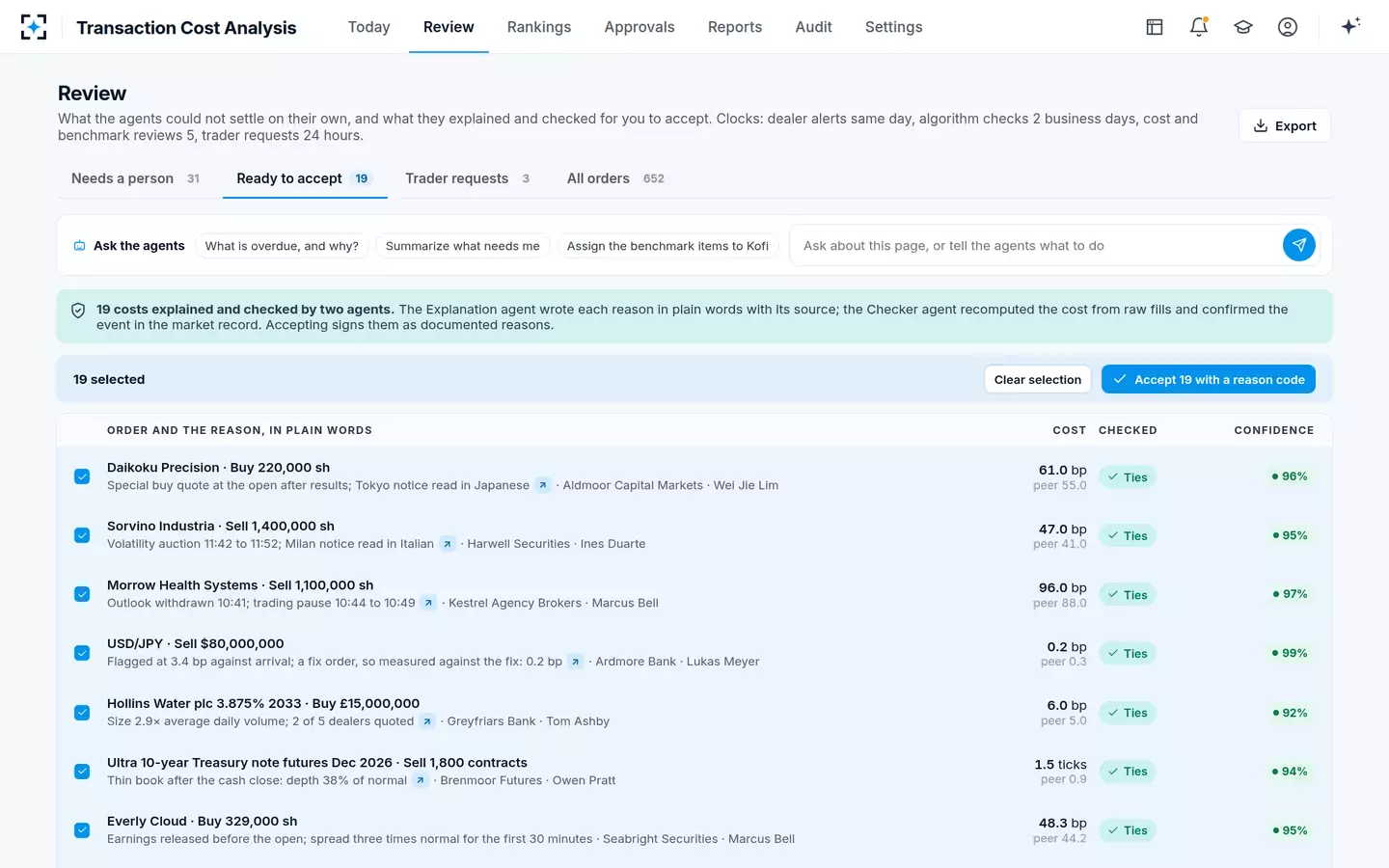
A trading analyst job description you can use
The checklist below is a job description for a buy-side TCA analyst that assumes agents do the data gathering and first drafts. It is written to be edited: remove what your desk does not trade, and add the systems you use.
Trading analyst (TCA) job description: responsibilities and requirements
- Own the benchmark rules in the execution policy
By asset class and instruction; propose changes with a back-test on the last quarter.
- Review every order above threshold each morning
Accept, edit or reject the explanation; ask the trader when nothing in the record explains the cost.
- Settle disagreements between the measurement and the check
Decide which fair price or cost stands, with a reason, when two computations differ beyond tolerance.
- Watch dealers, algorithms and venues for changes
Reject rates, hold times, participation against instruction, markouts; bring changes to the trader the same day.
- Maintain broker, algorithm and venue rankings
With sample sizes and confidence labels; refuse to rank on too few orders.
- Request and read public execution data
Rule 606(b)(3) routing reports from each broker every six months, and Rule 605 reports.
- Prepare the committee pack and client TCA reports
Every figure tied to the order record; client reports go out only after the head of trading approves.
- Keep the evidence an examiner will ask for
Policy, benchmarks, costs, reasons, approvals and the audit trail, by period.
- Skills: SQL or Python, FIX, market structure across equities, bonds and FX
Plus statistics for peer groups and confidence, and clear written English.
- Reports to the head of trading; presents to the best execution committee
With direct access to compliance for findings about the desk itself.
Two items on that list reach beyond the desk's own data. The routing reports are covered in the Rule 606(b)(3) guide, and the dealer behaviour that most often surprises a new analyst is in FX TCA and last look. For the basics behind every line of the job, start with what transaction cost analysis measures. The full workflow is on the Transaction Cost Analysis page.
Questions people ask
What is the difference between a trading analyst and a quant?
A quant builds models, such as market impact or pre-trade cost models; a trading analyst applies them to the desk's real orders, measures the results and explains the outliers. On smaller desks one person does both. The analyst's distinctive work is the reason behind each cost and the evidence the committee sees.
What qualifications does a trading analyst need?
Most come with a degree in finance, economics, mathematics or a technical subject; BLS lists a bachelor's degree as the typical entry level for both related occupations. Practical skill with data tools and an understanding of market structure matter more on the job than any single credential.
Is a trading analyst a front-office role?
Usually it sits in the front office, on or next to the trading desk, because the work depends on talking to traders the same day. Some firms place TCA in a middle-office or risk function for independence. Either way, the committee should receive the analyst's findings directly.
What does a trading analyst do in their first week?
Learn the execution policy and its benchmark rules, the systems that hold orders, fills and quotes, and which brokers and algorithms get the flow. Then tie one week of orders to fills end to end. An analyst who can reconcile a week by hand understands what the agents' counts mean when they say they tie.
How many trading analysts does a desk need?
No public benchmark exists. It depends on order volume, the number of asset classes and how much of the data work is automated. The solution's estimate for a multi-asset desk is that a month of post-trade TCA falls from 17 working days by hand to 3.3 with the agents, an estimate rather than a measured result.