Fixed income TCA measures what a bond trade cost against a fair price for that bond at the moment it traded, and its accuracy depends almost entirely on that price. Equities have a consolidated quote to measure against; most bonds trade a few times a week or less, so the benchmark is usually an evaluated price from a pricing service, the dealer quotes the desk received, the last TRACE print, or a price moved from a similar bond along the curve. When the evaluated price is a day or two old, the same trade can look three times as expensive as it was. The research is clear on the rest: bond trading costs fall with trade size, with post-trade transparency and with competition among dealers, so a fair comparison must hold those constant. Botminds' Transaction Cost Analysis builds a fair bond price whenever the evaluated price is stale, states its inputs and confidence, has a second agent compute its own, and sends the order to a person when the two disagree.
The research and regulatory sources are linked where they appear. The worked example is the solution's sample data on a fictional asset manager, Quillfield Capital, and fictional issuers and dealers.
Equity TCA and fixed income TCA, row by row
Equity TCA: Arrival price from the consolidated quote, or VWAP from the consolidated tape
Fixed income TCA: A fair price for the bond at trade time: evaluated price, dealer quotes, last prints, or a curve-adjusted price
Equity TCA: Firm, displayed quotes on many venues
Fixed income TCA: Request-for-quote responses, often from a handful of dealers; many bonds have no live quote
Equity TCA: Every trade printed in real time
Fixed income TCA: TRACE prints within 15 minutes for corporate and agency bonds; many bonds print rarely
Equity TCA: Same stock or size bucket, same participation
Fixed income TCA: Same rating, maturity bucket, size bucket and liquidity tier
Equity TCA: Usually execution: pace, venue, algorithm
Fixed income TCA: Often the benchmark: a stale price can make a good trade look poor, or hide a poor one
How does TCA work for bonds?
Bond TCA compares each fill with a fair price for the bond at trade time, then compares the cost across dealers, protocols and peer trades of similar rating, maturity and size. The steps are the same as in equities. The difference is that the first step, the benchmark, has to be built rather than read, and the method used to build it has to be written down for every trade.
FINRA's best execution guidance describes why. Pre-trade pricing information in bonds has grown, it said in 2015, but "it is still relatively limited as compared to equities and generally not readily accessible by the investing public", and "the market remains decentralized, with much trading still occurring primarily through individual dealers" (FINRA, Regulatory Notice 15-46, November 2015). A bond desk sends a request for quote to a few dealers, takes the best response and records the next best, the cover. Those quotes are the best real-time evidence it will get, and they come from the counterparties it is trying to evaluate.
Why the fair price decides fixed income TCA
In bonds the benchmark is the biggest source of error, so the fair price decides whether the cost figure means anything. Take a sample sale run through the solution: $25 million of the fictional Ashgrove Utilities 5.10% 2036, sold to the best of four bids at 99.42 after a request for quote to six dealers, with the cover at 99.38. The evaluated price on file was 99.71, two business days old; the last trade printed at 99.64 on the afternoon of October 14.
One bond sale, three fair prices, three costs
Measured against the stale price, the trade looks like an outlier at more than three times the peer median. Measured against a price that reflects two days of market movement, it is a modest premium for size on an afternoon when two of six dealers declined to quote. The difference between the two readings is not about the trader at all.
What benchmark do you use for a bond with a stale evaluated price?
Use a fair price built from the most direct evidence available, in a fixed order, and record which evidence set it. FINRA's markup rule for dealers gives a ready-made hierarchy for the same problem, determining the prevailing market price of a debt security. It starts from the dealer's contemporaneous cost; where that is not available, "a member must consider, in the order listed, the following types of pricing information": contemporaneous inter-dealer trades, then dealer trades with institutional accounts, then for actively traded securities contemporaneous quotations, then prices of similar securities and, last, economic models (FINRA Rule 2121, Supplementary Material .02).
A fair-price hierarchy for bond TCA, adapted from FINRA's markup rule
| Rank | Evidence | Use in TCA | Watch out for |
|---|---|---|---|
| 1 | Contemporaneous trades in the bond (inter-dealer, then dealer-to-institution) | The fair price, if recent and of similar size | A small print can mislead for a large trade |
| 2 | Firm quotes received on the desk's own request for quote | Bounds the fair price; the cover shows how close the next dealer was | Quotes come from the dealers being evaluated |
| 3 | Evaluated price from a pricing service | The default when current; record its timestamp | Stale after a day without trades or curve moves |
| 4 | Similar bonds: same issuer or rating, comparable spread, coupon, maturity and duration | Move the last price by the similar bonds' change | Similarity must be argued, not assumed |
| 5 | A model: curve plus spread | Last resort, with a confidence label | Model choice can move the result by a basis point or more |
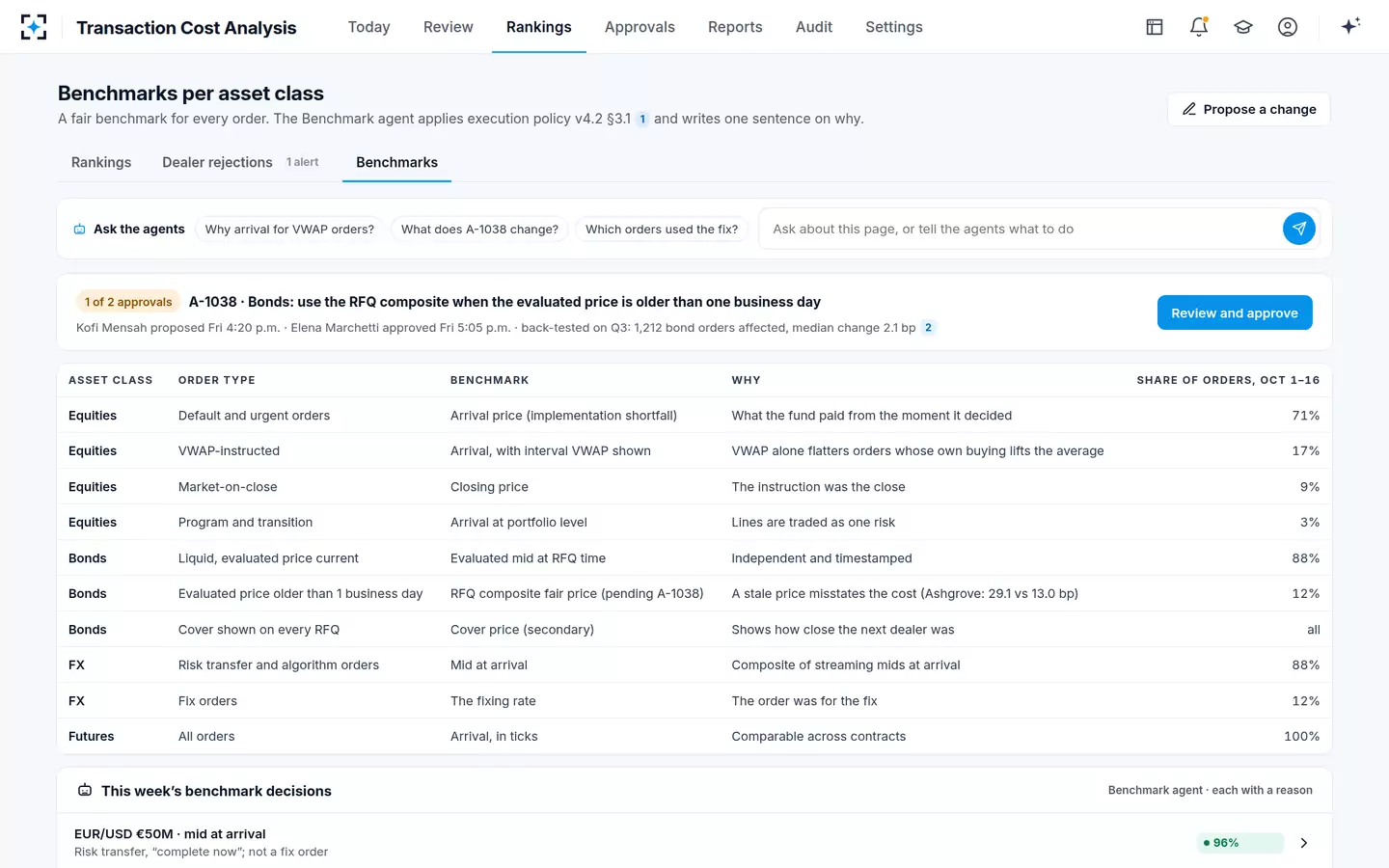
The solution's sample policy makes this concrete. Bonds are measured against the evaluated mid at the time of the request for quote when that price is current, which applied to 88% of bond orders in the first half of October; when the evaluated price is older than one business day, the proposed rule, A-1038, switches to a composite fair price built from the dealer quotes, which applied to the other 12%.
Does TRACE data help fixed income TCA?
Yes, twice: it gives the benchmark recent prints to anchor on, and its existence has lowered the costs being measured. Edwards, Harris and Piwowar, using a complete record of US over-the-counter corporate bond trades, found that "Costs are lower for bonds with transparent trade prices, and they drop when the TRACE system starts to publicly disseminate their prices" (Journal of Finance, 2007). Bessembinder, Maxwell and Venkataraman's working paper on institutional trades estimated "a reduction of approximately 50% in trade execution costs for bonds eligible for TRACE transaction reporting" and a 20% reduction even for bonds that were not eligible (SSRN working paper, 2005; published in the Journal of Financial Economics, 2006).
The controlled experiment is the most careful test. Goldstein, Hotchkiss and Sirri made some BBB bonds transparent and not others, and found that "Except for very large trades, spreads on newly transparent bonds decline relative to bonds that experience no transparency change", but also "no effect on spreads for very infrequently traded bonds" (Review of Financial Studies, 2007). The exceptions are the bonds that make bond TCA hard: very large trades and bonds that hardly trade.
What transparency did to corporate bond trading costs
~50%
lower execution costs for TRACE-eligible bonds in institutional trades
20%
lower even for bonds not eligible for TRACE, a spillover
15min
outer limit for reporting a trade to TRACE, unchanged after 2025
How fast a print reaches the tape matters for a same-day benchmark, and the rule nearly changed. In September 2024 the SEC approved FINRA's plan to cut the reporting limit for fully electronic trades from 15 minutes to one minute; a year later it approved FINRA's request to keep the 15-minute outer limit instead, after members described trades with complex workflows, such as allocations to managed accounts, that could not meet it (SEC, order approving SR-FINRA-2025-008, 90 FR 45283, September 19, 2025). Commenters added that "the vast majority of trades reported to TRACE are reported automatically upon execution and are therefore already reported within one minute." An SEC order published the same day approved the MSRB's return to 15 minutes for municipal trades under Rule G-14 (SEC order on MSRB Rule G-14, 90 FR 45274).
TRACE reporting: the one-minute rule that was approved and then withdrawn
- Report as soon as practicable, no later than 15 minutes after execution15 min
- Fully electronic trades1 min
- Year one 15, years two and three 10, then 5 minutes5 min
How do trade size and rating change bond trading costs?
Costs fall as trade size rises and are lower for highly rated, recently issued and short-dated bonds. Edwards, Harris and Piwowar reported that "transaction costs decrease significantly with trade size" and that "Highly rated bonds, recently issued bonds, and bonds close to maturity have lower transaction costs than do other bonds." That is the opposite of equities, where a larger order pays more impact, and it changes how a peer group must be built.
For a buy-side desk the consequence is that a single bond peer median is close to useless. A $25 million trade in a seasoned BBB utility due in ten years and a $1 million trade in a new AA bank issue due in two years belong to different populations. The sample peer bucket for the Ashgrove sale, investment-grade utilities from $10 million to $25 million, is the kind of grouping a committee can defend; a desk-wide average is not.
Is an RFQ to several dealers enough evidence of best execution?
It is good evidence, not proof. Hendershott and Madhavan found that "periodic one‐sided electronic auctions are a viable and important source of liquidity even in inactively traded instruments" (Journal of Finance, 2015), which supports the multi-dealer request for quote as a way to get competitive prices. But the quotes come from the dealers being evaluated, declines carry information, and a winning bid that beats the cover by a tick can still be far from fair if every dealer knew the bond was hard to place.
FINRA added a caution about displayed prices: those on an electronic platform "may not be the presumptive best price of that security for best execution purposes, especially for securities that are illiquid or trade infrequently." The record a committee needs for each bond trade is therefore the quotes, the declines, the cover, the fair price and the evidence that set it. The duty itself, and how a committee reviews it, is best execution territory; this guide stays with the measurement.
What FINRA says about fixed income best execution
FINRA's position is that the duty applies to bonds as it does to equities, with the method adapted to the market. Regulatory Notice 15-46 covers equities, options and fixed income together, notes that fixed income markets "can vary significantly depending on the specific fixed income product", and expects firms to consider whether pricing information from electronic systems should be part of their policies. For dealers, Rule 2121's hierarchy ties the markup to the prevailing market price, which is why the same hierarchy is a sound starting point for a buy-side benchmark.
For an investment adviser the obligation runs through its own duty to seek best execution for clients, and the evidence is the same: a written method for the fair price, applied consistently, with the exceptions explained. In the solution, a change to that method is a proposal back-tested on the last quarter and approved by compliance and then the head of trading; the sample A-1038 rule, back-tested on the third quarter, changed the measured cost of 1,212 bond orders by a median of 2.1 basis points.
How to compare bond dealers fairly
Compare dealers on trades of the same kind, with enough of them to tell skill from luck, and count what they declined as well as what they won. A dealer that wins many small liquid trades will look cheaper than one that takes the large, hard ones, so cost has to be measured against expected cost for each bucket. Response rates and cover distance tell a desk who is really making markets; a dealer that only quotes when it already has the other side may rank well on cost and still be of little use when liquidity is needed.
Fixed income TCA in the solution: a stale price replaced, and two agents disagreeing
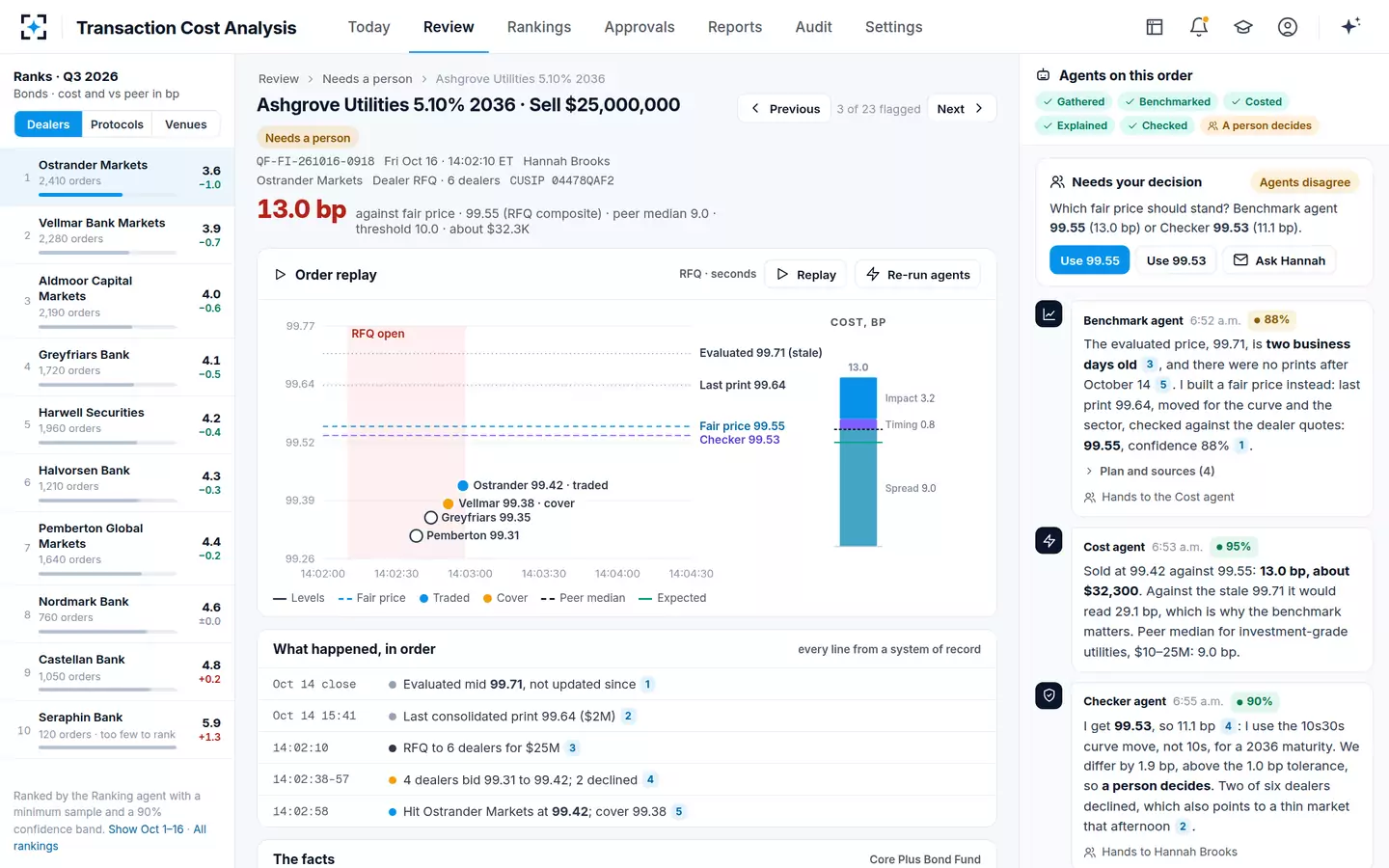
Fixed income TCA in Transaction Cost Analysis: one disagreement, settled by a person
The solution handles the Ashgrove sale in four moves. The Benchmark agent notices the evaluated price has not updated since the October 14 close and that no trade has printed since; it builds a fair price from the last print, moved for the curve and the sector, and checks it against the dealer quotes. Its confidence is 88%. The Cost agent computes 13.0 basis points and notes that the stale price would have read 29.1. The Checker agent, working independently on a different model family, uses a different curve point and lands 1.9 basis points away.
The agents do not average their answers. The question goes to the trader and the head of trading, with both fair prices, their inputs and the dealer quotes on one screen, and whoever decides signs with a reason. The same discipline applies across asset classes: FX TCA and last look covers a market with no consolidated tape at all, and TCA vendors compared shows where bond coverage separates one approach from another. The full workflow is on the Transaction Cost Analysis page.
The benchmark rules behind fixed income TCA, with the stale-price change waiting for a signature
Questions people ask
What is the best benchmark for fixed income TCA?
There is no single one. For bonds with a current evaluated price or recent prints, a mid from those sources is standard; for bonds that have not traded, a fair price moved from the last print by the curve and comparable bonds, checked against the quotes received. The key is a written order of preference and a record of which evidence set each price.
How does fixed income TCA differ for government bonds and corporate bonds?
On-the-run Treasuries trade continuously on electronic platforms, so TCA can use live prices much as in equities. Corporate and municipal bonds mostly trade by request for quote, many of them rarely, so the benchmark has to be built. Off-the-run government bonds sit in between.
What is cover price in bond trading?
The cover is the second-best quote in a request for quote, the price the trader would have got from the runner-up dealer. The gap between the winning price and the cover is a simple measure of competition on that trade; in the sample Ashgrove sale it was four cents per $100 of face value, 99.42 against 99.38.
Can TRACE be used as the benchmark for every bond?
Only for bonds that trade often enough. Goldstein, Hotchkiss and Sirri found transparency had no effect on spreads for very infrequently traded bonds, and for those bonds the last print may be days old. TRACE prints are best used as one input to a fair price, weighted by how recent and how large they were.
Does fixed income TCA cover municipal bonds?
It can, with the same method. Municipal trades are reported to the MSRB's Real-time Transaction Reporting System, also within 15 minutes after the MSRB withdrew a planned one-minute rule in 2025. Many municipal bonds trade very rarely, so the fair-price hierarchy matters even more.