TCA vendors sell one of three things: a third-party provider that takes a firm's execution data and returns costs against benchmarks and a peer universe built from many clients' trades; the components for an in-house build, market data, models and analytics software that the firm's own analysts assemble; or an agentic system that gathers the firm's data, applies its execution policy, explains each expensive order in plain words and leaves decisions to people. On liquid equity orders the three usually agree on the number. They diverge where TCA is hardest: choosing the benchmark per order, pricing a bond whose evaluated price is stale, measuring the cost of FX last-look rejections, and saying why an order cost what it did. Botminds' Transaction Cost Analysis is the third kind; this guide compares all three honestly on one order, including where a traditional provider does something the agents do not.
We describe approaches, not named vendors. The regulatory and central-bank sources are linked where they appear; the worked order is the solution's sample data on a fictional asset manager, Quillfield Capital, and fictional brokers and banks.
Three TCA approaches compared on one order
| Third-party TCA provider | In-house build | Agentic: Transaction Cost Analysis | |
|---|---|---|---|
| The order | €50M EUR/USD risk-transfer buy; one bank rejected three requests before filling 0.6 pip worse | Same | Same |
| Benchmark | Usually one per asset class, often configurable; fix or close orders need flags in the data | Whatever the team codes; often arrival for everything | Chosen per order from the policy and the instruction: mid at arrival, because the order was "complete now", with a sentence on why |
| Cost | 2.1 bp against arrival, ranked against a peer universe | 2.1 bp, against internal history only | 2.1 bp, split into delay, spread, timing, impact and fees, against the pre-trade estimate and peer median |
| Rejections | Only if the provider takes platform request logs as well as fills | Only if someone builds the feed | Read from the platform's millisecond log; reject rate, hold time and asymmetry tracked per bank |
| Reason | Not given; the analyst investigates | Not given; the analyst investigates | Written in plain words, each figure linked to its source |
| Check | Provider's own quality control | Peer review if there is time | A second agent recomputes from raw fills: 2.09 bp; above 1.0 bp of difference, a person decides |
| Time to result | Days to a month, depending on the feed | Depends on the team | Overnight |
| Decision | Outside the tool | Outside the tool | A trader's proposal, approved by someone else with a reason code, ratified by the committee |
What do TCA vendors provide?
A TCA vendor provides some combination of three things: market data to build benchmarks, analytics that compute and split costs, and a peer universe to compare against. The SEC described how the traditional model works in 2018: "customers of third-party TCA providers typically transmit their execution data to their TCA providers. The third-party TCA providers in turn base their models on the data they receive from all their customers" (SEC, 83 FR 58338, November 19, 2018, footnote 688). The peer universe is the provider's distinctive asset: a firm cannot build one from its own trades.
The BIS study group on FX algorithms listed who does TCA in practice: "TCA can be processed by liquidity providers, trading platforms, third-party TCA providers or the end user" (BIS Markets Committee, October 2020). Each has a different interest. A bank's or platform's own TCA is free and convenient, and it is the counterparty grading itself. A third-party provider is independent, and the group noted that such services "typically come at a non-negligible cost and hence may be available only to the most sophisticated users."
Three approaches: provider, in-house, agentic
The choice is about who does the work between the data and the decision. A provider computes the numbers and the firm's analysts do the rest. An in-house team does all of it, with full control and full cost. An agentic system does the gathering, computing, explaining and checking, and people make the decisions. None of them removes the need for a written execution policy, because every approach needs to be told which benchmark applies to which order.
Third-party provider and agentic TCA: what each is strongest at
Third-party provider: Its strength: a peer universe built from many firms' trades
Agentic TCA: Uses the peer universe and pre-trade model the desk already has; does not build one
Third-party provider: Configurable, but depends on flags in the data sent
Agentic TCA: Read from the order's instruction and the policy, with the reason recorded
Third-party provider: Left to the firm's analysts
Agentic TCA: Drafted for every expensive order, cited, then accepted or rejected by a person
Third-party provider: Varies widely by provider
Agentic TCA: Fair bond prices when evaluated prices are stale; last-look logs per bank
Third-party provider: Independent of the firm's brokers
Agentic TCA: Runs on the firm's own data; independence comes from the checker and the maker-checker rule
Third-party provider: Periodic
Agentic TCA: Overnight, before the desk opens
One order through each approach
Take the sample EUR/USD order in the first table. Every approach that has the fills will report roughly 2.1 basis points against arrival and flag it as expensive against a peer median of 0.7. What happens next is where they part. With a provider's report, an analyst sees an outlier, asks the FX trader, who remembers the bank rejecting him, and requests the platform's log; the finding reaches the committee in the quarterly pack, weeks after the bank changed its behaviour.
With the agentic approach, the platform's log is already part of the record. By 1:15 a.m. the Anomaly agent had tied the order to a pattern, 36 of 214 requests rejected since October 1 against a panel median of 0.8%, and to the bank's own disclosure dated September 28 raising its maximum last-look window from 50 to 200 milliseconds. It estimated the cost at $244,000 over 12 trading days and drafted an inquiry letter. By 08:46 London the FX trader had proposed moving the bank to Review on panels above €20 million, and the head of trading approved it in New York that morning. FX TCA and last look follows that bank in detail.
Can one TCA provider cover equities, bonds and FX?
Some cover all three, but the method has to change by asset class, and that is where coverage claims should be tested. Equities have a consolidated quote and tape. Bonds have far less pre-trade price information than equities, as FINRA's best execution guidance acknowledges (FINRA, Regulatory Notice 15-46), so the benchmark is built rather than read. FX has no consolidated tape at all. A provider that applies the equity method to bonds and FX will produce numbers, and the numbers will be least reliable exactly where a desk most needs help.
The solution covers equities, bonds, FX and futures with separate benchmark rules for each: arrival for equities with interval VWAP shown for VWAP orders and the close for market-on-close; the evaluated mid at request-for-quote time for bonds, with a fair price built when it is stale; the mid at arrival for FX, with fix orders against the fix; and arrival in ticks for futures. Fixed income TCA shows why bonds need their own rule.
Why the asset-class method matters when choosing a vendor
29.1bp
one sample bond sale against a stale evaluated price
13.0bp
the same sale against a fair price built from quotes, prints and the curve
3.4 → 0.2bp
a sample FX fix order, against arrival and then against the fix
What data do you have to send a TCA vendor?
For a meaningful result, more than fills. A TCA system needs orders with the portfolio manager's decision time and instruction, child orders and fills with timestamps from the FIX drop copy, commissions and fees, market data for the benchmarks, and for the hard markets the FX platforms' trade request logs and the bonds' request-for-quote records, including cover and declines. The GFXC's data template for algorithmic FX execution was written because, in its words, the findings and feedback "indicated that the bar for market participants to evaluate the performance of algorithmic execution by conducting Transaction Cost Analysis (TCA) is high" (GFXC, TCA Data Template instructions, July 2021).
The question to ask is not only what the vendor needs but where the data goes. A third-party provider receives the firm's execution data, which is how it builds its peer universe. An agentic system reads the firm's systems through read-only connections to the order management system, the execution system, the FX and bond platforms and market data, which is how the solution is set up. Both are legitimate; ask any vendor where the data is held and who else's models it feeds, and choose knowingly.
Should TCA be built in-house?
Build in-house if the firm has the analysts, the data engineering and the market data budget to keep it current, and wants full control of method and data. The cost is easy to underestimate: building the first version is a project, but keeping benchmark data clean across asset classes, adding new platforms, and producing committee and client reports is a permanent team. An in-house build also has no peer universe unless one is licensed.
The FCA's 2014 review of best execution shows a risk common to in-house monitoring: "We frequently found instances of firms comparing their order execution against inadequate or simplistic benchmarks and data, or using unsuitably wide tolerances, rules and alerts" (FCA, TR14/13, July 2014). A build that is never challenged drifts into exactly that. Whatever is built should have written benchmark rules, a change process, and someone other than its author checking its results. The same questions apply to the review layer above the numbers, and twelve questions for best execution monitoring software sets them out.
How to test a TCA vendor's benchmarks before you sign
Give every candidate the same past month of your own orders, including a set of known traps, and compare their answers with what you already know happened. A vendor that gets the traps right on your data will get them right in production; a polished demo on its own data proves nothing. The traps below are the cases where TCA most often goes wrong.
Ten trap orders to include in any TCA vendor test
- A market-on-close order
Should be measured against the close, not arrival.
- An FX order placed for the fix
Should be measured against the fixing rate.
- A VWAP order whose algorithm exceeded its participation cap
Should be expensive against arrival even if it looks fine against VWAP.
- A bond whose evaluated price was two days old
The vendor should notice and build a fair price, or say it cannot.
- An FX order with rejected requests
The rejections should appear, with hold times, not vanish into an average.
- An order partly cancelled
Unfilled shares should count as opportunity cost under implementation shortfall.
- An order during a trading halt or auction
The cost should be explained by the event, not blamed on the broker.
- A program trade
Measured at portfolio level as one risk, as well as line by line.
- A broker with only a few dozen orders
Should be labelled too few to rank, not placed first or last.
- A deliberately wrong timestamp
The vendor should catch the counts not tying rather than produce a number.
Score each vendor on four things: whether the benchmark was right, whether the cost was right, whether the vendor could say why, and whether you could trace each figure to a source record. The fourth is the one an examiner will care about. VWAP vs arrival price explains why the benchmark row matters most.
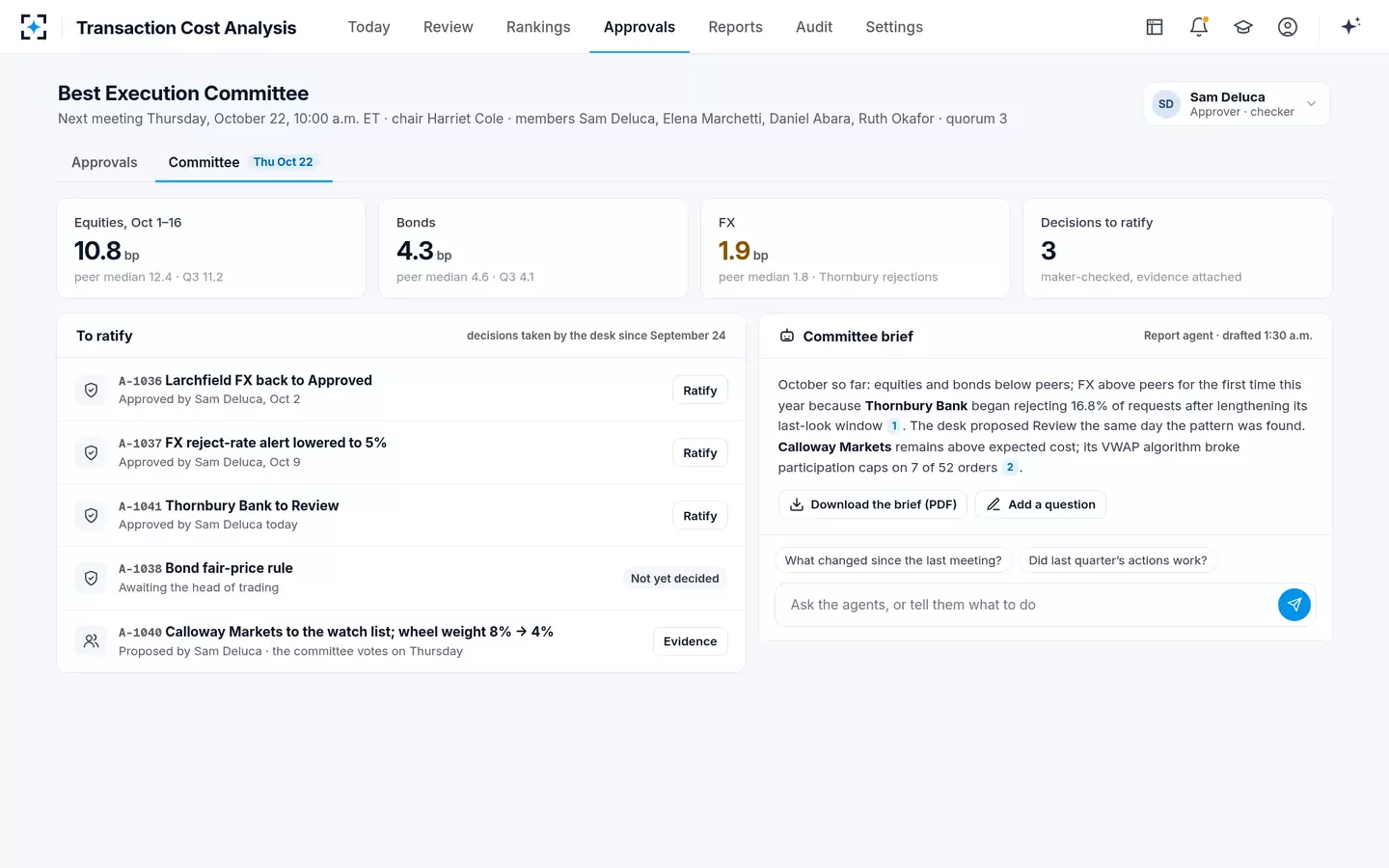
What the committee sees once costs arrive explained, in Transaction Cost Analysis
How long does switching TCA vendors take? A four-week parallel run
Plan on a parallel run, not a cut-over: run the new approach beside the old one on the same orders until the differences are understood. Four weeks is enough for most desks to learn whether a new approach is better, if the data connections are ready at the start. The plan below is one we suggest; the solution's own setup connects systems read-only, maps counterparties, reads the benchmarks from the firm's policy and back-tests a past quarter before it goes live.
A four-week parallel run to compare a new TCA approach with the old one
- Connect read-only; tie order, fill and log countsweek 1
- Load the execution policy; back-test last quarterweek 2
- Run both on the same live orders; list every differenceweek 3
- Explain the differences; committee decidesweek 4
Where Transaction Cost Analysis fits, and where it does not
The solution fits a desk that has an execution policy, trades more than one asset class, and wants every expensive order explained and checked before the desk opens, with decisions kept with people. It fits especially where bonds and FX are a large share of the flow, because those are the markets where a fair benchmark and the rejection logs change the answer.
It is not the right first step for a firm with no written execution policy, because the agents apply the firm's rules rather than invent them. It does not build an industry-wide peer universe; it works with the one a desk already licenses. And it will not move broker flow on its own: agents never change routing, panels or algo-wheel weights. AI transaction cost analysis, traced step by step shows those limits in action, and the solution can be run on a past month of a firm's own orders before any decision. The full workflow is on the Transaction Cost Analysis page.
Questions people ask
What is the difference between TCA software and a TCA provider?
TCA software is analytics a firm runs itself on its own data; a TCA provider is a service that receives the firm's execution data and returns results, usually with a peer universe built from many clients. Many firms combine the two: their own software for daily work, a provider for peer comparison.
How much does TCA cost?
Vendors do not publish prices, and costs depend on asset classes, order volume and market data. The BIS study group noted that independent TCA services come at a non-negligible cost, so are often available only to the largest users. Count the analysts' time too: in the solution's estimate, a month of post-trade TCA at a multi-asset desk takes 17 working days by hand.
Do brokers provide TCA for free?
Brokers and FX platforms often offer TCA on their own executions; the BIS study group lists liquidity providers and trading platforms among those that process TCA. It is useful, but it is the counterparty measuring itself, and it cannot compare across brokers. Free broker TCA is a supplement to independent measurement, not a substitute for it.
What should a TCA report include for the best execution committee?
Costs by asset class against benchmark, estimate and peers; broker, algorithm and venue rankings with sample sizes; the expensive orders with their reasons; and every decision taken since the last meeting with who proposed and who approved it. In the solution's sample, three decisions waited for ratification with their evidence attached.
Can we keep our current TCA provider and add agents?
Yes. The solution works with the peer universe and pre-trade model a desk already has. The agents add the per-order benchmark choice, the reasons, the independent check and the rejection and fair-price work, while the provider keeps doing peer comparison.