Transaction cost analysis is the measurement of what it cost to execute a trade, set against a benchmark price that stands for where the trade could fairly have been done. In trading, TCA turns each order into a number in basis points: the gap between the price the fund achieved and the benchmark, split into the delay before the order reached the market, the bid-ask spread, the drift in price while it worked, the market impact of the fund's own buying or selling, and the commissions and fees. Buy-side desks use it to show clients and compliance what execution cost, to compare brokers, algorithms and venues, and to decide where the next order goes. Its limit is that it measures cost, not cause: a 38 basis point order looks the same in a TCA report whether the broker's algorithm ran ahead of its instruction or the stock was halted. Botminds' Transaction Cost Analysis is an agentic solution built around that gap: agents cost every equity, fixed income and FX order against a fair benchmark overnight, write down why each expensive one cost what it did, and leave every decision to a person.
The research and regulatory sources on this page are linked where they appear. The worked examples come from the solution running on sample data for a fictional global asset manager, Quillfield Capital, and its fictional banks, brokers and issuers.
One order's cost, split into the five parts TCA measures
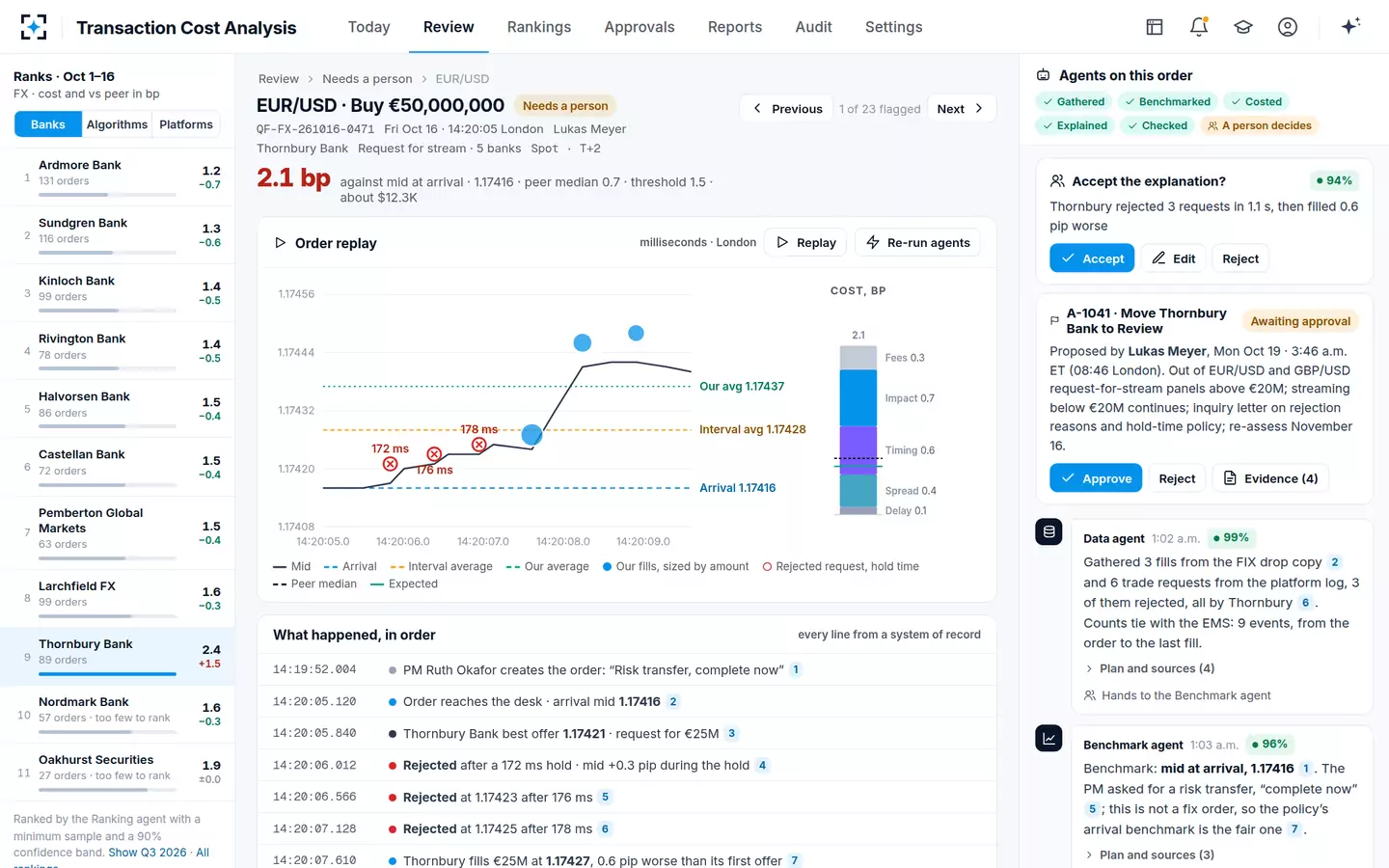
EUR/USD buy, €50 million: 2.1 bp against the mid at arrival (peer median 0.7 bp)
- Delay 0.1 bp · 5%
- Spread 0.4 bp · 19%
- Timing 0.6 bp · 29%
- Impact 0.7 bp · 33%
- Fees 0.3 bp · 14%
What is transaction cost analysis (TCA) in trading?
In trading, TCA is the comparison of an execution with a benchmark, done consistently enough that the comparisons add up to evidence. The Global Foreign Exchange Committee's code of conduct defines it in a single line: "Analysis to evaluate the quality of trade execution – for example, by comparing the resultant price of an execution against a benchmark" (FX Global Code, glossary, updated December 2024). Every serious TCA program follows from that sentence: pick the benchmark, compute the gap, and do it for every order, so that a broker, an algorithm or a trader can be compared with its peers on like-for-like orders.
The term needs one clarification because search engines mix the two. Transaction cost economics, the theory of why firms make rather than buy, shares the words and nothing else. Trading TCA is a measurement discipline inside an asset manager, a pension fund, a bank's markets business or a broker-dealer, and its unit is the basis point, one hundredth of a percent of the money traded.
The numbers involved are small per order and large in total. One basis point on a sample firm's quarter of trading, $412.2 billion of flow in the solution's fictional data, is an estimated $41.2 million. That arithmetic is why heads of trading argue over tenths of a basis point, and why the benchmark matters as much as the fills.
What costs does transaction cost analysis measure?
TCA measures four kinds of cost, and only one of them appears on an invoice. The SEC set them out in 2003, when it asked whether mutual funds should disclose trading costs: "Transaction costs include commissions, spreads, market impact costs and opportunity costs" (SEC, Request for Comments on Measures to Improve Disclosure of Mutual Fund Transaction Costs, 68 FR 74820, December 24, 2003). Modern TCA splits the same costs more finely, separating the delay before an order reaches the market from the drift while it works, but the four families still hold.
The cost families transaction cost analysis measures, and how each is estimated
| Cost | What it is | How TCA estimates it | Who mainly controls it |
|---|---|---|---|
| Commissions and fees | What the broker, venue or platform charges, plus taxes and levies | Read directly from confirmations; the only cost that is billed | Head of trading, through rates negotiated with brokers |
| Spread | Half the bid-ask spread paid to cross it, or the dealer markup in a bond | Execution price against the midpoint at the time of the order | The trader, through order type and venue |
| Delay | Price movement while the order waits: between the decision, the desk and the first child order | The price when the order was created or reached the desk against the price when it started working | The handoffs from portfolio manager to desk to broker |
| Timing and impact | Drift while the order works, and the price moved by the order itself | Average fill price against arrival, with a model to separate impact from market drift | The trader and the algorithm: pace, participation, venue |
| Opportunity | The cost of shares that were never bought or sold | Unfilled quantity priced at the move after the decision | The trader, by cancelling or not finishing |
The table also shows why TCA is contested. Commissions are facts. Everything else is an estimate built on a benchmark, and each benchmark has a view of what the order should have cost. The implementation shortfall formula is the version that charges an order for all of it, from the decision to the last fill, including the shares that were never filled.
Explicit and implicit trading costs: the part on the invoice is the small part
Explicit costs are the ones a firm is billed for; implicit costs are the ones it pays in price. The SEC's 2003 release drew the line plainly: "commissions are explicit costs, readily identifiable and quantifiable. Spread, impact, and opportunity costs are implicit costs." It then drew the consequence that still shapes the field: because the implicit costs are hard to measure and can exceed the explicit ones, there is no generally agreed method to calculate them.
The research since has confirmed that the implicit part varies with what is being traded and how. Studying $83 billion of institutional equity orders, Keim and Madhavan found that "trading costs are economically significant and increase with trade difficulty", and that they vary "with traderspecific factors such as investment style and order submission strategy" (Keim and Madhavan, Journal of Financial Economics, 1997). A small-cap momentum buy and a large-cap index rebalance can both be well executed and cost very different amounts, which is why a TCA number means nothing without a peer group of comparable orders.
Why the implicit cost is the one worth measuring
4
cost families the SEC listed in 2003; only commissions are billed
$83B
of institutional equity orders in Keim and Madhavan's sample: costs rise with trade difficulty
20–26bp
a year added to the average fund by interim trading skill, after costs
Pre-trade, real-time and post-trade TCA: three questions at three times
Pre-trade TCA estimates what an order should cost before it is sent; real-time TCA watches whether it is going to plan; post-trade TCA measures what it did cost. The Bank for International Settlements' study group on FX algorithms described TCA as "A tool that allows end users to monitor the efficiency of their transaction both pre- and post-trade" (BIS Markets Committee, FX execution algorithms and market functioning, October 2020, glossary). The three are one loop: the pre-trade estimate becomes the yardstick the post-trade cost is judged against.
Three TCA questions across one order's life
- Expected cost from a market impact modelestimate
- Choice of algorithm, pace and benchmarkplan
- Participation against the instructioncap
- Slippage against arrival so fardrift
- Cost against benchmark and estimatebp
- Reason, peer comparison, broker rankingwhy
The real-time lane is where most of the money is saved and least of it is measured. In the solution's sample data, a VWAP order for 640,000 shares of the fictional Corrigan Robotics carried a cap of 12% of volume; the broker's algorithm traded 31% for twenty minutes and lifted the price to the day's high. A month-end report would show 38.0 basis points against a 14 basis point estimate. The same morning, the agents put the participation chart in front of the trader with the instruction beside it, and VWAP vs arrival price walks through why that order looked acceptable against one benchmark and expensive against another.
Is transaction cost analysis required by regulation?
No US rule names TCA, but the duties it serves are written down, and TCA is how most firms meet them. Investment advisers that choose brokers owe their clients best execution, and the SEC's 2019 interpretation expects them to evaluate the execution they receive on a periodic and systematic basis (SEC, Commission Interpretation Regarding Standard of Conduct for Investment Advisers, 84 FR 33669, July 12, 2019). Broker-dealers that review execution quality on a regular and rigorous basis, rather than order by order, must do so at least quarterly under FINRA Rule 5310. In Europe, Directive (EU) 2024/790 rewrote MiFID II's Article 27(7) so that firms executing client orders must monitor the effectiveness of their execution arrangements and correct deficiencies (EUR-Lex), and the FCA's COBS 11.2A.31R says the same for UK firms (FCA Handbook).
The SEC has also said, in its own words, how institutions meet those duties in practice: "Many institutional investors regularly conduct, directly or through a third-party vendor, transaction cost analysis (``TCA'') of their orders to assess execution quality against various benchmarks" (SEC, Disclosure of Order Execution Information, 89 FR 26428, April 15, 2024). The regulation sets the duty; TCA is the evidence. Who sits on the committee that weighs that evidence, and what it must document, belongs to the best execution review, set out in the best execution committee guide; this page stays with the measurement.
Two gaps matter. Spot FX sits outside most best execution rules, and the BIS study group noted that some participants nonetheless apply similar criteria across all products. And no rule says which benchmark to use. That choice is the firm's, which is why an examiner asks for the execution policy before the numbers.
Who uses TCA reports, and what each needs from them
Five readers use the same TCA data for different decisions, and a report built for one usually fails the others. The trader wants yesterday's orders, with the reason for each outlier. The head of trading wants brokers, algorithms and venues ranked on enough orders to mean something. The best execution committee wants what changed and who approved it. Compliance and the examiner want the method, applied consistently. The client, a pension fund or an endowment, wants its own orders.
The last reader is the one most often served badly. When the FCA reviewed best execution at UK firms, it found that "Most firms generally provided some form of TCA to clients but this was usually only provided to clients upon request rather than as a matter of course and such requests were infrequent" (FCA, TR14/13, Best execution and payment for order flow, July 2014). A report that is only produced when someone asks is a report no one at the firm is learning from.
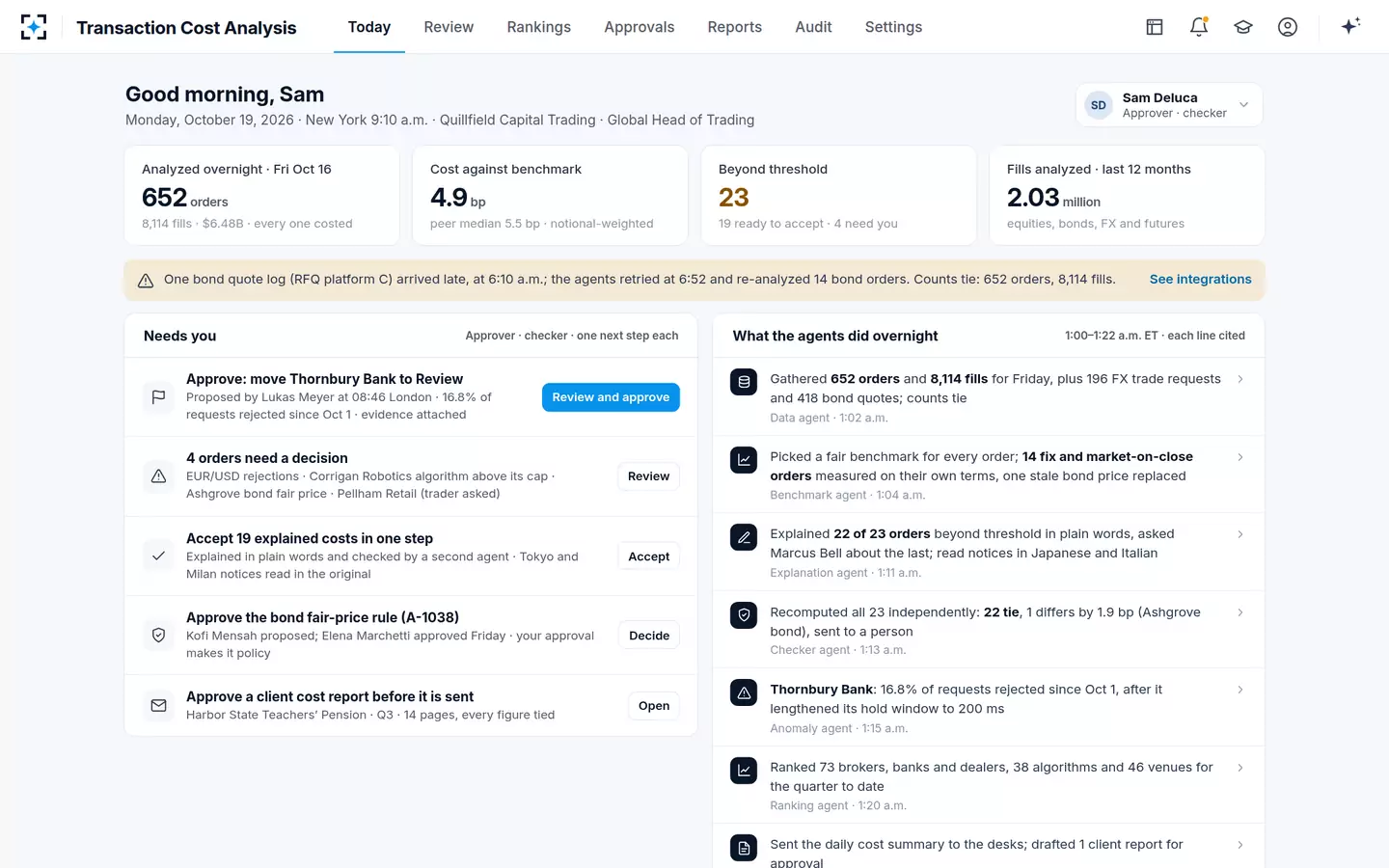
Transaction Cost Analysis: the head of trading's morning, every order costed overnight
What can't TCA tell you? The missing reason
TCA can tell you what an order cost; it cannot tell you why. A cost of 38 basis points could mean the broker's algorithm broke its instruction, the stock was halted, the company withdrew guidance during the order, or the portfolio manager's urgency was justified by news. Each reason leads to a different decision, from a broker inquiry to nothing at all, and the number is the same in every case.
The research shows why the reason matters. Anand, Irvine, Puckett and Venkataraman found that "institutional trading desks can sustain relative performance over adjacent periods" and that "trading-desk skill is not limited to a selection of better brokers" (Review of Financial Studies, 2012). If performance persists and sits partly in the desk, then a report that ranks brokers without explaining orders is blaming or crediting the wrong party some of the time.
The same expensive order, in a TCA report and with its reason attached
A TCA report: 38.0 bp against arrival; peer median 17.2 bp
With the reason written down: The same, split: delay 3.1, spread 2.4, timing 7.9, impact 21.8, fees 2.8 bp
A TCA report: Arrival, applied to every equity order
With the reason written down: Arrival as the policy requires, with interval VWAP also shown because the portfolio manager asked for VWAP
A TCA report: Not stated; rebuilt later from notes and memory
With the reason written down: The algorithm traded 31% of volume for twenty minutes against a 12% cap and lifted the price 26 cents to the day's high
A TCA report: Nobody until the quarter's review
With the reason written down: A second agent recomputing from the raw fills, then a person accepting the explanation
A TCA report: Discussed at the committee, weeks later
With the reason written down: A proposal for the trader to make about the broker, waiting for a person
TCA also struggles where the benchmark itself is uncertain. In bonds, the price an order is measured against may be an evaluated price two days old; in FX, the cost of a bank's rejected requests sits outside the average fill. Both get their own guides in this series, because the method changes, not just the data.
One order through Transaction Cost Analysis, from benchmark to signature
Botminds' Transaction Cost Analysis keeps the measurement and adds the parts a TCA report leaves to people with spreadsheets. Eight agents work overnight on the desk's own data: orders and instructions from the order management system, fills and routes from the FIX drop copy, FX platforms' rejection logs, bond quotes and market data. The Benchmark agent picks the fair benchmark from the execution policy and says why; the Cost agent splits the cost; the Explanation agent writes the reason with every figure cited; the Checker agent recomputes it on a different model family.
Take the EUR/USD order in the first figure. The portfolio manager asked for a risk transfer, "complete now", so arrival is the benchmark. The platform sent the request to the bank with the best offer, which rejected it three times after holds of 172, 176 and 178 milliseconds while the price rose, then filled half 0.6 pip worse. The Explanation agent wrote that down; the Checker agent recomputed 2.09 basis points from the raw fills and confirmed the holds. Neither agent may accept the explanation: the head of trading does, and any change to the bank's place on the panel is a trader's proposal that someone else signs.
One order replayed: fills, rejections and the cost stack in Transaction Cost Analysis
Where TCA comes from, a provider, an in-house team or an agentic system like this one, changes what the morning looks like. TCA vendors compared on one order runs the same order through each approach. The public data every equity desk can add to its own, free, is in the Rule 606(b)(3) guide. The full workflow is on the Transaction Cost Analysis page.
Questions people ask
What is TCA in trading?
TCA, transaction cost analysis, compares the price a trade achieved with a benchmark price and expresses the difference in basis points. The FX Global Code defines it as analysis to evaluate the quality of trade execution, for example against a benchmark. Desks use it to compare brokers, algorithms and venues and to show clients what execution cost.
What is the difference between pre-trade and post-trade TCA?
Pre-trade TCA estimates the cost of an order before it is sent, usually from a market impact model fed with size, volatility and volume. Post-trade TCA measures the actual cost after the last fill. The two belong together: an order is judged against its own estimate, and a model is judged by how well its estimates matched the results.
What is a good TCA result?
There is no absolute figure. A cost is good or bad against the order's own estimate and against a peer group of comparable orders: same asset class, similar size relative to volume, similar urgency. In the solution's sample data, equity orders cost 10.8 basis points in the first half of October against a peer median of 12.4; a single order can be far above that and still be explained.
Does TCA cover bonds and FX, or only equities?
All three, but the method differs. Equities have a consolidated quote and tape; bonds are traded by request for quote, and their benchmark is often an evaluated price; FX has no consolidated tape at all, which the BIS study group named as a challenge for choosing a benchmark. Each needs its own benchmark rules in the execution policy.
How often should a firm run TCA?
Broker-dealers that use a regular and rigorous review must run it at least quarterly under FINRA Rule 5310, and many advisers review at a committee each quarter. The measurement itself is most useful the next morning, while the trader still remembers the order and a broker can still be asked about it. Quarterly review then works from reasons already recorded.
Is TCA the same as best execution?
No. Best execution is the duty to seek the most favourable terms reasonably available for a client's order; TCA is one of the main ways to evidence it. A firm can run TCA and still fail its duty if it never acts on what the numbers show, which is the gap the FCA found in its 2014 review.