VWAP and arrival price answer different questions about the same order. Arrival price compares the average fill with the market price when the order reached the desk, so it charges the order for everything that happened while it traded, including the price its own buying pushed up; it is the basis of implementation shortfall. VWAP compares the average fill with the volume-weighted average price over the period the order traded, so it asks only whether the trader did as well as the market's average while they were in it. A large order that moves the price raises the VWAP it is measured against, so it can beat VWAP and still be expensive. The right benchmark is the one the order's instruction calls for, written into the execution policy and applied before anyone sees the number. That is how Botminds' Transaction Cost Analysis works: its Benchmark agent reads each order's instruction, applies the policy's benchmark, writes one sentence on why, and shows interval VWAP beside arrival when a portfolio manager asked for VWAP.
The research and regulatory sources are linked where they appear. The worked orders are the solution's sample data on a fictional asset manager, Quillfield Capital, and its fictional brokers.
One set of fills, four yardsticks: the same order passes or fails depending on the benchmark
What is the difference between VWAP and arrival price?
Arrival price is fixed the moment the order reaches the desk or the broker; VWAP is formed while the order trades. That single difference decides most of what follows. A benchmark known in advance cannot be moved by the trader. A benchmark formed during the order can be moved by the order, by the market's direction, and by the trader's choice of when to trade.
VWAP came into TCA as an improvement. Berkowitz, Logue and Noser proposed it in 1988 as a measure of market impact: "The measure is the volume‐weighted average price over the trading day. It yields results that are less biased than measures that use single prices, such as closes" (Journal of Finance, 1988). On more than 14,000 NYSE trades they found commissions averaging 18 basis points and execution costs against VWAP averaging only five. Against a day's average, execution looked cheap; the question that later TCA asked was what that average was hiding.
VWAP vs arrival price, side by side
Arrival price: When the order reaches the desk or broker
VWAP: Formed over the order's interval or the trading day
Arrival price: Everything after arrival: spread, timing, impact, fees
VWAP: Whether fills matched the market's average while trading
Arrival price: Its impact counts in full as cost
VWAP: Its impact lifts the benchmark, so measured cost shrinks
Arrival price: Drift counts as cost, whether or not the trader could avoid it
VWAP: Drift largely cancels out
Arrival price: Can be priced as opportunity cost
VWAP: Ignored
Arrival price: Urgent and default orders: the fund wanted the position now
VWAP: Orders the portfolio manager asked to trade with the volume
Can an order beat VWAP and still be expensive?
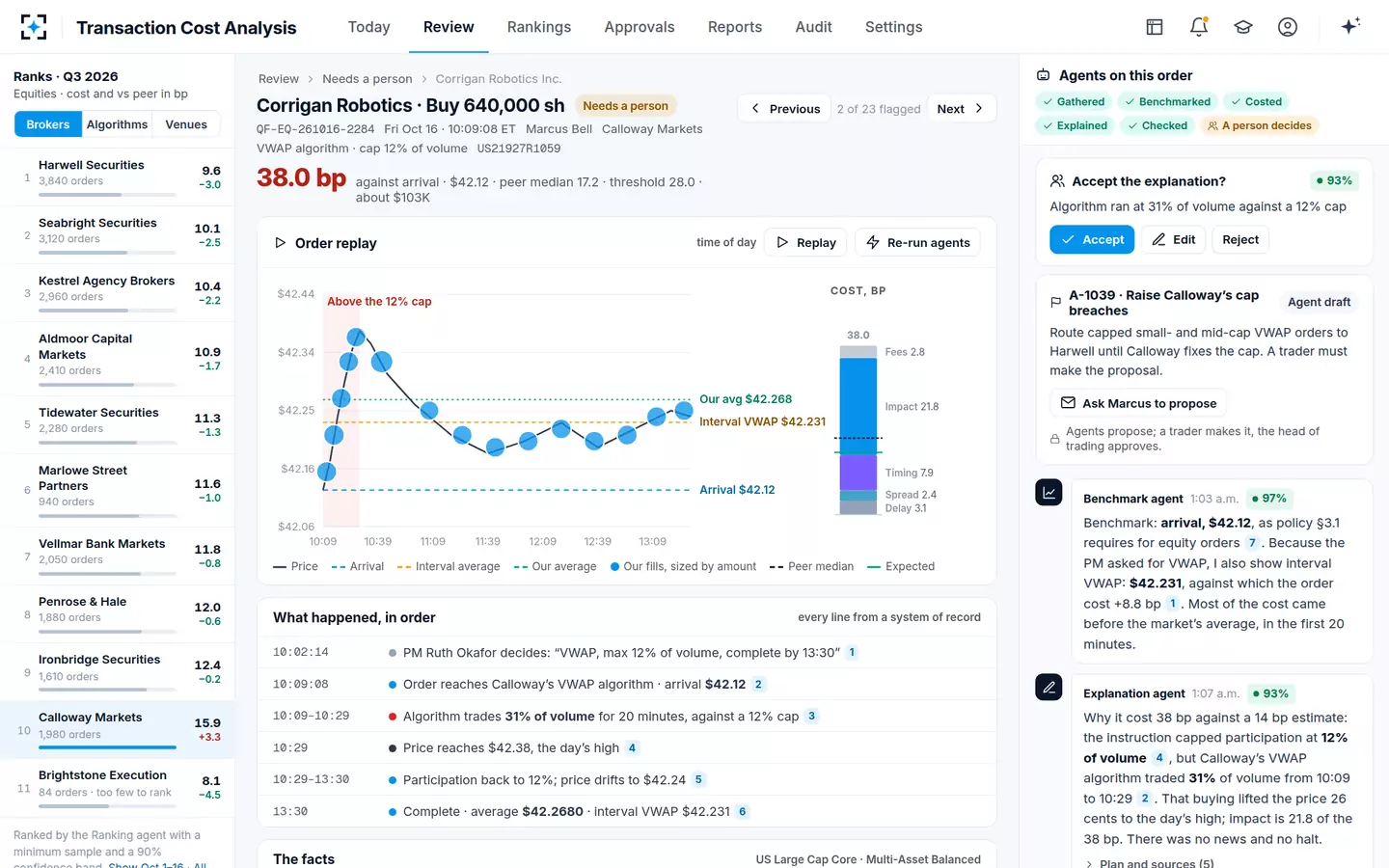
Yes, and the sample order shows how. The portfolio manager's instruction was to trade with VWAP, at no more than 12% of volume, by 13:30. The broker's algorithm traded at 31% of volume for its first twenty minutes and pushed the price 26 cents to the day's high of $42.38; it then slowed back to 12% and the price drifted to $42.24 by the end. Because so much volume printed at high prices early, the interval VWAP itself rose to $42.231. The order's average of $42.268 sits only 8.8 basis points above that, while it is 35 basis points above where the stock was when the order arrived.
Measured against VWAP, the algorithm looks acceptable. Measured against arrival, it cost the fund about $103,000, 38.0 basis points including fees, against a pre-trade estimate of 14. The difference between the two verdicts is the cost the order's own buying created, and VWAP absorbs it into the benchmark. This is what the solution's benchmark rules mean by "VWAP alone flatters an order whose own buying lifts the average".
An algorithm above its cap: arrival and interval VWAP on one chart in Transaction Cost Analysis
Can a trader game the VWAP benchmark?
A benchmark formed during the order can be managed, deliberately or not, and regulators noticed early. The SEC's 2003 concept release described how a measure whose price is known before trading could be manipulated by choosing which orders to fill:
A trader "could ``manufacture'' low transaction costs if, after each decision to trade is made, the trader would wait to take action on the order list, implement only the buy orders for which prices have fallen since the receipt of the order, implement only the sell orders for which the prices have risen, and dismiss the rest of the orders as ``too expensive'' to execute."
SEC, Request for Comments on Measures to Improve Disclosure of Mutual Fund Transaction Costs, 68 FR 74820 (December 24, 2003), footnote 31
VWAP has its own versions. An order that is a large share of the day's volume largely sets its own benchmark, so it will match VWAP almost whatever it pays. A trader can front-load or back-load an order to sit on the side of the average they expect to look good. And an order cancelled halfway is compared with the VWAP of the period it traded, so the shares never bought disappear from the comparison. None of these require bad intent; all of them make a VWAP number easier to hit than to deserve.
Which benchmark should you use? Match it to the instruction
Use the benchmark that matches what the portfolio manager asked for, decided by the execution policy before the order is traded. An order to buy now is judged against arrival; an order to trade with the volume through the day is judged against VWAP, with arrival shown so the impact is not lost; an order for the close is judged against the close. Judging an order against a benchmark it was never meant to beat produces a number with no meaning, in either direction.
Which TCA benchmark fits which instruction
| Instruction | Primary benchmark | Also show | Why |
|---|---|---|---|
| Buy or sell now; risk transfer; default orders | Arrival price (implementation shortfall) | Pre-trade estimate, peer median | The fund wanted the position at the price when it decided |
| Trade with the volume, VWAP to a time | Interval VWAP | Arrival price | Shows whether the algorithm tracked the volume, and what the order's impact cost |
| Spread evenly over time, TWAP | Interval TWAP | Arrival price | Fits thin or volume-erratic names where VWAP is noisy |
| Market on close; index rebalance | Official closing price | Arrival, if the decision came earlier in the day | The instruction was the close |
| FX order for a fixing | The fixing rate | Mid at arrival | A fix order measured against arrival looks expensive for no reason |
| Program or transition trade | Arrival at portfolio level | Per-line arrival | The lines are traded as one risk |
When to use VWAP vs TWAP
Use VWAP when the order should follow the market's volume pattern, and TWAP when it should spread evenly over time because volume is thin, erratic or likely to be dominated by the order itself. The BIS study group's glossary defines TWAP as "a trading benchmark used by traders that gives the average price of a security over a specified time" (BIS Markets Committee, October 2020). It weights each moment equally, so a burst of volume at a bad price does not pull the benchmark towards the fills the way it does with VWAP.
Both share VWAP's central weakness: they are formed during the order. For any order large enough to move the price, the arrival price should be reported beside them. A TWAP or VWAP result that looks good while the arrival result looks poor is a signal to look at participation, which is how the sample order's 31% was found.
What benchmark fits a market-on-close or a fix order?
The close for a market-on-close order and the fixing rate for an FX fix order, because that is the price the order was placed to get. The SEC's own execution-quality statistics follow the same logic: Rule 605's covered orders exclude "orders to be executed at a market opening price or a market closing price", among other orders with special handling instructions (17 CFR 242.600(b), definition of covered order). An auction order is not trying to beat the quote at arrival.
Two orders, two benchmarks each: the verdict follows the yardstick
3.4bp
a USD/JPY fix order, against the mid at arrival
0.2bp
the same order against the fixing it was placed for
1.8bp
a €50M EUR/USD buy against the mid at arrival, before fees
0.8bp
the same fills against the interval average, before fees
The FX pair shows the opposite danger to VWAP's. The EUR/USD order was a risk transfer, "complete now", so arrival is right and the interval average would have hidden the cost of a bank rejecting three requests while the price rose; FX TCA and last look follows that order. The USD/JPY order was placed for the fix, so arrival would have flagged a good execution as a 3.4 basis point outlier.
How to document the benchmark choice before the number
Write the benchmark rules into the execution policy by asset class and instruction, record which rule applied to each order with a reason, and change the rules only by a dated, approved proposal. The FCA's 2014 review shows what happens otherwise: "Several firms were unable to explain why they were using particular benchmark in their monitoring programme, why they were thought to be adequate, how they had been developed or when they had last been reviewed" (FCA, TR14/13, July 2014). One firm it visited only looked at executions more than a fixed £500 from a benchmark, whatever their size, so small orders could miss by a wider margin than large ones before anyone noticed.
Two records make a benchmark choice defensible. The first is the per-order record: which benchmark applied and why, written at the time, not reconstructed. The second is the change record: when a rule changed, who proposed it, who approved it, and what it would have changed had it applied to the last quarter. In the sample, the bond fair-price rule A-1038 was back-tested on the third quarter, where it changed the measured cost of 1,212 bond orders by a median of 2.1 basis points, before compliance approved it and while it waited for the head of trading. Fixed income TCA covers why bonds need that rule.
Benchmarks per asset class in Transaction Cost Analysis, each with the reason
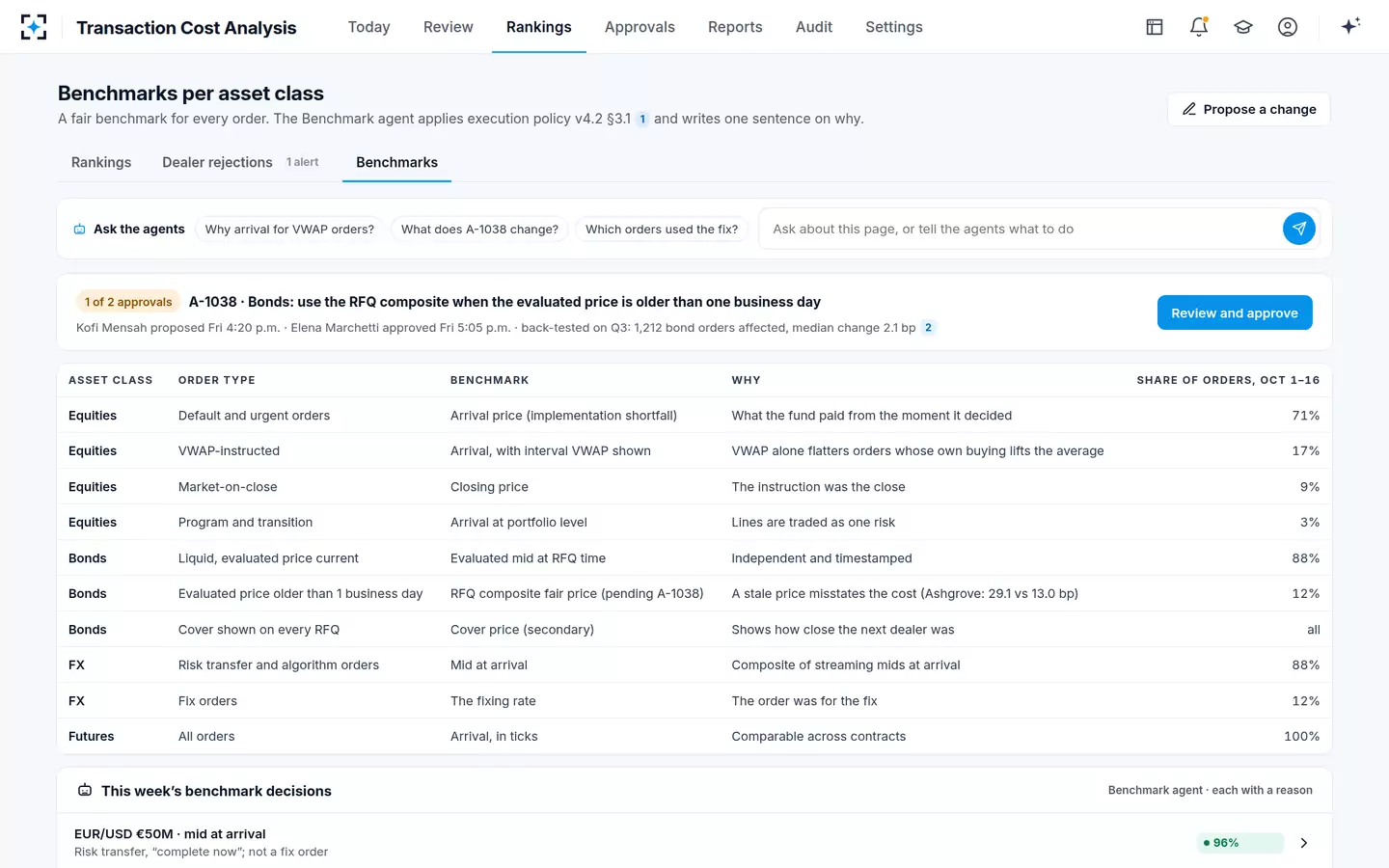
Arrival, VWAP and the reason, together in Transaction Cost Analysis
In the solution the benchmark is decided by policy, not by whoever reads the report. The Benchmark agent reads each order's instruction from the order management system, applies the policy's benchmark and writes why; for VWAP-instructed equity orders it also shows interval VWAP, so the trader can see whether the algorithm tracked the volume and the head of trading can see what the order's impact cost. The Explanation agent then writes why an expensive order cost what it did. For the Corrigan order that was participation: 31% of volume against a 12% cap, found the next morning rather than at the quarter's committee.
The agents may not change the policy, accept their own explanations, or change a broker's algo-wheel weight; the broker question on the Corrigan order is a draft for the equity trader to make, and a person approves it. The implementation shortfall formula works the arrival benchmark line by line, and the market impact model shows why 31% of volume costs so much more than 12%. The full workflow is on the Transaction Cost Analysis page.
Questions people ask
Is VWAP a good benchmark for TCA?
For orders a portfolio manager asked to trade with the volume, yes, as long as arrival price is shown beside it. On its own it understates the cost of large orders, because their impact raises the average they are compared with. Berkowitz, Logue and Noser introduced it in 1988 as an improvement on single prices such as the close.
What is the arrival price benchmark?
The market price, usually the mid, at the moment the order reaches the desk or the broker. Cost against arrival includes spread, timing, impact and fees, so it is the basis of implementation shortfall. Firms must define the moment precisely, because a few minutes can move the result by basis points.
What is implementation shortfall vs VWAP?
Implementation shortfall measures from the decision or arrival price and counts unfilled shares as opportunity cost; VWAP measures against the market's average while the order traded and ignores what was not filled. On the sample order, the first gave 38.0 basis points and the second 8.8.
Which benchmark do regulators require?
None prescribes one. In the US, advisers must evaluate the execution they receive and broker-dealers must review execution quality; in the UK and EU, firms must monitor the effectiveness of their execution arrangements. The FCA's 2014 review criticised firms that could not explain their benchmarks, which is a requirement to justify the choice rather than to make a particular one.
How do you calculate cost against VWAP?
For a buy, subtract the interval VWAP from the order's average fill price, divide by the VWAP and multiply by 10,000 for basis points; for a sale, reverse the subtraction. The interval should run from when the order started working to its last fill, and fees are added separately.